| F/A-18F Super Hornet |
| F/A-18F Super Hornet
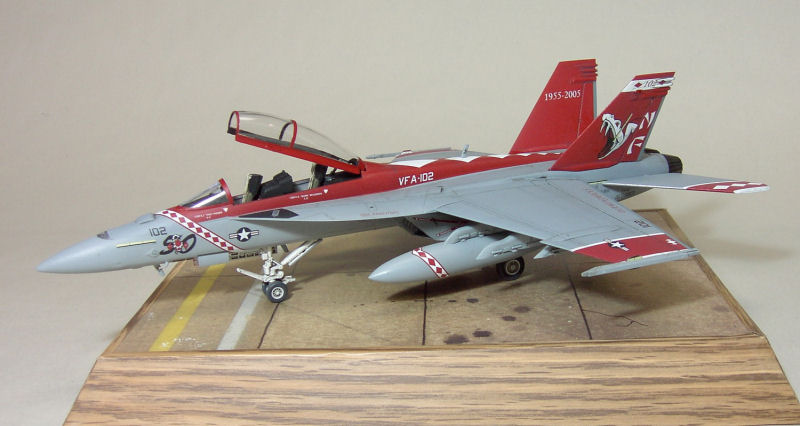
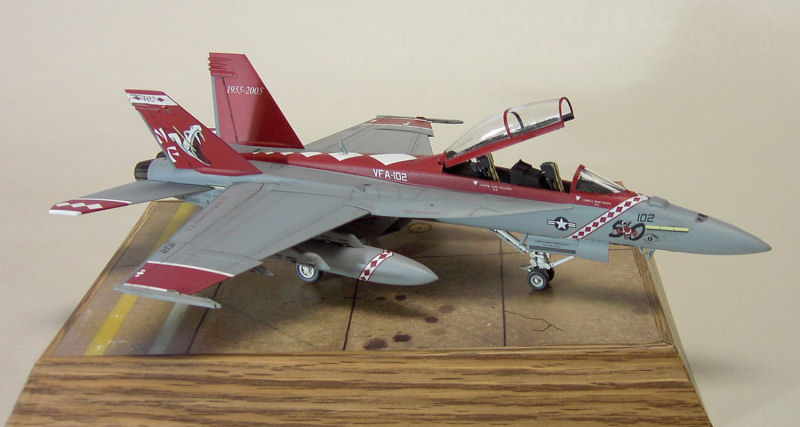
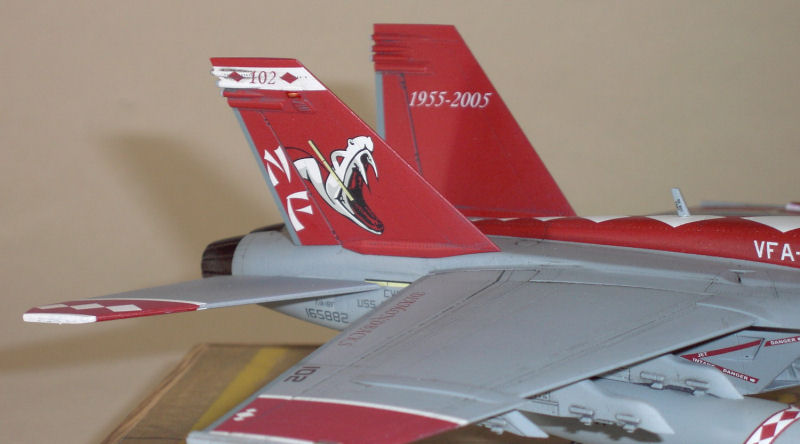
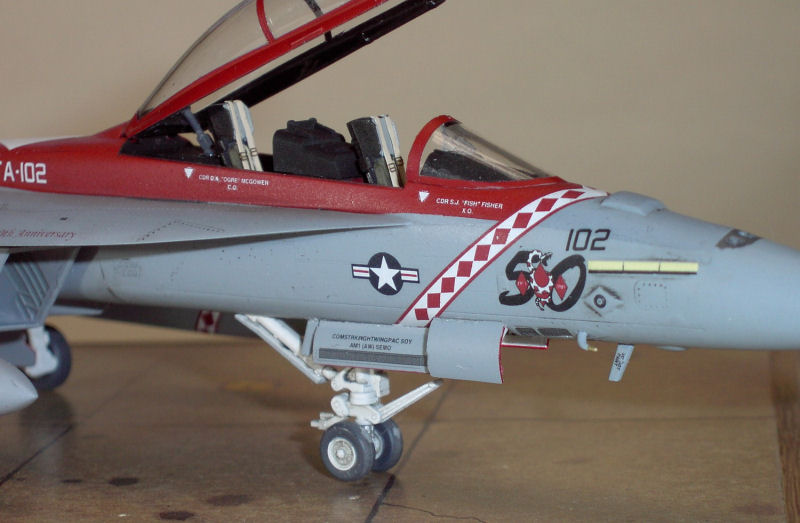
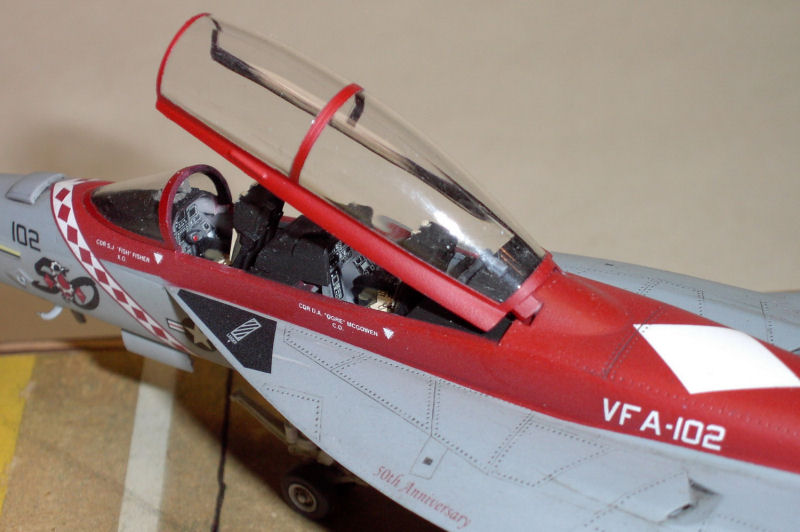
1/72 scale Hasegawa Kit E18 MSRP $26.98 As the original versions of the McDonnell Douglas F/A-18 Hornet became the standard ground attack aircraft of the US Navy, a couple of major shortcomings became apparent. First, the range was less than ideal, requiring extensive refueling during missions. The second problem related to load carrying capabilities. The F/A-18 was less capable than the A-7 that it replaced. To resolve these problems, McDonnell Douglas proposed a larger version of the Hornet with more internal fuel capacity and better engines. The design included two additional stations under the wings for external stores. Although the new model was different from the original in most areas, the Navy still designated it as the F/A-18 - F/A-18E for the single seat model and the F/A-18F for the two-seat model. It was named the Super Hornet. Over the coming decade, the Super Hornet will continue to replace older models of the F/A-18, the F-14 Tomcat and eventually the EA-6B Intruder. The Super Hornet is projected to become one of the most versatile aircraft in the history of the U.S. Navy. Kit Assembly This kit from Hasegawa was first released in late 2003 and is regarded as the definitive model of the Super Hornet. The kit features the usual excellent level of external detail that we expect from Hasegawa. Surface detail is finely engraved and the engineering of the kit is very good. The model goes together without any major problems. The nose section including the cockpit assembles easily. The cockpit is rather basic and utilizes decals for detail. In this small scale, this seems acceptable although I added the two hand controllers to the rear cockpit area. The ejection seats were also very simple. I added some belts from lead foil to spruce them up a little. The fuselage assembly goes together very easily. The only unsightly area is the upper surfaces of the inside of the intakes. A rather unsightly seam shows in this area but I felt that since it was not normally visible, I would leave it alone. I probably would have caused more problems trying to fix this and it wasn�t worth the effort. I was concerned about the wings at first. I was afraid that the wing droop angle might vary because it didn�t look like the mounting areas were large enough. The result was perfect so I guess that Hasegawa knew what they were doing. The horizontal and vertical stabilizers were particularly well engineered. The verticals are divided along the actual panel lines, including reinforcements, of the original. This allows them to be painted before assembly and makes special paint schemes easier. The horizontals are a friction fit into a couple of soft plastic bushings within the fuselage. Again, these can be painted separately allowing for easy handling of the model. The only assembly problems that I encountered were with the three small blade antennas on the fuselage. The mounting slots were smaller than the tabs on the antennas. I probably should have test fit these parts before I painted them. I could have thinned them at that time. I also had a little problem with the open canopy. When I first tried to assemble it, I couldn�t fit the tab behind the rear seat and the canopy looked to be open too far. I did some trimming of the brace and got the assembly to look better. Color and Markings This kit comes with three interesting sets of markings. The first is for a bird from VFA-102 �Diamondbacks� from 2003. This has a red and white band on the nose and the diamondback emblem on the tail. The second is also for VFA-102 but features a slightly muted noseband as worn in March 2002. The final scheme is a CAG bird from VFA-2 �Bounty Hunters�. This features the red, white and blue nose band and tail flash made famous on the Bounty Hunter F-14 Tomcats. In addition to the major markings, the decal sheet provides all of the little markings stenciled on the original. These are enough to drive anyone crazy. The tailhook of the original is painted with alternating color stripes. Normally this is left to the modeler to try to duplicate but Hasegawa provided a decal that does the job very effectively. I was particularly impressed with the painting directions of Hasegawa. They note such things as the slightly different colors of the wing edges etc. In spite of the great color schemes offered by Hasegawa, I wanted to use a decal sheet from Twobobs which covers a special paint scheme applied to a VFA-102 �Diamondbacks� F/A-18F aircraft to commemorate their 50th anniversary. Fighter Squadron 102 was established in 1955 and first flew Banshees. Over the years, they have flown Skyrays, Phantoms, Tomcats and Hornets in addition to the Super Hornet. They have participated in many of the major operations of the US Navy in the years since their establishment and have established a proud tradition. The special aircraft markings used to commemorate this anniversary were spectacular with liberal use of red and white diamonds, a mean snake head on the rudders and a special �50� emblem on the nose. When I first saw photos of this scheme, I knew that I had to add it to my collection. As I expected, Twobobs Decals came to the rescue with this impressive sheet. Twobobs have produced the bands at the tips of the wings and horizontals in one piece while the fuselage diamonds and the rudder markings are applied over red painted areas. I used Testors Insignia Red to paint these areas and was pleased with the match. Twobobs use a three-layer decal to ensure that the nose marking is accurate and a two piece decal for the tail snakes. They allow the great detail of the markings to accurately show through. My only concern with the decals was that the instructions show the wing tip bands to extend to the trailing edges of the wings. The kit directions showed a different colored area along the trailing edges and the photos with the decals showed that the bands did not cover this area. The decals are designed correctly as the reference photos show. Overall Impression I was pleased with this kit. It accurately reflects this latest aircraft in the US Navy inventory. No filler was required and the engineering of the kit allows the model to go together well and to be painted easily. Exterior details are exceptional. Note-the contour and details of the nose of the kit are better than reflected by my model. Blame a super glue spill (don�t ask). This kit is well recommended for modelers of most skill levels. Clare |
 |
 |
 |
 |
 |
 |