#55 - Cesium
By: Cesar Caro
Cesium, or Caesium, is atomic number 55. With the symbol Cs, it is quite
an interesting element. It has a yellowish silver color, with and emission
spectra of two shades of blue. (Its name originated from caesius, the latin
word for sky blue.) It is the softest metal, with its hardness rating 0.2
on Moh’s scale, and it is, along with gallium and mercury, one of the three
metals to be at its liquid state at or around room temperature. This is
due to its low melting point of 28.5 degC (301.6 K, or 83.3 degF). (Its
boiling point is low too, only at 678.4degC!) Generally speaking, elements
that have a lower melting point also have a lower specific heat. This is
true for cesium, with it having a specific heat of 0.24 J/gC. Although
its melting point is so close to room temperature, its density is still
measured at 20 degC, when it is in its solid state. Under these conditions,
its volume density is 1.873 g/cm3. This is nearly double that
of water, which is 1 on the same scale.
 Cesium
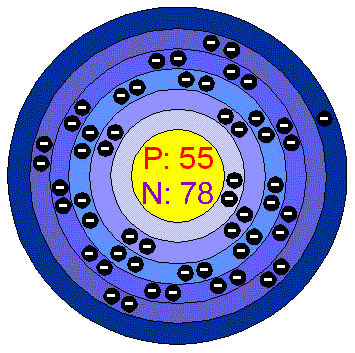
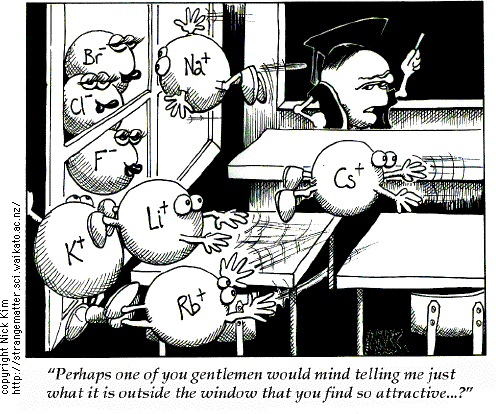
is in group 1a of the Periodic Table, which means that it is of the main
group of alkali metals. Because cesium is the most alkaline of this group,
it is the most alkaline of all of the elements. This means that a solution
of cesium and water would form a very alkaline substance, which is a sign
of high reactivity. Cesium’s electron configuration accounts for this.
It has a total of six shells in its pure state, with the configuration
being 2-8-18-18-8-1. This extra electron is released during reaction, making
cesium a positive one ion. It reacts vigorously with air, hydrochloric
acid, nitric acid, sodium hydroxide, hydroxide, oxygen, and water. When
it reacts with hydroxide to form cesium hydroxide, it will form a very
strong base and it will be able to destroy glass. It will react with oxygen
to form Cs2O, CsO, or CsO2. It will also react vigorously
with water, explosively with cold water. It is able to react with ice,
if the ice’s temperature is above –116 degC. Unusually, this doesn’t affect
the fact that cesium is non-toxic.
Cesium
is in group 1a of the Periodic Table, which means that it is of the main
group of alkali metals. Because cesium is the most alkaline of this group,
it is the most alkaline of all of the elements. This means that a solution
of cesium and water would form a very alkaline substance, which is a sign
of high reactivity. Cesium’s electron configuration accounts for this.
It has a total of six shells in its pure state, with the configuration
being 2-8-18-18-8-1. This extra electron is released during reaction, making
cesium a positive one ion. It reacts vigorously with air, hydrochloric
acid, nitric acid, sodium hydroxide, hydroxide, oxygen, and water. When
it reacts with hydroxide to form cesium hydroxide, it will form a very
strong base and it will be able to destroy glass. It will react with oxygen
to form Cs2O, CsO, or CsO2. It will also react vigorously
with water, explosively with cold water. It is able to react with ice,
if the ice’s temperature is above –116 degC. Unusually, this doesn’t affect
the fact that cesium is non-toxic.
 There are different
places to acquire cesium naturally, even though it is a rare element. The
french island of Elba has been discovered to have ores of the highest concentration
of cesium oxide, which is a concentration of 34% cesium oxide. The United
States has pollux in Maine and South Dakota, but this ore only has a concentration
of 13% cesium oxide. Cesium can also be found in lepodolite, carnalite,
and some types of feldspars. To remove the cesium from these ores, the
cesium compound must first be extracted from the mineral. Then, the compound
must be turned into cesium cyanide, or CsCN. Finally, the process of electrolysis
puts the element into its pure form. Or, as an alternative method, the
hydroxides or carbonates could be heated with aluminum or magnesium, and
the chlorides could be heated with calcium.
There are different
places to acquire cesium naturally, even though it is a rare element. The
french island of Elba has been discovered to have ores of the highest concentration
of cesium oxide, which is a concentration of 34% cesium oxide. The United
States has pollux in Maine and South Dakota, but this ore only has a concentration
of 13% cesium oxide. Cesium can also be found in lepodolite, carnalite,
and some types of feldspars. To remove the cesium from these ores, the
cesium compound must first be extracted from the mineral. Then, the compound
must be turned into cesium cyanide, or CsCN. Finally, the process of electrolysis
puts the element into its pure form. Or, as an alternative method, the
hydroxides or carbonates could be heated with aluminum or magnesium, and
the chlorides could be heated with calcium.
There are many useful properties cesium retains that make it helpful
in many situations. Its high reactivity with air makes it a good "getter,"
or a substance that helps remove air from a tube to create a vacuum tube.
It is also useful in medicine. It releases more energy than radium, therefore
it kills more cancer cells for better cancer treatment. Amazingly enough,
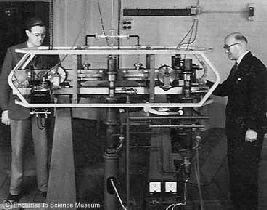
this wonder element can also be used for clocks. Cesium’s stable form is
Cs-133, which has 55 protons and 78 neutrons. In a cesium clock, microwaves
are applied to cesium-133 until it vibrates at one of 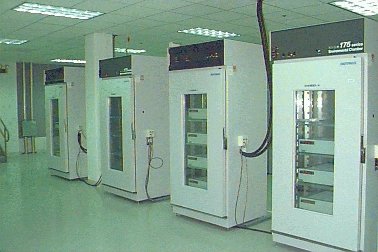 its
resonant frequencies. This helps to keep a quartz clock at a pulse of 5
MHz. This entire device is enclosed and protected from the outer environment
and from exterior magnetic fields. How well insulated and how precise these
clocks are determines which of two classes they are in. One kind is a "laboratory
standard," and the other is a "commercial standard." The lab standard is
far better than the commercial standard, but the commercial version is
less expensive, with some the relative size of a suitcase. These are often
placed in clusters to produce an accurate mean time for scientific and
public use.
its
resonant frequencies. This helps to keep a quartz clock at a pulse of 5
MHz. This entire device is enclosed and protected from the outer environment
and from exterior magnetic fields. How well insulated and how precise these
clocks are determines which of two classes they are in. One kind is a "laboratory
standard," and the other is a "commercial standard." The lab standard is
far better than the commercial standard, but the commercial version is
less expensive, with some the relative size of a suitcase. These are often
placed in clusters to produce an accurate mean time for scientific and
public use.
In contrast, the lab standard is very large and is also very accurate,
more so than the commercial version. It is unfortunately more expensive.
The laboratory models are mainly used for research and measurements of
extreme accuracy and precision. These clocks have a measurement error of
one second per 1.4*106 years. It is the most accurate
measurement man has achieved. This is why there are only a few in the world.
 When we think
of time or of medicine, we generally think of accurate and effective ways
to do things. We may want a clock that keeps time precisely, or a method
to kill cancer cells. In any case, we want something that has the properties
needed to make such devices. In 1860, when German chemist Robert Bunsen
and German physicist Gustav Kirchhoff discovered cesium through the use
of a spectroscope, they were not aware of its possible uses. Cesium turned
out to be an effective tool to create precise clocks and to kill cancer
cells.
When we think
of time or of medicine, we generally think of accurate and effective ways
to do things. We may want a clock that keeps time precisely, or a method
to kill cancer cells. In any case, we want something that has the properties
needed to make such devices. In 1860, when German chemist Robert Bunsen
and German physicist Gustav Kirchhoff discovered cesium through the use
of a spectroscope, they were not aware of its possible uses. Cesium turned
out to be an effective tool to create precise clocks and to kill cancer
cells.
Bibliography
-
"Cesium." 16 Nov. 2000 http://www.chemicool.com/elements/cesium.html
-
"Cesium." Microsoft Encarta 97 Encyclopedia. ©1996 Microsoft Corporation
-
"Cesium Atomic Clocks." 16 Nov. 2000 http://tycho.usno.mil/cesium.html
-
"Periodic Table: Cesium." 16 Nov. 2000 http://www.chemicalelements.com/elements/cs.html
-
"Periodic Table – WebElements : caesium : key data." 16 Nov. 2000 http://www.webelements.com/webelements/elements/text/Cs/key.html
 Home
Home
 My Papers Home
Terms of Use
Copyright 2000 @ Cesar Caro
[email protected]
Last updated Sunday, December 3 2000.