Nikola Tesla
Cesar Caro
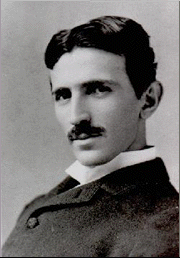
Nikola Tesla was a Serbian-American inventor, scientist, and researcher.
He discovered the rotating magnetic field, leading to his many inventions
with alternating current, including the AC generator, transformers, and
the Tesla coil. He had many patents in inventions still in use.
Tesla was born to an Orthodox priest and an uneducated woman in Smiljan,
Croatia at midnight on July 9, 1856. He was a dreamer, and gained qualities
of discipline that helped him when he went to study for an engineering
degree at the Technical University at Graz, Austria. This is where here
he fist sighted the Gramme dynamo, a generator that can be formed into
an electric motor, and came up with a way to use alternating current effectively.
Afterwards, while in Budapest, he created plans for an induction motor
based on conceptions of a rotating magnetic field. He was walking though
a park with a friend, when he visualized a new design drew a diagram in
the sand. The first time that his diagram was used in production of an
induction motor was when he built one while on assignment in Strassburg.
 Nikola then moved
again in 1884, this time to the United States, arriving in New York City
with four cents, some poems, and calculations for a flying machine. Upon
arrival, Tesla received employment under Thomas Edison. The two had many
disagreements.
Nikola then moved
again in 1884, this time to the United States, arriving in New York City
with four cents, some poems, and calculations for a flying machine. Upon
arrival, Tesla received employment under Thomas Edison. The two had many
disagreements.
"Tesla came over from Graz and went to work for Thomas Edison. Edison
couldn't stand Tesla for several reasons. One was that Tesla showed up
for work every day in formal dress - morning coat, spats, top hat and gloves
- and this just wasn't the American Way at the time. Edison also hated
Tesla because Tesla invented so many things while wearing these clothes."
-Laurie Anderson, "Dance of Electricity", United States part
1
Edison liked to use direct current, while Tesla strongly preferred AC.
Because Edison did not completely understand the light bulbs that he created,
he thought that his lights would work better with DC, even though AC works
just as well. When Tesla confronted Edison about backing AC, Edison said,
"Hold up! Spare me that nonsense. It’s dangerous. We’re set up for direct
current in America, and it’s all I’ll ever fool with." Tesla got the job,
anyhow.
Edison offered $50,000 to Tesla if he could improve Edison’s designs
of DC generators. Nikola came up with vast improvements on the original
designs by creating new ones, and asked for the $50,000 promised. Edison
claimed that Tesla didn’t "understand our American humor" and never paid
him the money.
Due to various differences, Nikola Tesla no longer worked for Edison
and found himself unemployed. He worked as a laborer on a New York street
gang to keep from starving to death. He then applied for patents on inventions,
including multi-phase AC motors, transformers, and distribution systems.
People were informed about the extraordinary patents, resulting in Tesla
lecturing before the American Institute of Electrical Engineers. The presentation
and ideas were considered new, lucid, and thorough, catching the attention
of businessman George Westinghouse. Westinghouse already knew and appreciated
the advantages of alternating current, and was a supporter from the beginning.
He wanted to supply AC electricity, but couldn’t due to the unpredictability
of the AC generators of the day. Westinghouse then found what he needed.
In 1885, Westinghouse Electric Company in Pittsburgh, PA, bought Tesla’s
patents on his various electrical inventions. An agreement was reached
between Tesla and Westinghouse to pay Tesla a royalty of two dollars and
fifty cents, for every horsepower of AC equipment sold. This would have
made Tesla one of the richest men in the world, had it not been for J.P.
Morgan (J.P. Morgan was Edison’s financial supporter, and bought Edison’s
patents.), Thomas Edison and their crew.
Edison was not able to challenge AC with DC on scientific accounts,
so Edison made demonstrations on how lethal AC was to dogs when current
was passed through their bodies. The demonstrations were not effective.
What was effective was Morgan’s action in the race between J.P. Morgan
and George Westinghouse for dominance in the providing of public electricity.
The House of Morgan, J.P. Morgan’s bank, went after Westinghouse by spreading
rumors in the financial world. Investors began to turn from Westinghouse,
decreasing his funds. This ultimately resulted in the decrease of Tesla’s
royalty on AC equipment.
The Westinghouse-Tesla approach to the servicing of AC electricity eventually
won the battle, allowing Nikola Tesla to be more inventive with his own
laboratory that he created in 1887 in New York City. He gave shows within
his own laboratory, to prove the safety of alternating current. He lighted
lamps, using only his body as the conductor.
Some of his other work included experiments with a carbon button lamp,
on the power of electrical resonance, with turbines, and on different types
of lightning. He also worked on the Tesla coil, which he invented in 1891.
This is widely used today in radios and televisions.
Westinghouse used his turbine system to light the Columbian Exposition
at Chicago in 1893. Tesla had great success, and this helped him to get
a contract to install the first power machinery at Niagara Falls. The machines
had Tesla’s name and patent numbers, and powered Buffalo by 1896.
In Colorado Springs, CO, from May 1899 to 1900, Tesla discovered terrestrial
stationary waves. He proved that Earth is a conductor and is responsive
to electrical vibrations of a certain frequency. He also lighted 200 lamps
from 25 miles away, wirelessly. This does not include the fact that he
created a flash of lightining135 feet long.
After he returned to New York in 1900, Tesla began construction of a
wireless world broadcasting tower on Long Island with $150,000 capital
from J.P. Morgan. Tesla said that he secured the loan by issuing Morgan
patent rights on telephony and telegraphy. Tesla’s expectations of creating
a broadcasting center of pictures, messages, weather and stock reports
failed due to lack of support from Morgan, as well as financial panic.
Tesla changed his focus to turbines and other things. The ideas stayed
on paper because of lack of financial stability. He was later awarded the
Edison Award in 1917, which is the highest honor that the American Institute
of Electrical Engineers can bestow.
Little happened after this, and Tesla died nearly penniless in a New
York City hotel room in 1943. He is given very little credit for what he
accomplished, and very few people recognize his name. Many credits are
awarded to people for what Nikola Tesla worked on. Guglielmo Marconi has
credit for inventing the radio, while Tesla’s work predates Marconi’s by
three years. The U.S. Supreme Court ruled in Tesla’s favor in this subject
in 1943, when Marconi applied for a patent. Some scientists applying for
patents on silicone logic gates experienced the same result, when they
realized that Tesla had beat them to their accomplishment.
The modern world is proof that Tesla’s work was useful, due to the amount
of his inventions still in use. He may not have received credit, but his
creations had a definite impact on the world today.
Bibliography
-
"Nikola Tesla: A Short Biography." August 17, 2000. October 3, 2000. http://neuronet.pitt.edu/~bogdan/tesla/bio.htm
-
Chew, Robin. "Nikola Tesla – Serbian/American Inventor." September 20,
1999. October 3, 2000. http://www.lucidcafe.com/library/96jul/tesla.html
-
"A Small Introduction to Nikola Tesla." October 3, 2000. -http://www.speakeasy.org/~ohh/tesla.htm
 Home
Home
 My Papers Home
Terms of Use
Copyright 2000 @ Cesar Caro
[email protected]
Last updated Tuesday, December 12 2000.