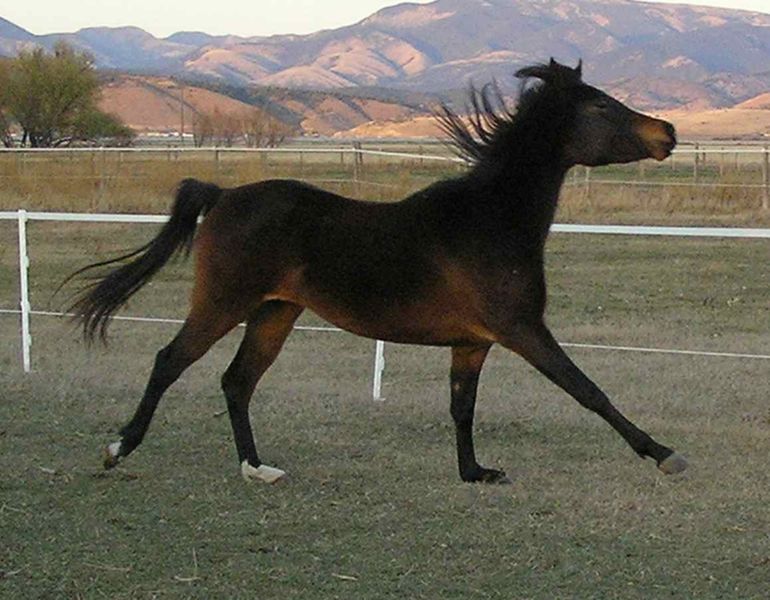
An affected foal is usually born without any clinical signs, but after 6 weeks and even as late as 18 months the following notable symptoms may be observed: A palsy-like head shaking called �intention tremors� affecting only the head and not the neck or body, particularly noticeable when the foal is trying to focus on something; the lack of a normal blink response although vision is correct; and an awkward exaggerated form of action with the forelimbs called �hyper-metric action� similar to a military goose-step or high elevation used to cross over a very low object. Sometimes in a badly affected individual it appears that the hind legs are also affected, but not usually. This hyper-metric action involves a shooting out and up of the foreleg directly from the elbow at both the walk and the trot. The hoof is brought down to the ground with a thump, often heel first. When cantering on level ground the horse looks as if it is cantering uphill, like a butterfly stroke in swimming. It is a highly exaggerated gait. The more stressed the horse, the more exaggerated the gait. Their spinal column is not involved; they do not lose weight; they are not in pain; they are neither lethargic nor show signs of increasing weakness, or loss of muscle tone.
As these affected foals will often run into things or fall down, sometimes causing head injuries, their condition can be misdiagnosed as injuries from a blow to the head or neck, making the true neurological condition go unnoticed. A CA affected horse has little to no control over its balance and has difficulty judging distances between itself and an object. Hence, they startle easily and appear panicky and hyper-active. When maintained in a constant environment, the older the horse or foal becomes the more it adapts to the surroundings and its own disabilities, thus appearing as if it is improving. Change the environment and the affected horse will have to undergo a serious of hopefully minor 'accidents' before it has adapted to the new distances and objects. Often an older affected horse will have a 'horse buddy�, which will be their guide. Horses with CA will often be referred to mistakenly as 'Wobblers', which is a condition of the spinal cord, not of the brain, or are misdiagnosed as a head injury caused by an accident. The degree of severity varies, with some foals having fast onset of severe coordination problems, others showing milder symptoms. In theory, mildly affected horses could live a full lifespan, but in practice, most are euthanized before adulthood because they are so accident-prone as to be a danger to themselves and others. They are not safe to ride.
Although the clinical signs are distinctive, the only way to confirm a diagnosis of CA is to examine the brain after euthanasia. There is currently no genetic test for CA but extensive research to identify the gene and create such a test is now under way in USA and Europe. To enhance and speed research, UC Davis and the Swiss Genetics Institute have agreed to exchange data information on gathered samples, thus expanding knowledge for both research centres. This also facilitates the mailing of samples to the nearest research centre.
CONTACTS FOR CURRENT RESEARCH INTO CA: Dr. Cecelia Penedo PhD., Geneticist.
Veterinary Genetics Laboratory
University of California
One Shields Avenue
Davis, California 95616-8744
USA
Tel:+1-530-752-2211; Fax:+1-530-752-3556
Email: [email protected]
Website: http://www.vgl.ucdavis.edu/research/equine/CA.html
Dr. Penedo is carrying on the research started by the late Dr. Ann Bowling, well-known author and geneticist, whose studies in 1984 were unable to be published prior to her untimely death. Dr. Penedo has very recently identified the chromosome (locus) which holds the mutant allele and is now researching the genes within that area.
Prof. Dr. Tosso Leeb, Molecular Geneticist
Institute of Genetics,
University of Berne,
Bremgartemstr. 109a, P.O. Box 8466,
3001 Berne
Switzerland
Email: [email protected]
Web: http://www.vetsuisse.unibe.ch/genetic/content/e2353/e2734/index_eng.html(English version)
And: http://www.vetsuisse.unibe.ch/genetic/content/e2353/e2734/index_ger.html(German version)
Dr. Leeb is highly involved in the recently completed Horse Genome Project (January 2007) which is a giant step forward for the research of genetic diseases in the horse, and his genetic research has been widely published. http://www.uky.edu/Ag/Horsemap/proposal.pdf
Vincent Gerber, PhD. DACVIM, DECEIM, FVH.
Head of Equine Internal Medicine,
Vetsuisse-Fakulty, University of Berne,
Langgass-strasse 124,
3012 Berne, Switzerland
Email: [email protected]
Dr Gerber participated in the most recent published paper specifically on Cerebellar Abiotrophy with his late father in 1995: Gerber, H. et al; �Cerebellare Abiotropie bei Vollblut-araber Fohlen� (Cerebellar Abiotrophy in pure-bred Arabians) (German), Pferdeheilkunde 1995;11:423-43