|
ADVANCED 250 SPADES
By Jason Lee Logelin “IRONSPADE”
Why is 250 spades the most exciting form of spades? Perhaps it is due
to the amount of strategy and flexibility a player can capitalize on. The standard
spades played by most is 500 spades, which is a lesser burden upon a player’s
mathematical abilities than in 250 spades. This is largely due to the lack of
flexibility to play bad cards to your advantage, therefore lowering the amount of
options available to a player during game play. The purpose of this guide is to
help a player assess their options in 250 spades. By using this guide, I hope I can
assist you in your campaign to become the best you can be.
This manual is meant for mostly experienced players. A good player
would follow most the rules I lay out in this manual, which is probably only
carried out by a select few, especially the 250 spades players. The majority of
players and strategists exist on the zone and yahoo where they only play 500
spades and are more precise in how they lead cards. These rules I set forth came
out of Playsite Spades, where it has always been questionable as to the nature of
the game. However, the tips below are statistically the most effective against
veteran opponents.
When playing against beginners or “newbies,” one might consider other
strategies such as over bidding and under bidding to confuse their opponents.
Also, you don’t have to worry as much about leading a suit three times against an
amateur opponent. Very few beginner opponents can resist trumping in the 2nd
seat. I do not recommend leading a suit three times in many situations, because
it takes you backward from where you need to be. Some of you may be thinking
right now, why not lead a suit three times in order to save your partners kings.
This all depends on the bids and the way the cards are led. To understand this
and more you have to read what I lay out for you. Soon this will become second
nature to you, of which can make or break a game.
|
|
2
OUTLINE FOR STRATEGY GUIDE
Pages 1-2…………………….. Intro
Page 3 ………………………. All players note
Pages 4-5……………………..Personal experiences
Pages 6-8 …………………… Most important tips
Page 8 - 9 …………………….Basic bidding strategy
Pages 9-11…………………….Card values
Pages 11-16……………………Bidding Continued
Pages 16-17……………………Scenarios
Pages 18-26 …………………..All about the nil
Pages 27- 39…………………. Leading (table pg 29)
Pages 40-47 …………………. You’re a team
Page 47 ………………………Running spades
Pages 48-51………………….. Scores and strategy
Page 52………………………..Bagging
Pages 53-55…………………...Psychology
Page 55-56…………………… Setting
Pages 56-58………………….. Miscellaneous
Pages 59-64………………….. Test your skills
***
500 spades players should only pay attention to the following topics:
All Players Note, Most Important Tips (except points 3, 9, and maybe 4),
Basic Bidding, Card Values, and Leading
|
 3
ALL PLAYERS NOTE:
Everything below is essential for the manual
X = 2 to J ex: xxA xxxxQ xxK xx or 38A 4789Q 89K 24
South player is at the bottom (your position), West player (LHO or left
hand opponent) is the player to the left, North player is above (your
partner), and the East player (RHO or right hand opponent) is to the right
Everyone has a 3 hand with about 3 spades unless I say otherwise
1st position is the 1st to bid or play, 2nd position is 2nd to bid…and so on
Assume each suit has about 3 cards each, unless I state otherwise
3.5 hand means you have a 50% chance of making 3 or 4 tricks
Assume the first card played can’t be trumped (playsite rules)
When you are trumping you are cutting or making a ruff
Overtricks are each trick you make on top of what you bid
Assume the score is 0 to 0 or tied unless I indicate otherwise
Assume your going for set unless I indicate otherwise
THE TIPS I GIVE ARE NOT AN EXACT SCIENCE. SOME SPADES MASTERS
HAVE DIFFERENT TECHNIQUES BUT THEY ALL REACH A SIMILAR GOAL.
ONCE A PLAYER KNOWS THE RULES OF STRATEGY THEY CAN ADJUST IT
BASED ON EACH UNIQUE SITUATION. THROWING OFF FOR BN AT THE
START CAN BE MORE DESIRABLE THEN A TIE SCORE IF OVERTRICKS, AT
LEAST 4 OF THEM, CAN BE EFFECTIVELY PUSHED ON THE OTHER TEAM.
LEADING IS THE ONE AREA THAT MAY CHANGE FREQUENTLY DURING A
GAME. LEADING RULES CHANGE BASED ON WHAT CARDS EACH PLAYER
LAYS DOWN. YOU GENERALLY LEAD A SUIT CONTINUOUSLY IF YOUR
PARTNER APPEARS SHORT IN THAT SUIT. LEADING RULES CHANGE
BASED ON WHAT EACH OPPONENT BIDS. WITH A WEAK BID FROM THE
RIGHT SIDE OPPONENT YOU HAVE A CHANCE TO LEAD RISKY, AND YOU
OFTEN UNDER LEAD YOUR ACES WHEN FORCED TO LEAD FROM THAT
SUIT. THERE ARE TIMES YOU UNDER LEAD FROM A LONG SUITED KING
WHEN YOU HAVE SPADE LENGTH. WITH A HIGH BID FROM THE LEFT
OPPONENT YOU WILL CONSIDER YOUR HAND TO BE LESS VALUABLE,
WHERE AS THE OPPOSITE IS TRUE WHEN THE HIGHER BID IS COMING
FROM THE RIGHT. SO ADJUST YOUR BID DOWN OR UP 1 AS A RESULT.
ANOTHER THING TO REMEMBER IS TO TRUMP WHEN THERE IS
INDICATION YOU MAY NOT HAVE THE OPPORTUNITY LATER ON OR
MAYBE YOU JUST NEED TO CHANGE SUIT. THE TIPS GIVEN ARE BASED
ON TENDENCY BUT ONE MUST WATCH EACH CARD PLAYED
ACCORDINGLY AND MAKE THEIR ADJUSTMENT. ALSO BIDDING COULD
BE BASED ON INTUITION BUT ONE MUST NOT DEFY THE BASIC RULES OF
BIDDING. THERE IS ALWAYS THE MOST PROBABLE ANSWER.
|
|
4
Before I start, I must mention my own personal strategy to winning games. The game is
won mostly by setting the opponents, even if it may lead to taking 8 overtricks by the end of
the game. Another strategy of mine is to bid aggressively, which means to consider each and
every card in your hand. There is a tendency for conservative players to lose out on more
games than they should. Now with 250 spades it can pay off to throw off to bag the other
team, but you must look at your hand and figure you have potential to do deliver some heavy
bags to the other team. Give up the bagging idea if you’re close to making your bid because
the last thing you want is to make 4 out of the 5 bid. Also many amateur teams tend to under
bid and setting them when the bids add to 11 just mean bags for your team. Generally it’s best
to just make bid when they add to 11 but the second they try to lay a bag on you go for the set,
but do it sneakily. There are players with different tactics, which astray from my own.
However, spades is about making the most precise mathematically correct play at the right
time. Other than my own strategy, I will mention a little about myself.
I was born in Houston, Texas in the year 1981. I ended up in a middle class suburb
of Hillsborough, New Jersey by age 5. My father was an engineer and my mother is a teacher,
both from Detroit, Michigan. I have an older sister, by three years, named Melissa. I recall
doing a lot of vacationing during my youth. My family did what they thought was right. To
sum it up, I was an extremely anxious and withdrawn person throughout my life, often
dwelling on one issue. Dealing with these difficulties, I blocked my thoughts by submerging
myself into one main interest.
Most of my life I devoted to academics, which I more than excelled at. Ironically, I
never enjoyed reading and I can’t say I valued the material. My hobbies would include the
Internet, techno music, weight lifting, drinking, drawing, and raving. I like drama, sci-fi, and
scary movies. I love Chinese food. I will do just about anything for kicks.
It was during my first year at Rutgers University (New Brunswick) in 2000, that my
roommate taught me spades. I acquired the IRONSPADE screen name, which I picked out
from a song, before I even knew how to play spades. I started using the name at the msn
gaming zone. A change in format of the site prevented me from being able to access the zone,
due to a glitch in the screen name system. My goal being to find another gaming site, I went
to www.games.com and saw a link for (|www.playsite.com). Playsite slowly became addictive
like crack, swallowing me whole. I would spend hours transfixed on the blaring white and
blue screen hoping to dull the pain and release me from my obsessive thoughts. Since it was a
dependency, it only made it worse. At least it was an experience.
|
|
5
I remember every player I come across in one way or another, as well as their stories,
each broadening my perspective. Most of my social aspects to the game were shared with a
friendly Rutgers graduate named Josh aka Mafiahead, toughplayer, and AKQspades. We did
spend a tremendous amount of time chatting away online, rarely about spades, and mostly just
joking around (waldo ring). He kept a lot of secrets as to his real identity. One player I
remember nicknamed hatan and Ps_UPS, a good chess player and an intriguing calculative
man, left me guessing as to whether or not he could see people’s hands. There is virtualangel
and smurfkiss, both an absolute joy to be around. I remember a woman nicknamed mmmmm
who was affiliated with the Ontario players, and who was kind enough to invite spades players
such as myself to visit her home. Of course I have to mention my friend Jen nicknamed
bestpever, who I confided in with all aspects of my life. An older, more eccentric friend of Jen
and mine named Sam was my one and only spades mentor. He claimed playsite fell victim to
the laws of diminishing returns, meaning what goes up must go down. After coming back
from California, I met a young lady named Kayla, who is the daughter of a woman nicknamed
lacy4. I visited a cool player named Dante near Newark, NJ. Last but not least is Mary aka
nytilelady from upstate New York, the kindest woman I ever got to know online and offline,
not to mention the most trendy. Playsite can cause good memories and bad.
Playsite caused me problems, which was just the icing on the cake. Thankfully, I
have the opportunity to bring clarity to those unanswered spades questions. You take me into
the dark and I’ll show you the light. This manual is for playsite and for those who play the
game.
It’s time to play the game
|
 6
HOW TO PLAY THE GAME:
1. OFTEN TIMES YOU RESIST TRUMPING YOUR OPPONENTS EARLY IN THE GAME. YOU
MAY HAVE LAST LOOK AT THE PLAY WITH THE OPPORTUNITY TO CUT, BUT YOU MAY
NOT WANT TO DO SO. INSTEAD OF TRUMPING, CONSIDER SHORT SUITING. THIS
STRATEGY WORKS BEST WHEN YOU’RE ON THE DEFENSE WITH HOLES IN YOUR HAND
AND YOU NEED THEM LEADING TO YOU AND YOUR PARTNER, MEANWHILE YOU’RE
SAVING YOUR SPADES FOR THE END OF ROUND. DO CUT IF YOU BELIEVE YOU NEED
TO CHANGE SUIT. IF YOU DO CONSIDER TRUMPING EARLY, YOUR SPADES SHOULD
LOOK LIKE
xA, xxA, xx, xxK, AND xxx. MOST EXPERTS JUST COUNT THE NUMBER OF
SPADES IN THEIR HAND THAT DIFFER FROM THE STANDARD OF THREE, EACH EXTRA
COUNTING AS 1 TRICK. FOR EXAMPLE, XXXK SPADES IS WORTH 2. MOST OF THE TIME
ONLY 1 TRUMP TRICK CAN BE CONSIDERED. WHEN IN THE 2ND POSITION YOU
SHOULD NOT BE TRUMPING UNLESS AND ONLY MAYBE IF YOU HAVE 3 SPADES OR
LESS.
CUT WITH A TEAM BID OF 8 OR MORE AND THEN YOU NEED TO RUN SPADES FAST.
2. LEADING IS VERY ESSENTIAL TO WINNING GAMES. GENERALLY YOU DON’T LEAD
ACES, BECAUSE YOU ALWAYS WANT THEM TO LEAD TO YOU WHEN YOU HAVE AN ACE.
WHEN THE BIDS ADD TO 11, YOU WILL RISK YOUR PARTNERS KINGS AND SAVE YOUR
QUEENS. THIS JUST MEANS THAT YOU DON’T LEAD WITH SUITS THAT CONTAIN A
LONE QUEEN, KING, OR ACE. WHEN LEADING A CARD BESIDES AN ACE, LEAD A LOW
CARD IN YOUR LONG SUIT (OR A HIGH CARD IF BACKED UP BY AN HONORS EX: 10J, JQ,
OR KQ). SOMETIMES YOU LEAD SHORT SUITS WHEN YOUR PARTNER BID HIGH OR IF
YOU NEED A VERY CHEAP CUT.
IF THE OPPONENT TO YOUR RIGHT LEADS A LOW CARD IN A SUIT IN WHICH YOU
CONTAIN AN ACE IN, YOU PLAY A CARD LOWER THAN THE ACE (UNLESS IT WAS Ax
UPON WHICH YOU NORMALLY PLAY THE ACE FIRST TO GIVE UP CONTROL IN ORDER
TO SET UP A RUFF IF NEEDED), GIVING YOUR PARTNER LAST LOOK AT THE PLAY.
YOU TRY NOT TO RISK YOUR PARTNER’S KINGS WHEN THE BIDS ADD TO 12 OR 13,
MEANING YOU PLAY LOW IN SUITS IN WHICH YOU CONTAIN A QUEEN, PROTECTING
YOUR PARTNER’S KING BUT RISKING YOUR QUEEN. WITH A STRONG PARTNER, ONE
SHOULD NOT HAVE TO LEAD THEIR ACES IN CASE THERE WAS NOT A QUEEN IN
ANOTHER SUIT TO UNDER LEAD. HOWEVER, LEAD YOUR ACES IF YOU HAVE A
COMMANDING LEAD IN THE GAME.
ALSO, AVOID LEADING SUITS YOUR OPPONENTS LEAD. PLAY SUITS YOUR PARTNER
LEADS. BUT STILL, TRY NOT TO LEAD ACES.
IF YOU DO MAKE A CUT, CONSIDER LEADING BACK WITH SPADES. YOU MAY THINK
THE OPPONENTS ARE CLOSE TO A CROSS TRUMP. OR IT COULD BE THAT YOU OR
YOUR PARTNER IS LONG IN SPADES.
AVOID LOW LEADING A SUIT THREE TIMES WHEN IT APPEARS THAT AN OPPONENT IS
OUT OF THAT SUIT, UNLESS YOU HAVE VULNERABLE KINGS OR AN AQ COMBINATION
IN BOTH YOUR OTHER SUITS. WITH THE BIDS ADDING TO 12 OR 13, YOU WILL LEAD A
SUIT TWICE AND TRY TO SWITCH OFF TO A SUIT IN WHICH YOU CONTAIN A QUEEN. IF
YOU DON’T HAVE A SUIT WITH A QUEEN, SWITCH OFF TO YOUR LONG SUIT (UNLESS
YOUR PARTNER BID HIGH IN WHICH YOU LEAD FROM A SHORT SUIT). SOMETIMES
YOU PLAY A SUIT 3 TIMES IF YOUR PARTNER MAY BENEFIT. IF YOUR PARTNER IS OUT
OF THAT SUIT, IT MIGHT PAY TO LEAD THREE TIMES, ESPECIALLY IF HIS BID WAS
INSIGINIFICANT. BUT YOU DON’T WANT TO FORCE A HIGH BIDDING PARTNER TO
|
 7
TRUMP WHEN YOU COULD LEAD WHAT IS MOST LIKELY HIS LONG SUIT INSTEAD. IT
MAY ALSO BENEFIT YOU TO LEAD A BOSS QUEEN INTO A HIGH BIDDING OPPONENT,
TO DIMINISH THEIR SPADES STRENGTH. TRY NOT TO LEAD SHORT SUITS UNLESS
YOU NEED A VERY CHEAP CUT WITH xA, xxK, xxA, xx, OR xxx OF SPADES. DO LEAD
THEM IF YOUR PARTNER BID HIGH.
WHEN SOMEONE LEADS TO YOU AND YOU HAVE Qx or Kx YOU SHOULD PLAY YOUR X
AND SAVE THE HIGHER CARD FOR LATER. WHEN YOU’RE LEADING IN THESE SUITS,
YOU WOULD LEAD THE HIGHER OF THE TWO.
IF YOUR RIGHT HANDED OPPONENT DOESN’T HAVE A HIGH BID, PLAY YOUR
SINGLETON SUIT AND RISK YOUR PARTNERS KING IF YOU CAN MAKE A CHEAP CUT.
3. WHEN 50 POINTS DOWN YOU AND YOUR PARTNER SHOULD BID 5 AND NIL. WITH 1ST
BID AND 50 DOWN WITH A 2 HAND YOU NIL, AND WITH 3 TO 5 YOU BID 5 (I SAY TO BID 5
HERE BECAUSE IT GIVES YOUR PARTNER A CHANCE TO ASSUME YOU HAVE 3 TO 5 AND
CONSIDER NOT GOING NIL IN CASE HE HAS A GOOD HAND). OTHER THAN THAT YOU
WANT TO JUST BID YOUR HAND. MAKE SURE YOUR PARTNER KNOWS THIS MOVE
BEFORE YOU BID IT BECAUSE 95% OF THEM DON’T.
ANOTHER POINT IS, IT’S BETTER TO BE DOWN 50 POINTS THAN DOWN 30 OR 70. SET
YOURSELF UP TO BE 50 POINTS DOWN INSTEAD.
WHEN YOU’RE MORE OR LESS THAN 50 POINTS DOWN, DIFFERENT RULES APPLY. BUT
DO NOT FOLLOW THESE RULES WHEN THE GAME IS ALMOST OVER AND THEY HAVE
LAST BID, RATHER JUST BID AS MUCH AS YOU POSSIBLY THINK YOU MAY GET. WHEN
30 POINTS DOWN WITH A 2 HAND IN POSITION 1, GO NIL WHILE THE OTHER JUST BIDS
THEIR HAND. WHEN 30 POINTS DOWN WITH A 3 HAND IN POSITION 1, BID 3. WHEN
YOUR PARTNER WENT 3 AND YOUR 30 POINTS DOWN, BID NIL WITH A 2 OR 3 HAND.
EXAMPLE: TIE GAME, YOUR OPPONENT BIDS 4 OR 5. WITH A 1 HAND IN 2ND POSITION
YOU WOULD BID NIL. IF 40 POINTS DOWN AND YOUR OPPONENT BIDS 1, WITH A 1
HAND IN POSITION 2 YOU WOULD BID NIL. IF YOUR NOT DOWN IN POINTS, JUST BID
YOUR HAND, EVEN IF IT’S JUST 1. BID LOW WHEN DOWN OVER 50 POINTS, UNLESS IT’S
LATE IN THE GAME, IN WHICH YOU HAVE TO BID YOUR HAND.
4. AVOID A TEAM BID OF 5 WITH LAST BID WHEN THE OPPONENTS ARE 6 (ASSUMING
SCORE IS TIED…ALWAYS ASSUME THIS AS I POINTED OUT IN GUIDELINES). IF YOUR
OPPONENTS BID SIX, CONSIDER GOING SIX AS WELL. AND MANY TIMES WITH A
STRONG 5 AND 3RD TO LAST BID, YOU WOULD UP IT TO 6 EARLY IN THE GAME.
5. DON’T BID FOUR OR LESS FIRST HAND. YOU’RE GOING TO MAKE THE TEAM BID ADD
UP TO FIVE OR YOU CAN JUST NIL IN THE ATTEMPT TO MAKE A BN. THIS MAY NOT
APPLY WHEN YOUR PARTNER BID 1, IN WHICH CASE YOU MAY BE FORCED TO BID 4.
6. OVERTRICKS ARE ONLY GOOD WITH A CLOSE GAME TOWARDS THE END. AVOID
THEM EARLY ON AND EVEN LATER IF YOU HAVE A SIZEABLE LEAD. YOU ALMOST
ALWAYS START THE GAME WITH THE IDEA TO SET THE OPPONENTS AND RISK TAKING
AS MANY AS 3 OVERTRICKS 1ST HAND. IF THERE IS A VERY STRONG POSSIBILITY YOU
CAN DELIVER 4 OVERTRICKS TO THE OPPONENTS, THEN THROW OFF. OF COURSE
YOU NEVER THROW OFF IF YOUR HAVE THE LARGER BID AND THE SCORES ARE EVEN.
ALSO WHEN YOUR PARNTER IS BN OFTEN TIMES YOU WILL TRY TO EXAGGERATE
YOUR BID TO 5 AND THROW OFF WITH THE PROPER PASSING. SAME GOES FOR THE
BN PLAYER, HE SHOULD REALIZE HIS PARTNER IS WEAK AND EXAGGERATING BASED
ON HIS HAND AND SHOULD ATTEMPT TO EITHER SELF SET TO TAKE OUT THE
OPPONENTS BID OR MAKE A PASS THAT CAN BE USED TO BAG THEM WITH.
|
 8
7. TRY TO SET THE NUMBER BIDDING OPPONENT WHEN THE OTHER OPPONENT IS
NIL AND THE NUMBER BIDS ADD TO 11 OR MORE.
8. PLAY YOUR LOWEST CARD UNDER YOUR RIGHT HANDED OPPONENT IN THE 2ND
POSITION UNLESS YOU BELIEVE HE HAS THE KING IN WHICH CASE YOU PLAY THE
QUEEN WITH AQX. PLAY YOUR HIGHEST CARD IN THE 3RD POSITION UNLESS YOU
HAVE A JACK-ACE, JACK-KING, OR QUEEN-ACE COMBINATION, IN WHICH CASE YOU
MOST OFTEN PLAY THE LOWER OF THE TWO.
9. WHEN YOU’RE BN AND THERE IS NO WAY YOU CAN MAKE YOUR BID, PASS YOUR
PARTNER YOUR SHORT SUIT AND EXPECT THAT HE WILL DO THE SAME IN ORDER
TO SET THE OPPONENTS NUMBER BID. WITH NO SHORT SUITS, PASS YOUR SPADES.
A. BID COUNT OFTEN DEPENDS ON NUMBER OF
SPADES AND THE BIDS (this is the most important)
THE NUMBERS LISTED BELOW SHOULD BE BASED ON THE ODDS WITH EVEN BIDS
AROUND THE BOARD. THE MORE THE SPADES, THE MORE WEIGHT YOU GIVE TO OTHER
CARDS (for each extra spade you have, you want to increase the value of your kings by .25 and
deduct by .25 with each less spade. With queens the rule may change in that the queen requires
more support from the cards below. In the case that you have xxQ with 5 spades, the Q is worth
about 1 if it has support from a jack. Also if the opponents bid really high, your hand may take a
lesser value, so bid conservatively unless you’re down a lot of points. If the player to the right bids
really low, consider raising your bid, assuming you have a higher hand count and you’re down in
points. This holds true MUCH more when you know what your partner bid, upon which a player
adjusts their team bid by .25 to 1. You’re hand is more safe with a higher bid from the right
opponent and less when there is a higher bid from the left opponent. I normally go up or down 1 on
that information when they bid 4 or more. Just to make more sense, assume everyone bid the
number of spades in their hand. So I might raise or lower my bid by 1 based on that information
alone. With a very high bid on the table, 4 small spades without a short suit would be worthless.
Also if the opponents have bn, you might want to consider lowering your bid, in the case that you’re
lacking spades, but by no more than 1.
If you have 5 or 6 spades or more and you are long in another suit, you need to count
those worthless cards in your long suit as tricks on the fact that after you play out your spades,
nobody will have cards in your long suit but you or vice versa. So if u have
xxxxxQA
xxxKA,
two or three of those clubs will make it besides the ace, so bid 2 to 3 on top of what else you have
depending on score.
The values listed below are very crude. Most players just estimate the hand value in
their head based on the bids from the other players. My strategy is to just take the long suited king
values I list below and subtract .25 for each less spade and add .25 for each extra. Short suited
kings tend not to change in value. Just subtract or add .25 for the values that are listed below 1. In
the case that a long suited king is backed by a queen or ace you may count it as a trick. You might
|
 9
consider queens as 1 with four or more spades and a jack supporting. The more spades you have,
the higher the probability of making the queen, with or without backing. Each spade pass three
should be considered as .75 or higher. Your kings, queens, and spades tend to have better odds
when the opponent your right has the higher of their bids AND the reverse is true if he has the lower
bid, so adjust that by .5 one way or another. When your partner is nil the kings are worth about .66,
maybe more if the right hand opponent has the higher bid. When the opponents are nil, your
queens may go up in value as much as .50. Trump tricks count more with an ace supporting a 2-
carded suit like Ax, because you can signal your partner to play that suit. If you have first bid you
may adjust down from my values by .25 in case you are conservative.
Assuming you have 3 spades, this is how you bid in 4th
spot (everyone else has about a 3 hand)
Just remember that for each less spade you subtract .25 from the value of the cards that
are listed as being less than 1. Kings in 3 carded suits with 2 spades are worth 1 still. Kings in 3
carded suits 3 with 1 spade are worth .95. Kings in 6 carded suits with 4 spades are worth .95. If
you are the first to bid, you may adjust down .25 from some of these values to play it safe,
especially with the lead. If you are the last to bid, you may adjust down .25 to 1 with a strong bid
coming from the left and adjust up .25 to 1 with a weak bid coming from the left. This depends
mostly on the score, don’t adjust down when you’re already losing (holds true with bn
also….consider bidding up by 3 instead of 2 when down in score)
1. Ace
a.
Ace = 1
b.
AJ10 = 1.25
2. King
a. 1 suited King = 0 or .33 if your 1
st
to play (the 1st player to bid is the 1st to play)
b. 2 suited King = 1
c. 3 suited King = 1
d. 4 suited King = 1
e. 5 suited King = .95
f. 6 suited king = .7
3. Queen
a. 1 suited Queen = 0
b. 2 suited Queen = 0
c. 3 suited Queen = .4, QJx = .5
d. 4 suited Queen = .25, QJxx = .35
|
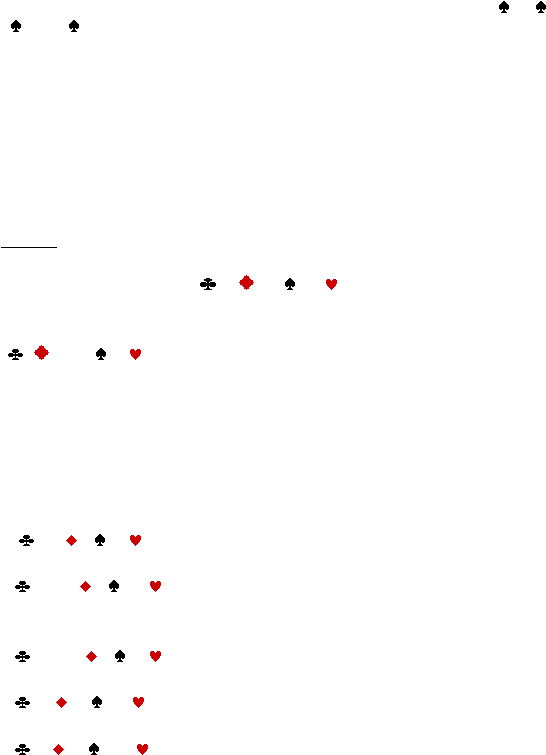 10
4. Trump Tricks, NOTE: TRUMP TRICKS YOU DON’T ADD TO YOUR BID UNLESS YOU HAVE 2 TO maybe 5
SPADES. YOU RARELY CONSIDER TWO TRUMP TRICKS IN YOUR BID. YOU MOSTLY TRUMP WITH
XXA,
XXK,
XA, AND
XXX. THE ODDS OF A SECOND TRUMP TRICK IN ANOTHER SUIT SHOULD BE CUT IN HALF.
a. 2 of a suit = .5
b. 1 of a suit = .75, with 4 spades = 1
c. void of a suit = 1, with 4 spades = 1.375
d.
2 of a suit w/ 2 spades = 0
e.
1 of a suit w/ 2 spades = .25
f.
0 of suit w/ 2 spades= .5
5.
spades:
some people count spades as trump tricks like I went over above, but that might be
incorrect when you have more than 3 to 5 spades. Experts say that anything over 3 spades you
have to consider as a trick (example
xxx
xxA
xxxx
xxx ….. this would be a 2 hand (1.75)
because you have 1 spade more than 3). Now if the player to your left had bid 5 or more, it’s only
1. The only time you may count a trump trick is when you have 2 to 4 spades and a short suit such
as (
x
xxxxxA
xxx
xxK) and consider 1 of your 3 low spades as a cut but no more than that.
This is a hard concept to understand because people always considered spades as a method of
trumping. The reason why you bid the number of spades over 3 is because you want to save your
spades until the end. By not trumping early with more than 3 spades you keep your opponents
leading to you and your partner. With this method you will gain more tricks than you would if you
cut each time you had the chance. As hard as this concept may be, I will explain the way you lead
later on in the manual, which should shed some light on this technique.
ex1:
xxxA
xx
xxx
xxxK consider this a 2 hand. You have 50% chance of making three.
ex2:
xxxxxA
xx
xxxx
A you could make 2 cuts but you try not to count cut tricks
twice….risk going 4 if you need it. This is a three hand. But you have about 50% odds of 4.
ex3:
xxxxxxA
xx
xxx
x this hand is valued as 2
ex4:
xxA
xxx
xxxx
xxK consider this a 3 hand because you have 1 more than 3 spades
ex5:
xA
xxx
xxxxx
xxK consider this a 3.65 hand
a.
xK spades = .75
b.
xxQ, xxK, xxA = 1
c.
xxxx = .75 or 1 if short suited
|
|
11
d.
xxxxx = 1.65, with jack or 1 suited = 2
e.
xxxxxx = 2.75, with 10 or jack = 3
f.
xxxxxxx = 4
g.
AKQx = 3.75, with 10 or jack or short suited = 4
h.
AKQxx = 5
i.
Axxx = 2, Axxxx = 3, Axxxxx = 4, Kxxx = 1.75 to 2, Kxxxx = 2.75 to 3,
Kxxxxx = 4
j.
Aqx = 2, AQxx = 2.75 to 3, AQJxx = 4, AKxxx = 4
6. When you have last bid, when needed, bid for a blind nil..be creative..bid high & set self..bid nil
& self set..use any fake bid that would put you into the best blind nil
7. When you have last bid, do not place a bid that will put the opponents into a blind nil unless you
have a chance to set the number bid.
8. Overbid with high cards but low number bid in the case that your partner is nil and you can bid for
bn.
Example: They go 9, your partner is nil, and you have a 1 hand… consider bidding 6 with semi
high cards for bn or 2 if you don’t have enough cover for your partner. If you had a 2 hand you
would bid 6 with high cards or 3 if you have low cards and the game is at an early stage, otherwise
you might want to bid 2.
9. Always bid the blind nil, when your partner will have last bid. Even if an opponent went nil, go bn.
10. Underbid last hand when the opponents bid max amount they need to win with a nil… So if they
are bn and 7 and you need just 6 to win, bid 5 or 6 (5 if you have 5 to 6 and 6 if you have 7) which
is high enough to tell your partner to set the number bid and low enough that the nil player won’t be
able to set your bid. Also if an opponent goes nil last hand, assume it is false and bid low to set it,
unless you’re sure you can win with a number bid.
If your partner is bn last hand, and you have 3rd to last bid, bid what you would need to win
(example: score is 100 to 220 them, than you should bid 8 if your 3rd
to bid…….Now if the tables
were turned and your opponents went 8 and bn, you would bid 3 or 4. The 3 bid is for when you
|
   12
want to set the bn. Don’t bid 4 or 5 if you don’t think you can make 6. If you can make 6 it’s best to
bid 4 to tell your partner you’re going to set the 8.
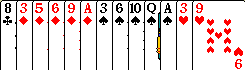
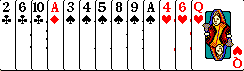
11.
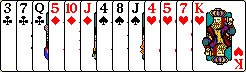
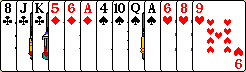
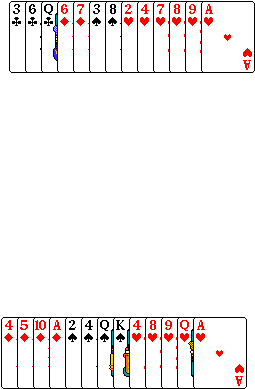
Hand 1
Hand 2
Hand 2 is better than hand 1 in that you have a very good chance at 6 tricks where as hand 1
makes about 5 (note: I would start leading hand 1 with the
3)
Although hand 1 looks more powerful, it has only 5 spades in which maybe 4 tricks will be
made….that with the ace diamonds makes 5……..although there is a considerable amount of
diamonds, they are very low and can’t really be considered for this hand
Hand 2 on the other hand has 6 spades, in which 3 will make tricks along with the Ace which makes
4….the ace diamonds makes 5 and there is a very good chance the Queen will make 6
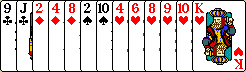
12.
You are winning 156 to 64. You have six bags while your opponents have four. The player
to your right opens the bidding with 3. What would you bid?
|
  13
You would bid 1 because you are high in overtricks. The k is worth about .45 and the spades are
almost worthless depending on your partners spade length.
This practice of overbidding, however, I do not always recommend. It should be up to the last
bidder in your team to bid up by 1.
13. Consider upping your bid by .5 early in game (under 150 points) when the player to the right of
u bids low by 2 or more. This also holds when the scores are tight towards the end of the game.
So if you have a 3.5 hand and the player to your right bids 1, many times you would bid 4. Also, If
it’s late in the game….it would require for you to see your partners bid before you up your bid by
.5…..EXAMPLE: so if your partner in the 1st position bids 5 and you have 2.5 and the player to your
right bid 2, than you could count your hand as a 3.
14. Avoid making a team bid over 10….whatever you do, unless you have a lot of bags, don’t bid so
high they could get lucky and set or make a bn bid.
15. When your partner is bn, and you have a 1 hand…..it’s normally best you bid 4 or 5 unless you
have last bid and can make a better assessment. If you have a 0 hand than you bid 4, depending
on the highness of your cards. There are cases when you have last bid and the opponents bid
fairly low telling you that your partner is loaded…..in that case you can bid for set but the best bid is
5 …..you will most likely make 5 even with your small hand because your partner has most of the
cards…..with a 5 bid your partner can still decide if his hand can set or not which brings us to the
next point.
16.
You tend to only count long suits other than spades for tricks when you have 5 to 6 spades or
more….unless you have AKQ spades which in that case you need 4 spades…..but just remember
your long suit should have a couple high cards in it like the AK….or AQ for example
example:
xxxKA
xx
xxxJQA This hand you will make about 5 of your spades (3 + Q +
A)….you will make your AK of clubs…..but you will also make an extra 1 or 2 clubs making this
hand a powerful 8 or a reasonable 9.
|
 14
With the option of setting the number bid or the nil, do not play your high cards unless it is
necessary. In the next example you have a chance to set a nil or a number bid.
Say your number bidding opponent leads the
10 to you and you have the
XJA…..you might top
the
10 with the
J ….now you have the option of playing the ace in the hopes to set the number
bid but this would be a bad play…..there is still a queen and king outstanding and by playing the
ace your risking the fact that your partner or the nil bidder has them. Lead a low spade the 2nd time
around.
17.
Bid conservative when your bid is based only on spades. Partners can share tricks in spades.
18. If your team bids 5 + nil or 6 + nil and the opponents bid 0 or 1, the perfect defense for that is
break your own team's nil early and pour all the bags on them. A 1-7 score is much better than 107
to 1.
19. When the other team has a nil bid, you and your partner should attempt to set their number bid,
when the bids add to 11 or more (sometimes even 10 if you get a free trick or two). But this may
depend on your cards. Change strategies if you have to.
EXAMPLE: THEIR BIDS ARE 3 AND NIL……YOUR TEAM BID IS 8………BEST YOU SET THE 3
AND NOT THE NIL
EXAMPLE2: THEY ARE NIL AND 2…..YOU HAVE TEAM BID 9…..BEST YOU SET THE 2,
20. 2 queens in 3 carded suits is 1
xxQ
xxQ
xxA
xxx is a 3 hand
21. Never bid 5 against the opponents 5 1st hand. Go 6 & 5
22. Never bid 6 against the opponents 4 1st hand…..Go 7
23. 1st bidder hints what he has when score is 0 to 0 when the score is tied. Now if you have 1
hand you only need about a 30% probability of making it to bid it.
|
|
15
Example: your 1st
player to bid with a 1 hand…..just bid the 1…don’t fake a nil you don’t have with
a tie game and first bid unless it’s last hand…with a 0 hand you just nil.
24.
If it is last hand and you have a hand that is more than good enough to make bid, it might be best
that you bid your hand to the fullest instead of the typical team bid of 7. If you have a total of 8 and
the scores are 204 to 201 them and you’re in 3rd
position meanwhile the number bidding opponent
went 3, it is imperative that you bid 8. If you had went 7 the 4th position opponent could have bid nil
and win the game. Make sure you bid your hand to the fullest if it helps you stop their nil bid.
If the opponents, last hand, have a total team bid that you can’t set and you’re in the 4th position, go
nil even if you can’t possibly make it. By going nil, you and your partner may get a couple cheap
tricks, which will aid you in setting their number bid.
25.
If your partner bid really high, do not consider 4 small spades as 1 unless you’re short suited.
26. When your partner is bn and you can’t catch up to the opponents in score or make another bn
after all is done (which would be a bid to bring you back to 100 points down again after the hand is
played)……bid to put you in the position where your 50 points down. Being 50 points down is a
good place to be. It gives you and your partner the chance to bid nil and 5 next hand, with the idea
of making another bn.
Example: score - 60 to 60 them…..your partner is bn…..the opponents team bid 7 ……you have a
5 hand after your partner passes you his high cards…..however, you do not bid your hand. You
would bid 4. If you had bid your hand the score would be 90 to 130 them. By bidding 4 you make
the score 80 to 130 them, an even 50 points down. After that you and your partner would go 5 and
nil to bring yourself about 100 points down, giving you another bn next time around.
27.
I had mention before if the opponents are nil and 3, you can bid 7 or 9 or even 10….very rare you
would bid 8. In order to bid 8 your hand would need to add up to 7 maybe 8 and be mostly middle to
high cards.
Also if the opponents went nil and 2, you can bid 7 or 9 or 10…..never bid 8
|
|
16
28.
If your partner is bn and you are the 3rd bidder with very little tricks possible, than it’s usually best to
bid 5 and try to self set or make the 5 in the case that they bid 5…….rarely do you go 4 but in the
case that you have a 0 to 1hand, a 4 bid would not be out of line.
29.
In some cases you bid low so you can have 10 overtricks…Example: they have 20 and you have
118…they team bid 4….with a 7 hand you should bid 5 to make the scores 70 to 60 them.
30.
Avoid bidding 2 in 3rd
position first hand when your partner is nil. It’s a very weak way to start t he
game. Just bid 3 or if you have last bid of course you can bid 2 assuming they went 8.
I will give you scenarios like the ones below to test your thinking.
Example : remember that score is tied …score is always tied unless I say otherwise
(South) player bid 3
(West) player bid 4
(North) player bid 3
(East) player has a 1.33 hand and last bid. What should the player bid?
The East player should take the risk and bid 6 (1 more than what his team bid would have been)
When the score is tied, you match the opponents bid if they go 6, assuming your not nil.
I will give pointers, some with examples, such as the ones below to give you insight
1. If you have last bid and score is less than 150 with a 6.5 hand, and they are 5, consider a bid of
7.
2. When the opponents have a nil, the value of your cards go up considerably, jacks turn into
powerful queens and 10’s turn powerful jacks. Also you have the ability to lead a suit that your
partner and the number bid to your left doesn’t have, which almost always leads to a set. So
maybe bid up by 2 if you have all high cards otherwise the bids would just add to 11.
|
 17
So if both your partner and the opponent with the number bid to your left are out of clubs,
play clubs. In which case the number bidding opponent should either short suit or play a high
spade. But often he will lose out on what he bid.
Example : Score is 74 to 90 them
East player opens the bid with nil
South player bids 5
West player bids 4
North player has last bid. What should he bid? His hand is
810k
10JA
79j
810Q
The North player should bid 9 because his hand is loaded with high cards. Even though he has a 2
hand with a team bid of 7. A nine bid would be my bid since they more than likely will make 9 and
you’re already down in score. Bidding 0 on this hand for bn would be too risky considering the
overtricks.
Example 2: Score is 63 to 60 them
East player opens the bid with nil
South player bids 3
West player bids 3
North player has last bid with:
10jKA
69K
8KA
4810
What should North bid? With all those high cards he should realize that he has a very little chance
of setting the nil. So he has to up his bid by 1 making it a team bid of 9.
If the North player had a hand such as
46A
3JA
48K
49KA
What should he bid? With all these low cards he should team bid 7 because he has a good
chance of setting the nil and keeping them down by 90 points. If he sets the nil the scores will
become 134 to 42 them, giving them no chance for a bn.
|
|
18
B. All about the Nil
a.
When opponent nils, consider adding 1 to 3 tricks to your count or just bidding an even 5. Bid
at most 2 extra if you don’t have last bid (it’s sometimes best to bid 5 in 3rd position with a
hand count of 4 to 6 as a team bid). Make sure you make what you bid though unless the
game is towards the end or if throwing off gives you fairly good bn, which in that case you
would throw off your bid or set the number bid.
Example: they team bid 5 and nil, you have 6 total and could make a team of 8 but the only time
you would really do this is if the 5 bid came before the nil (in the case that the 5 bid came after the
nil most likely he has a solid 5, it’s probably best to bid 5 unless you have a really strong hand). If
the 5 bid came before the nil it most likely will benefit you to make a team bid of 8, especially with a
very strong 6 hand, reason being that you have a good chance of setting with jacks and queens
and leading back to your partner. In that same situation you could bid just 5 if you had a 4 hand or
if your hand was insignificant (in that case the next hand your team will have to go 5 and nil for bn
assuming the opponents achieved what they bid).
Example: They bid 5 and nil and your bids added to 5. Let’s assume they make their 5 and nil bid
to make the scores 51 to 103 them. The next hand either you or your opponent should go nil or 5.
If your 2nd to bid, always bid nil unless you have a 5 hand, which you would just bid 5. If your 1st to
bid, you should bid 5,nil, (or 0 if you have it). Now in the case that you bid 5, your expert partner
should be smart enough to bid nil to keep you at 51 points for a possible bn
If they team bid 4 and nil and you have 7, most likely you want to bid 8 or 9 depending on the
strength of the hand. If they go 3 and nil you want to team bid 7 or 9…7 to stop a bn….and 9 if you
think your hand is strong. If they go nil and 2, you want to team bid 7, 9, or 10. What you hardly
ever want to do is bid 8 when the opponents are nil and 3, especially when it’s 1st hand. It would be
best to bid 7 to set the nil and keep them down 90 points.
|
|
19
b.
When your opponent and your partner nils, add 2 - 3 tricks to your bid, depending on the
highness of your cards. In the case that your down a significant amount of points (about 30)
or if the opponents have a lot of bags already, it would be in your best interest to throw off
your number bid in the chance that you can set the opponents nil or bag them for bn. This
pointer is very confusing. It even depends on which player has the number bid. If you and
the player to your right have the number bid, it’s best you throw off and keep him leading. If
you and the player to your left are the number bidding players, it’s best to take what you bid.
Example: score is 54 to 74 them……your partner is nil and you are 5…..the opponents are nil and
5…………It would be best that you make your 5 bid because the game is fairly close. If the player
to your right is the 5 bidder it might be good to throw off instead, in the case that you don’t think you
have enough cover for your partner.
Example2: score is 52 to 74 them…..you are 5 and your partner is nil….opponents have the same
bids…..in this case you might want to throw off your 5 bid because the opponents are not only 20
points ahead, but they have lead in overtricks, which can often make or break games. It is
especially helpful to throw off when the opponent to your left has the team bid of 5 because you will
have last look at each card he plays. By not taking five your giving them overtricks and risking their
nil.
c.
When just your partner nils..bid conservatively..you may not get some tricks like you normally
would, because of need to cover.. count kings as .66 ( but you should always make sure the
bids add up to at least 9 or 10, depending on score. If you think your partner doesn’t have a
nil you might want to lower your bid as last bidder to make a perfect bn. When covering a nil
it’s best to play your high long suit. If you don’t have a promising long suit, switch to a suit
where you have 2 lone middle cards and then try to trump to start spades run.
Example: they team bid 8 and your partner is nil….you have a 3 hand but no cover for your
partner. In this case you might want to bid 2 so that if your partners nil is set, you will still have a
perfect bn. Most of the time you just bid 3, but with all low cards your not left with many options.
Example2: If they team bid 6 and your partner is nil…. if you had a semi weak 3 hand you still want
to bid 4 at least to make the bids add up to 10 ….but bid 3 if you have a very weak 3 hand
(opponents will rarely set the number bid when bids add up to 10)
|
  20
Example3: Score is 0 to 0 and the opponents bid 9. Your partner is nil….you have a weak 2 hand
with last bid…..in this case you will want to bid 3 assuming your expert partner will make a move to
set the 9 bid. If you had bid 3 before they went 9 your partner should wait till self set. If you had a
strong 2 hand it might also be good to bid 6 to go down 10 points after all is said and done for bn.
Example4: If your hand is
710K
59K
6789
69 and your partner is nil…. the hand value of
this hand would be a 2 and not a 3 because you have weak kings.
If they are nil and 6 (assuming score is tied) bid 0 or sometimes 1 unless you can make 5, then bid
7 assuming the nil will stay nil and you can set the 6. If they are nil and 5, don’t bid 0…bid 5 or 8.
In case you’re wondering why you would go 5, by going 5 you give your self chance to be down 50
points upon which you and your partner must bid 5 and nil next hand.
D. Bid nil if they are ahead by 30 to 40 points. For example, if player to the right (score is tied) bids
5 and you have a 1 hand, go nil. If your down 40 points and the player to your right bids 2….if you
have a 3 hand you should just bid 3 because that would make you only 20 points down. If you had
had a 2 hand you would nil. If the player to the right bids 1 and your 30 pts down with a 2.5 hand
you should consider going 3 do to the weakness of your opponents bid.
E. Last hand always bid nil (assuming score is tied) if you have 0 to 1 tricks with 1st bid.
If you have 2nd bid with a 1 hand and player to the right bids 3, you might want to bid 1 or 2 if u
have the lead with over tricks and nil if u don’t. Basically someone has to go nil last hand if u can’t
win the game by solid tricks. The example below is a nil hand if it’s last hand and the scored it tied.
F.
Bid nil if your team bid would add up to 4 or less and your partner didn’t hint 3 or 4. If your
partner bids 3 or 4, you want to up the bid to 5 or go nil even if u have 4 tricks total. So if
your p goes 2 and u have 2 tricks yourself (game is tied), bid nil or 5.
|
|
21
If your partner goes nil and your opponents bid 8, and you have a weak 3 hand that wouldn’t
cover a nil, I would bid 3 if it was early in the game and I would only bid 2 if we were leading in
overtricks and the game was tied and the scores were pass 150
If your partner goes 0 and you have total team bid of 3 or less, just bid 4 for bn. You bid the 4
and throw off to take you down 40 points. Even though your opponents may end up ahead of you
by to 40 points, it’s the best you can do.
If your partner goes 1 and you have 2 tricks… bid 4 or nil depending on overtricks….bid 4 if you
have too many overtricks and nil if you don’t.
g.
Break a nil if there is a strong possibility to set (assuming if you didn’t break the nil , the score
would be tied or they would have the lead). This rule is more definite when after you break
your nil, you can still get bn in case you fail to set them. Also try to break nil for bn if your
partner loses a trick, even if you can’t set (but only if you can have a decent bn). On a further
note, when nil you want to try to save some high cards if you can.
Example: if your partner bids 4 before you make your nil bid, and the opponents team bid 9, you
should consider breaking your nil or playing high to scare them. If you’re nil and your partner has
last bid and goes 4 while the opponents went 9, then it’s best to stay nil but still consider setting
yourself. Sometimes an opponent bids high to self set. Be aware of that.
H.
Bid nil or 5 when your 50 points down to make a
perfect bn.
So if score is 50 to 100 them, and your partner has last bid, you almost always
go nil. The same holds true if your partner doesn’t have last bid….you should go 5 or nil and
assume your partner is smart enough to bid 5 or nil.
When your down 50 points and the player to the right of you bids 1 & you have a 4 hand …than just
bid 4. The bidding of nil when 50 points down works best when everyone has about 3. If someone
bid high while you have low or vice versa, you should probably scratch the nil 5 idea.
When you’re down 50 points, if you have 1st bid with a 5 hand or less it is generally a good idea to
bid 5 if you have 3 to 5 tricks and nil if you have 2 tricks. By going 5 you give your partner the
chance to bid nil or high as much as 8 or 9 in case he has a 5 hand or more.
|
|
22
If your last bid and your partner went nil (still 50 points in their favor), bid whatever you would need
for bn…Example: if your partner went nil and they team bid 5…and you have a 3 hand….bid 4 to be
down 110 points. Example 2: if your partner is nil and your opponents bid 7….bid 1 to be down 110
points
I. If you’re nil and your partner is playing a suit you don’t like, pause to let him know that suit is off
limits. Also your partner should know not to play a suit your throwing off and they should play a suit
that you start out with, assuming you, the nil bidder, was the 1
st
bidder and the 1st to play.
J. If you’re nil and you have 23579 in a suit, then you might want to play the 2 as soon as possible
to let your partner know that you’re safe in that suit. The idea is to not let your partner cut that suit
to save your nil.
When nil, always play the higher of the two cards. So if you have 489 diamonds, play the 9 before
the 8….the reason you play a high card is because you need to save your low cards till the end.
You normally want to throw out your high cards twice if you need to and save one low card.
K. If you’re the 1st
player to play and you are trying to make a nil, lead your short suit, no matter
how high it is.
L. If you’re trying to make a nil, save your 2’s and 3’s until the 3rd time the suit is played. So if you
have 3 8 10 diamonds and the player to the right leads the 2, play the 8. Generally, you always
save your lowest card until the suit is led 3 times. A rare example in which you don’t save your low
card is if you had 39 of hearts and the opponent to your right led a 4 of hearts, you may want to
play the 3 instead of the 9 if the bids add to 10 or less. The only reason to play a 9 in this short suit
is if you believe your partner is at risk of not making what he bid.
M. Sometimes setting the number bid can give a bn. In that case you may need to set the nil and
the number bid.
If the opponents are down a lot of points and you see them bid a high number bid and a nil, look to
see if they are trying to fool you into giving them a bn, in which case you might want to bid low
(example: they bid nil and 5 when the score is 100 to 50 them…..you have last bid with a total team
bid of 4…in that case bid 4 to make the next score 140 to 50 them, assuming you set their nil) .
|
 23
N. If your partner is nil and you have 7 overtricks or more, either bid up 1 to 3 tricks or down 1 to 3
tricks. Example: score is 77 to 20 them…your partner bids nil followed by East’s 3 bid, you have a
5 hand with 3rd
to last bid. In this scenario you would bid 3 to save yourself from giving away a bn
and having 9 overs to deal with.
O.
Cards from 6 to 7 on up are dangerous when it comes to nil. Having 2 cards above a 7 w/ one card
lower will have risk unless it’s something like 3810, which most likely will make it. An example of a
fairly safe nil would be
456k
69
34J
38Q. An example of a nil you wouldn’t want to take
would be
45Q
510
3510
6810….what hurts this hand from being a nil is the
6810.
You don’t want to risk nil with xxk if score is tied or when you’re in the lead.
You don’t have a nil hand with 4 spades unless the opponents are bn and you need points or if
someone bids high and also if you have short suits. But don’t take risks with 20 to 30 leads unless
the opponents start to bid really high. Do take risks when you are down 20 to 30 points or more.
P. There are seven ways to set a nil. One way is to throw away all your high spades. Another way
is to play all your spades out until the number bidding opponent is out of spades, and then lead a
low card in the suit that the number bidding opponent can’t cover. The third method is to lead low
cards to the number bidding opponent in which he has to cut in order to cover the nil….by draining
his spades he will run out of cover. It is very important to play middle cards when trying to set a nil
and save your low cards till the end. Also if you have all high cards in one suit it’s best you play
them out so they are out of the way. It is very important for you to get rid of your high cards,
especially when it’s your short suit. Last but not least, if your desperate just throw everything off
and self set in order to overtrick them and set their nil.
More importantly, if the number bidding opponent plays the J and you have the k, don’t top this j
when trying to set a nil. So many players top a card they shouldn’t. The nil could always have the
Q. It doesn’t matter how short your hand is, play under the number bidder.
Q. When covering a nil make sure you save at least 2 spades even if it means not cutting a 2 or 3
lead from the opponents.
|
|
24
R.
If nil, rarely you would self set in order to set them unless it was the case that your partner signals
you with a low card lead early in the round. However, a low card lead when there are 2 nils on the
board is not a signal. It is your partner making them take the lead in order to avoid bags or leading
back to the opponent. Also a low card lead could be because he has something like 45A in which
case he would always play the 5 before the Ace unless the opponent to the right played a 2 or 3, in
that case he plays the ace.
Also, when covering a nil, never lead a suit in which you have low cards supported by only 1 high
card, lead other suits so that you have the opportunity to you the high card in an emergency.
Example: 67A….don’t lead the ace when covering nil. If forced, start out with the 7 first.
S.
BREAKING YOUR OWN NIL WHEN THE BIDS ADD UP TO 12:
MANY TIMES YOU END UP SETTING THE NIL REGARDLESS OF HINTS IF U THINK YOU CAN PULL ENOUGH
TRICKS TO SET BEING 1-2, BUT THIS ALL DEPENDS ON WHO BID LAST. IF OPPONENTS HAD LAST BID AND THEY
GO 9 WHILE YOUR PARTNER WAS 3, THAN YOU NORMALLY DON’T SELF SET UNLESS YOUR PARTNER FALLS
SHORT. IF YOUR PARTNER HAD LAST BID AND WENT 3 WHILE THEY ARE 9, YOU NORMALLY SELF SET. THE
REASON BEING THAT YOUR PARTNER IS AWARE OF THE 9 BID AND FEELS IT IS NECESSARY THAT YOU AID HIM
IN MAKING 3 TRICKS TO AVOID BEING 20 POINTS DOWN.
T. When you and your partner are attempting to break the opponent's nil bid (in this case let’s say
West is nil) and you are left with 4 small spades at the end of the game, when North leads a suit
West may or may not still have, generally you play your lowest spade with the idea that West could
have 4 spades as well.
U. BN’S CAN BREAK AND IF YOU’RE ON THE LAST HAND TO WIN THE GAME AND OPPONENTS ARE BN, YOU
SHOULDN’T FAKE A NIL, ITS BETTER TO JUST BID LOW AND GO FOR SETTING THE BN. So if they are bn and
7 and you don’t have more than 3 tricks and you only need 3 to reach 250, then just bid the 3 and
hope the 7 bid was fake and the bn will set. Rarely do you want to fake a nil when your last to bid
and the opponents are bn. You might want to fake it if your 3rd
to bid and your partner bid low, but I
rarely do this.
V. If you know your nil is set and there is a chance you can set their number bid, try to take a cheap
trick by playing over your partner before you go for the kill.
|
  25
W. Avoid taking overtricks if your partner is nil when it could risk you getting a bn if he is set.
However, sometimes it’s good to take as many tricks as possible when your partner is bn so that
your opponents can’t afford to let your nil set. So if your 3 and nil …they are 8…be careful about
taking 1 overtrick but take 2 overtricks once you already have 1…. the reason being that if your
partner gets set and you have 2 overtricks, you don’t qualify for a bn next hand.
X.
If the opponents have a good lead and you have a 1 carded suit and 4 spades, it’s best to
go nil considering you can throw off other suits.
Y. Your partner has bid nil. You must cover. The player to your right leads the 7 of
Diamonds. How should you follow?
You would want to play the 5 diamonds because there are 3 cards lower than that 8 and by playing
the ace you would only be risking your partner’s nil. Try to wait on using those high cards for when
the opponents lead 2 to 6.
Z. There are times when covering a nil or bn that you want to get rid of a short suit fast so you can
make trumps. If you have to, throw your highest cards in that short so that you’re not stuck leading
another suit. Example: cards:
10Q
45678J
567810 ………. Player to your right leads Ace of
diamonds. It is important to throw out the 10 clubs 1st thing. Then you want to throw out the Q as
well or cut a diamond if played as soon as possible, given the opportunity. The idea is to not have
to be stuck with the lead. You have a lot of middle hearts in hearts, a terrible cover suit. So you
need to cut right away and lead spades as cover for your partner in hearts. You may not do this,
however, if the opponents were trying to set you and not the nil.
28. If you’re nil, remember to get rid of a spade if you can duck in other suits. So if you have 2Q
diamonds and 456 spades and diamonds have already been played twice….throw the 6 of spades rather
than the Q diamonds when you get a chance because often times the opponents are throwing off spades
and there will be no spades left to cover your 3 spades.
|
 26
31.
When covering a nil it is sometimes best to play a low card in a suit instead of a high card such as an
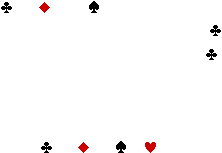
ace. Let’s say your hand is down to
45A
79QA
6K and your trying to cover a nil and one
opponent is out of diamonds early. You would have to switch off to the
5 right away so that the
opponents are not successful in throwing off their high clubs. Save the
A for the second time suit is
played.
32.
With a large lead last hand such as 70 points, it would be very dumb to go nil unless it was perfect
and only if you had first bid (perfect I mean
234
234
23
23456 ). It would be even more
stupid to go nil when you have a lot of overtricks, leaving your partner with the task of covering you
and not setting you at the same time. But even more stupid than that, I see players go nil with last
bid even when all they have to do is bid a regular number for the team and take the win. Enough
said!!!
33.
When you’re covering your partners nil make sure you save at least one spade in case you have to
make a cut. Even if the nil is out of spades, save at least one spade and switch to another suit.
34.
When nil it’s important to reserve playing your spades or throw them away at 1
st
opportunity. You
only throw away spades when you have 3 spades and your fine in your other suits. There is a time
even when your covered in your other suits, that you would not get rid of a spade.
Example: your nil with, 26Q spades & 34 diamonds and the last to look at the play…..the east
player trumps with the 10 spades giving you opportunity to throw away the 6. This is a trick by the
opponent to drain you of your safe spades. You would not play the six. Rather you would throw
away the 4 diamonds. The reason is you need those low 2 spades to duck under in case your
partner doesn’t have the K or A. This may depend on the bids and how many spades your partner
has left, which brings me to next point.
When you have nil with one high spade and 1 or 2 low spades, it might be best to play your high
spade over East’s low spade lead. You would do this with the idea that your partner needs 1 more
trick to make his bid, or also if you believe he is running out of spades.
|
 27
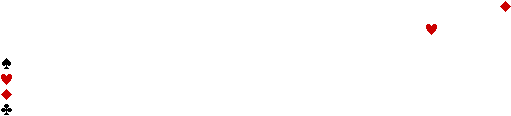
C. LEADING (card play in position 1)
a.
Every card that you lead or play should be led or played for a reason. If you find yourself
throwing a card out on the table for no reason, than you are not thinking hard enough
b. Avoid leading short suit in beginning unless you want to run spades fast because of an 8 bid or
sometimes if you have a cheap cut you want to make with 3 spades or less. You also lead a short
suit when your partner bid high, normally a 5 bid or higher. Avoid leading a short suit for a cheap
cut if the right hand opponent has a high bid of 4 or more.
75% of the time you would not lead a short suit
Example: If the bids add to 12 or 13 and bids are even, this time you would play the
4 so you
don’t risk your partner’s king. If the bids add to 11 than I would play the
9.
2 4 5 9 10
3 6 9
4 8 Q
5 8
c. Lead the suit that your partner is out of so he can short suit or cut if he need to. Remember, it’s
not always good to cut until at least ½ to 1/3 into the game.
d.
Do not lead a suit that opponents are trumping, unless stronger factors prevent you from
leading other suits (such as suits with Kings), than it is ok to a lead suit opponents are
trumping but it’s probably best to lead a spade instead to drain their cuts. When leading
spades you only want to play them twice and then lead the suit they are cutting.
This reminds me of another point I made previously, when a player does trump, often times he
should lead back a spade. If you get off a trump early and your team has a low bid, a spade lead
can take away from their ability to cross trump. But pick another suit if your partner may ruff.
e.
Avoid leading your aces unless you have Ax and a high bidding partner. Pick any other suit.
By keeping those aces you have the power to demolish their kings and queens. You would
normally lead an ace if you have a sizeable lead with 30 or more points.
|
|
28
F. If you have to lead an ace and you have AQ, lead the Ace and not the Queen. If that suit is
led to you, play the Queen before the Ace in the 3rd
seat and anything below it in 2nd.
g. Watch closely and remember what all players have led, and if at all possible, lead the suit that
your partner previously led and do not lead the suit that opponents have led (this works when they
are nil or not).
H. Only lead a Queen if you are 1 or 2 suited in that suit
I. If they bid 8 and u bid 4 with score tied, throw off the 4 for bn
J.
If player to the right leads an x diamonds and you have
xxxxxxA diamonds, play an x always
K. If your partner led a low card to you, always play your highest card in the 3rd position even if it means
you might lose a king
In the 2nd or 3
rd
position, play a king over your opponent’s queen always.
L. With 6 spades and a long suit you will make extra tricks in the long suit
Example: QJ1087 spades and Akj976 diamonds
In this scenario you play all your diamonds because you have 5 spades, and once it’s trumped you lead
spades twice and return to diamonds. You should pull at least 7 tricks with that hand.
|
 29
m. note: ******* the king is led before the x with xk *******
x
Ax
AK
AKQ
AKQx
KQ10x
xxx
Kx
KQ
AKJ
AKJx
KJ10x
xxxx
Qx
KJ
AK10
AKJ10
AJ109
xxxxx
Jx
K10
AKx
AQJ10
AJ10x
xxxxxx
10x
QJ
AQX
AQ109
AQXX
Q10
QJ10
KQJ
KQJ10
AJXX
J10
QJx
KQ10
KQ109
A10xx
J10x
Q10x
KQx
KJx
X= Card below a ten
Red = Suggested Lead
Yellow=Not a suit recommended to lead
HOLDINGS
LEAD FROM RIGHT PROPER PLAY in 2nd position
AQ
X
Q
AQX
X
X
KX
X
X (K w/ high bidding partner)
AQ10
X
Q STANDARD or 10 RISKY
KQX
X
K or X RISKY
KJX
10
J
AKJ
10
K STANDARD or J RISKY
AX+ X X
In the 3rd position you often play the Jack and the Queen before the Ace. You never
hold back from playing your King if you’re forced.
|
 30
N.
If you are one carded in a suit, you would want to lead it if you had spades such as:
Ax,
Axx,
Kxx, or
xxx. Other than this, you do not lead short suits unless your
partner bid 5 or more.
15. If your partner leads a spade, play your highest spade and if you win the trick, lead back your
lowest spade. Again, you almost always lead back what your partner leads.
16. If you are the number bidder and your bn partner passes you 2 cards of the same suit other
than spades (assuming he wants to you to help set the opponents)...do not lead a card in the suit
that he passed you when your in position 1, right off the bat (because he has probably voided that
suit).
17.
You have 2 suits to choose from xxJ clubs or xxA diamonds
In this case you will play the J of clubs because you don’t lead a suit in which you have the ace.
18.
Bids add to 12…….you have 2 suits to choose from xxQ clubs or xxJ diamonds
In this case you will lead the x in the club suit because you try not to risk your partner’s king
19. Don’t play queens unless you have xq and that’s it, or just the q
|
 31
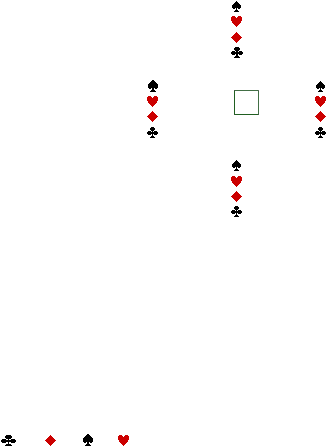
20. Don’t lead AK spades if you have other high spades such as jack, 10, and 9 if your 1st to play
and the opponents have a lot of spades outstanding, lead the ace once and then lead a low spade
to the opponent so that any other spade he plays you can top. Example below:
North
8 4
8
9
Q J
West
7 6
--
9
5 4
East
Q 10 5 2
--
--
8
South
A K J 9 3
--
--
--
If you’re south play the ace spades once than lead back with a low spade so that your jack and 9
can win more easily. Also note, often times you don’t want to lead too many high spades in the
case that your p is running out of spades fast. If you see your partner playing a 10 spades under
your ace spades, try playing a low spade instead.
21. Play the K when you have KQx even if you have xxJ, when the bids add to 12. If your hand
was
KQx
Axx
xxx
xxJ, you would want to lead the jack if the bids add to 11 or less and the
king if the bids add to 12 or more. As always this depends on the score. Be risky when down in
score and play the jack.
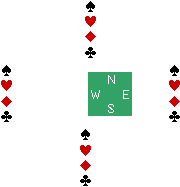
22. Duck on spades even if you have boss spades. The 2nd time they lead high, play your boss
card and lead back with a low spade. By doing so, the opponent will be stuck leading to you or
|
 32
your opponent. In this example, when east leads k of spades, south ducks and then plays the ace
over the Q, and then he leads back with spades. By doing so his partner can make diamonds and
clubs that he wouldn’t have made if south lead back another suit. This brings up another
point….when your opponents are loaded with spades and they have already been broken, it’s best
to play your remaining spades to reduce the number of spades they have, assuming your partner
can’t make a cut.
3
AJ10
J1092
KQJ65
986
76542
A8
1087
KQJ1052
--
KQ64
A32
A74
KQ983
753
94
23. When covering a nil, and you are the one leading the cards, don’t play a suit in which the
opponents are throwing off on….in that case switch suits even if it is low. Don’t play your ace
before a low card.
North
|
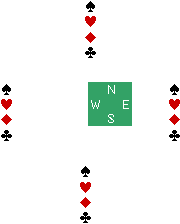 33
J
AK532
10832
A63
West
432
1084
KQ
QJ985
East
10975
6
J965
KJ74
South
AKQ86
QJ97
A74
2
If you’re the south player and north went nil, you would lead QJ hearts 1
st
(after the 2
nd
heart you
will see that east is out….when an opponent is out it’s time to take risks and switch suits), then you
would switch suits and play the 2 clubs (the reason you don’t play the ace is because you have very
low cards in that suit and you need to save your ace for later) …..By playing the 2 of clubs you’re
giving your partner the best chance of ducking in clubs because both opponents will have a lot of
clubs outstanding
24. Allow the player to your left to trump you if you know they will lead back a suit you can top. This
works if you want to drown out his spades so you can lead that same suit over again with him
unable to cut. (Mostly this takes place when he is covering a nil).
|
 34
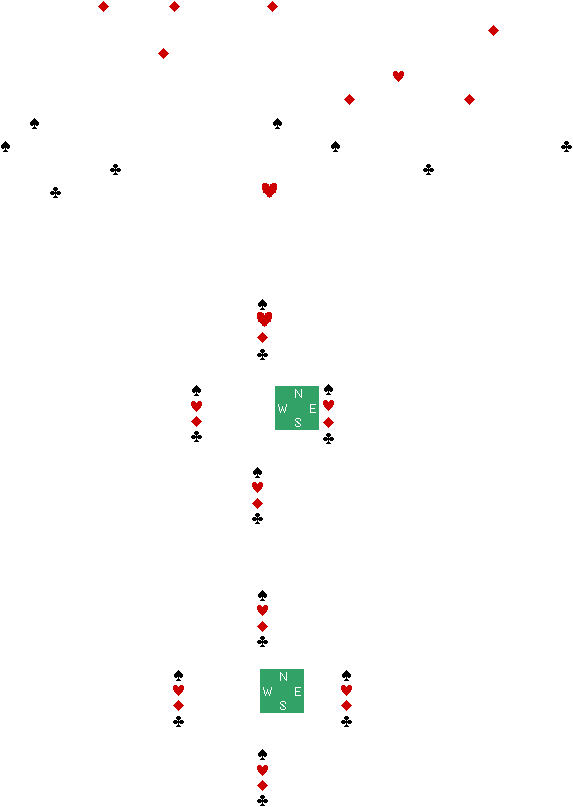
There are times of course when you stray from the rules of leading in order to try and gain tricks. In this
scenario I experienced first hand I had the lead with the bids adding to 6 for both teams. Having a
choice between the
A and the
5, I picked the
5. In this scenario the bids are dead even and you
only have about 3 cards per suit; so the ace will be safe. The idea is to cash in on the
J. The playing
went as follows: West played
K and led back with hearts, hoping to later gain trump tricks. I have last
look because my partner successfully played low and I take it with my
K. I lead another heart and
West trumps. West leads diamonds again and I take with my
J and last with my
K. I soon followed
with the
3, upon which my partner took with the
A and led back spades, upon which I played with
my
K. I then lead another heart but west takes it with the
J upon which he is forced to lead the
-8.
East cashes in on the
-A and leads back clubs upon which I take with my
-K and lead back for my p
to take with
-Q. North finally cashes in on the
A and leads back with the final spade upon which
East takes with the Queen. In the end, our team is able to set with 8
North
47A
89JA
106
347Q
West
5810J
4
469QK
-8910
East
29Q
23Q
2378
25A
South
36K
5610K
5JA
6JK
25.
North
7
10742
--
Q7
West
J
6
1054
J9
East
--
J9
AQ98
5
South
Q9
KQ
J75
--
|
 35
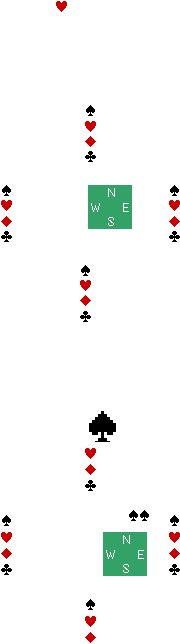
South should lead diamonds instead of spades so that they get an extra trick
26. In this example west would lead a
4. Because East has a powerful 6 hand, it is best to lead
for West to lead his short suit in the hopes his partner can establish a long suit. When given the
option of leading your short suit or long suit, you generally lead the long suit unless you need to
trump or your partner has a boss hand such as this.
North
K7
10962
10632
AJ3
West
QJ62
43
9875
K104
East
A9843
AQ
AJ
Q852
South
105
KJ875
KQ4
976
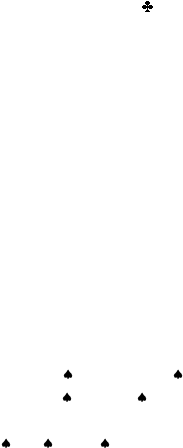
27. Make sure you grab all the spades before leading a suit nobody has towards the end of the
game.
North
--
--
8 3 2
--
West
--
6
10
10
IRON
East
9
--
7
4
South
10
8 7
--
|
 36
--
In this case south should lead the 10 spades before the 8 & 7 of hearts
28. Don’t play aces over queens
29. If the opponent to your right leads the King and you have the ace, wait on topping it until the 2nd
time the suit is played. This does not always hold true. If your very long in that suit you will play the
Ace with the idea that he may have the lone king.
30.
You don’t want to top your opponent’s high spades in all situations. Say the opponent to your right
leads the k spades and you have the ace with 2 lower spades…..you would play the lower
spade…then you wait to see what he plays next…if he plays the Q spades you are forced to top that
spade. Another time you don’t want to top a high spade is if one opponent is out of spades…..say
the player to your right leads a
Q and you have
xxk (meanwhile the player to your left is out of
spades) you would not top the
Q with the
K….you would wait until you are forced to play over
him ( Reason being that you want your partner to be able to top the opponent’s spade). If you have
spades such as this
Axx,
Kxx, or
Qxxx. You do not top aces over kings or kings over queens or
Queens over jacks.
31. If the LHO is cutting a suit and your partner is cutting the same suit…when the RHO leads that
same suit, you don’t want to top that lead with your highest card (top the lead with a low card if you
can)….….that way you get to save your high cards, meanwhile the opponent to your right is leading
to your partner
32. Trump your own partner if spades need to be led as soon as possible. Mostly this is done
when you have a really high bid.
33. When the opponent plays a spade to squeeze out your options….for example …..You have no
spades and the number bidding opponent has drained all your spades….he plays 1 more spade
and you have the option of throwing away a card in these 2 suits…. K10 hearts and KQ
diamonds….if diamonds have been exhausted already, you should dump the k of diamonds.
|
 37
If you have a lot of high spades such as KQJxx or AKQxx, you need to lead the high ones…..in the
case that you have AKJ975 you need to lead the ace 1st and then your lowest spade with the idea
that your partner gets a chance to make his spades and that you’re the last person to run spades
with the option of leading a suit that will benefit you.
34. When the bn player is trying to set your team bid, this is a time in which you would cut as
soon as possible and lead spades to avoid cross cutting from both opponents. Cross cutting
is when they lead suits they both have trumped
35.
.
Let’s say you started the bid with nil and the following bids were nil, 5, and 5. Which card
would you lead first?
I stated before you often lead your short suit when nil. However, in this case your partner is
vulnerable if you lead the 7 of diamonds. Leading the 7 forces your partner to take the lead,
upon which he would be forced to cover you while the other opponent throws off his low cards
to safeguard his partner. By leading the 4 of hearts you give your partner a chance to duck the
nil hand and give up the lead to the opponent. The opponent leading will be putting his partner
as risk each time he leads; meanwhile your partner is throwing off cards that risk your nil. But
leading the 7 should signal to your partner that you have nothing higher.
36.
Which card would make a good lead? If you led the ace of diamonds you may leave your queen
of hearts vulnerable. By leading the 4 of diamonds you’re attempting to give up control to the
other players. Having them leading gives your queen a chance to steel a trick.
37.
When covering a nil and you lead a high middle card…..in this case let’s say it is the 10 of clubs……if
your partner plays a low club under that, such as a 3, this means he either has almost no more cards
left in the suit or a card higher than the 10. It’s could very well be the latter, so switch suits if you can
do it safely.
|
 38
38.
Let’s say your hand was
AK764
Q876
1098
J…how would you go about leading with this
hand?
Bids add to 12:
If this scenario you would play the
K and most likely come back with the
6. You normally want to
keep the
A for later unless you think your partner is shorter in that suit compared to the opponents. By
leading back with the
6 you’re not risking your partner’s king. If you had 2 spades instead of 3 you
might lead your lone jack of hearts to make a very cheap cut.
Bids add to 11:
In this scenario you would start again with the
K. Then it’s best to come back with the
J because
you don’t risk your queens.
39.
When you have a string of cards such as AQJ10 and forced to lead that suit, it would work best to
lead the 10 instead of the Ace. By doing so the opponent to your left may lose out on his king.
40.
If you have mirror suits such as
AKQ and
AKQJ10, you would try to make the
K right away if
you’re the 1st to play (playsite rules they can’t trump 1st
card played). You would then play the
KA
followed by the
A and then back to the
Q. You would try to cash in on your clubs before the
hearts because most likely the hearts will be trumped and by risking them too early you may be
risking your clubs as well.
41.
Suppose your hand was
AK5
84
Kq43
j742 and the west player led the
A. In this scenario
you would play the
8 before the
4 to indicate to your partner that you’re short suited.
42.
Suppose you have
K10432
5
Kq943
j5. How would you lead? You should start out with the
2 since you want to establish your long suit, given your spades strength.
43.
K1094
AQJ85
AK87. How would you lead? Take the small risk and lead the
10. This gives
you a chance to cash in on your AQ combination. The spades should protect your
K. Another
example like this hand would be
K104
AQ52
AK43
AQ. Underlead the
K.
44.
With a 1 bid from the RHO and a hand such as
A73
A94
Q83
K973, you would under lead
the
A with the
4. Whether the bids add to 11 or 12, under leading of the
A works well with a low
bid from the right side. Also if you come away with a cheap trump trick, you almost always under
lead an Ace to give your partner the best odds of leading back your trump suit.
|
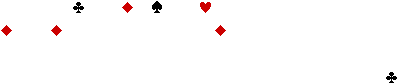 39
45.
Your cards:
AQ83
72
9863
K97……..Diamonds are led by the left opponent as follows:
A532,
K897, and for the 3rd time
Q10J leaving u in 4th position with a chance to trump. You
shouldn’t trump unless your partner bid 4 or more. There is no need to waste away one of your
spades when you can short suit hearts and try to cash in on your
AQ combination. If your partner
had bid 4 or more you would trump and lead spades. With less than 3 spades below a Q you would
trump regardless of bids. With three spades and a low bidding partner, it may or may not be good to
trump, but generally I don’t trump if I need them to lead to me in anyway. If you had three spades
below a Queen and two other suits that are 4 suited, it’s good to trump since you can’t short yourself.
46.
So how do you know when to lead a suit for the 2nd or 3rd time? If you see your partner play high to
low like 73, 64, etc … it is a signal that he is short in that suit so it would make a good lead. If you
see your partner playing high cards in that suit it is generally a sign that he is short relatively short in
that suit so it would make a good lead but if he is playing low it most often makes a bad lead. So
with AKXX you would lead the king and decide whether or not to lead that suit twice based on how
high your partner played in comparison to the opponents. With the cards dead even around the
table, you might have to guess whether or not it is a good lead. Don’t forget to consider the bids.
With the weaker bidder on the right and dead even cards, maybe a 3rd
time is a bad idea.
47.
Don’t risk your boss queens if you think a weak bidder will have the chance to trump. You will know
the risk involved based on how high each player played under the AK. If the higher bidding opponent
seems to be out of that suit, which most often is the case, it would not harm you as much to lead a
boss queen. You want high bidders to be forced to trump.
|
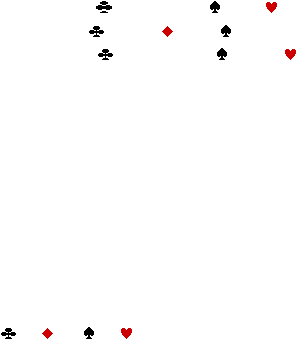 40
YOU’RE A TEAM
1. Spade Play
a.
If your partner trumps in the 2rd position, do not trump over your partner unless you have 3
low spades or less and the one opponent in position 4 is nil, in which case you might want to
over trump your partner’s spade and lead back a suit that he would be vulnerable to play if
he had to lead it to the opponent with the number bid.
South has the cards 4678
579
JA
West has the cards 39K
10JQ
10KA
North has the cards 9QA
2310
10QK
East is nil
Let’s say west leads 10 of diamonds….North cuts the 10 of diamonds with the 2 of spades South
doesn’t have any diamonds so what should he do?
Since clubs have not yet been led, it’s best that South tops North’s spade with the 5 of spades
and lead back clubs. The reason is because South has worthless spades that will not make a
trick anyways and by over trumping North, he has the opportunity to lead clubs. After South
leads clubs West has no choice but to lead his K of clubs, which North eats with the Ace and
leads back his Queen of clubs
If you have
689
910
679
34A and they lead diamonds to you 3 times in which case you
have an opportunity to trump, don’t cut because it would be better that you short suit clubs and
have them lead back to your partner.
If the player to your right cuts your partner and you have the option to cut him, it would not be in
your best interest to over trump the opponent unless you had 1 to 3 low spades. Normally, you
let the opponents spade go and short suit so they lead back to your partner.
Example: the player to your right over trumps your partner with the J of spades…..you with the
56Q of spades have the option to over trump that opponent with the Q of spades….it’s best that
you restrain from trumping that opponent and just short suit. There is no need to over trump
since your Queen of spades will most likely take a trick at the end of the game. Also by not over
trumping the player to your right will have to lead back to your partner
|
 41
Generally you don’t cut the player to your right unless you and your partner have a team
bid of 8. And then you can lead back spades.
2. Do not play Ace over your partner's Queen
3. Throw away a high card of a suit if you know your partner has lower boss cards in that suit
towards the end of the game. In this example, North (after south plays the last remaining spade)
would want to get rid of his queen diamonds so that his partner can play his remaining high
diamonds. That way he can get rid of his 3 lowest hearts. If you know that the opponents are out
of a suit that you and your partner share, throw off your high card if you know your partner has
more cards in that suit. This way you don’t top your partner and lead something they can easily
top.
North
6
A943
Q
--
West
7
Q10652
--
--
East
J
KJ8
--
65
South
109
7
1065
--
|
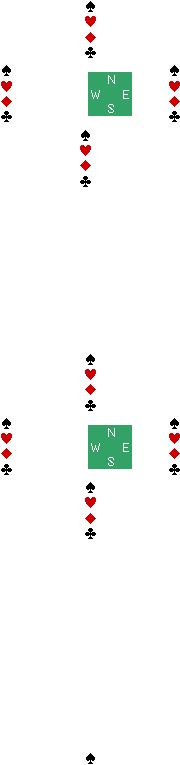 42
4. Allow your opponents king lead to ride unless you have a long spades suit, in which you cut it
and lead spades to your partner….in this scenario the South player has a significant amount of
spades
K3
A9532
K102
J54
1096
J876
A953
Q10
AQ
KQT4
QJ8
8763
J87542
--
764
AK92
If east leads the k hearts you should cut it with the 2 spades and then play an additional spade to
void the opponents of spades. You would not do this however if you have about 5 spades or less.
5. Don’t lead boss cards when your partner is loaded with spades, better you play low spades so
you don’t risk your partner’s trumps being cut by the opponents.
K98753
--
--
--
2
986
10
8
Q104
--
95
6
AJ
J3
86
--
South would play the spades before the diamonds to lower the risk of East over trumping his p
6.
Don’t void yourself of a suit your partner is already void of
98
|
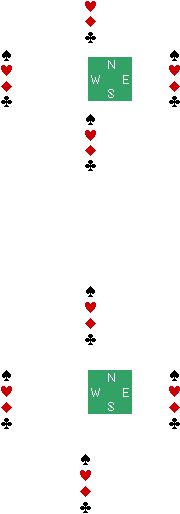 43
87
9
--
--
QJ65
A
--
--
9
Q1085
--
103
104
--
J
After south leads his boss jack clubs, North should throw off on hearts and not diamonds
7. When your opponent is out of a suit early in the game (also they signal you to not play another
suit by throwing away a Queen).
North
A6542
--
Q
Q976532
West
KQJ7
109
KJ972
104
East
98
KQJ843
A64
AJ
South
103
A7652
10853
K8
In this scenario, if your south and you start off with Ace hearts….(most of the time you
don’t lead the ace of hearts but in this case the bids add to 12 and he can’t afford to risk his
partner’s king)….. And notice that your partner throws off on the Q of diamonds. You should
assume the one suit you don’t want to play is diamonds. Since the game is early, you don’t want to
lead another heart or diamond because your partner most likely is loaded with clubs. So you’re left
with Kx, in which case you would lead the k always before the x. By doing so, you’re giving your
partner a chance to play out his long suit and save his spades till later in the game. If you had led
the 8 clubs you might have been stuck with the lead and would resort to play a heart, which will
reduce the magnitude of your partner’s spades run. Either way you always lead the k before the x.
Note: I said before you want to lead the suit your partner is out of. This does not apply in the
scenario above.
|
|
44
8. Don’t trump a suit when your partner is the last to play unless maybe
the position 1 player plays high the 1
st
or 2nd time the suit is used, but
even then you wouldn’t cut unless you couldn’t short suit or if u had low
spades without any other short suit.
Example: player to your right plays Ace of diamonds….then he plays k
of diamonds (at that point you have opportunity to cut the king of
diamonds……….if you had 4 low spades you wouldn’t……if you had
xxQ, xxA, xK, or xA your certainly wouldn’t……..if you had 3 low
spades and no other suits with 3 or less than you may want to cut (but
again this all depends on the bids)
Bare with me now. The question is, if your have 3 spades or less, then
when do you cut? With 1 or 2 spades I would cut……..with 3 low spades and no
other short suits, I would cut only if I wouldn’t be risking my partner’s kings once I
switch suits (assuming the bids add to 12)…..if the bids add to 11 I would cut and
risk my partners kings anyways. Also, you will always cut if you have a team bid of
8 or more.
9. Watch closely at what your partner plays and does at all times. One thing to notice is, if you are
bagging them and you see your partner start taking and trumping tricks, than you should switch
from bagging to setting them so start taking all the tricks you can get. Trust your partner even if you
think he is wrong.
10. When you are blind nil and your partner bids an overlap bid..such as 9-5..8-6..this indicates that
he wants you to break your blind nil and go for set
THIS DEPENDS ON IF HE COULD HAVE BID LESS AND MADE A PERFECT BN. HE WONT
BID A 9-5 AND WANT U TO BREAK NIL IF HE COULD HAVE BID LESS SO THAT WHEN YOU
BREAK YOUR BLIND NIL YOU CAN MAKE A PERFECT BN, UNLESS OF COURSE YOU HAVE
A LOT OF OVERTRICKS, IN WHICH CASE YOU WOULD SET YOUR BN.
|
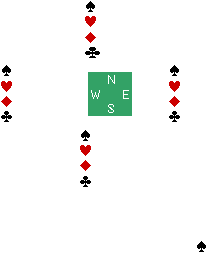 45
Example: score is 80 to 190 them, you are bn and the opponents bid 6. your partner will not bid 7
or 8 unless he has 7 or 8. If your partner is smart he will bid 4 for bn which signals you to self set
your bn to make the score 23 to 130 them.
11. When you need to set the opponents number bid when you are bn and you don’t have a short
suit to pass your partner, it’s best you just pass your high spades.
12. Play the higher of the 2 cards such as 10j, play the jack so your partner isn’t confused (this
doesn’t hold true when the player to the left of you is covering a bn or nil, in that case play the lower
of the 2 so that he won’t duck under you. Also, if you’re trying to set a nil, play your middle cards
like 678 before you play your 2’s and 3’s.
13. Don’t trump if your partner has weak spades. Do trump if you have weak spades.
10 2
7 5 3
A K 8
J 7 6 5 3
A 8 5 4 3
K Q 6
9 3
9 8 4
K 7 6
A J 10 8 2
10 7
A 10 2
Q J 9
9 4
J 9 6 5 4 2
K J
If you’re the south player and hearts are led 3 times with you in the 4th position when they play
hearts for the 3rd time in a row….it’s best to hold back on cutting and let them lead back another
diamond or a club to your partner. You don’t need to cut with
Qxx.
14. You may want to trump with a spade if you and your partner are void in 2 suits. Cut the suit you
are out of and lead the suit he is out of. This is called cross cutting. This works mostly when you or
your partner has blind nil and you’re trying to set the opponents.
Remember, when trying to set with a blind nil, make sure you pass your short suit rather than
spades…..unless you don’t have a short suit.
|
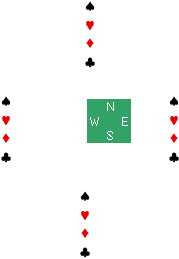 46
15. If your partner leads a queen and you have the ace, don’t play the ace
16.
When your partner plays the 13th card in the suit towards the end of the game and you
have 3 low spades below a Queen or xQ….it is often best to cut the 13th
card with the highest
spade you have in order to save your partners spades…..your partner would not have played the
13th card in a suit if he didn’t have a chance at making 1 of his 3 spades. The reason why you
would lead your 13th card would only be to save your spades…..you would not lead your 13th in
most situations but the one I described.
Example: in this scenario South would play J clubs and North would cut it with the J spades to
save your partners highest spades.
North
J 5 4
--
10
--
West
9 8
J 9
--
--
East
A K Q 3
--
--
--
South
10 7 6
--
--
J
17.
When you and your partner share spades, it is best to set up a cross cut but there are
other ways to utilize the spades for leading purposes. Let’s say the opponent’s spades have been
diminished and you and your partner are the only ones left with spades. Now most of the time you
would not want to play another spade because you would just be exhausting your own partners
supply. But there are times in which you would play a low spade in order to give up control to your
partner. This might be because there is a higher bid from the right side and with an AQ
combination or something similar in one of your suits, you wouldn’t want to lead to that right sided
opponent.
18.
When you and your partner are bn and you’re trying to set up a cross trump to set the
opponents, you must be careful not to play a card (assuming you are first to lead) in a suit in which
|
|
47
your partner passed you, unless it’s the Ace. And even if you aren’t trying to set up a cross trump,
when 1st to play be careful not to lead a suit in which your partner may want to trump. Playsite rules
being that a player can’t trump the first card played in a hand.
19. When u are looking at a nil or a strong 1 hand in last position and your partner bid
high as well as the opponents making the team bids add to 12 or 13, it might be best to not
go nil and just attempt the set. Look at risk and rewards. Your partner has a high chance
of being set. The reward for making a nil is high but not as high as if you made a number
bid and set the other team. If you know your partner bid his hand to the max like he should
be doing, then a nil is not the way to go. If your hand looks terribly weak but you could
still manage 1 then it might be best to bid 0 for yourself instead of the nil. Often times your
partner, assuming he bid his hand to the max, bid as if you had at least some support. Now
if you had 0 spades in your hand and your partner bid 5 or 6 in the 2nd position. He
probably won’t have a chance if the opponents bid 6. So don’t bid nil or team bid 7, just go
6. But if you’re down in points sure take the risk and go nil or 7.
RUNNING SPADES
a.
Running spades is when you and your partner keep playing spades by leading and leading
back
b. Running spades nearly always helps the team with the higher bid
b.
Do not start a spades run if you have cards of a suit that your partner is trumping. Lead a
card of that suit first, before you start a spades run.
c.
If you and your partner are running spades (assuming you have a higher bid)…generally you
want to run them only twice and switch to another suit…….so play out the Ace and the King
of spades and switch to your long suit (which they previously were trumping) so they don’t
have the luxury to trump. But remember If you have 45910KA play the Ace once and lead
back a low spade so that you don’t over trump your partner’s high spades…..let your partner
attempt to take control of spades, after which he can led his long suit
d.
Do run spades if they are cross cutting
|
|
48
SCORES AND STRATEGY
1. When your team has the lead, especially a 30+ point lead, bid more conservatively and don’t
count .5’s unless the opponents bid high to shorten your lead.
2. When your team is behind, especially by 30+ points, bid more aggressively with fake nils or
high number bids unless your partner makes a high bid in position 1.
3. Do not bid nil and 5 with your partner if your over 60 to 70 points down or more and if your
behind or over 30 to 40 points because this usually prevents your team from being able to bid for a
blind nil………this rule may not apply when you have more or less than the standard 3 hand
For example if score is 102 them, 40 you…If you have 1st bid you should just bid your hand (unless
if you have a 4 hand which is one more than the normal 3….in that case you could bid nil with the
idea that your partner will bid 5)
Example2: if your 43 points down and you have 2nd bid with a 0 hand, it’s best you bid your hand
and let your partner have last look to attempt a bn (in the chance that your opponents team bid 7,
your partner can team bid 0 for a perfect bn)
4. If you have last bid..always add up all bids to see what score will be when bids are made…take
more overtricks than them at the end
5. Take more overtricks than opponents when you’re close to last hand as long as you don’t have
more than 6 overtricks, keep going (it’s better u have 6 to 8 overtricks if they have 5 overtricks
when it’s last hand). Don’t be afraid of having 8 or 9 overtricks. Better you set them to force a bn
and take the overtricks, rather than having the game tied at the end.
6. Always set your opponents even if it means taking 4 overtricks 1
st
hand. Keep your opponents at
a bn position rather than have them be tied with you, even if it means having 8 and even 9 overs by
2nd to last hand.
|
 49
7. There are times when you’re on the fringes of being down 20 to 30 pts. Before I talked about
bidding nil when you think you will be 30 pts down. However, at the end of the game this can be
very risky. So many times you have to bid your hand or up it by 1 trick.
I present to you 3 scenarios: you’re down 20 points early in the game
Let’s say your hand is
368
789
28A
5789 with 3rd to last bid and your partner bid 3
Obviously this hand is a 1 hand. You should make the assumption with this hand that your
opponents have 8. A nil would be your best bet to make a bn.
Score is 144 to 121 them….and you have what appears to be a possible team bid of 4:
If you team bid 5 and they go 7 and they set you, you may lose out on a bn, but a 7 bid by the opponents
could cost them 10 pts in the case that you make 5....if they go 8 they may end up 10 pts ahead or 110
pts ahead. A 5 bid would be slightly risky but most likely worth it.
If you go 4 and they go 8 you most likely will be down 20 point but you will have the over lead. 4 would
still be an acceptable bid.
If you go 6 they may be convinced to lower an 8 bid to 7, which would give you a perfect bn. However, a
smart opponent may bid 8.
Score is 141 to 124 them:
If you go 5 they will be forced to go 8. Here bid is 5 for sure. With a 5 bid they have no choice but to go 8
because the only way they can stop you from a bn is if they go 6.
Score is 145 to 121them, and you have a strong 4 hand (close to 4.5 for the team):
If you go 5 they will go 7 or 8... If they go 7 and they set you, you lose out on a bn. There is a high
probability they will go 7. If you make your 5 you will be tied with them. A 5 bid may be worth the risk.
If you go 4 and they go 8, you will be 20 pts down with over lead. However, they might just bid 7.
If you go 6 you might cause them to bid 7 for a perfect bn. It would be hard for them to bid 6 unless their
hand shows that they have 8, upon which they should bid 6. A 6 bid has major risks and rewards.
|
|
50
8. I told you before it might be good to underbid with a lot of overtricks in order to over out. There
is a time, however, that you would bid your hand with 9 overtricks and risk them getting perfect
bn, when it is last hand.
Example: scores are 229 to –60 them
They team bid 6 ……you have last bid with a 5 hand…..what do you bid? Now you don’t want to
bid more than 5 because you never risk a lead like that. If you bid 4 you stop them from getting a
bn next hand. This bid here is 4 or 5. You can bid 5 because you can still stop them from a bn if
you don’t take overtricks and you can even win the game right then and there. Anything more than
5 would be too risky.
The 4 bid just makes the opponents bid for bn the 2nd time around and the safety precaution by
bidding it is outweighed by the potential of a 5 bid. Many high experts would not understand this. I
myself would be a victim to bidding 4 myself. It takes a lot of concentration to make the right bid
sometimes. I never said I don’t make mistakes. I know the right play most of the time, but often I
am a victim of circumstance. Another problem is my memory. My memory has been fading fast
since my accident. Spades players are not machines, but it might be nice to play like one.
9.
When you’re down a lot of points with a nil hand and first bid, and the game is almost over, it
is best to go nil rather than 0.
Example: 80 to 160 them…you have last bid with a nil hand. Even though you’re down 80 points and
you most likely need a bn, the opponents have last bid and there’s no hope for you in making a bn. The
bid here is nil.
10. When you’re down a lot of points early on in the game with a nil hand, you don’t go nil. When
the game is still young, the only time you might want to go nil is when at least 50 points down
or less.
Example: 40 to 120 them….you have 1st bid with a nil hand….best you bid 0
Example2: 40 to 80 them….you have 1st
bid with a nil hand….best you bid nil
|
 51
11. Take more overtricks than your opponents at the end of the game. This rule is also
considered when an opponent is nil. Don’t trash all your cards just to set the nil. Keep some
high ones and try your best to have the lead in overtricks at the end.
12. If at the end of the game and your down a significant amount of points, one player has to nil
and the other has to been extremely high in order to force the opponents to bid their hand or
more.
Example: score is 171 to 225 them and you have 1st bid. What do you bid, regardless of your
hand? The answer is nil, 6 or 7. If you go nil your partner has to go 6 or 7. A bid that would make
the opponents think you have the ability to make 110 points, such as nil and 6, and it might force
them to bid 6. The 6 may be better than 7 because they will know your just trying to fool them and
they might bid one less than 6.
13. Score is 158 to 191 them. They team bid 6 and you have last bid. What should be your bid
regardless of your hand value? In this case you would bid 7, with the idea that if you set the 6 the
score will become either (229 to 131 them) or (130 to 131 them).
14. Score is 136 to 189 them. You have 3rd to last bid with a 5 team bid. Do you bid 5? This
would depend on your cards. With all high cards I would go 5 and with all low cards I would go 4.
Many times you end up having to set the 7 anyways so keep taking and keep them on ice.
15. Score is 4 to 71 them. North and East both bid 3. You’re in the south spot with 3rd to last bid
and
6810
789
10JQK
5789, a solid 3 hand. You could not underbid a hand like this in
hopes for a bn down the road unless you’re ready for some heavy bagging. My bid here is 7.
Risking being set by one upping a baggy hand is low risk considering the options you have at this
point in the game. More than likely the 4th seat opponent is looking to make at best a team bid of 6.
Your 7 bid will most likely scare the west player into a 5 team bid. If you manage the 7 tricks
against their 5 you are now only 50 down from a tie, an excellent opportunity for going nil and 5.
Now if West team bids 6 you have to be careful not to attempt at making your 7 bid because you
don’t want to be 60 points down with a bag lead at that stage in the game. You would throw off this
7 bid to make the scores around –66 to 133 them, which puts you 200 points down for back to back
bn capability.
|
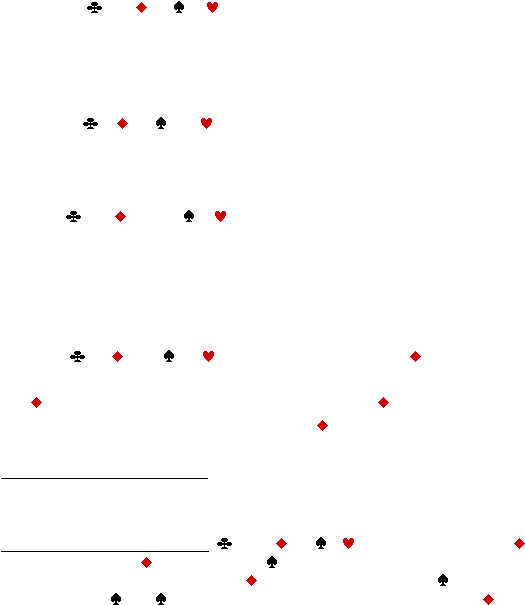 52
Bagging
When the opponents are bagging you, try to save your 2’s and 3’s till the end. It’s also good to play
your short suit, so you can throw off high cards in other suits. If you have AK2 for example, save
the 2 for last. That way your partner can drop his highest cards in the suit and also they won’t be
able to stick you with that suit towards the end of the game. When you are long in a suit and they
are bagging, sometimes you want to save your high cards so you can top your partner in case he
ends up getting stuck in that suit.
With the hand
10JA
346
368
2810J (assuming you want to bag opponents) for this hand
you would play your diamonds first thing. Then you would switch off to the J of hearts and keep
your 2 hearts till the end. Now if an opponent started in another suit it might be best to play off the
top cards in that same suit.
With the hand
67
23A
6789
35K (assuming you want to bag) for this hand you play your
clubs out right away with the idea that if clubs are played again you can throw off your ace of
diamonds
If you have
2310
457910K
4A
10 make sure you save the k diamonds, even if your trying
to over the opponents and the opponents play the ace, you should not dump the king of diamonds.
The reason is because that is your long suit and you have enough cards already to duck if
necessary. Save the king in case your partner is stuck with all diamonds in the end and you have
to top him in order to lead low in another suit
If you have
K65
J1096
A74
A72 you would start off with your
J.
With
AJ10982 and a low lead your partner you would play the
8. But if you were to lead from
that suit with the purpose to bag you start off with the
J.
To bag them when partner is bn: If u have high spades just trump and try to use them early
on as if u were trying to set them. It will keep them on their toes; meanwhile you are really
just throwing off in a sense so they can’t stick you with that spade suit later in the hand.
Emergency pass to bag while bn:
56789
910
Q
xxQKA, maybe pass the
910.
Many would pass the
10 diamonds and
Q. That pass will force your partner to take at
least 1 trick in diamonds covering the
9 and another trick with the
Q when he might
already have the
K or
A. If you must do some heavy bagging, pass the
910.
|
|
53
PSYCHOLOGY
1. PSYCHOLOGY OF SPADES: MANY TIMES WE MAKE BIDS THAT HAVE A PURPOSE,
WHICH COULD BE TO EITHER MAKE BID, SELF SET, OVERTRICK, OR SET. NOW IF THE
OPPONENTS WERE TRYING TO OVERTRICK YOU AND THEY WERE DOING A REALLY
GOOD JOB AT IT THEN IT’S BEST TO REVERSE YOUR STRATEGY AND SET THEM. NOW IF
THEY WERE TRYING TO SET YOU AND THEY WERE DOING A GOOD JOB REALIZE YOU
HAVE LOST THE BID AND START TO OVER THEM. SOON AS THEY SLIP UP BY 1 TRICK
YOU SHOULD MAKE THEM PAY FOR IT.
2. One psychology tactic players use when they know they are about to be set is to throw away
middle to high cards in the effort to bag. However, when playing against weaker opponents you
may want to save a few high cards in case the opponents decide to throw off as well. It is very
common for the opponents to feed you back one too many tricks (just remember you don’t want to
be set unless you have no choice). The way to gain back tricks is to play your high middle
cards….once you have exhausted your middle cards it is time to take control….One of the most
effective ways to gain back tricks is to wait for them to play low in order to duck you….it’s your
chance to play fairly high and make them think you just didn’t have enough low cards…do this a
couple times and then lead out a high card. Soon you will have enough to make your bid and then
some. The same goes for the opponents, if they are smart they won’t give away more than 1 to 2
tricks….anything over that would be risky and dumb (this all depends on overtricks….you would
give them at least 2, sometimes 3)
4. One dirty little pointer that some really clever players do is this:
Say an opponent is trying to set your number bid and at the same time your partner is nil. The opponent,
at the end of the hand, will keep playing high spades in order to diminish the spades in your hand. Now if
the opponent feels like he has the number bid set, he will have the option of taking the rest of the tricks or
setting the nil. Most of the time, setting the nil will be desirable. So the number bidder will play a low
spade after the assumption that the number bidder is already set. However, you fooled the number
bidder. You had played a high spade previous to confuse the opponent. You in fact have the card
directly under that, a power card that can earn you your bid.
|
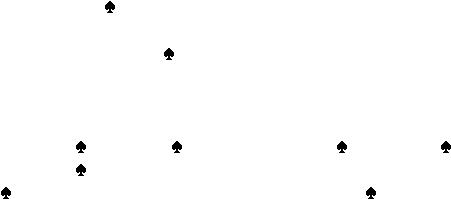 54
How this works is:
Say your spades are
610J
Your partner is nil
Opponent trying to set you has
AKQ2
The opponent trying to set you runs the following spades
Opponent plays
Ace, you play
6, the opponent plays the
K, you play the
J (the point is you don’t
want to play the
10 because you want the opponent to think your out of spades), the opponent plays
the
2 thinking he now has a chance to set the nil, you play your
10 and win the trick.
You made your bid and your nil is safe. The opponent has to take off his hat to you on that one.
Another time this comes up is when an opponent is trying to set you (you being the number bidder) and
he thinks he diminished your spades and he might lead a suit he is vulnerable in thinking his partner may
have the last trump card. Let’s say the above example happened. An opponent may stop leading
spades after playing the king. Thinking you have no more spades, he could lead a suit in which you
might be able to top, upon which he hopes his partner will trump. His partner may or may not trump
because he could be out of spades. And even if he does trump, he’s still under the impression that
you’re out of spades and that his partner has more spades than he really does.
You have them all fooled on this one.
5. One psychology method is to bid low in the 3rd position when dealing with aggressive bidding
opponents and high when dealing with opponents who like to bag.
6. Don’t be afraid to make a high team bid when the opponents are down a lot of points and they over bid
by 2 or 3. Bid your hand so they don’t make a bn where they are 200 points down, opponents sometimes
bid high to fool you into bidding low so they end up with a more precise bn. Say the score is 50 to -20
them ….your partner bids 7 and they go 6. You have last bid with a 2 hand. If you team bid 8 the score
would turn out to be 130 to –80 them making them about 200 points down, a prime spot for making two
bn’s in a row. The opponents could have gone 3 and end up with the scores being 140 to 10 them.
However, by overbidding they want to confuse you from bidding too high.
|
|
55
When you can’t make bn where you’re at least –120 points down, it might be good to overbid and attempt
at –200 points. The way you overbid is, when you figure you would be down 140 points after all the bids
are made (assuming that would be the score if you had just bid your hand), you need to bid high enough
to fool the opponents in making it an even –200. You figure you need to gain at least 20 points. In that
case you add what the opponents would bid (being 9 in this case)….then you figure out that if you bid
your hand, it would put you down 140 points……and so you bid an amount high enough to make them
underbid by 2, leaving you approximately 200 points down. By bidding 6 they fool the opponents to
underbid by at least 1 and in some cases as much as 3.
The point is, do not be fooled by these high bids. Bid your hand, maybe minus 1 to keep them from an
even –200 points down.
SETTING
1.
If opponents are nil, always set the number bid if bids add to 11. I mentioned this point before but it
is very important….ALMOST ALWAYS SET THE NUMBER BIDDING OPPONENT WHEN THE
BIDS ADD TO 11.
Also, if they are 5 and nil, and you have a 6 hand…. Bid 8 and set the 5. Be risky!
2.
If your bn and odds are you won’t make it, best you try to set your opponents by breaking your bn.
3.
When an opponent went nil and your not trying to set that nil…..it is still helpful to keep 1 or 2 high
cards in a suit.………if the opponent with the number bid to your left started out with Ace of clubs
right off the bat (being the 1st card he played) and you have xxxQ clubs……you would have to
keep your queen to prevent the number bidding opponent from running all high cards in that suit
which, will help his partner throw off cards in other suits once he runs out of the suit his partner is
running. By keeping the Q of clubs you’re giving yourself a chance to top the number bidding
opponents clubs and lead back another suit. What’s also important to remember is that you would
not want to use the Queen until the suit has been played 3 times….this is because you let the
number bidding opponent lead to you, giving you the last look in the attempt to set the nil. In the
|
 56
case that you had xxQ of clubs and the opponent started out with the Ace clubs right off the bat, it
would still be good to keep the Q because it’s the suit the opponent started with……however it
might be ok to dump the Q the 2nd round the suit is played. In the case that you have xxQ and the
number bidding opponent led the Ace clubs ( but in this case it was the 3rd suit to be played ) ….
During this scenario it might best to throw off the Queen under the Ace because most likely the
number bidding opponent does not have high cards in that suit.
4.
Pass short suits when your bn and you want to set the opponents.
Example: assume the opponents have a nil bid and you want to set it…..
You’re bn, your hand before the pass is
68910
69
610A
678 in this case you would pass
your partner the 9 of diamonds and the Ace of spades.
MISCELLANEOUS
1.
Remember what your opponents bid so you can better asses the amount of spades and
boss cards they have left
2. Know which cards are boss (meaning the highest in the suit) so you don’t risk trumping your
partner. It’s best to count down from the highest card, being the ace to the lowest for each suit (at
least up to the jack). Also when your trying to make a nil, you want to count to see what 2’s, 3’s,
and 4’s are left. That way if you know there is a 2 diamonds left outstanding and you have the 3
diamonds you must throw away the 3 so they don’t stick you with it at the end of the game.
If the opponents have a nil bid and you had already bid very high with the hope that you can match their
bids or set the number bidder, and the nil bidder starts playing high cards, it’s best you just self set and
let the nil bidder take everything because there is little chance for you to make bid when your fighting
against both opponents
3. When you have a high team bid of 10 …throw out the rules for not playing a suit with the Ace with
Axxx……..you need to take charge because there is no reason not to play the ace since most likely
your partner either has that suit cut or has the king….with a high bid count such as that it’s likely that
your opponent is void in that suit or will be after you play your Ace. By not playing the Ace, you’re
taking too much risk when there is no room for error.
|
|
57
4. There is a time when you cut the opponent to your right even if you’re risking your high card
from being over trumped by the player on your left. Let’s say it’s towards the end of the game in
which everyone has 3 cards each and you need one more trick to make your bid. Your partner
leads diamonds and you have no diamonds left with xk spades in your hand and the opponent to
your right cuts the diamond fairly high with a 10 of spades. It’s best you risk playing your K of
spades from being over trumped by the player to your left, even if he could be out of that suit. By
not playing the king your risking the chance that the player to your right will lead a low spade the
next time around in which you are forced to play the x or k to the opponent on your left. If you
played the king over the 10 earlier, you would have higher odds in that the opponent on your left
may have not have the Ace of spades. But lets say you didn’t cut the opponent on your right, then
what do you do when they the opponent on your right leads another high spade. In that case,
you’re forced to play the king of spades. The reason behind that is, considering the opponent to
your right played a significantly high spade rather than having his partner take last look, most likely
he is loaded with spades and he wants you to not risk your high card from overtrumping him, with
the idea that the next round of spades you will play your x and possibly have your king eaten the
next time around. When you’re the only one left to make the team bid, play your high spade over
the player to your right.
When cutting on the 3rd time the suit is played and you’re the 3rd person to play, make sure you cut
as high as a jack when you’re in the 3rd position so the 4th player won’t overtake your spade. So if
you have 69j spades, play the jack after the suit you’re trumping is played 3 times. You don’t cut if
you have xxQ, xk, and so on… just let the position 4 player lead back to your p.
This point is very important and many players cut low when they should be cutting high….if there is any
chance that your trump can be over trumped by an opponent, play the highest spade you have below a
Queen….but if you have xxQ or xK you would never cut there.
|
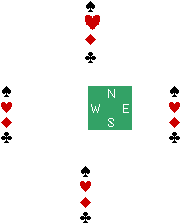 58
5.
If you know or suspect that your right-hand opponent is void in a suit, void yourself in the same suit.
Even if you must throw the boss card in the suit you will nearly always gain an extra trick.
North
K7
10962
106
--
West
QJ62
43
87
--
East
A9843
AQ
--
8
South
105
KJ875
K
--
South would want to void himself of the boss k diamonds.
6.
Never throw off for bn (even when score is 0 to 0) unless it helps your score. Example: they are 8
and you are 4, throw off the 4 for bn.
|
 59
TEST YOUR SKILLS
CLUBS DIAMONDS SPADES HEARTS Hand Value
1. 3 876 AKQ7654 J5 ?
2. AQ10 AQ95 752 109 ?
3. J109 J 543 Q10976 ?
4. 86 AQ10732 963 105 ?
5. J109874 AKQ7654 note: playsite you can’t cut 1st
card
6. K10987 2 36Q 5810J ?
7. Score is 190 to 80 you have 80 your partner is bn and u have 3rd to last bid with a 2 hand, 2nd
bid was a 3. What do you bid?
8. Score is 50 to 100 them. You have 2nd bid with a 2 hand, 1st bid was a 3, what do u bid?
9 score is 140 to 62 them, you have last bid. Your partner bid 2 and they team bid 3. What is your
bid if your hand looks like
AK5
AK6
KQ43
j74
10. Score is 103 to 214 them. They bid 6 and u have last bid with a 3 hand, what do you bid?
11a. Score is 0 to 0, they bid 9, your partner is nil, u have last bid with a 1 hand and cards that are
high enough to make an ok cover, what do u bid?
11b. If your cards were all 2-6 what should u bid?
12. Usually when u want to set them when your partner is bn what pass do you make?
13. Score is 200 to 100, the opponents bid bn and 7 and you have last bid. Both you and your
partner's hands add up to 7, what do u bid?
|
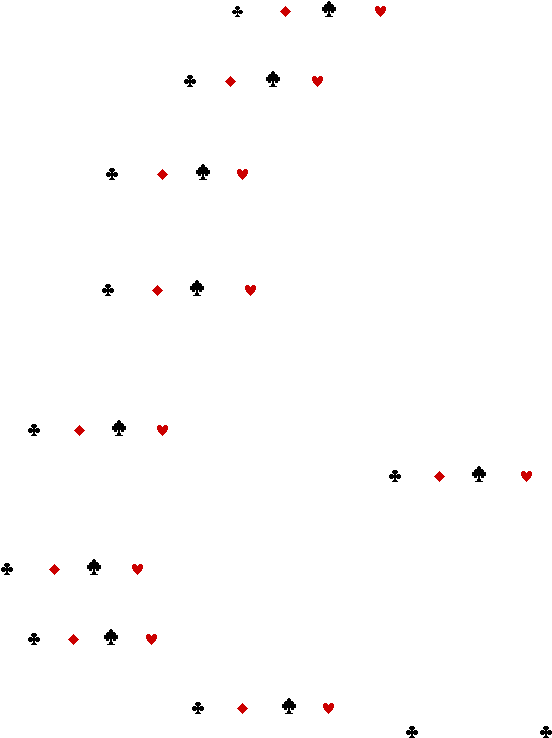 60
14. Score is 140 to 72, you have 140 and last bid. Your partner bids 2. They made a team bid of 3.
What is your bid if your hand looks like
AK10
Aj10
KQ86
765 ?
15. Score is 140 to 62, u have 140 and last bid. Your partner bid 2 and they team bid of 3. What is
your bid if your hand looks like
AK5
AK6
K43
10954?
16. Score is 92 to 183 them and you have 1st bid with a nil hand. Do you bid nil or 0 for bn?
17. Your hand is
AKQ7
A87
653
Q87 and the bids add to 12. How would you lead?
18. Score is 26 to 100 them. The opponent’s team bid 4 and you have last bid with a total of a
possible 5 between you and your partner. What do you bid?
19. Your hand is
AQ10
987
10987
KJ10 and the bids add to 12. How would you lead?
20. Score is 225 to 241 them. The bids are as follows…North 3, East 1, and you have 3rd to last
bid in the South seat. You have a 3 hand approximately, what do you bid?
21. Score is 190 to 190. West player bids 3, north bids 3, east team bids 7 and you have last bid
with
8910
789
9QA
2610j. What is your bid?
22. The bids are as follows: North 7, East 2, and your South with
8910
789
4567
2610j …
what is your bid?
23. Score is 0 to 0. The bids are as follows: West 4, North nil, East nil, and your South with
89KA
59J
4QA
8910J. What is your bid?
24. Score is 144 to 140 them. The bids are as follows: West 4, North nil, East 4, and your South
with
27A
48A
57A
36710. What is your bid?
25. Score is 0 to 0. Your nil with
357J
3479
489
4789. Your partner had started the bid
with 4 and the opponents ended with a 9 bid. Your partner starts off
6 followed by East’s
10.
How should you follow in the South spot?
26.
Score is 51 to 104 them. Bids are North 5, East 3, and your south with….
|
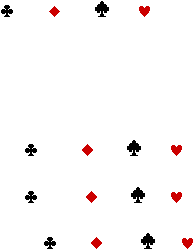 61
89KA
5910
4KA
89K, what’s your bid?
27.
Score is 50 to 104 them. You have 1st bid with a 1 hand, what is your bid?
28.
Score is 73 to 171 and you have 1st bid with a nil hand, what do you bid?
29.
810QA
578J
4KA
78… what would you lead first (partner’s bid is 3)?
30.
568QA
578J
48J
7… what do you lead first (bids are close)?
31. A)
678A
25QK
478
5 bids are as follow: South(you) 3, West 2, North 2, East 5…how do you
lead? B) Same cards…. Bids are as follows: South 3, West 3, North 3, East 3….how do you lead?
|
|
62
ANSWERS
1. 7
2. 3.25
3. .75
4. nil or 2
5. 9
6. 2
7. In my opinion you bid 4 or 6. The reason for 4 is that you don't have what you need to win and
you might as well assume they have about 6. You would be bidding for bn by underbidding and
setting the bn to be down 100. Furthermore, some players would bid 6 in this situation so that they
will bid 5 assuming they have about 4 to 5 tricks. It’s also good in case they have a nil due to the
fact that you have more leeway.
Same situation (roles reversed)….Now if your opponents bid 4 and bn, meanwhile you have last bid
with a 4 hand….you should bid 5 because they won’t set that. If your opponents bid bn and
6…meanwhile you have a good 5 hand, you should bid 6 because the last thing you want to do is
give them last bid with the score tied.
8. Nil for bn and hope your partner overbids to make about 5 depending on his hand. This only
works with a p that knows how to really play.
9. You could bid 4 to prevent a bn but you have enough here to bid 9 for a 130 point lead. If you
had only 8, I would probably bid 4.
10. You bid 4 because the bn player is going to have to break to help u set to get another bn.
11a. The bid is 6 because you’re bidding for bn and you have high cards to cover your p.
11b. It’s best to bid 2 to 3 because most likely your partner will set.
12. Your shortest suit besides spades unless you don't have one
13. You bid 5 because you need 7 and there’s no point in bidding the 7 to just risk being set. If the
goal is to set to win, always underbid up to 250 so u don't risk being set. Many times you bid to up
to 11 or 12 if they have a nil or bn…no point in bidding what u need to win because the bn will set u.
|
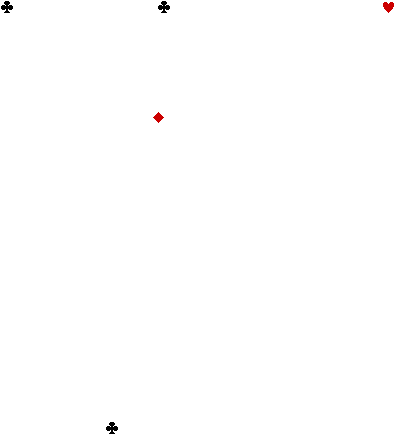 63
14. The bid is 5 and with a hand like that your going to do some heavy overs. Better to take the
overtricks rather than fork up a bn. If the score was 91 and they had 23 with the same hands than it
might be smart to just bid your hand up by 1 because it’s not worth the overtricks so early in the
game.
15. The bid is 4 because you don't want to give them a bn.
16. The bid is nil because there is no way you and your partner can prevent the opponents
from keeping their 90 point lead. Bid nil and hope you catch up in score by some miracle.
17. The
K..then most likely the
A, after which you would lead the
7
18. The bid is 7. You can’t bid 1 with so many overtricks. A 7 bid would bring you down 50
points, in which you would then go 5 and nil. Even if they set the 7 you could still come back
with two bn’s in a row.
19. This time you would lead the
9.
20. A bid of 7 would force them to go 6. Although you need 8, by going 7 you’re reducing
the odds of them bidding and making a nil.
21. Although with a possible 5 team bid and a chance to set the 7, the only logical bid here
would be nil. By doing so you’re increasing yours odds of setting the 7.
22. You should team bid 7 because your partners 7 bid is high enough to disqualify your 4
spades as 1 trick. But normally 4 small spades is considered 1 unless the opposition are bn.
23. The bid is 6. It’s safe to assume with two nils you will manage 6. But make sure West
takes 4 or he gets bn.
24. The bid here should be 2. It is late in the game and you can’t afford to risk your nil being
set. You have 3 but little cover for your partner. If it was 0 to 0 you could risk bidding 3.
25. You need to play the
J to aid your partner in making his bid and to scare the opponents into
thinking your trying to set them. Keep playing high in the 3rd
position until you’re sure about your
partner’s bid being met.
26.
You should bid 8 or 9. Your partners 5 bid most likely signals he has 3 to 4 tricks. The
odds of your partner having 5 are slim since you have about 5 yourself.
27. You would be best off bidding 1. Your partner would generally have to team bid about 3 to
give room for a bn next hand. If you had a 2 to 4 trick hand you would go nil. .
|
 64
28.
You would bid nil because the opponents have last bid and there is no hope for a bn.
29.
5…you lead the low card in long suit
30.
7…you have an opportunity to make a cheap trump trick out of your meaningless spades
31a.
K…you don’t want to risk your partner’s kings with a high bidding RHO
b.
5…the bids are even and it’s fair game to risk your partner’s king to make that cheap cut.
I owe thanks to JohnGault Strichman for the graphic examples. Some of the picture examples were borrowed
from other players. I would like to give mention to my good friends John, Mary, and Jen. I am trying to bring in
better players and create a community for playsite. My only goal with spades now is to polish up some skills,
teach others, and encourage playsite to further divide the players based on skill level for a more competitive as
well as social atmosphere. Sooner or later, I won’t play spades anymore, nor will I tolerate misinformed playsite
players, and this manual will most likely vanish with only a few players benefiting.
|
|
65
|