| Following the Sleep Pathway |
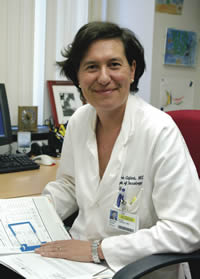
| Emma Ciafaloni, assistant professor of neurology, has an MDA grant to study excessive sleepiness in myotonic dystrophy. |
| Not far from Charles Thornton's lab is the office of Emma Ciafaloni, assistant professor of neurology and recipient of an MDA grant to study excessive sleepiness in MMD. |
| Ciafaloni is part of the Neuromuscular Disease Center at URMC and is affiliated with the Wellstone Center as well. |
| "All projects here are related in a way," she says. |
| Ciafaloni, originally from Italy, came to URMC in 2002 from Duke University in Durham, N.C., where she directed the MDA clinic. |
| "When I was at Duke, I saw a lot of myotonic dystrophy patients," Ciafaloni says. "And the observation came to me that many of these patients, even when they had pretty mild muscular problems, were very disabled. |
| "Most of them were out of work and spent most of their days at home, while we had patients with other muscular dystrophies who were very active and kept working. The complaint of feeling sleepy all the time came across." |
| Excessive daytime sleepiness has long been observed in many people with MMD, but its origins have been unclear. Some doctors have concluded that respiratory muscle weakness, resulting in interrupted nighttime sleep, is the primary cause. |
| Ciafaloni talks with Carol Czebatol, who has myotonic dystrophy and is participating in the sleep study. Ciafaloni doesn't think that's the whole story. |
| "It turns out that many patients do not have sleep apnea [breathing interruption] from respiratory muscle weakness," she says. "Some patients even when still very strong have this pattern on a sleep study that looks similar to another disease." |
| That disease is narcolepsy, a neurologic disorder involving excessive sleepiness during the day and irresistible "attacks" of sleep while going about everyday activities. |
| The resemblance started Ciafaloni thinking. |
| "It points to a central nervous system problem, a brain problem," Ciafaloni says. "And we know that myotonic dystrophy affects many systems, not just muscles." |
| Participants in Ciafaloni's study undergo an overnight sleep study (polysomnogram), which measures brain waves, muscle activity and heart function; and a multiple sleep latency test, which measures how quickly they fall asleep at intervals during the next day. |
| They also undergo a lumbar puncture to get a sample of the fluid surrounding the spinal cord. That procedure enables Ciafaloni to measure the nervous system protein orexin, which is diminished in narcolepsy and is believed to help regulate the sleep-wake cycle. |
| Sleep and the orexin pathway, as Ciafaloni describes it, might in fact be a window to the nervous system abnormalities in MMD. |
| "It's an easier thing to study than other central nervous system things, and it may give us a clue about the CNS phenotype [symptoms]," she notes. |
| Meanwhile, nearby, Thornton's study of brain cells from people with MMD will include looking to see if there are abnormalities in orexin or related molecules. |
| "The goals cover several clinical questions," Ciafaloni says of this study, "but they also cover the molecular biology and the basic pathophysiology of this disease." |
| **QUEST Volume 11, Number 5, SEPTEMBER/OCTOBER 2004 http://www.mdausa.org/publications/Quest/q115centers.cfm |
 |
 |