 |
| THE CORE OF THE PROBLEM; TOO MUCH CALCIUM IN THE MUSCLE CELL When CCD was first described in 1959, almost nothing was known about the molecular problems that cause the disease. Now, 40 years later, we're getting a handle on the cause of this elusive neuromuscular disorder. New research from MDA grantee, David MacLennan of the University of Toronto and collaborator Tommie McCarthy of the University of Cork, Ireland, suggest that too much calcium in the wrong part of the muscle cell could be the problem. |
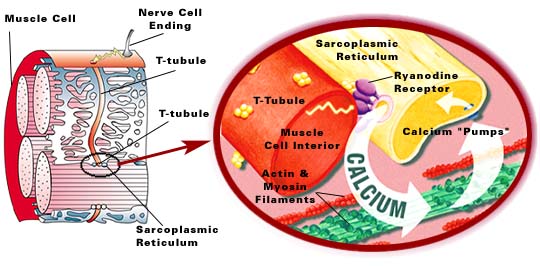
| 1. NORMAL MUSCLE CONTRACTION When the nervous system signals the muscle cell to contract, an electrical signal is sent from the surface of the muscle cell to the inner part of the cell through the T-tubule. |
| 2. A CLOSER VIEW OF THE T-TUBULE AND SARCOPLASMIC RETICULUM The electrical signal traveling through the T-tubule activated the ryaodine receptor to release calcium from the sarcoplasmic reticulum. The calcium washes over the actin and myosin filaments and makes them squeeze together. Calcium is then pumped back into the sarcoplasmic reticulum through a spcial pump. |
| More About CCD |
 |
| . |
 |