
This is the story of a house of the Lord, the University Baptist Church of Austin.
As an usher, I have had the privilege of greeting a number of early arriving visitors. As they enter the sanctuary for the first time, I can depend on them saying, "What a beautiful church!"
I agree. I don't believe there are many--if any--churches in the area that match the beauty of UBC. I started to take pictures of some of this beauty, and the more pictures I took, the more I saw. As I worked, I began to wonder, were these windows always here? When was the organ built? Who did the sculpture on the student building?
I turned to long-time members who had good memories and many mementos of the past, which they graciously loaned to me. I found more information in the church archives. Putting it all together, I was able to compile a brief history of our church buildings.
The University Baptist Church was organized in October, 1908. Rapid growth soon caused its congregation to seek a permanent adequate space in which to minister to the University of Texas community. In 1914, the church purchased property at the corner of 22nd and Guadalupe streets, across the street from the UT campus. It then employed Albert Kelsey, an eminent architect from Philadelphia (and an Episcopalian), to submit plans for a building to serve the worship and Christian education needs of the membership.
The architect's drawing shows a bell tower and a tiled dome, which
were later removed from the plans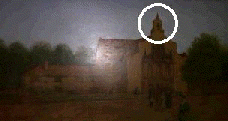
Work began in 1918. The south wing and basement were built first. Constuction was of brick with cast stone detailing. Kelsey's original plan had included a bell tower and dome for the sanctuary, but budgetary constraints led to their elimination from the final scheme. Also,the use of common brick testifies to the architect's original intention that the building be finished with stucco. The sanctuary and beautiful entrance way were completed in 1921 with the capping of the roof with clay tiles. On the north side of the building along 22nd Street, a line of bricks, slightly inset, mark the division of the two phases of construction.
The picture shows Dr. Maddry standing in front of the nearly completed first phase.
The front of the church is ornately decorated with a design of cast stone. The recessed doorways are lined with glazed tiles featuring a bluebonnet and leaf motif. The front facade of the church and an example of the tile are shown below.
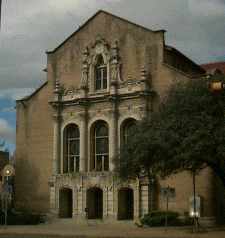
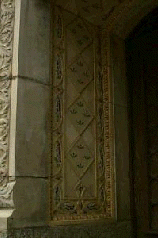
The Sanctuary Building, recently placed on the National Register
of Historic Places, was completed in 1921. It reflects the Spanish
Colonial Revival architectural style, a style normally reserved
for Catholic churches but which was popular in Texas during the
1920s and 1930s. The sanctuary's cathedral-like ceiling vaults,
in the shape of a Greek cross, create a near-perfect acoustical
environment in which the softest organ stop or choral pianissimo
can be heard without difficulty. Because its resonant acoustics
are similar to those of the great cathedrals, the sanctuary is
a favorite performance space for groups which perform classical
religious and secular music. The sanctuary has also hosted performances
of modern music, ranging from gospel choirs to solo appearances
by country-western singers Willie Nelson and Larry Gatlin.
During the construction of the church sanctuary, members of the building committee urged Mr. Kelsey to remember that water is an important element in Baptist services. He remembered. "Recalling the sunrise on the Colorado River," he later wrote, "I wished to suggest the river bank and decided to edge the pool with a long marble flower box. To keep the idea of living, purifying water constantly in the mind of the congregation, I decided on a thin veil of water to run during the entire service. . ." To represent the colors of the sunrise, which heralded the resurrection and represented the blood of Christ, Kelsey specified that the baptistry be made of pink Etowah marble from Georgia. In the baptistry's center, above the pool, is a stylized geranium flower carved from marble, curving down toward the pool and concealing an incandescent light which illuminates the translucent stone. During a baptism, water spills over the marble curb as the candidate is lowered, causing the marble to glow and sparkle and creating the musical cadence of water splashing down a stream.
The inscription behind the pool of the baptistry reads:
WE ARE BURIED WITH HIM BY BAPTISM INTO DEATH; THAT LIKE AS
CHRIST WAS RAISED UP FROM THE DEAD BY THE GLORY OF THE FATHER,
EVEN SO WE ALSO SHOULD WALK IN NEWNESS OF LIFE. ROMANS VI; IV.
The first organ was a pedal-pumped, two-manual reed instrument that sat where the display pipes are now. It proved inadequate for the sanctuary. In 1924 the Majestic Theater (now the Paramount) purchased a new organ, and the church bought the old one for $1,000. This was a small electric pipe organ.
From 1931 to 1937, Dr. C. P. Boner, a physics professor at UT, with the assistance of Robert Newman, added components from three organs and parts from all over that he bought, begged, or swapped for. When completed, the organ had 2,100 pipes and 80 stops.
By 1960 patches on the organ could no longer be patched, and Mr.
Otto Hofmann of Austin was commissioned to build a new organ.
Many of the old pipes were used, but most were made especially
for the church. When completed in 1963, the instrument had 2,945
pipes. From time to time, Mr. Hofmann has made improvements and
repairs to the organ. In 1986 he added 85 pipes of festival trumpets
that play on all manuals and pedals.
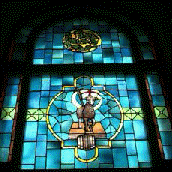
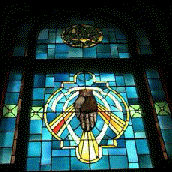
When the building was erected, the top sections of the north and south windows in the sanctuary were of stained glass, showing a dove on a blue background. The top of the window over the east balcony had a leaf design. All other windows of the sanctuary and foyer were of amber glass.
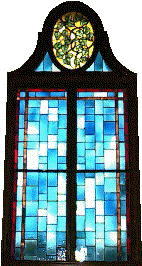 East balcony window. The leaf design in the upper oval was part of the original building. The blue stained glass was added to the shutters in 1974. | 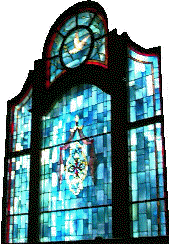 South balcony window (north balcony window is identical). The upper sunburst with the dove was installed initially with the lower stained glass added in 1974. |
During a remodeling of the building in 1974, $10,000 was set aside to place stained glass in all of the windows throughout the sanctuary and foyer. The church chose a San Antonio firm to do the design and work. The craftsmen closely matched the blue background and incorporated the vine motif in the design. The center design of the north and south upper window is the same (shown in the picture above).
The tops of the lower windows originally had square corners. These were rounded to accommodate the vine motif. This motif is shown at the top of the lower windows. Unlike the upper windows, the center designs of the south and north windows are different from one another.
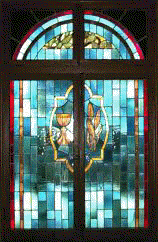 North window on main level of sanctuary. Note the leaf motif and rounded top section. | 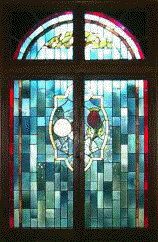 South window on main level of sanctuary. Note the differing center designs. |
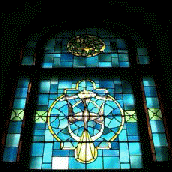
There are three tall windows in the foyer. The leaf motif is at the top, with a Christian symbol in the center. The north window shows a dove. The center window shows a lamb. The east window shows the hand of God reaching down.
| 
| 
|
The student building (now the educational building) was built in 1949 as a joint project of the church and the UT Baptist Student Union. (Later, the church bought out the BSU.) The architect was Carlton Brush. On the left end of the building on the 22nd Street side, the entrance to the chapel features a mural by Seymore Fogel which depicts the creation. Inscribed on the wall to the right are the words, "In the beginning God created the Heavens and the earth. Genesis 1:1." At the far right end there is a sculpture by Charles Umlauf above the main entrance to the building. The second floor windows were installed during a renovation in 1990-'91. Original plans called for a future addition at the rear of the building, so it was left with an unfinished appearance.
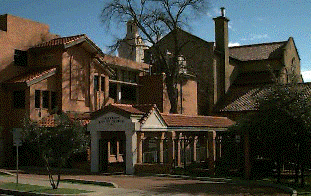
South side of the educational building (formerly the student building). | 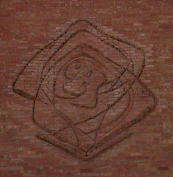
Charles Umlauf sculpture on the educational building's north face. |
In the early years of the church, many members lived within walking distance, and for others parking was available on the UT Campus across the street. Everyone used the beautiful front entrance. After UT built on the parking area, the church acquired land on the west side of San Antonio Street for parking. As it was more convenient to enter the church property by the less attractive rear entrance, use of the front entrance to the church gradually declined.
In the late 1980s, the church decided to "turn the church around." This was accomplished by adding a new driveway, a wrought iron fence with an attractive gate, and a covered walkway extending from the driveway to the alley. Also added was a new entrance arch for the church on San Antonio Street. Renovations to the educational building included an atrium on the building's south side and an elevator to serve all three floors. In the sanctuary building, the back entrance and the first floor of the south wing were renovated. The improved facilities were dedicated on September 24-29, 1991.
In 1992 a stained glass memorial to Deacon Howard Lee was placed
on the wall over the landing of the rear stairway in the sanctuary
building. The windows in the four pairs of doors to the Sanctuary
were of clear leaded glass at that time. In 1993 and 1994, several
memorial gifts provided funds to replace the clear glass with
stained glass designs on a clear background.
(Note: For more information about the history of the University
Baptist Church of Austin, see A Brief
History of The University Baptist Church, Austin, Texas,
by Roger A. Griffin, UBC Church Historian.)
(The author is a deacon, usher, and unofficial photographer for
Univrsity Baptist Church. Roger Griffin, UBC Church Historian,
provided a small amount of supplementary material. The quotations
are from Albert Kelsey, The Honor of the Church [Philadelphia,
1921].)