A Talk with
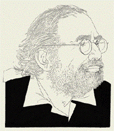
FRANCIS FORD COPPOLA
| Writing
and Directing The Conversation A Talk with FRANCIS FORD COPPOLA |
|
|
Visionary, maverick
director Francis Ford Coppola began his film career in Hollywood as a
screenwriter. Three times he won a screenplay Oscar for a film which
also won Best Picture (Patton, The Godfather, and The
Godfather Part II), an accomplishment as yet unequaled by any other
screenwriter. His career, for all its twists and turns, has been marked
by an ability to utilize the apparatus of studio-based filmmaking to
create deeply personal work. Born in Detroit in 1939, Coppola moved with
his family to New York, where his father, Carmine Coppola, was a
featured flautist with Arturo Toscanini’s celebrated NBC Symphony
Orchestra. When he was ten years old, young Francis developed polio,
which forced him to spend a year in bed. It was during this time,
playing with puppets, listening to the radio, watching television, that
Coppola developed his long-standing interest in technology. “I became
obsessed with remote control.”
Coppola studied at Hofstra University on Long Island in 1956,
majoring in theater arts and producing and directing plays. There he saw
Sergei Eisenstein’s Ten Days That Shook the World, “On Monday
I was in theater, and on Tuesday I wanted to be a filmmaker.” In the
autumn of 1960, Coppola entered the burgeoning film department at UCLA,
which included among its faculty French director Jean Renoir, and
Dorothy Arzner, one of the few significant female directors in Hollywood
up to that point. It was at UCLA that Coppola edited together footage
from two separate films—his own short and footage from someone
else’s nudie Western—to form the nudie-cutie quickie Tonight for
Sure (1962). During this time, he was also writing at a furious
pace, winning, at 22 years old, the prestigious Samuel Goldwyn Award for
his script “Pilma Pilma.” Soon, like many young filmmakers at the
time, Coppola fell into the ranks of those working for exploitation king
Roger Corman, learning Corman’s brand of fast, guerrilla-style
production.
For Corman, Coppola edited and dubbed Russian action films for
American release, worked as dialogue coach, and on The Terror,
was associate producer and shot second unit. While in Europe shooting The
Young Racers, Coppola pitched Corman an idea for a horror flick
which could utilize much of the same cast and crew. Always looking to
save costs and cut corners, Corman liked the idea of getting two films
out of his European sojourn instead of just one. Dementia 13
(1963), Coppola’s debut as writer/director, was the result.
While working on Dementia, Coppola met his lifelong partner, Eleanor
Neil, and the two married in 1963. At this same time, based on the
strength of the scripts he wrote at UCLA, Coppola began writing for
Seven Arts. He wrote drafts of This Property Is Condemned, Is
Paris Burning? and an early draft of Reflections in a Golden Eye.
He wrote numerous unproduced scripts such as “The Disenchanted,”
“The Fifth Coin,” and “My Last Duchess.” He also used his own
money to buy the option on the David Benedictus novel You’re A Big Boy
Now. He originally approached Roger Corman with his script adaptation,
but due to contractual complications involving Seven Arts, he was
obliged to make the film for that studio. Coppola used his ownership of
the script to leverage his own hiring as director for his first
studio-financed film.
A “nutty comedy about a young male virgin,” as the review in Variety
read, the film was entered in competition at the 1966 Cannes Film
Festival and garnered a Supporting Actress Academy Award nomination for
Geraldine Page. The jazzy, meandering manner in which Coppola shot the
Times Square sequences of the film became the inspiration for similar
footage in Midnight Cowboy. Coppola also submitted the film as
his thesis at UCLA, and received his Master of Arts degree.
Just prior to the opening of You’re A Big Boy Now, Coppola
completed his screenplay on the life of General George S. Patton. Even
though other writers worked on the script for Patton during its
long production process (it wasn’t released until 1970), it was
Coppola’s draft which star George C. Scott and director Franklin
Schaffner referred to most definitively. Coppola’s next assignment was
to direct Fred Astaire and Petula Clarke in an adaptation of the stage
musical Finian’s Rainbow.
Years earlier, while studying at Hofstra, Coppola wrote an original
script then titled “The Old Grey Station Wagon,” inspired by a
childhood memory of his mother’s two-day disappearance. After meeting
the actress Shirley Knight, Coppola was inspired to revise the script,
which focused on three housewives, into the poignant story of one
woman’s journey away from her husband and family and toward
self-discovery. Coppola directed the film, re-titled The Rain People
(1969). Legend has it that Coppola secured financing for the picture
while awaiting the 1968 release of Finian’s Rainbow by
spreading a rumor around the Warner-Seven Arts lot in Los Angeles that
he was working on a secret project in New York and then dropping out of
sight. The strategy worked, for the head of the studio, afraid of losing
the project, signed Coppola to a contract without even seeing the
script. The Rain People was the most personal of any project
Coppola had undertaken so far, and he sank much of his own savings into
the production, buying equipment which would form the basis of his own
San Francisco-based mini-studio, American Zoetrope, which he founded in
1969.
A four-month on-the-road shoot that traveled across 18 states, The
Rain People brought together numerous actors and technicians who
would work with Coppola in the coming years, including actors James Caan
and Robert Duvall, sound engineer Walter Murch, editor Barry Malkin, and
associate producer Mona Skager. Filming a documentary of the production
was a young USC student named George Lucas, who had met Coppola during
shooting of Finian’s Rainbow. Coppola produced Lucas’ first
feature, the sci-fi thriller THX 1138.
Having established a reputation as a talented writer and director,
Coppola was approached to adapt Mario Puzo’s best-selling novel The
Godfather, an exploration of a multi-generational Mafia family. In
juxtaposing Mafia gangsters with a rich familial sensibility, Coppola
created a classic work. While the film has, over the years, grown in
stature to its present position as a cultural landmark, the process of
the film’s production was a difficult one. Coppola faced extreme
pressure over his casting decisions and had to fight hard for the actors
he wanted, most notably Al Pacino and Marlon Brando. Despite the
headaches of production, The Godfather went on to become one of
the highest-grossing films of all time.
When The Godfather was released early in 1972, Coppola was
already at work on numerous other projects. He executive-produced George
Lucas’ second feature, American Graffiti (nominated for Best
Picture in 1974), and this one made money. A million-dollar cancelled
check hangs framed on a wall in Coppola’s Napa Valley office, and
across it is Lucas’ handwritten note: “Thanks for the start.”
During this time, Coppola also staged a revival of Noel Coward’s Private
Lives in San Francisco, formed The Directors’ Company with Peter
Bogdanovich and William Friedkin, and began work on his next feature, The
Conversation. He had been working on the script on and off for
several years, dating back to 1967, and had originally hoped to make it
after The Rain People.
The Directors’ Company was a production experiment whereby each
member would make two films for the company and produce a third by one
of the others, all to be released by Paramount. As it turned out, only The
Conversation and Bogdanovich’s Paper Moon came out of the
venture.
Production on The Conversation began in December 1972, with a
modest budget of $1.9 million. When shooting was completed, Coppola
needed to begin pre-production on The Godfather Part II, so the
sound mix and editing process for The Conversation took nearly a
year. By the time the film was released, the Watergate scandal had hit,
making the project surprisingly timely. “A devastating study of the
moral and psychological consequences of cold-blooded professionalism,”
wrote Stephen Farber in The New York Times. Despite winning the
Palm d’Or at the 1974 Cannes Film Festival, the film did only moderate
business at the box office.
The Godfather Part II, which featured Robert DeNiro in one of
his first major roles, was an unqualified success. Working mainly from
his own story ideas, Coppola crafted a sequel which built upon the
previous film, the two interweaving like a tapestry. “They were
siblings,” said Coppola. “One film hangs over the other like a
ghost.” At the 1975 Academy Awards ceremonies, where Godfather II
won Best Director, Best Picture and Best Adapted Screenplay, Coppola’s
main competition was from The Conversation, nominated for Best
Picture and Best Original Screenplay.
By this time, Coppola had also purchased for himself The Little Fox
Theater, City magazine, and a radio station, attempting to create
a self-contained Zoetrope media empire. Coppola believed that journalism
was rich ground for story ideas, hence the magazine, and that theater
and radio doubled as good testing grounds to workshop film ideas.
His next project, Apocalypse Now (1979), based on a script by
John Milius which Coppola rewrote, itself an adaptation of Joseph
Conrad’s Heart of Darkness, was more than five years in the
making and almost drove Coppola to the brink of personal and financial
destruction. The troubles which beset the production have been
well-documented by Eleanor Coppola in her book Notes and in her on-set
documentary Hearts of Darkness: A Filmmaker’s Apocalypse. In
many ways, Apocalypse Now ushered in the scorecard fascination
which now plagues Hollywood and entertainment journalism, as the
film’s spiraling costs and substantial box-office returns received as
much coverage as the film itself. The film, a spectacular metaphysical
exploration of the madness of war, won the 1979 Cannes’ Palm d’Or
and garnered ten Academy Award nominations, including those for Best
Director, Best Picture and Best Adapted Screenplay.
Coppola’s next film again revealed his fascination with technology.
One From the Heart (1982)—shot on film but using live video
techniques, including “video-assist,” now used on all films—was a
lavish, experimental, soundstage musical, but was a box-office disaster
and caused the financial ruin of the fledging Zoetrope studio. Despite
such financial setbacks, Coppola continued to work at a fierce pace
throughout the 1980s. He filmed two S.E. Hinton adaptations, The
Outsiders (1983) and Rumble Fish (1983), back-to-back in
Tulsa, Oklahoma. Next, he directed The Cotton Club (1984, which
he also wrote), Peggy Sue Got Married (1986) and Gardens of
Stone (1987).
With Tucker: A Man and His Dream (1988), the story of an
independent car manufacturer doomed for being too ahead of his times,
Coppola seemed to find a perfect analogy for himself and his place in
Hollywood—the idealistic dreamer railing against the confines of a
system hostile to outsiders.
Next, Coppola took on The Godfather Part III (1990) and the
formidable task of continuing the storyline of what had by then become
his signature work. Godfather III earned Best Picture and Best
Director nominations. He subsequently directed the visually stunning
Bram Stoker’s Dracula (1992), Jack (1996), and John
Grisham’s The Rainmaker (1997, which Coppola adapted from the
novel).
Over the years Coppola has also executive-produced filmmakers he has
believed in, beginning with Lucas and including Paul Schrader (Mishima),
Akira Kurosawa (Kagemusha) and Wim Wenders (Hammett).
He has also continued to have a wide range of ongoing projects,
turning his attention toward his growing family of Zoetrope interests:
the Coppola-Niebaum winery in Napa Valley, CA, the Blancaneux Lodge in
Belize, and Zoetrope: All-Story magazine in New York City. Zoetrope:
All-Story sponsors an ongoing screenplay submissions site, where
aspiring screenwriters can, once they’ve evaluated the work of
contemporaries and colleagues, submit their own work for critique. All
can be found at www.zoetrope.com.
Was one of the early challenges of the script for The
Conversation how to balance the thriller aspects with a character
portrait?
The Conversation, in truth, was, just as one might think,
inspired from seeing Blow Up, to the extent that I saw Blow Up
and I thought, gee, that’s the kind of movie I want to make. I was
there, in Hollywood, between the two poles of the studio films that were
being made, and the auteur films that we had seen when we were younger,
in the ’50s and ’60s. Blow Up was successful, and I said,
look, there’s a film that’s a very interesting personal film, so
just as a goal, I thought I’d like to make a film like that. I like
the component of it where it dealt with revelations of information in
razor slices. I was beginning to think it would be interesting to make a
film that used repetition as a motif, in that we repeat the same thing,
over and over again.
Like a music score.
Yes, it would be like a musical composition. So I was interested in
working with repetition. I was walking down the street once with the
director Irvin Kershner, and we were talking about technology. He was
saying that now they have microphones that they aim with a sight, and
that you could aim it on a person’s mouth and be able to hear what
they were saying. I thought, that’d be curious, what if someone walked
in front of it and there was a part you didn’t get? Out of that, and
wanting to make a film more like Blow Up, an art thriller, as it
were, I started working on the opening of The Conversation. I
began to get intrigued with the idea of a very mundane conversation that
wasn’t about anything at all. Like, “What are you doing?” “I
don’t know. Nice day.” “I saw Joe yesterday . . .” And then you
began to realize that someone was going to great trouble to record it,
through a number of means. Through these high-distance microphones, and
through people trying to get close enough to get what they wanted. And
so then the conversation was starting to become important, clearly not
for what they were saying, but for the efforts that people were going
through to get it. So that’s how I began to write the script.
My pattern with original writing has always been the same—I write
the script up to a point, maybe halfway through, and then I just hate it
and abandon it. I’m convinced that writers have a hormone that’s
secreted when they’re working which makes them hate what they’re
writing. But the hormone does, in time, go away. So I began it,
abandoned it, and I picked up another screenplay that I had been working
on years before that I had also abandoned about halfway through. I think
it was called “The Grey Station Wagon” then, but it became The
Rain People. So I then looked at that, and I thought, gee, this
wasn’t so bad, this is interesting. So I started working on that
again, and I ultimately made the film. By the same token, I was starting
on something else when I got discouraged and found the fragment of The
Conversation. Once again, I picked it up, and the hormone was gone,
so I read it and thought, gee, this is promising. So I finished it.
That’s been the pattern for me, with original material.
You were also reading Hermann Hesse at the time?
I had read a number of Hesse novels, so the mood of Steppenwolf,
with the solitary guy, was in there. I’ve always believed it was fine
for younger artists, or any artist really, to do that. My father used to
say: “Steal from the best.” Especially when you’re young, and you
don’t know exactly what your so-called voice is. With an original
screenplay you don’t know where you’re going. You’re in uncharted
territory, and that’s terrifying.
There’s an almost prescient anxiety about technology in The
Conversation. Was that a personal thing for you, because you use
cameras and gadgets?
Personal, yes, but I’ve never had anxiety about technology. Since I
was a child, I was always very comfortable with technology. From the day
I was a little boy I always had a workbench [gestures toward a
workbench] and have one to this day, where I can go to take
something apart and fix it. So I didn’t have anxiety, I had
fascination and comfort with technology. But after a while, working on
the film, I realized that what I wanted to do was to make a film about
privacy. Sometimes it helps, when you can say what your film is about in
the simplest possible terms.
We let technology into our lives, but there’s a moral ambiguity
there, certainly with surveillance technology. Surveillance was partly
born out of a journalistic impulse, the desire to uncover truth, but
your film explores the ramifications.
Well, I wasn’t really thinking in those terms. Although, when we
were making The Conversation, the news on the Watergate break-in
happened. I remember we were shooting, and we said, hey, isn’t this
weird? This is sort of what we’re about. But I didn’t approach it
that way. Wiretapping and surveillance were, quite honestly, something
that appealed to me. Partly because I was paralyzed as a kid, and I was
very good at technology and science, so I knew how to plant microphones
in things and hear what people were saying. I remember we threw a party
once and we bugged the bathroom so we could hear the girls talking. [Laughs]
And this was in 1952! I was a friend of technology. And surveillance, I
think, is another aspect of remote control. When you’re paralyzed,
remote control is everything. That’s why boys like Lionel Trains.
Technology becomes an appendage, an extension of your will.
Yes, when you can’t walk. And in those days they didn’t have
remote-control television. So as much as possible, by my bed, when I was
about nine, I had my projector and I had my tape recorder and I wished I
had remote-control so I could change the television stations. So I saw
technology as something that extended me, and wiretapping as something
that extended my ears. So I was on the other side. I was on the wrong
side of the tracks. [Laughs] I didn’t come to The
Conversation in any way as a social critic, or to be critical of
that. I began to be interested, of course, in the story and in the
consequences of it. The plot turned on [electronic eavesdropping],
because Harry was someone who felt ashamed of and responsible for what
his information had done in previous cases.
|