

Dogs are carnivorous (meat-eating) mammals. These
fast-moving animals have keen senses, with an exceptionally good sense of
smell. Dogs have powerful jaws, and sharp teeth. Domestic dogs were bred from
wild dogs; wild dogs are the descendants of wolves.
Below are
information about popular dogs.
Basenji
Hound Group
Breed Standard
General Appearance
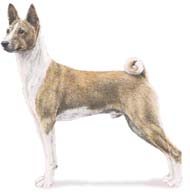 The Basenji is a small, short haired hunting dog from Africa. It
is short backed and lightly built, appearing high on the leg compared to its
length. The wrinkled head is proudly carried on a well arched neck and the tail
is set high and curled. Elegant and graceful, the whole demeanor is one of
poise and inquiring alertness. The balanced structure and the smooth
musculature enables it to move with ease and agility. The Basenji hunts by both
sight and scent. Characteristics--The Basenji
should not bark but is not mute. The wrinkled forehead, tightly curled tail and
swift, effortless gait (resembling a racehorse trotting full out) are typical
of the breed. Faults--Any
departure from the following points must be considered a fault, and the
seriousness with which the fault is regarded is to be in exact proportion to
its degree.
The Basenji is a small, short haired hunting dog from Africa. It
is short backed and lightly built, appearing high on the leg compared to its
length. The wrinkled head is proudly carried on a well arched neck and the tail
is set high and curled. Elegant and graceful, the whole demeanor is one of
poise and inquiring alertness. The balanced structure and the smooth
musculature enables it to move with ease and agility. The Basenji hunts by both
sight and scent. Characteristics--The Basenji
should not bark but is not mute. The wrinkled forehead, tightly curled tail and
swift, effortless gait (resembling a racehorse trotting full out) are typical
of the breed. Faults--Any
departure from the following points must be considered a fault, and the
seriousness with which the fault is regarded is to be in exact proportion to
its degree.
Size, Proportion, Substance
Ideal height for dogs is 17 inches and bitches 16 inches. Dogs 17 inches and
bitches 16 inches from front of chest to point of buttocks. Approximate weight
for dogs, 24 pounds and bitches, 22 pounds. Lightly built within this height to
weight ratio.
Head
The head is proudly carried. Eyes--Dark hazel to dark brown, almond shaped, obliquely set and
farseeing. Rims dark. Ears--Small, erect and slightly hooded, of fine texture and set
well forward on top of head. The skull is flat, well chiseled and of medium
width, tapering toward the eyes. The foreface tapers from eye to muzzle with a
perceptible stop. Muzzle shorter than skull, neither coarse nor snipy, but with
rounded cushions. Wrinkles appear upon the forehead when ears are erect, and
are fine and profuse. Side wrinkles are desirable, but should never be
exaggerated into dewlap. Wrinkles are most noticeable in puppies, and because
of lack of shadowing, less noticeable in blacks, tricolors and brindles. Nose--Black
greatly desired. Teeth--Evenly aligned with a scissors bite.
Neck, Topline, Body
Neck of good length, well crested and slightly full at base of throat. Well set
into shoulders. Topline--Back level. Body--Balanced with a short back, short
coupled and ending in a definite waist. Ribs moderately sprung, deep to elbows
and oval. Slight forechest in front of point of shoulder. Chest of medium
width. Tail
is set high on topline, bends acutely forward and lies well curled over to
either side.
Forequarters
Shoulders moderately laid back. Shoulder blade and upper arm of approximately
equal length. Elbows tucked firmly against brisket. Legs straight with clean
fine bone, long forearm and well defined sinews. Pasterns of good length, strong
and flexible. Feet--Small,
oval and compact with thick pads and well arched toes. Dewclaws are usually
removed.
Hindquarters
Medium width, strong and muscular, hocks well let down and turned neither in
nor out, with long second thighs and moderately bent stifles. Feet--Same
as in "Forequarters."
Coat and Color
Coat short and fine. Skin very pliant.
Color
Chestnut red; pure black; tricolor (pure black and chestnut red); or brindle
(black stripes on a background of chestnut red); all with white feet, chest and
tail tip. White legs, blaze and collar optional. The amount of white should
never predominate over primary color. Color and markings should be rich, clear
and well-defined, with a distinct line of demarcation between the black and red
of tricolors and the stripes of brindles.
Gait
Swift, tireless trot. Stride is long, smooth, effortless and the topline
remains level. Coming and going, the straight column of bones from shoulder
joint to foot and from hip joint to pad remains unbroken, converging toward the
centerline under the body. The faster the trot, the greater the convergence.
Temperament
An intelligent, independent, but affectionate and alert breed. Can be aloof
with strangers.
Approved May 8, 1990
Effective June 28, 1990
Pomeranian
Toy Group
Breed Standard
General Appearance
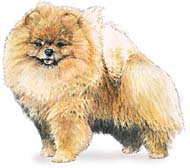 The Pomeranian is a compact, short-backed, active toy dog. He
has a soft, dense undercoat with a profuse harsh-textured outer coat. His
heavily plumed tail is set high and lies flat on his back. He is alert in
character, exhibits intelligence in expression, is buoyant in deportment, and
is inquisitive by nature. The Pomeranian is cocky, commanding, and animated as
he gaits. He is sound in composition and action.
The Pomeranian is a compact, short-backed, active toy dog. He
has a soft, dense undercoat with a profuse harsh-textured outer coat. His
heavily plumed tail is set high and lies flat on his back. He is alert in
character, exhibits intelligence in expression, is buoyant in deportment, and
is inquisitive by nature. The Pomeranian is cocky, commanding, and animated as
he gaits. He is sound in composition and action.
Size, Proportion, Substance
The average weight of the Pomeranian is from 3 to 7 pounds, with the ideal
weight for the show specimen being 4 to 6 pounds. Any dog over or under the
limits is objectionable. However, overall quality is to be favored over size.
The distance from the point of shoulder to the point of buttocks is slightly
shorter than from the highest point of the withers to the ground. the distance
from the brisket to the ground is half the height at the withers. He is
medium-boned, and the length of his legs is in proportion to a well-balanced
frame. When examined, he feels sturdy.
Head
The head is in balance with the
body. The muzzle is rather
short, straight, fine, free of lippiness and never snipey. His expression is alert and may be
referred to as fox-like. The skull
is closed. The top of the skull is slightly rounded, but not domed. When viewed
from the front and side, one sees small ears
which are mounted high and carried erect. To form a wedge, visualize a line
from the tip of the nose ascending through the center of the eyes and the tip
of the ears. The eyes are dark,
bright, medium in size and almond-shaped. They are set well into the skull on
either side of a well-pronounced stop. The pigmentation is black on the nose
and eye rims except self-colored in brown, beaver, and blue dogs. The teeth meet in a scissors bite. One
tooth out of alignment is acceptable. Major
Faults: Round, domed skull; under-shot mouth; overshot mouth.
Neck, Topline, Body
The neck is short with its base
set well into the shoulders to allow the head to be carried high. The back is short with a level topline. The body is compact and well-ribbed with brisket reaching the elbow.
The plumed tail is one of the
characteristics of the breed, and lies flat and straight on the back.
Forequarters
The Pomeranian has sufficient layback of shoulders to carry the neck and head
proud and high. The shoulders
and legs are moderately muscled. The length of the shoulder blade and upper arm
are equal. The forelegs are
straight and parallel to each other. Height from elbows to withers
approximately equals height from ground to elbow. The pasterns are straight and
strong. The feet are
well-arched, compact, and turn neither in nor out. He stands well up on his
toes. Dewclaws may be removed. Major Faults: Down in pasterns.
Hindquarters
The angulation of the hindquarters balances that of the forequarters. The
buttocks are well behind the set of the tail. The thighs are moderately muscled
with stifles that are moderately
bent and clearly defined. The hocks
are perpendicular to the ground and the legs
are straight and parallel to each other. The feet are well-arched, compact, and turn neither in nor out. He
stands well up on his toes. Dewclaws,
if any on the hind legs may be removed. Major
Faults: Cowhocks or lack of soundness in hind legs or stifles.
Gait
The Pomeranian's gait is smooth, free, balanced and vigorous. He has good reach
in his forequarters and strong drive with his hindquarters. Each rear leg moves
in line with the foreleg on the same side. To achieve balance, his legs
converge slightly inward toward a center line beneath his body. The rear and
front legs are thrown neither in nor out. The topline remains level, and his
overall balance and outline are maintained.
Coat
A Pomeranian is noted for its double coat. The undercoat is soft and dense. The outer-coat is long, straight, glistening and harsh in texture. A
thick undercoat will hold up and permit the guard hair to stand off from the
Pomeranian's body. The coat is abundant from the neck and fore part of
shoulders and chest, forming a frill which extends over the shoulders and
chest. The head and leg coat is tightly packed and shorter in length than that
of the body. The forequarters are well-feathered to the hock. The tail is
profusely covered with long, harsh, spreading straight hair. Trimming for
neatness and a clean outline is permissible. Major Faults: Soft, flat or open coat.
Color
All colors, patterns, and variations there-of are allowed and must be judged on
an equal basis. Patterns: Black and Tan - tan or rust sharply
defined, appearing above each eye and on muzzle, throat, and forechest, on all
legs and feet and below the tail. The richer the tan the more desirable; Brindle - the base color is gold, red,
or orange-brindled with strong black cross stripes; Parti-color - is white with any other color distributed in patches
with a white blaze preferred on the head. Classifications: The Open Classes at specialty shows may be
divided by color as follows: Open Red, Orange, Cream, and Sable; Open Black,
Brown, and Blue; Open Any Other Color, Pattern, or Variation.
Temperament
The Pomeranian is an extrovert, exhibiting great intelligence and a vivacious
spirit, making him a great companion dog as well as a competitive show dog.
EVEN THOUGH A TOY DOG, THE POMERANIAN MUST BE SUBJECT TO THE SAME REQUIREMENTS
OF SOUNDNESS AND STRUCTURE PRESCRIBED FOR ALL BREEDS, AND ANY DEVIATION FROM
THE IDEAL DESCRIBED IN THE STANDARD SHOULD BE PENALIZED TO THE EXTENT OF THE
DEVIATION.
Approved December 9, 1996
Effective January 31, 1997
Poodle
Non-Sporting Group
and Toy Group
Breed Standard
The Standard for the Poodle (Toy variety) is the same as for the Standard and
Minature varieties except as regards heights.
General Appearance,
Carriage and Condition
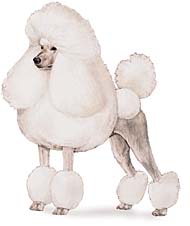 That of a very active, intelligent and elegant-appearing dog,
squarely built, well proportioned, moving soundly and carrying himself proudly.
Properly clipped in the traditional fashion and carefully groomed, the Poodle
has about him an air of distinction and dignity peculiar to himself.
That of a very active, intelligent and elegant-appearing dog,
squarely built, well proportioned, moving soundly and carrying himself proudly.
Properly clipped in the traditional fashion and carefully groomed, the Poodle
has about him an air of distinction and dignity peculiar to himself.
Size, Proportion, Substance
Size
The Standard
Poodle is over 15 inches at the highest point of the shoulders. Any
Poodle which is 15 inches or less in height shall be disqualified from
competition as a Standard Poodle.
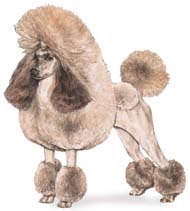 The
Miniature Poodle is 15 inches or under at the highest
point of the shoulders, with a minimum height in excess of 10 inches. Any
Poodle which is over 15 inches or is 10 inches or less at the highest point of
the shoulders shall be disqualified from competition as a Miniature Poodle.
The
Miniature Poodle is 15 inches or under at the highest
point of the shoulders, with a minimum height in excess of 10 inches. Any
Poodle which is over 15 inches or is 10 inches or less at the highest point of
the shoulders shall be disqualified from competition as a Miniature Poodle.
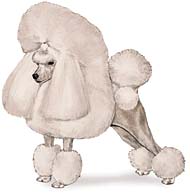 The Toy
Poodle is 10 inches or under at the highest point of
the shoulders. Any Poodle which is more than 10 inches at the highest point of
the shoulders shall be disqualified from competition as a Toy Poodle.
The Toy
Poodle is 10 inches or under at the highest point of
the shoulders. Any Poodle which is more than 10 inches at the highest point of
the shoulders shall be disqualified from competition as a Toy Poodle.
As long as the Toy Poodle is definitely a Toy Poodle, and the Miniature Poodle
a Miniature Poodle, both in balance and proportion for the Variety,
diminutiveness shall be the deciding factor when all other points are equal.
ProportionTo
insure the desirable squarely built appearance, the length of body measured
from the breastbone to the point of the rump approximates the height from the
highest point of the shoulders to the ground.
SubstanceBone and muscle of both
forelegs and hindlegs are in proportion to size of dog.
Head and Expression
(a) Eyes--
very dark, oval in shape and set far enough apart and positioned to create an
alert intelligent expression. Major
fault: eyes round, protruding, large or very light.
(b) Ears--
hanging close to the head, set at or slightly below eye level. The ear leather
is long, wide and thickly feathered; however, the ear fringe should not be of
excessive length.
(c) Skull--
moderately rounded, with a slight but definite stop. Cheekbones and muscles
flat. Length from occiput to stop about the same as length of muzzle.
(d) Muzzle--
long, straight and fine, with slight chiseling under the eyes. Strong without
lippiness. The chin definite enough to preclude snipiness. Major fault: lack of chin. Teeth--
white, strong and with a scissors bite. Major
fault: undershot, overshot, wry mouth.
Neck, Topline, Body
Neck
well proportioned, strong and long enough to permit the head to be carried high
and with dignity. Skin snug at throat. The neck rises from strong, smoothly
muscled shoulders. Major fault: ewe
neck. The topline is level, neither sloping nor roached, from the highest
point of the shoulder blade to the base of the tail, with the exception of a
slight hollow just behind the shoulder.
Body
(a)
Chest deep and moderately wide with well sprung ribs.
(b)
The loin is short, broad and muscular.
(c)
Tail straight, set on high and carried up, docked of sufficient length to
insure a balanced outline. Major
fault: set low, curled, or carried over the back.
Forequarters
Strong, smoothly muscled shoulders. The shoulder blade is well laid back and
approximately the same length as the upper foreleg. Major fault: steep shoulder.
(a)Forelegs
straight and parallel when viewed from the front. When viewed from the side the
elbow is directly below the highest point of the shoulder. The pasterns are
strong. Dewclaws may be removed.
Feet
The feet are rather small, oval in shape with toes well arched and cushioned on
thick firm pads. Nails short but not excessively shortened. The feet turn
neither in nor out. Major fault: paper
or splay foot.
Hindquarters
The angulation of the hindquarters balances that of the forequarters.
(a)
Hind legs straight and parallel when viewed from the rear. Muscular with width
in the region of the stifles which are well bent; femur and tibia are about
equal in length; hock to heel short and perpendicular to the ground. When
standing, the rear toes are only slightly behind the point of the rump. Major fault: cow-hocks.
Coat
(a) Quality--(1)
Curly: of naturally harsh texture, dense throughout. (2) Corded: hanging in
tight even cords of varying length; longer on mane or body coat, head, and
ears; shorter on puffs, bracelets, and pompons.
(b) Clip--
A Poodle under 12 months may be shown in the "Puppy" clip. In all
regular classes, Poodles 12 months or over must be shown in the "English
Saddle" or "Continental" clip. In the Stud Dog and Brood Bitch
classes and in a non-competitive Parade of Champions, Poodles may be shown in
the "Sporting" clip. A Poodle shown in any other type of clip shall
be disqualified.
(1) "Puppy"--A Poodle under a year old may be shown in the
"Puppy" clip with the coat long. The face, throat, feet and base of
the tail are shaved. The entire shaven foot is visible. There is a pompon on
the end of the tail. In order to give a neat appearance and a smooth unbroken
line, shaping of the coat is permissible. (2) "English Saddle"--In
the "English Saddle" clip the face, throat, feet, forelegs and base
of the tail are shaved, leaving puffs on the forelegs and a pompon on the end
of the tail. The hindquarters are covered with a short blanket of hair except
for a curved shaved area on each flank and two shaved bands on each hindleg.
The entire shaven foot and a portion of the shaven leg above the puff are
visible. The rest of the body is left in full coat but may be shaped in order
to insure overall balance. (3) "Continental"--In the
"Continental" clip, the face, throat, feet, and base of the tail are
shaved. The hindquarters are shaved with pompons (optional) on the hips. The
legs are shaved, leaving bracelets on the hindlegs and puffs on the forelegs.
There is a pompon on the end of the tail. The entire shaven foot and a portion
of the shaven foreleg above the puff are visible. The rest of the body is left
in full coat but may be shaped in order to insure overall balance. (4)
"Sporting"--In the "Sporting" clip, a Poodle shall be shown
with face, feet, throat, and base of tail shaved, leaving a scissored cap on
the top of the head and a pompon on the end of the tail. The rest of the body,
and legs are clipped or scissored to follow the outline of the dog leaving a
short blanket of coat no longer than one inch in length. The hair on the legs
may be slightly longer than that on the body.
In all clips the hair of the topknot may be left free or held in place by
elastic bands. The hair is only of sufficient length to present a smooth
outline. "Topknot" refers only to hair on the skull, from stop to
occiput. This is the only area where elastic bands may be used.
Color
The coat is an even and solid color at the skin. In blues, grays, silvers,
browns, cafe-au-laits, apricots and creams the coat may show varying shades of
the same color. This is frequently present in the somewhat darker feathering of
the ears and in the tipping of the ruff. While clear colors are definitely
preferred, such natural variation in the shading of the coat is not to be
considered a fault. Brown and cafe-au-lait Poodles have liver-colored noses,
eye-rims and lips, dark toenails and dark amber eyes. Black, blue, gray,
silver, cream and white Poodles have black noses, eye-rims and lips, black or
self colored toenails and very dark eyes. In the apricots while the foregoing
coloring is preferred, liver-colored noses, eye-rims and lips, and amber eyes
are permitted but are not desirable. Major
fault: color of nose, lips and eye-rims incomplete, or of wrong color for color
of dog.
Parti-colored dogs shall be disqualified. The coat of a parti-colored dog is
not an even solid color at the skin but is of two or more colors.
Gait
A straightforward trot with light springy action and strong hindquarters drive.
Head and tail carried up. Sound effortless movement is essential.
Temperament
Carrying himself proudly, very active, intelligent, the Poodle has about him an
air of distinction and dignity peculiar to himself. Major fault: shyness or sharpness.
Major Faults
Any distinct deviation from the desired characteristics described in the Breed
Standard.
Disqualifications
Size--
A dog over or under the height limits specified shall be disqualified. Clip-- A
dog in any type of clip other than those listed under coat shall be
disqualified. Parti-colors--
The coat of a parti-colored dog is not an even solid color at the skin but of two
or more colors. Parti-colored dogs shall be disqualified.
Value of Points
General appearance, temperament, carriage and condition.......30
Head, expression, ears, eyes and teeth.......20
Body, neck, legs, feet and tail.......20
Gait.......20
Coat, color and texture.......10
Approved August 14, 1984
Reformatted March 27, 1990
Dalmatian
Non-Sporting Group
Breed Standard
General Appearance
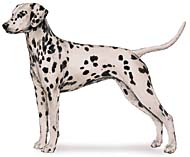 The Dalmatian is a distinctively spotted dog; poised and alert;
strong, muscular and active; free of shyness; intelligent in expression;
symmetrical in outline; and without exaggeration or coarseness.
The Dalmatian is a distinctively spotted dog; poised and alert;
strong, muscular and active; free of shyness; intelligent in expression;
symmetrical in outline; and without exaggeration or coarseness.
The Dalmatian is capable of great endurance, combined with fair amount of
speed. Deviations from the described ideal should be penalized in direct
proportion to the degree of the deviation.
Size, Proportion, Substance
Desirable height at the withers is between 19 and 23 inches. Undersize or
oversize is a fault. Any dog or bitch over 24 inches at the withers is
disqualified.
The overall length of the body from the forechest to the buttocks is
approximately equal to the height at the withers.
The Dalmatian has good substance and is strong and sturdy in bone, but never
coarse.
Head
The head is in balance with the overall dog. It is of fair length and is free of
loose skin. The Dalmatian's expression is alert and intelligent, indicating a stable and
outgoing temperament.
The eyes
are set moderately well apart, are medium sized and somewhat rounded in
appearance, and are set well into the skull. Eye color is brown or blue, or any
combination thereof; the darker the better and usually darker in black-spotted
than in liver-spotted dogs.
Abnormal position of the eyelids or eyelashes (ectropion, entropion,
trichiasis) is a major fault.
Incomplete pigmentation of the eye rims is a major fault.
The ears
are of moderate size, proportionately wide at the base and gradually tapering
to a rounded tip. They are set rather high, and are carried close to the head,
and are thin and fine in texture. When the Dalmatian is alert, the top of the
ear is level with the top of the skull and the tip of the ear reaches to the
bottom line of the cheek.
The top of the skull is flat with a slight vertical furrow and is approximately
as wide as it is long. The stop is moderately well defined. The cheeks blend smoothly into
a powerful muzzle,
the top of which is level and parallel to the top of the skull. The muzzle and
the top of the skull are about equal in length.
The nose
is completely pigmented on the leather, black in black-spotted dogs and brown
in liver-spotted dogs. Incomplete nose pigmentation is a major fault.
The lips
are clean and close fitting. The teeth meet in a scissors bite. Overshot or undershot
bites are disqualifications.
Neck, Topline, Body
The neck
is nicely arched, fairly long, free from throatiness, and blends smoothly into
the shoulders.
The topline
is smooth. The chest
is deep, capacious and of moderate width, having good spring of rib without
being barrel shaped. The brisket reaches to the elbow. The underline of the rib
cage curves gradually into a moderate tuck-up.
The back
is level and strong. The loin is short, muscular and slightly arched. The flanks narrow
through the loin. The croup is nearly level with the back.
The tailis
a natural extension of the topline. It is not inserted too low down. It is
strong at the insertion and tapers to the tip, which reaches to the hock. It is
never docked. The tail is carried with a slight upward curve but should never
curl over the back. Ring tails and low-set tails are faults.
Forequarters
The shoulders
are smoothly muscled and well laid back. The upper arm is approximately equal in
length to the shoulder blade and joins it at an angle sufficient to insure that
the foot falls under the shoulder. The elbows are close to the body. The legs are
straight, strong and sturdy in bone. There is a slight angle at the pastern
denoting flexibility.
Hindquarters
The hindquarters
are powerful, having smooth, yet well defined muscles. The stifle is
well bent. The hocks
are well let down. When the Dalmatian is standing, the hind legs, viewed from
the rear, are parallel to each other from the point of the hock to the heel of
the pad. Cowhocks are a major fault.
Feet
Feet
are very important. Both front and rear feet are round and compact with thick,
elastic pads and well arched toes. Flat feet are a major fault. Toenails are
black and/or white in black- spotted dogs and brown and/or white in liver-
spotted dogs. Dewclaws may be removed.
Coat
The coat
is short, dense, fine and close fitting. It is neither woolly nor silky. It is
sleek, glossy and healthy in appearance.
Color and Markings
Color and
markings and their overall appearance are very important points to be
evaluated.
The ground color is pure white. In black-spotted dogs the spots are dense
black. In liver-spotted dogs the spots are liver brown. Any color markings
other than black or liver are disqualified.
Spots
are round and well-defined, the more distinct the better. They vary from the
size of a dime to the size of a half-dollar. They are pleasingly and evenly
distributed. The less the spots intermingle the better. Spots are usually
smaller on the head, legs and tail than on the body. Ears are preferably
spotted.
Tri-color(which
occurs rarely in this breed) is a disqualification. It consists of tan markings
found on the head, neck, chest, leg or tail of a black- or liver-spotted dog.
Bronzing of black spots, and fading and/or darkening of liver spots due to
environmental conditions or normal processes of coat change are not
tri-coloration.
Patches
are a disqualification. A patch is a solid mass of black or liver hair
containing no white hair. It is appreciably larger than a normal sized spot.
Patches are a dense, brilliant color with sharply defined, smooth edges. Patches
are present at birth. Large color masses formed by intermingled or overlapping
spots are not patches. Such masses should indicate individual spots by uneven
edges and/or white hairs scattered throughout the mass.
Gait
In keeping with the Dalmatian's historical use as a coach dog, gait and
endurance are of great importance. Movement is steady and effortless. Balanced
angulation fore and aft combined with powerful muscles and good condition
produce smooth, efficient action. There is a powerful drive from the rear
coordinated with extended reach in the front. The topline remains level.
Elbows, hocks and feet turn neither in nor out. As the speed of the trot
increases, there is a tendency to single track.
Temperament
Temperament is stable and outgoing, yet dignified. Shyness is a major fault.
SCALE OF POINTS
|
General Appearance |
5 |
|
Size, proportion, substance |
10 |
|
Head |
10 |
|
Neck, topline, body |
10 |
|
Forequarters |
5 |
|
Hindquarters |
5 |
|
Feet |
5 |
|
Coat |
5 |
|
Color and markings |
25 |
|
Gait |
10 |
|
Temperament |
10 |
|
TOTAL |
100 |
Disqualifications
Any dog or bitch over 24 inches at the
withers
Overshot or undershot bite.
Any color markings other than black or liver.
Tri-color
Patches
Approved July 11, 1989
Effective September 6, 1989
Bearded
Collie
Hearding Group
Breed Standard
Characteristics
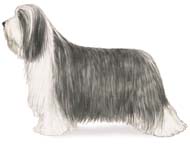 The Bearded Collie is hardy and active, with an aura of strength
and agility characteristic of a real working dog. Bred for centuries as a
companion and servant of man, the Bearded Collie is a devoted and intelligent
member of the family. He is stable and self-confident, showing no signs of
shyness or aggression. This is a natural and unspoiled breed.
The Bearded Collie is hardy and active, with an aura of strength
and agility characteristic of a real working dog. Bred for centuries as a
companion and servant of man, the Bearded Collie is a devoted and intelligent
member of the family. He is stable and self-confident, showing no signs of
shyness or aggression. This is a natural and unspoiled breed.
General Appearance
The Bearded Collie is a medium sized dog with a medium length coat that follows
the natural lines of the body and allows plenty of daylight under the body. The
body is long and lean, and, though strongly made, does not appear heavy. A
bright inquiring expression is a distinctive feature of the breed. The Bearded
Collie should be shown in a natural stance.
Head
The head is in proportion to the size of the dog. The skull is broad and flat;
the stop is moderate; the cheeks are well filled beneath the eyes; the muzzle
is strong and full; the foreface is equal in length to the distance between the
stop and occiput. The nose is large and squarish. A snipy muzzle is to be
penalized. (See Color section for pigmentation.)
Eyes: The eyes are large,
expressive, soft and affectionate, but not round nor protruding, and are set
widely apart. The eyebrows are arched to the sides to frame the eyes and are
long enough to blend smoothly into the coat on the sides of the head. (See
Color section for eye color.)
Ears: The ears are medium
sized, hanging and covered with long hair. They are set level with the eyes.
When the dog is alert, the ears have a slight lift at the base.
Teeth: The teeth are strong and
white, meeting in a scissors bite. Full dentition is desirable.
Neck
The neck is in proportion to the length of the body, strong and slightly
arched, blending smoothly into the shoulders.
Forequarters
The shoulders are well laid back at an angle of approximately 45°; a line drawn
from the highest point of the shoulder blade to the forward point of
articulation approximates a right angle with a line from the forward point of articulation
to the point of the elbow. The tops of the shoulder blades lie in against the
withers, but they slope outwards from there sufficiently to accommodate the
desired spring of ribs. The legs are straight and vertical, with substantial,
but not heavy, bone and are covered with shaggy hair all around. The pasterns
are flexible without weakness.
Body
The body is longer than it is high in an approximate ratio of five to four,
length measured from point of chest to point of buttocks, height measured at
the highest point of the withers. The length of the back comes from the length
of the ribcage and not that of the loin. The back is level. The ribs are well
sprung from the spine but are flat at the sides. The chest is deep, reaching at
least to the elbows. The loins are strong. The level back line blends smoothly
into the curve of the rump. A flat croup or a steep croup is to be severely
penalized.
Hindquarters
The hind legs are powerful and muscular at the thighs with well bent stifles.
The hocks are low. In normal stance, the bones below the hocks are
perpendicular to the ground and parallel to each other when viewed from the
rear; the hind feet fall just behind a perpendicular line from the point of
buttocks when viewed from the side. The legs are covered with shaggy hair all
around.
Tail: The tail is set low and
is long enough for the end of the bone to reach at least the point of the
hocks. It is normally carried low with an upward swirl at the tip while the dog
is standing. When the dog is excited or in motion, the curve is accentuated and
the tail may be raised but is never carried beyond a vertical line. The tail is
covered with abundant hair.
Feet
The feet are oval in shape with the soles well padded. The toes are arched and
close together, and well covered with hair including between the pads.
Coat
The coat is double with the undercoat soft, furry and close. The outercoat is
flat, harsh, strong and shaggy, free from wooliness and curl, although a slight
wave is permissible. The coat falls naturally to either side but must never be
artificially parted. The length and density of the hair are sufficient to
provide a protective coat and to enhance the shape of the dog, but not so
profuse as to obscure the natural lines of the body. The dog should be shown as
naturally as is consistent with good grooming but the coat must not be trimmed
in any way. On the head, the bridge of the nose is sparsely covered with hair
which is slightly longer on the sides to cover the lips. From the cheeks, the lower
lips and under the chin, the coat increases in length towards the chest,
forming the typical beard. An excessively long, silky coat or one which has
been trimmed in any way must be severely penalized.
Color
Coat: All Bearded Collies are
born either black, blue, brown or fawn, with or without white markings. With
maturity, the coat color may lighten, so that a born black may become any shade
of gray from black to slate to silver, a born brown from chocolate to sandy.
Blues and fawns also show shades from dark to light. Where white occurs, it
only appears on the foreface as a blaze, on the skull, on the tip of the tail,
on the chest, legs and feet and around the neck. The white hair does not grow
on the body behind the shoulder nor on the face to surround the eyes. Tan
markings occasionally appear and are acceptable on the eyebrows, inside the
ears, on the cheeks, under the root of the tail, and on the legs where the
white joins the main color.
Pigmentation: Pigmentation on
the Bearded Collie follows coat color. In a born black, the eye rims, nose and
lips are black, whereas in the born blue, the pigmentation is a blue-gray
color. A born brown dog has brown pigmentation and born fawns a correspondingly
lighter brown. The pigmentation is completely filled in and shows no sign of
spots.
Eyes: Eye color will generally
tone with the coat color. In a born blue or fawn, the distinctively lighter
eyes are correct and must not be penalized.
Size
The ideal height at the withers is 21-22 inches for adult dogs and 20-21 inches
for adult bitches. Height over and under the ideal is to be severely penalized.
The express objective of this criterion is to insure that the Bearded Collie
remains a medium sized dog.
Gait
Movement is free, supple and powerful. Balance combines good reach in
forequarters with strong drive in hindquarters. The back remains firm and
level. The feet are lifted only enough to clear the ground, giving the
impression that the dog glides along making minimum contact. Movement is lithe
and flexible to enable the dog to make the sharp turns and sudden stops
required of the sheepdog. When viewed from the front and rear, the front and
rear legs travel in the same plane from the shoulder and hip joint to pads at
all speeds. Legs remain straight, but feet move inward as speed increases until
the edges of the feet converge on a center line at a fast trot.
Serious faults:
--snipy muzzle
--flat croup or steep croup
--excessively long, silky coat
--trimmed or sculptured coat
--height over or under the ideal
Approved August 9, 1978
Great Dane
Working Group
Breed Standard
General Appearance
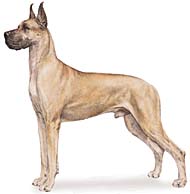 The Great Dane combines, in its regal appearance, dignity,
strength and elegance with great size and a powerful, well-formed, smoothly
muscled body. It is one of the giant working breeds, but is unique in that its
general conformation must be so well balanced that it never appears clumsy, and
shall move with a long reach and powerful drive. It is always a unit-the Apollo
of dogs. A Great Dane must be spirited, courageous, never timid; always
friendly and dependable. This physical and mental combination is the
characteristic which gives the Great Dane the majesty possessed by no other
breed. It is particularly true of this breed that there is an impression of great
masculinity in dogs, as compared to an impression of femininity in bitches.
Lack of true Dane breed type, as defined in this standard, is a serious fault.
The Great Dane combines, in its regal appearance, dignity,
strength and elegance with great size and a powerful, well-formed, smoothly
muscled body. It is one of the giant working breeds, but is unique in that its
general conformation must be so well balanced that it never appears clumsy, and
shall move with a long reach and powerful drive. It is always a unit-the Apollo
of dogs. A Great Dane must be spirited, courageous, never timid; always
friendly and dependable. This physical and mental combination is the
characteristic which gives the Great Dane the majesty possessed by no other
breed. It is particularly true of this breed that there is an impression of great
masculinity in dogs, as compared to an impression of femininity in bitches.
Lack of true Dane breed type, as defined in this standard, is a serious fault.
Size, Proportion, Substance
The male should appear more massive throughout than the bitch, with larger
frame and heavier bone. In the ratio between length and height, the Great Dane
should be square. In bitches, a somewhat longer body is permissible, providing
she is well proportioned to her height. Coarseness or lack of substance are
equally undesirable. The male shall not be less than 30 inches at the
shoulders, but it is preferable that he be 32 inches or more, providing he is
well proportioned to his height. The female shall not be less than 28 inches at
the shoulders, but it is preferable that she be 30 inches or more, providing
she is well proportioned to her height. Danes under minimum height must be
disqualified.
Head
The head shall be rectangular, long, distinguished, expressive, finely
chiseled, especially below the eyes. Seen from the side, the Dane's forehead
must be sharply set off from the bridge of the nose, (a strongly pronounced
stop). The plane of the skull and the plane of the muzzle must be straight and
parallel to one another. The skull plane under and to the inner point of the
eye must slope without any bony protuberance in a smooth line to a full square
jaw with a deep muzzle (fluttering lips are undesirable). The masculinity of
the male is very pronounced in structural appearance of the head. The bitch's
head is more delicately formed. Seen from the top, the skull should have
parallel sides and the bridge of the nose should be as broad as possible. The
cheek muscles should not be prominent. The length from the tip of the nose to
the center of the stop should be equal to the length from the center of the
stop to the rear of the slightly developed occiput. The head should be angular
from all sides and should have flat planes with dimensions in proportion to the
size of the Dane. Whiskers may be trimmed or left natural.
Eyes
shall be medium size, deep set, and dark, with a lively intelligent expression.
The eyelids are almond-shaped and relatively tight, with well developed brows.
Haws and mongolian eyes are serious faults. In harlequins, the eyes should be
dark; light colored eyes, eyes of different colors and walleyes are permitted
but not desirable.
Ears
shall be high set, medium in size and of moderate thickness, folded forward
close to the cheek. The top line of the folded ear should be level with the
skull. If cropped, the ear length is in proportion to the size of the head and
the ears are carried uniformly erect.
Nose
shall be black, except in the blue Dane, where it is a dark blue-black. A black
spotted nose is permitted on the harlequin; a pink colored nose is not desirable.
A split nose is a disqualification.
Teeth
shall be strong, well developed, clean and with full dentition. The incisors of
the lower jaw touch very lightly the bottoms of the inner surface of the upper
incisors (scissors bite). An undershot jaw is a very serious fault. Overshot or
wry bites are serious faults. Even bites, misaligned or crowded incisors are
minor faults.
Neck, Topline, Body
The neck shall be firm, high set, well arched, long and muscular. From the
nape, it should gradually broaden and flow smoothly into the withers. The neck
underline should be clean. Withers shall slope smoothly into a short level back
with a broad loin. The chest shall be broad, deep and well muscled. The
forechest should be well developed without a pronounced sternum. The brisket
extends to the elbow, with well sprung ribs. The body underline should be
tightly muscled with a well-defined tuck-up.
The croup should be broad and very slightly sloping. The tail should be set
high and smoothly into the croup, but not quite level with the back, a
continuation of the spine. The tail should be broad at the base, tapering
uniformly down to the hock joint. At rest, the tail should fall straight. When
excited or running, it may curve slightly, but never above the level of the back.
A ring or hooked tail is a serious fault. A docked tail is a disqualification.
Forequarters
The forequarters, viewed from the side, shall be strong and muscular. The
shoulder blade must be strong and sloping, forming, as near as possible, a
right angle in its articulation with the upper arm. A line from the upper tip
of the shoulder to the back of the elbow joint should be perpendicular. The
ligaments and muscles holding the shoulder blade to the rib cage must be well
developed, firm and securely attached to prevent loose shoulders. The shoulder
blade and the upper arm should be the same length. The elbow should be one-half
the distance from the withers to the ground. The strong pasterns should slope
slightly. The feet should be round and compact with well-arched toes, neither
toeing in, toeing out, nor rolling to the inside or outside. The nails should
be short, strong and as dark as possible, except that they may be lighter in
harlequins. Dewclaws may or may not be removed.
Hindquarters
The hindquarters shall be strong, broad, muscular and well angulated, with well
let down hocks. Seen from the rear, the hock joints appear to be perfectly
straight, turned neither toward the inside nor toward the outside. The rear
feet should be round and compact, with well-arched toes, neither toeing in nor
out. The nails should be short, strong and as dark as possible, except they may
be lighter in harlequins. Wolf claws are a serious fault.
Coat
The coat shall be short, thick and clean with a smooth glossy appearance.
Color, Markings and Patterns
Brindle--The
base color shall be yellow gold and always brindled with strong black cross
stripes in a chevron pattern. A black mask is preferred. Black should appear on
the eye rims and eyebrows, and may appear on the ears and tail tip. The more
intensive the base color and the more distinct and even the brindling, the more
preferred will be the color. Too much or too little brindling are equally
undesirable. White markings at the chest and toes, black-fronted, dirty colored
brindles are not desirable.
Fawn--The
color shall be yellow gold with a black mask. Black should appear on the eye
rims and eyebrows, and may appear on the ears and tail tip. The deep yellow
gold must always be given the preference. White markings at the chest and toes,
black-fronted dirty colored fawns are not desirable.
Blue--The
color shall be a pure steel blue. White markings at the chest and toes are not
desirable.
Black--The
color shall be a glossy black. White markings at the chest and toes are not
desirable.
Harlequin--Base
color shall be pure white with black torn patches irregularly and well
distributed over the entire body; a pure white neck is preferred. The black
patches should never be large enough to give the appearance of a blanket, nor so
small as to give a stippled or dappled effect. Eligible, but less desirable,
are a few small gray patches, or a white base with single black hairs showing
through, which tend to give a salt and pepper or dirty effect.
Mantle--The
color shall be black and white with a solid black blanket extending over the
body; black skull with white muzzle; white blaze is optional; whole white
collar is preferred; a white chest; white on part or whole of forelegs and hind
legs; white tipped black tail. A small white marking in the blanket is
acceptable, as is a break in the white collar.
Any variance in color or markings as
described above shall be faulted to the extent of the deviation. Any Great Dane
which does not fall within the above color classifications must be disqualified.
Gait
The gait denotes strength and power with long, easy strides resulting in no
tossing, rolling or bouncing of the topline or body. The backline shall appear
level and parallel to the ground. The long reach should strike the ground below
the nose while the head is carried forward. The powerful rear drive should be
balanced to the reach. As speed increases, there is a natural tendency for the
legs to converge toward the centerline of balance beneath the body. There
should be no twisting in or out at the elbow or hock joints.
Temperament
The Great Dane must be spirited, courageous, always friendly and dependable,
and never timid or aggressive.
DISQUALIFICATIONS
Danes under minimum height.
Split nose. Docked Tail.
Any color other than those described under "Color, Markings and
Patterns."
Approved March 8, 1999
Effective April 28, 1999
Greyhound
Hound Group
Breed Standard
Head
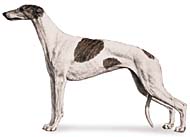 Long and narrow, fairly wide between the ears, scarcely
perceptible stop, little or no development of nasal sinuses, good length of
muzzle, which should be powerful without coarseness. Teeth very strong and even
in front.
Long and narrow, fairly wide between the ears, scarcely
perceptible stop, little or no development of nasal sinuses, good length of
muzzle, which should be powerful without coarseness. Teeth very strong and even
in front.
Ears
Small and fine in texture, thrown back and folded, except when excited, when
they are semi-pricked.
Eyes
Dark, bright, intelligent, indicating spirit.
Neck
Long, muscular, without throatiness, slightly arched, and widening gradually
into the shoulder.
Shoulders
Placed as obliquely as possible, muscular without being loaded.
Forelegs
Perfectly straight, set well into the shoulders, neither turned in nor out,
pasterns strong.
Chest
Deep, and as wide as consistent with speed, fairly well-sprung ribs.
Back
Muscular and broad.
Loins
Good depth of muscle, well arched, well cut up in the flanks.
Hindquarters
Long, very muscular and powerful, wide and well let down, well-bent stifles.
Hocks well bent and rather close to ground, wide but straight fore and aft.
Feet
Hard and close, rather more hare than catfeet, well knuckled up with good
strong claws.
Tail
Long, fine and tapering with a slight upward curve.
Coat
Short, smooth and firm in texture.
Color
Immaterial.
Weight
Dogs, 65 to 70 pounds; bitches 60 to 65 pounds.
SCALE OF POINTS
|
General Symmetry and quality |
10 |
|
Head and neck |
20 |
|
Chest and shoulders |
20 |
|
Back |
10 |
|
Quarters |
20 |
|
Legs and feet |
20 |
|
TOTAL |
100 |
Shiba Inu
Non-Sporting Group
Breed Standard
General Appearance
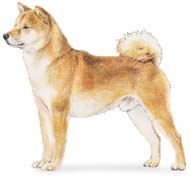 The Shiba is the smallest of the Japanese native breeds of dog
and was originally developed for hunting by sight and scent in the dense
undergrowth of Japan's mountainous areas. Alert and agile with keen senses, he
is also an excellent watchdog and companion. His frame is compact with
well-developed muscles. Males and females are distinctly different in
appearance: males are masculine without coarseness, females are feminine
without weakness of structure.
The Shiba is the smallest of the Japanese native breeds of dog
and was originally developed for hunting by sight and scent in the dense
undergrowth of Japan's mountainous areas. Alert and agile with keen senses, he
is also an excellent watchdog and companion. His frame is compact with
well-developed muscles. Males and females are distinctly different in
appearance: males are masculine without coarseness, females are feminine
without weakness of structure.
Size, Proportion, Substance
Males 14½ inches to 16½ inches at withers. Females 13½ inches to 15½ inches.
The preferred size is the middle of the range for each sex. Average weight at
preferred size is approximately 23 pounds for males, 17 pounds for females.
Males have a height to length ration of 10 to 11, females slightly longer. Bone
is moderate. Disqualification--Males
over 16½ inches in dogs and under 14½ inches. Females over 15½ inches and under
13½ inches.
Head
Expression is good natured with
a strong and confident gaze. Eyes
are somewhat triangular in shape, deep set, and upward slanting toward the
outside base of the ear. Iris is dark brown. Eye rims are black. Ears are triangular in shape, firmly
pricked and small, but in proportion to head and body size. Ears are set well
apart and tilt directly forward with the slant of the back of the ear following
the arch of the neck. Skullsize
is moderate and in proportion to the body. Forehead is broad and flat with a slight furrow. Stop is moderate. Muzzle is firm, full, and round with
a stronger lower jaw projecting from full cheeks. The bridge of the muzzle is straight. Muzzle tapers
slightly from stop to nose tip. Muzzle length is 40% of the total head length
from occiput to nose tip. It is preferred that whiskers remain intact. Lips are tight and black. Nose is black. Bite is scissors, with a full
complement of strong, substantial, evenly aligned teeth.
Serious Fault: Five or more
missing teeth is a very serious fault and must be penalized.
Disqualification--Overshot or
undershot bite.
Neck, Topline and Body
Neck is thick, sturdy, and of
moderate length. Topline is
straight and level to the base of the tail. Body is dry and well muscled without the appearance of
sluggishness or coarseness. Forechest is well developed. Chest depth measured
from the withers to the lowest point of the sternum is one-half or slightly
less than the total height from withers to ground. Ribs are moderately sprung. Abdomen is firm and well tucked-up. Back is firm. Loins are strong. Tail
is thick and powerful and is carried over the back in a sickle or curled
position. A loose single curl or sickle tail pointing vigorously toward the
neck and nearly parallel to the back is preferred. A double curl or sickle tail
pointing upward is acceptable. In length the tail reaches nearly to the hock
joint when extended. Tail is set high.
Forequarters
Shoulder blade and upper arm are moderately anuglated and approximately equal
in length. Elbows are set close to the body and turn neither in nor out.
Forelegs and feet are moderately spaced, straight, and parallel. Pasterns are
slightly inclined. Removal of front dewclaws is optional. Feet are catlike with
well-arched toes fitting tightly together . Pads are thick.
Hindquarters
The angulation of the hindquarters is moderate and in balance with the
angulation of the forequarters. Hind legs are strong with a wide natural
stance. The hock joint is strong, turning neither in nor out. Upper thighs are
long and the second thighs short but well developed. No dewclaws. Feet as in
forequarters.
Coat
Double coated with the outer coat being stiff and straight and the undercoat
soft and thick. Fur is short and even on face, ears, and legs. Guard hairs
stand off the body are about 1½ to 2 inches in length at the withers. Tail hair
is slightly longer and stands open in a brush. It is preferred that the Shiba
be presented in a natural state. Trimming
of the coat must be severely penalized. Serious Fault--Long or woolly
coat.
Color
Coat color is as specified herein, with the three allowed colors given equal
consideration. All colors are clear and intense. The undercoat is cream, buff
or gray.
Urajiro (cream to white ventral
color) is required in the following areas on all coat colors: on the sides of
the muzzle, on the cheeks, inside the ears, on the underjaw and upper throat
inside of legs, on the abdomen, around the vent and the ventral side of the
tail. On reds: commonly on the
throat, forechest, and chest. On blacks
and sesames: commonly as a triangular mark on both sides of the
forechest. White spots above the eyes permitted on all colors but not required.
Bright orange-red with urajiro lending a foxlike appearance to dogs of this
color. Clear red preferred but a very slight dash of black tipping is permitted
on the back and tail.
Black with tan points and
urajiro. Black hairs have a brownish cast, not blue. The undercoat is buff or
gray. The borderline between black and tan areas is clearly defined. Tan points
are located as follows: two oval spots over the eyes: on the sides of the
muzzle between the black bridge of the muzzle and the white cheeks; on the
outside of the forelegs from the carpus, or a little above, downward to the
toes; on the outside of the hind legs down the front of the stifle broadening
from hock joint to toes, but not completely eliminating black from rear of
pasterns. Black penciling on toes permitted. Tan hairs may also be found on the
inside of the ear and on the underside of the tail.
Sesame(black-tipped hairs on a
rich red background) with urajiro. Tipping is light and even on the body and
head with no concentration of black in any area. Sesame areas appear at least
one-half red. Sesame may end in a widow's peak on the forehead, leaving the
bridge and sides of the muzzle red. Eye spots and lower legs are also red.
Clearly delineated white markings are permitted but not required on the tip of
the tail and in the form of socks on the forelegs to the elbow joint, hind legs
to the knee joint. A patch of blaze is permitted on the throat, forechest, or
chest in addition to urajiro.
Serious fault--Cream, white
pinto, or any other color or marking not specified is a very serious fault and
must be penalized.
Gait
Movement is nimble, light, and elastic. At the trot, the legs angle in towards
a center line while the topline remains level and firm. forward reach and rear
extension are moderate and efficient. In the show ring, the Shiba is gaited on
a loose lead at a brisk trot.
Temperament
A spirited boldness, a good nature, and an unaffected forthrightness, which
together yield dignity and natural beauty. The Shiba has an independent nature
and can be reserved toward strangers but is loyal and affectionate to those who
earn his respect. At times aggressive toward other dogs, the Shiba is always
under the control of his handler. Any aggression toward handler or judge or any
overt shyness must be severely penalized.
Summary
The foregoing is a description of the ideal Shiba. Any deviation from the above
standard is to be considered a fault and must be penalized. The severity of the
fault is equal to the extent of the deviation. A harmonious balance of form,
color, movement, and temperament is more critical than any one feature.
DISQUALIFICATIONS
Males over 16½ and under 14½ inches.
Females over 15½ and under 13½ inches.
Overshot or undershot bite.
Approved February 7, 1997
Effective March 31, 1997
Siberian
Husky
Working Group
Breed Standard
General Appearance
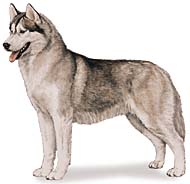 The Siberian Husky is a medium-sized working dog, quick and
light on his feet and free and graceful in action. His moderately compact and
well furred body, erect ears and brush tail suggest his Northern heritage. His
characteristic gait is smooth and seemingly effortless. He performs his
original function in harness most capably, carrying a light load at a moderate
speed over great distances. His body proportions and form reflect this basic
balance of power, speed and endurance. The males of the Siberian Husky breed
are masculine but never coarse; the bitches are feminine but without weakness
of structure. In proper condition, with muscle firm and well developed, the
Siberian Husky does not carry excess weight.
The Siberian Husky is a medium-sized working dog, quick and
light on his feet and free and graceful in action. His moderately compact and
well furred body, erect ears and brush tail suggest his Northern heritage. His
characteristic gait is smooth and seemingly effortless. He performs his
original function in harness most capably, carrying a light load at a moderate
speed over great distances. His body proportions and form reflect this basic
balance of power, speed and endurance. The males of the Siberian Husky breed
are masculine but never coarse; the bitches are feminine but without weakness
of structure. In proper condition, with muscle firm and well developed, the
Siberian Husky does not carry excess weight.
Size, Proportion, Substance
Height--Dogs, 21 to 23½ inches at the withers. Bitches, 20 to 22 inches at the
withers. Weight--Dogs, 45 to 60 pounds. Bitches, 35 to 50 pounds. Weight is in
proportion to height. The measurements mentioned above represent the extreme
height and weight limits with no preference given to either extreme. Any
appearance of excessive bone or weight should be penalized. In profile, the
length of the body from the point of the shoulder to the rear point of the
croup is slightly longer than the height of the body from the ground to the top
of the withers. Disqualification--Dogs
over 23½ inches and bitches over 22 inches.
Head
Expression
is keen, but friendly; interested and even mischievous. Eyes almond shaped, moderately spaced
and set a trifle obliquely. Eyes may be brown or blue in color; one of each or
parti-colored are acceptable. Faults--Eyes set too obliquely; set too
close together. Ears of medium size, triangular in shape, close fitting and set
high on the head. They are thick, well furred, slightly arched at the back, and
strongly erect, with slightly rounded tips pointing straight up. Faults--Ears
too large in proportion to the head; too wide set; not strongly erect. Skull of
medium size and in proportion to the body; slightly rounded on top and tapering
from the widest point to the eyes. Faults--Head clumsy or heavy; head too
finely chiseled. Stop--The stop is well-defined and the bridge of the nose is
straight from the stop to the tip. Fault--Insufficient stop. Muzzle of
medium length; that is, the distance from the tip of the nose to the stop is
equal to the distance from the stop to the occiput. The muzzle is of medium
width, tapering gradually to the nose, with the tip neither pointed nor square.
Faults Muzzle either too snipy
or too coarse; muzzle too short or too long. Nose black in gray, tan or black dogs;
liver in copper dogs; may be flesh-colored in pure white dogs. The
pink-streaked "snow nose" is acceptable. Lips are well pigmented and close
fitting. Teeth
closing in a scissors bite. Fault--Any bite other than scissors.
Neck, Topline, Body
Neck
medium in length, arched and carried proudly erect when dog is standing. When
moving at a trot, the neck is extended so that the head is carried slightly
forward. Faults--Neck
too short and thick; neck too long. Chest deep and strong, but not too broad,
with the deepest point being just behind and level with the elbows. The ribs
are well sprung from the spine but flattened on the sides to allow for freedom
of action. Faults--Chest
too broad; "barrel ribs"; ribs too flat or weak. Back--The
back is straight and strong, with a level topline from withers to croup. It is
of medium length, neither cobby nor slack from excessive length. The loin is
taut and lean, narrower than the rib cage, and with a slight tuck-up. The croup
slopes away from the spine at an angle, but never so steeply as to restrict the
rearward thrust of the hind legs. Faults--Weak or slack back; roached back;
sloping topline.
Tail
The well furred tail of fox-brush shape is set on just below the level of the
topline, and is usually carried over the back in a graceful sickle curve when
the dog is at attention. When carried up, the tail does not curl to either side
of the body, nor does it snap flat against the back. A trailing tail is normal
for the dog when in repose. Hair on the tail is of medium length and
approximately the same length on top, sides and bottom, giving the appearance
of a round brush. Faults--A snapped or tightly curled tail; highly plumed tail;
tail set too low or too high.
Forequarters
Shoulders--The
shoulder blade is well laid back. The upper arm angles slightly backward from
point of shoulder to elbow, and is never perpendicular to the ground. The
muscles and ligaments holding the shoulder to the rib cage are firm and well
developed. Faults--Straight
shoulders; loose shoulders. Forelegs--When standing and viewed from the front, the legs are
moderately spaced, parallel and straight, with the elbows close to the body and
turned neither in nor out. Viewed from the side, pasterns are slightly slanted,
with the pastern joint strong, but flexible. Bone is substantial but never
heavy. Length of the leg from elbow to ground is slightly more than the
distance from the elbow to the top of withers. Dewclaws on forelegs may be
removed. Faults--Weak
pasterns; too heavy bone; too narrow or too wide in the front; out at the
elbows. Feet
oval in shape but not long. The paws are medium in size, compact and well
furred between the toes and pads. The pads are tough and thickly cushioned. The
paws neither turn in nor out when the dog is in natural stance. Faults--Soft
or splayed toes; paws too large and clumsy; paws too small and delicate; toeing
in or out.
Hindquarters
When standing and viewed from the rear, the hind legs are moderately spaced and
parallel. The upper thighs are well muscled and powerful, the stifles well
bent, the hock joint well-defined and set low to the ground. Dewclaws, if any,
are to be removed. Faults--Straight stifles, cow-hocks, too narrow or too wide in
the rear.
Coat
The coat of the Siberian Husky is double and medium in length, giving a well
furred appearance, but is never so long as to obscure the clean-cut outline of
the dog. The undercoat is soft and dense and of sufficient length to support
the outer coat. The guard hairs of the outer coat are straight and somewhat
smooth lying, never harsh nor standing straight off from the body. It should be
noted that the absence of the undercoat during the shedding season is normal.
Trimming of whiskers and fur between the toes and around the feet to present a
neater appearance is permissible. Trimming the fur on any other part of the dog
is not to be condoned and should be severely penalized. Faults--Long, rough, or shaggy coat;
texture too harsh or too silky; trimming of the coat, except as permitted
above.
Color
All colors from black to pure white are allowed. A variety of markings on the
head is common, including many striking patterns not found in other breeds.
Gait
The Siberian Husky's characteristic gait is smooth and seemingly effortless. He
is quick and light on his feet, and when in the show ring should be gaited on a
loose lead at a moderately fast trot, exhibiting good reach in the forequarters
and good drive in the hindquarters. When viewed from the front to rear while
moving at a walk the Siberian Husky does not single-track, but as the speed
increases the legs gradually angle inward until the pads are falling on a line
directly under the longitudinal center of the body. As the pad marks converge,
the forelegs and hind legs are carried straightforward, with neither elbows nor
stifles turned in or out. Each hind leg moves in the path of the foreleg on the
same side. While the dog is gaiting, the topline remains firm and level. Faults--Short,
prancing or choppy gait, lumbering or rolling gait; crossing or crabbing.
Temperament
The characteristic temperament of the Siberian Husky is friendly and gentle,
but also alert and outgoing. He does not display the possessive qualities of
the guard dog, nor is he overly suspicious of strangers or aggressive with
other dogs. Some measure of reserve and dignity may be expected in the mature
dog. His intelligence, tractability, and eager disposition make him an
agreeable companion and willing worker.
Summary
The most important breed characteristics of the Siberian Husky are medium size,
moderate bone, well balanced proportions, ease and freedom of movement, proper
coat, pleasing head and ears, correct tail, and good disposition. Any appearance
of excessive bone or weight, constricted or clumsy gait, or long, rough coat
should be penalized. The Siberian Husky never appears so heavy or coarse as to
suggest a freighting animal; nor is he so light and fragile as to suggest a
sprint-racing animal. In both sexes the Siberian Husky gives the appearance of
being capable of great endurance. In addition to the faults already noted, the
obvious structural faults common to all breeds are as undesirable in the
Siberian Husky as in any other breed, even though they are not specifically
mentioned herein.
DISQUALIFICATION
Dogs over 23½ inches and bitches over
22 inches.
Approved October 9, 1990
Effective November 28, 1990
Doberman
Pinscher
Working Group
Breed Standard
General Appearance
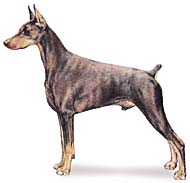 The appearance is that of a dog of medium size, with a body that is
square. Compactly built, muscular and powerful, for great endurance and speed.
Elegant in appearance, of proud carriage, reflecting great nobility and
temperament. Energetic, watchful, determined, alert, fearless, loyal and
obedient.
The appearance is that of a dog of medium size, with a body that is
square. Compactly built, muscular and powerful, for great endurance and speed.
Elegant in appearance, of proud carriage, reflecting great nobility and
temperament. Energetic, watchful, determined, alert, fearless, loyal and
obedient.
Size, Proportion, Substance
Height at the withers: Dogs 26 to 28 inches, ideal about 27½ inches; Bitches 24
to 26 inches, ideal about 25½ inches. The height, measured vertically from the
ground to the highest point of the withers, equalling the length measured
horizontally from the forechest to the rear projection of the upper thigh.
Length of head, neck and legs in proportion to length and depth of body.
Head
Long and dry, resembling a blunt wedge in both frontal and profile views. When
seen from the front, the head widens gradually toward the base of the ears in a
practically unbroken line. Eyes almond shaped, moderately deep set, with
vigorous, energetic expression. Iris, of uniform color, ranging from medium to
darkest brown in black dogs; in reds, blues, and fawns the color of the iris
blends with that of the markings, the darkest shade being preferable in every
case. Ears normally cropped and carried erect. The upper attachment of the ear,
when held erect, is on a level with the top of the skull.
Top of skull flat, turning with slight stop to bridge of muzzle, with muzzle
line extending parallel to top line of skull. Cheeks flat and muscular. Nose
solid black on black dogs, dark brown on red ones, dark gray on blue ones, dark
tan on fawns. Lips lying close to jaws. Jaws full and powerful, well filled
under the eyes.
Teeth strongly developed and white. Lower incisors upright and touching inside
of upper incisors a true scissors bite. 42 correctly placed teeth, 22 in the
lower, 20 in the upper jaw. Distemper teeth shall not be penalized.
Disqualifying Faults: Overshot more than 3/16 of an inch. Undershot more than
1/8 of an inch. Four or more missing teeth.
Neck, Topline, Body
Neck proudly carried, well muscled and dry. Well arched, with nape of neck
widening gradually toward body. Length of neck proportioned to body and head.
Withers pronounced and forming the highest point of the body. Back short, firm,
of sufficient width, and muscular at the loins, extending in a straight line
from withers to the slightly rounded croup.
Chest broad with forechest well defined. Ribs well sprung from the spine, but
flattened in lower end to permit elbow clearance. Brisket reaching deep to the
elbow. Belly well tucked up, extending in a curved line from the brisket. Loins
wide and muscled. Hips broad and in proportion to body, breadth of hips being
approximately equal to breadth of body at rib cage and shoulders.
Tail docked at approximately second joint, appears to be a continuation of the
spine, and is carried only slightly above the horizontal when the dog is alert.
Forequarters
Shoulder Blade sloping forward and downward at a 45-degree angle to the ground
meets the upper arm at an angle of 90 degrees. Length of shoulder blade and
upper arm are equal. Height from elbow to withers approximately equals height
from ground to elbow. Legs seen from front and side, perfectly straight and
parallel to each other from elbow to pastern; muscled and sinewy, with heavy
bone. In normal pose and when gaiting, the elbows lie close to the brisket.
Pasterns firm and almost perpendicular to the ground. Dewclaws may be removed.
Feet well arched, compact, and catlike, turning neither in nor out.
Hindquarters
The angulation of the hindquarters balances that of the forequarters. Hip Bone
falls away from spinal column at an angle of about 30 degrees, producing a
slightly rounded, well filled-out croup. Upper Shanks at right angles to the
hip bones, are long, wide, and well muscled on both sides of thigh, with
clearly defined stifles. Upper and lower shanks are of equal length. While the
dog is at rest, hock to heel is perpendicular to the ground. Viewed from the
rear, the legs are straight, parallel to each other, and wide enough apart to
fit in with a properly built body. Dewclaws, if any, are generally removed. Cat
feet as on front legs, turning neither in nor out.
Coat
Smooth-haired, short, hard, thick and close lying. Invisible gray undercoat on
neck permissible.
Color and Markings
Allowed Colors: Black, red, blue, and fawn (Isabella). Markings: Rust, sharply
defined, appearing above each eye and on muzzle, throat and forechest, on all
legs and feet, and below tail. White patch on chest, not exceeding 1/2 square
inch, permissible. Disqualifying Fault: Dogs not of an allowed color.
Gait
Free, balanced, and vigorous, with good reach in the forequarters and good
driving power in the hindquarters. When trotting, there is strong rear-action
drive. Each rear leg moves in line with the foreleg on the same side. Rear and
front legs are thrown neither in nor out. Back remains strong and firm. When
moving at a fast trot, a properly built dog will single-track.
Temperament
Energetic, watchful, determined, alert, fearless, loyal and obedient. The judge
shall dismiss from the ring any shy or vicious Doberman.
Shyness: A dog shall be judged fundamentally shy if, refusing to stand for
examination, it shrinks away from the judge; if it fears an approach from the
rear; if it shies at sudden and unusual noises to a marked degree.
Viciousness: A dog that attacks or attempts to attack either the judge or its
handler, is definitely vicious. An aggressive or belligerent attitude towards
other dogs shall not be deemed viciousness.
Faults
The foregoing description is that of the ideal Doberman Pinscher. Any deviation
from the above described dog must be penalized to the extent of the deviation.
DISQUALIFICATIONS
Overshot more than 3/16 of an inch, undershot more than 1/8 of an inch. Four or
more missing teeth. Dogs not of an allowed color.
Approved February 6, 1982
Reformatted November 6, 1990
Weimaraner
Sporting Group
Breed Standard
General Appearance
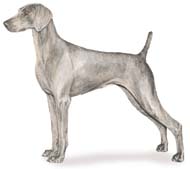 A medium-sized gray dog, with fine aristocratic features. He
should present a picture of grace, speed, stamina, alertness and balance. Above
all, the dog's conformation must indicate the ability to work with great speed
and endurance in the field.
A medium-sized gray dog, with fine aristocratic features. He
should present a picture of grace, speed, stamina, alertness and balance. Above
all, the dog's conformation must indicate the ability to work with great speed
and endurance in the field.
Height
Height at the withers: dogs, 25 to 27 inches; bitches, 23 to 25 inches.
One inch over or under the specified height of each sex is allowable but should
be penalized. Dogs measuring less than 24 inches or more than 28 inches and
bitches measuring less than 22 inches or more than 26 inches shall be
disqualified.
Head
Moderately long and aristocratic, with moderate stop and slight median
line extending back over the forehead. Rather prominent occipital bone and
trumpets well set back, beginning at the back of the eye sockets. Measurement
from tip of nose to stop equals that from stop to occipital bone. The flews
should be straight, delicate at the nostrils. Skin drawn tightly. Neck
clean-cut and moderately long. Expression kind, keen and intelligent. Ears--Long
and lobular, slightly folded and set high. The ear when drawn snugly alongside
the jaw should end approximately 2 inches from the point of the nose. Eyes--In
shades of light amber, gray or blue-gray, set well enough apart to indicate
good disposition and intelligence. When dilated under excitement the eyes may
appear almost black. Teeth--Well set, strong and even; well-developed and
proportionate to jaw with correct scissors bite, the upper teeth protruding
slightly over the lower teeth but not more than 1/16 of an inch. Complete
dentition is greatly to be desired. Nose--Gray. Lips and Gums--Pinkish
flesh shades.
Body
The back should be moderate in length, set in a straight line, strong,
and should slope slightly from the withers. The chest should be well developed
and deep with shoulders well laid back. Ribs well sprung and long. Abdomen
firmly held; moderately tucked-up flank. The brisket should extend to the
elbow.
Coat and Color
Short, smooth and sleek, solid color, in shades of mouse-gray to silver-gray,
usually blending to lighter shades on the head and ears. A small white marking
on the chest is permitted, but should be penalized on any other portion of the
body. White spots resulting from injury should not be penalized. A distinctly
long coat is a disqualification. A distinctly blue or black coat is a
disqualification.
Forelegs
Straight and strong, with the measurement from the elbow to the ground
approximately equaling the distance from the elbow to the top of the withers.
Hindquarters
Well-angulated stifles and straight hocks. Musculation well developed.
Feet
Firm and compact, webbed, toes well arched, pads closed and thick, nails
short and gray or amber in color. Dewclaws--Should be removed.
Tail
Docked. At maturity it should measure approximately 6 inches with a
tendency to be light rather than heavy and should be carried in a manner
expressing confidence and sound temperament. A non-docked tail shall be
penalized.
Gait
The gait should be effortless and should indicate smooth coordination.
When seen from the rear, the hind feet should be parallel to the front feet.
When viewed from the side, the topline should remain strong and level.
Temperament
The temperament should be friendly, fearless, alert and obedient.
FAULTS
Minor Faults--Tail
too short or too long. Pink nose.
Major Faults--Doggy
bitches. Bitchy dogs. Improper muscular condition. Badly affected teeth. More
than four teeth missing. Back too long or too short. Faulty coat. Neck too
short, thick or throaty. Low-set tail. Elbows in or out. Feet east and west.
Poor gait. Poor feet. Cowhocks. Faulty backs, either roached or sway. Badly
overshot, or undershot bite. Snipy muzzle. Short ears.
Very Serious
Faults--White, other than a spot on the chest. Eyes other than gray,
blue-gray or light amber. Black mottled mouth. Non-docked tail. Dogs exhibiting
strong fear, shyness or extreme nervousness.
DISQUALIFICATIONS
Deviation in height of more than one
inch from standard either way.
A distinctly long coat. A distinctly blue or black coat.
Approved December 14, 1971
Labrador Retriever
Sporting Group
Breed Standard
General Appearance
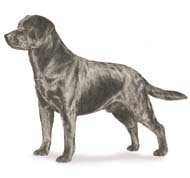 The
Labrador Retriever is a strongly built, medium-sized, short-coupled, dog
possessing a sound, athletic, well-balanced conformation that enables it to
function as a retrieving gun dog; the substance and soundness to hunt waterfowl
or upland game for long hours under difficult conditions; the character and
quality to win in the show ring; and the temperament to be a family companion.
Physical features and mental characteristics should denote a dog bred to
perform as an efficient Retriever of game with a stable temperament suitable
for a variety of pursuits beyond the hunting environment.
The
Labrador Retriever is a strongly built, medium-sized, short-coupled, dog
possessing a sound, athletic, well-balanced conformation that enables it to
function as a retrieving gun dog; the substance and soundness to hunt waterfowl
or upland game for long hours under difficult conditions; the character and
quality to win in the show ring; and the temperament to be a family companion.
Physical features and mental characteristics should denote a dog bred to
perform as an efficient Retriever of game with a stable temperament suitable
for a variety of pursuits beyond the hunting environment.
The most distinguishing characteristics of the Labrador Retriever are its
short, dense, weather resistant coat; an "otter" tail; a clean-cut
head with broad back skull and moderate stop; powerful jaws; and its
"kind," friendly eyes, expressing character, intelligence and good
temperament.
Above all, a Labrador Retriever must be well balanced, enabling it to move in
the show ring or work in the field with little or no effort. The typical
Labrador possesses style and quality without over refinement, and substance
without lumber or cloddiness. The Labrador is bred primarily as a working gun
dog; structure and soundness are of great importance.
Size, Proportion and Substance
Size--The height at the withers
for a dog is 22½ to 24½ inches; for a bitch is 21½ to 23½ inches. Any variance
greater than ½ inch above or below these heights is a disqualification.
Approximate weight of dogs and bitches in working condition: dogs 65 to 80
pounds; bitches 55 to 70 pounds.
The minimum height ranges set forth in the paragraph above shall not apply to
dogs or bitches under twelve months of age.
Proportion--Short-coupled;
length from the point of the shoulder to the point of the rump is equal to or
slightly longer than the distance from the withers to the ground. Distance from
the elbow to the ground should be equal to one half of the height at the
withers. The brisket should extend to the elbows, but not perceptibly deeper.
The body must be of sufficient length to permit a straight, free and efficient
stride; but the dog should never appear low and long or tall and leggy in
outline. Substance--Substance
and bone proportionate to the overall dog. Light, "weedy" individuals
are definitely incorrect; equally objectionable are cloddy lumbering specimens.
Labrador Retrievers shall be shown in working condition well-muscled and
without excess fat.
Head
Skull--The skull should be
wide; well developed but without exaggeration. The skull and foreface should be
on parallel planes and of approximately equal length. There should be a
moderate stop--the brow slightly pronounced so that the skull is not absolutely
in a straight line with the nose. The brow ridges aid in defining the stop. The
head should be clean-cut and free from fleshy cheeks; the bony structure of the
skull chiseled beneath the eye with no prominence in the cheek. The skull may
show some median line; the occipital bone is not conspicuous in mature dogs.
Lips should not be squared off or pendulous, but fall away in a curve toward
the throat. A wedge-shape head, or a head long and narrow in muzzle and back
skull is incorrect as are massive, cheeky heads. The jaws are powerful and free
from snippiness-- the muzzle neither long and narrow nor short and stubby. Nose-- The nose should be wide and
the nostrils well-developed. The nose should be black on black or yellow dogs,
and brown on chocolates. Nose color fading to a lighter shade is not a fault. A
thoroughly pink nose or one lacking in any pigment is a disqualification. Teeth--The teeth should be strong and
regular with a scissors bite; the lower teeth just behind, but touching the
inner side of the upper incisors. A level bite is acceptable, but not
desirable. Undershot, overshot, or misaligned teeth are serious faults. Full
dentition is preferred. Missing molars or pre-molars are serious faults. Ears--The ears should hang moderately
close to the head, set rather far back, and somewhat low on the skull; slightly
above eye level. Ears should not be large and heavy, but in proportion with the
skull and reach to the inside of the eye when pulled forward. Eyes--Kind, friendly eyes imparting
good temperament, intelligence and alertness are a hallmark of the breed. They
should be of medium size, set well apart, and neither protruding nor deep set.
Eye color should be brown in black and yellow Labradors, and brown or hazel in
chocolates. Black, or yellow eyes give a harsh expression and are undesirable.
Small eyes, set close together or round prominent eyes are not typical of the
breed. Eye rims are black in black and yellow Labradors; and brown in
chocolates. Eye rims without pigmentation is a disqualification.
Neck, Topline and Body
Neck--The neck should be of
proper length to allow the dog to retrieve game easily. It should be muscular
and free from throatiness. The neck should rise strongly from the shoulders
with a moderate arch. A short, thick neck or a "ewe" neck is
incorrect. Topline--The back is
strong and the topline is level from the withers to the croup when standing or
moving. However, the loin should show evidence of flexibility for athletic
endeavor. Body--The Labrador
should be short-coupled, with good spring of ribs tapering to a moderately wide
chest. The Labrador should not be narrow chested; giving the appearance of
hollowness between the front legs, nor should it have a wide spreading,
bulldog-like front. Correct chest conformation will result in tapering between
the front legs that allows unrestricted forelimb movement. Chest breadth that
is either too wide or too narrow for efficient movement and stamina is
incorrect. Slab-sided individuals are not typical of the breed; equally
objectionable are rotund or barrel chested specimens. The underline is almost
straight, with little or no tuck-up in mature animals. Loins should be short,
wide and strong; extending to well developed, powerful hindquarters. When
viewed from the side, the Labrador Retriever shows a well-developed, but not
exaggerated forechest. Tail--The
tail is a distinguishing feature of the breed. It should be very thick at the
base, gradually tapering toward the tip, of medium length, and extending no
longer than to the hock. The tail should be free from feathering and clothed thickly
all around with the Labrador's short, dense coat, thus having that peculiar
rounded appearance that has been described as the "otter" tail. The
tail should follow the topline in repose or when in motion. It may be carried
gaily, but should not curl over the back. Extremely short tails or long thin
tails are serious faults. The tail completes the balance of the Labrador by
giving it a flowing line from the top of the head to the tip of the tail.
Docking or otherwise altering the length or natural carriage of the tail is a
disqualification.
Forequarters
Forequarters should be muscular, well coordinated and balanced with the
hindquarters. Shoulders--The
shoulders are well laid-back, long and sloping, forming an angle with the upper
arm of approximately 90 degrees that permits the dog to move his forelegs in an
easy manner with strong forward reach. Ideally, the length of the shoulder
blade should equal the length of the upper arm. Straight shoulder blades, short
upper arms or heavily muscled or loaded shoulders, all restricting free
movement, are incorrect. Front Legs--When
viewed from the front, the legs should be straight with good strong bone. Too
much bone is as undesirable as too little bone, and short legged, heavy boned
individuals are not typical of the breed. Viewed from the side, the elbows
should be directly under the withers, and the front legs should be
perpendicular to the ground and well under the body. The elbows should be close
to the ribs without looseness. Tied-in elbows or being "out at the
elbows" interfere with free movement and are serious faults. Pasterns
should be strong and short and should slope slightly from the perpendicular
line of the leg. Feet are strong and compact, with well-arched toes and
well-developed pads. Dew claws may be removed. Splayed feet, hare feet,
knuckling over, or feet turning in or out are serious faults.
Hindquarters
The Labrador's hindquarters are broad, muscular and well-developed from the hip
to the hock with well-turned stifles and strong short hocks. Viewed from the
rear, the hind legs are straight and parallel. Viewed from the side, the
angulation of the rear legs is in balance with the front. The hind legs are
strongly boned, muscled with moderate angulation at the stifle, and powerful,
clearly defined thighs. The stifle is strong and there is no slippage of the
patellae while in motion or when standing. The hock joints are strong, well let
down and do not slip or hyper-extend while in motion or when standing.
Angulation of both stifle and hock joint is such as to achieve the optimal
balance of drive and traction. When standing the rear toes are only slightly
behind the point of the rump. Over angulation produces a sloping topline not
typical of the breed. Feet are strong and compact, with well-arched toes and
well-developed pads. Cow-hocks, spread hocks, sickle hocks and over-angulation
are serious structural defects and are to be faulted.
Coat
The coat is a distinctive feature of the Labrador Retriever. It should be
short, straight and very dense, giving a fairly hard feeling to the hand. The
Labrador should have a soft, weather-resistant undercoat that provides
protection from water, cold and all types of ground cover. A slight wave down
the back is permissible. Woolly coats, soft silky coats, and sparse slick coats
are not typical of the breed, and should be severely penalized.
Color
The Labrador Retriever coat colors are black, yellow and chocolate. Any other
color or a combination of colors is a disqualification. A small white spot on
the chest is permissible, but not desirable. White hairs from aging or scarring
are not to be misinterpreted as brindling. Black--Blacks are all black. A black with brindle markings or a
black with tan markings is a disqualification. Yellow--Yellows may range in color from fox-red to light cream,
with variations in shading on the ears, back, and underparts of the dog. Chocolate--Chocolates can vary in
shade from light to dark chocolate. Chocolate with brindle or tan markings is a
disqualification.
Movement
Movement of the Labrador Retriever should be free and effortless. When watching
a dog move toward oneself, there should be no sign of elbows out. Rather, the
elbows should be held neatly to the body with the legs not too close together.
Moving straight forward without pacing or weaving, the legs should form
straight lines, with all parts moving in the same plane. Upon viewing the dog
from the rear, one should have the impression that the hind legs move as nearly
as possible in a parallel line with the front legs. The hocks should do their
full share of the work, flexing well, giving the appearance of power and
strength. When viewed from the side, the shoulders should move freely and
effortlessly, and the foreleg should reach forward close to the ground with extension.
A short, choppy movement or high knee action indicates a straight shoulder;
paddling indicates long, weak pasterns; and a short, stilted rear gait
indicates a straight rear assembly; all are serious faults. Movement faults
interfering with performance including weaving; side-winding; crossing over;
high knee action; paddling; and short, choppy movement, should be severely
penalized.
Temperament
True Labrador Retriever temperament is as much a hallmark of the breed as the
"otter" tail. The ideal disposition is one of a kindly, outgoing,
tractable nature; eager to please and non-aggressive towards man or animal. The
Labrador has much that appeals to people; his gentle ways, intelligence and
adaptability make him an ideal dog. Aggressiveness towards humans or other
animals, or any evidence of shyness in an adult should be severely penalized.
Disqualifications
1. Any deviation from the height prescribed in the
Standard.
2. A thoroughly pink nose or one lacking in any
pigment.
3. Eye rims without pigment.
4. Docking or otherwise altering the length or natural
carriage of the tail.
5. Any other color or a combination of colors other
than black, yellow or chocolate as described in the Standard.
Approved February 12, 1994
Effective March 31, 1994
Alaskan Malamute
Working Group
Breed Standard
General Appearance
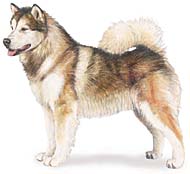 The
Alaskan Malamute, one of the oldest Arctic sled dogs, is a powerful and
substantially built dog with a deep chest and strong, well-muscled body. The
Malamute stands well over the pads, and this stance gives the appearance of
much activity and a proud carriage, with head erect and eyes alert showing
interest and curiosity. The head is broad. Ears are triangular and erect when
alerted. The muzzle is bulky, only slight diminishing in width from root to
nose. The muzzle is not pointed or long, yet not stubby. The coat is thick with
a coarse guard coat of sufficient length to protect a woolly undercoat.
Malamutes are of various colors. Face markings are a distinguishing feature.
These consist of a cap over the head, the face either all white or marked with
a bar and/or mask. The tail is well furred, carried over the back, and has the
appearance of a waving plume.
The
Alaskan Malamute, one of the oldest Arctic sled dogs, is a powerful and
substantially built dog with a deep chest and strong, well-muscled body. The
Malamute stands well over the pads, and this stance gives the appearance of
much activity and a proud carriage, with head erect and eyes alert showing
interest and curiosity. The head is broad. Ears are triangular and erect when
alerted. The muzzle is bulky, only slight diminishing in width from root to
nose. The muzzle is not pointed or long, yet not stubby. The coat is thick with
a coarse guard coat of sufficient length to protect a woolly undercoat.
Malamutes are of various colors. Face markings are a distinguishing feature.
These consist of a cap over the head, the face either all white or marked with
a bar and/or mask. The tail is well furred, carried over the back, and has the
appearance of a waving plume.
The Malamute must be a heavy boned dog with sound legs, good feet, deep chest
and powerful shoulders, and have all of the other physical attributes necessary
for the efficient performance of his job. The gait must be steady, balanced,
tireless and totally efficient. He is not intended as a racing sled dog
designed to compete in speed trials. The Malamute is structured for strength
and endurance, and any characteristic of the individual specimen, including
temperament, which interferes with the accomplishment of this purpose, is to be
considered the most serious of faults.
Size, Proportion, Substance
There is a natural range in size in the breed. The desirable freighting sizes
are males, 25 inches at the shoulders, 85 pounds; females, 23 inches at the
shoulders, 75 pounds. However, size consideration should not outweigh that of
type, proportion, movement and other functional attributes. When dogs are
judged equal in type, proportion, movement, the dog nearest the desirable
freighting size is to be preferred. The depth of chest is approximately one
half the height of the dog at the shoulders, the deepest point being just
behind the forelegs. The length of the body from point of shoulder to the rear
point of pelvis is longer than the height of the body from ground to top of the
withers. The body carries no excess weight, and bone is in proportion to size.
Head
The head is broad and deep, not coarse or clumsy, but in proportion to the size
of the dog. The expression is soft and indicates an affectionate disposition.
The eyes are obliquely placed in the skull. Eyes are brown, almond shaped and of
medium size. Dark eyes are preferred. Blue
Eyes are a Disqualifying Fault. The ears are of medium size, but small in proportion to the head. The
ears are triangular in shape and slightly rounded at the tips. They are set
wide apart on the outside back edges of the skull on line with the upper corner
of the eye, giving ears the appearance, when erect, of standing off from the
skull. Erect ears point slightly forward, but when the dog is at work, the ears
are sometimes folded against the skull. High set ears are a fault.
The skull is broad and
moderately rounded between the ears, gradually narrowing and flattening on top
as it approaches the eyes, rounding off to cheeks that are moderately flat.
There is a slight furrow between the eyes. The topline of the skull and the
topline of the muzzle show a slight break downward from a straight line as they
join. The muzzle is large and
bulky in proportion to the size of the skull, diminishing slightly in width and
depth from junction with the skull to the nose. In all coat colors, except
reds, the nose, lips, and eye rims' pigmentation is black.
Brown is permitted in red dogs. The lighter streaked "snow nose" is
acceptable. The lips are close fitting. The upper and lower jaws are broad with
large teeth. The incisors meet with a scissors grip. Overshot or undershot is a
fault.
Neck, Topline, Body
The neck is strong and moderately arched. The chest is well developed. The body
is compactly built but not short coupled. The back is straight and gently
sloping to the hips. The loins are hard and well muscled. A long loin that may
weaken the back is a fault. The tail is
moderately set and follows the line of the spine at the base. The tail is
carried over the back when not working. It is not a snap tail or curled tight
against the back, nor is it short furred like a fox brush. The Malamute tail is
well furred and has the appearance of a waving plume.
Forequarters
The shoulders are moderately sloping; forelegs heavily boned and muscled,
straight to the pasterns when viewed from the front. Pasterns are short and
strong and slightly sloping when viewed from the side. The feet are of the
snowshoe type, tight and deep, with well-cushioned pads, giving a firm, compact
appearance. The feet are large, toes tight fitting and well arched. There is a
protective growth of hair between the toes. The pads are thick and tough;
toenails short and strong.
Hindquarters
The rear legs are broad and heavily muscled through the thighs; stifles
moderately bent; hock joints are moderately bent and well let down. When viewed
from the rear, the legs stand and move true in line with the movement of the
front legs, not too close or too wide. Dewclaws on the rear legs are
undesirable and should be removed shortly after puppies are whelped.
Coat
The Malamute has a thick, coarse guard coat, never long and soft. The undercoat
is dense, from one to two inches in depth, oily and woolly. The coarse guard
coat varies in length as does the undercoat. The coat is relatively short to
medium along the sides of the body, with the length of the coat increasing
around the shoulders and neck, down the back, over the rump, and in the
breeching and plume. Malamutes usually have a shorter and less dense coat
during the summer months. The Malamute is shown naturally. Trimming is not
acceptable except to provide a clean cut appearance of feet.
Color
The usual colors range from light gray through intermediate shadings to black,
sable, and shadings of sable to red. Color combinations are acceptable in
undercoats, points, and trimmings. The only solid color allowable is all white.
White is always the predominant color on underbody, parts of legs, feet, and
part of face markings. A white blaze on the forehead and/or collar or a spot on
the nape is attractive and acceptable. The Malamute is mantled, and broken
colors extending over the body or uneven splashing are undesirable.
Gait
The gait of the Malamute is steady, balanced, and powerful. He is agile for his
size and build. When viewed from the side, the hindquarters exhibit strong rear
drive that is transmitted through a well-muscled loin to the forequarters. The
forequarters receive the drive from the rear with a smooth reaching stride.
When viewed from the front or from the rear, the legs move true in line, not
too close or too wide. At a fast trot, the feet will converge toward the
centerline of the body. A stilted gait, or any gait that is not completely
efficient and tireless, is to be penalized.
Temperament
The Alaskan Malamute is an affectionate, friendly dog, not a "one
man" dog. He is a loyal, devoted companion, playful in invitation, but
generally impressive by his dignity after maturity.
Summary
IMPORTANT: In judging Malamutes, their function as a sledge dog for heavy
freighting in the Arctic must be given consideration above all else. The degree
to which a dog is penalized should depend upon the extent to which the dog
deviates from the description of the ideal Malamute and the extent to which the
particular fault would actually affect the working ability of the dog. The legs
of the Malamute must indicate unusual strength and tremendous propelling power.
Any indication of unsoundness in legs and feet, front or rear, standing or
moving, is to be considered a serious fault. Faults under this provision would
be splay-footedness, cowhocks, bad pasterns, straight shoulders, lack of
angulation, stilted gait (or any gait that isn't balanced, strong and steady),
ranginess, shallowness, ponderousness, lightness of bone, and poor overall
proportion.
Disqualifications
Blue Eyes
Approved April 12, 1994
Effective May 31, 1994
Australian Shepherd
Herding Group
Breed Standard
General Appearance
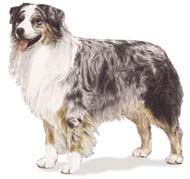 The
Australian Shepherd is an intelligent working dog of strong herding and
guarding instincts. He is a loyal companion and has the stamina to work all
day. He is well balanced, slightly longer than tall, of medium size and bone,
with coloring that offers variety and individuality. He is attentive and
animated, lithe and agile, solid and muscular without cloddiness. He has a coat
of moderate length and coarseness. He has a docked or natural bobbed tail.
The
Australian Shepherd is an intelligent working dog of strong herding and
guarding instincts. He is a loyal companion and has the stamina to work all
day. He is well balanced, slightly longer than tall, of medium size and bone,
with coloring that offers variety and individuality. He is attentive and
animated, lithe and agile, solid and muscular without cloddiness. He has a coat
of moderate length and coarseness. He has a docked or natural bobbed tail.
Size, Proportion, Substance
Size--The preferred height for
males is 20-23 inches, females 18-21 inches. Quality is not to be sacrificed in
favor of size. Proportion--Measuring
from the breastbone to rear of thigh and from top of the withers to the ground
the Australian Shepherd is slightly longer than tall. Substance--Solidly built with moderate bone. Structure in the
male reflects masculinity without coarseness. Bitches appear feminine without
being slight of bone.
Head
The Head is clean cut, strong
and dry. Overall size should be in proportion to the body. The muzzle is equal
in length or slightly shorter than the back skull. Viewed from the side the
topline of the back skull and muzzle form parallel planes, divided by a
moderate, well-defined stop. The muzzle tapers little from base to nose and is
rounded at the tip.
Expression --Showing
attentiveness and intelligence, alert and eager. Gaze should be keen but
friendly. Eyes are brown, blue,
amber or any variation or combination thereof, including flecks and marbling.
Almond shaped, not protruding nor sunken. The blue merles and blacks have black
pigmentation on eye rims. The red merles and reds have liver (brown)
pigmentation on eye rims. Ears
are triangular, of moderate size and leather, set high on the head. At full
attention they break forward and over, or to the side as a rose ear. Prick ears
and hanging ears are severe faults.
Skull Top flat to slightly
domed. It may show a slight occipital protuberance. Length and width are equal.
Moderate well-defined stop. Muzzle
tapers little from base to nose and is rounded at the tip.
Nose--Blue merles and blacks
have black pigmentation on the nose (and lips). Red merles and reds have liver
(brown) pigmentation on the nose (and lips). On the merles it is permissible to
have small pink spots; however, they should not exceed 25% of the nose on dogs
over one year of age, which is a serious
fault. Teeth--A full
complement of strong white teeth should meet in a scissors bite or may meet in
a level bite. Disqualifications--Undershot.
Overshot greater than 1/8 inch. Loss of contact caused by short center incisors
in an otherwise correct bite shall not be judged undershot. Teeth broken or
missing by accident shall not be penalized.
Neck, Topline, Body
Neck is strong, of moderate
length, slightly arched at the crest, fitting well into the shoulders. Topline--Back is straight and strong,
level and firm from withers to hip joints. The croup is moderately sloped. Chest is not broad but is deep with
the lowest point reaching the elbow. The ribs are well sprung and long, neither
barrel chested nor slab-sided. The underline shows a moderate tuck-up. Tail is straight, docked or naturally
bobbed, not to exceed four inches in length.
Forequarters
Shoulders--Shoulder blades are
long, flat, fairly close set at the withers and well laid back. The upper arm,
which should be relatively the same length as the shoulder blade, attaches at
an approximate right angle to the shoulder line with forelegs dropping
straight, perpendicular to the ground. Legs
straight and strong. Bone is strong, oval rather than round. Pastern is medium length and very
slightly sloped. Front dewclaws may be removed. Feet are oval, compact with close knit, well arched toes. Pads
are thick and resilient.
Hindquarters
The width of the hindquarters is equal to the width of the forequarters at the
shoulders. The angulation of the pelvis and upper thigh corresponds to the
angulation of the shoulder blade and upper arm, forming an approximate right
angle. Stifles are clearly
defined, hock joints moderately bent. The hocks are short, perpendicular to the
ground and parallel to each other when viewed from the rear. Rear dewclaws must
be removed. Feet
are oval, compact with close knit, well arched toes. Pads are thick and
resilient.
Coat
Hair is of medium texture, straight to wavy, weather resistant and of medium
length. The undercoat varies in quantity with variations in climate. Hair is
short and smooth on the head, ears, front of forelegs and below the hocks.
Backs of forelegs and britches are moderately feathered. There is a moderate
mane and frill, more pronounced in dogs than in bitches. Non-typical coats are severe faults.
Color
Blue merle, black, red merle, red-all with or without white markings and/or tan
(copper) points, with no order of preference. The hairline of a white collar
does not exceed the point of the withers at the skin. White is acceptable on the
neck (either in part or as a full collar), chest, legs, muzzle underparts,
blaze on head and white extension from underpart up to four inches, measuring
from a horizontal line at the elbow. White on the head should not predominate,
and the eyes must be fully surrounded by color and pigment. Merles
characteristically become darker with increasing age. Disqualifications White body splashes,
which means white on body between withers and tail, on sides between elbows and
back of hindquarters in all colors.
Gait
The Australian Shepherd has a smooth, free and easy gait. He exhibits great
agility of movement with a well-balanced, ground covering stride. Fore and hind
legs move straight and parallel with the center line of the body. As speed
increases, the feet (front and rear) converge toward the center line of gravity
of the dog while the back remains firm and level. The Australian Shepherd must
be agile and able to change direction or alter gait instantly.
Temperament
The Australian Shepherd is an intelligent, active dog with an even disposition;
he is good natured, seldom quarrelsome. He may be somewhat reserved in initial
meetings. Faults Any display of
shyness, fear or aggression is to be severely penalized.
Disqualifications
Undershot. Overshot greater than 1/8 inch.
White body splashes, which means white on body between withers and tail, on
sides between elbows and back of hindquarters in all colors.
Approved May 14, 1991
Effective January 1, 1993
German Shepherd Dog
Herding Group
Breed Standard
General Appearance
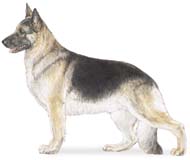 The
first impression of a good German Shepherd Dog is that of a strong, agile, well
muscled animal, alert and full of life. It is well balanced, with harmonious
development of the forequarter and hindquarter. The dog is longer than tall,
deep-bodied, and presents an outline of smooth curves rather than angles. It
looks substantial and not spindly, giving the impression, both at rest and in
motion, of muscular fitness and nimbleness without any look of clumsiness or
soft living. The ideal dog is stamped with a look of quality and
nobility--difficult to define, but unmistakable when present. Secondary sex
characteristics are strongly marked, and every animal gives a definite
impression of masculinity or femininity, according to its sex.
The
first impression of a good German Shepherd Dog is that of a strong, agile, well
muscled animal, alert and full of life. It is well balanced, with harmonious
development of the forequarter and hindquarter. The dog is longer than tall,
deep-bodied, and presents an outline of smooth curves rather than angles. It
looks substantial and not spindly, giving the impression, both at rest and in
motion, of muscular fitness and nimbleness without any look of clumsiness or
soft living. The ideal dog is stamped with a look of quality and
nobility--difficult to define, but unmistakable when present. Secondary sex
characteristics are strongly marked, and every animal gives a definite
impression of masculinity or femininity, according to its sex.
Temperament
The breed has a distinct personality marked by direct and fearless, but not
hostile, expression, self-confidence and a certain aloofness that does not lend
itself to immediate and indiscriminate friendships. The dog must be approachable,
quietly standing its ground and showing confidence and willingness to meet
overtures without itself making them. It is poised, but when the occasion
demands, eager and alert; both fit and willing to serve in its capacity as
companion, watchdog, blind leader, herding dog, or guardian, whichever the
circumstances may demand. The dog must not be timid, shrinking behind its
master or handler; it should not be nervous, looking about or upward with
anxious expression or showing nervous reactions, such as tucking of tail, to
strange sounds or sights. Lack of confidence under any surroundings is not
typical of good character. Any of the above deficiencies in character which
indicate shyness must be penalized as very serious faults and any dog exhibiting pronounced indications of
these must be excused from the ring. It must be possible for the judge to
observe the teeth and to determine that both testicles are descended. Any dog
that attempts to bite the judge must be disqualified.
The ideal dog is a working animal with an incorruptible character combined with
body and gait suitable for the arduous work that constitutes its primary
purpose.
Size, Proportion, Substance
The desired height for males at
the top of the highest point of the shoulder blade is 24 to 26 inches; and for
bitches, 22 to 24 inches.
The German Shepherd Dog is longer than tall, with the most desirable proportion as 10 to 8½. The length is
measured from the point of the prosternum or breastbone to the rear edge of the
pelvis, the ischial tuberosity. The desirable long proportion is not derived
from a long back, but from overall length with relation to height, which is
achieved by length of forequarter and length of withers and hindquarter, viewed
from the side.
Head
The head is noble,
cleanly chiseled, strong without coarseness, but above all not fine, and in
proportion to the body. The head of the male is distinctly masculine, and that
of the bitch distinctly feminine.
The expression keen,
intelligent and composed. Eyes
of medium size, almond shaped, set a little obliquely and not protruding. The
color is as dark as possible. Ears
are moderately pointed, in proportion to the skull, open toward the front, and
carried erect when at attention, the ideal carriage being one in which the
center lines of the ears, viewed from the front, are parallel to each other and
perpendicular to the ground. A dog with cropped or hanging ears must be disqualified.
Seen from the front the forehead is only moderately arched, and the skull
slopes into the long, wedge-shaped muzzle without abrupt stop. The muzzle is long and strong, and its
topline is parallel to the topline of the skull. Nose black. A dog with a nose that is not predominantly black
must be disqualified. The lips
are firmly fitted. Jaws are strongly developed. Teeth --42 in number--20 upper and 22 lower--are strongly
developed and meet in a scissors bite in which part of the inner surface of the
upper incisors meet and engage part of the outer surface of the lower incisors.
An overshot jaw or a level bite is undesirable. An undershot jaw is a disqualifying fault. Complete
dentition is to be preferred. Any missing teeth other than first premolars is a
serious fault.
Neck, Topline, Body
The neck is strong and
muscular, clean-cut and relatively long, proportionate in size to the head and
without loose folds of skin. When the dog is at attention or excited, the head
is raised and the neck carried high; otherwise typical carriage of the head is
forward rather than up and but little higher than the top of the shoulders,
particularly in motion.
Topline-- The withers are higher than and sloping
into the level back. The back
is straight, very strongly developed without sag or roach, and relatively
short. The whole structure of the body
gives an impression of depth and solidity without bulkiness.
Chest--Commencing at the
prosternum, it is well filled and carried well down between the legs. It is
deep and capacious, never shallow, with ample room for lungs and heart, carried
well forward, with the prosternum showing ahead of the shoulder in profile. Ribs well sprung and long, neither
barrel-shaped nor too flat, and carried down to a sternum which reaches to the
elbows. Correct ribbing allows the elbows to move back freely when the dog is
at a trot. Too round causes interference and throws the elbows out; too flat or
short causes pinched elbows. Ribbing is carried well back so that the loin is
relatively short. Abdomen
firmly held and not paunchy. The bottom line is only moderately tucked up in
the loin.
Loin Viewed from the top, broad
and strong. Undue length between the last rib and the thigh, when viewed from
the side, is undesirable. Croup long
and gradually sloping.
Tail bushy, with the last
vertebra extended at least to the hock joint. It is set smoothly into the croup
and low rather than high. At rest, the tail hangs in a slight curve like a
saber. A slight hook- sometimes carried to one side-is faulty only to the
extent that it mars general appearance. When the dog is excited or in motion,
the curve is accentuated and the tail raised, but it should never be curled
forward beyond a vertical line. Tails too short, or with clumpy ends due to
ankylosis, are serious faults.
A dog with a docked tail must be disqualified.
Forequarters
The shoulder blades are long and obliquely angled, laid on flat and not placed
forward. The upper arm joins the shoulder blade at about a right angle. Both
the upper arm and the shoulder blade are well muscled. The forelegs, viewed
from all sides, are straight and the bone oval rather than round. The pasterns
are strong and springy and angulated at approximately a 25-degree angle from
the vertical. Dewclaws on the forelegs may be removed, but are normally left
on.
The feet are short, compact
with toes well arched, pads thick and firm, nails short and dark.
Hindquarters
The whole assembly of the thigh, viewed from the side, is broad, with
both upper and lower thigh well muscled, forming as nearly as possible a right
angle. The upper thigh bone parallels the shoulder blade while the lower thigh
bone parallels the upper arm. The metatarsus (the unit between the hock joint
and the foot) is short, strong and tightly articulated. The dewclaws, if any,
should be removed from the hind legs. Feet as in front.
Coat
The ideal dog has a double coat of medium length. The outer coat should be as
dense as possible, hair straight, harsh and lying close to the body. A slightly
wavy outer coat, often of wiry texture, is permissible. The head, including the
inner ear and foreface, and the legs and paws are covered with short hair, and
the neck with longer and thicker hair. The rear of the forelegs and hind legs
has somewhat longer hair extending to the pastern and hock, respectively. Faults in coat include soft, silky,
too long outer coat, woolly, curly, and open coat.
Color
The German Shepherd Dog varies in color, and most colors are permissible.
Strong rich colors are preferred. Pale, washed-out colors and blues or livers
are serious faults. A white dog
must be disqualified.
Gait
A German Shepherd Dog is a trotting dog, and its structure has been developed
to meet the requirements of its work. General
Impression-- The gait is outreaching, elastic, seemingly without effort,
smooth and rhythmic, covering the maximum amount of ground with the minimum
number of steps. At a walk it covers a great deal of ground, with long stride
of both hind legs and forelegs. At a trot the dog covers still more ground with
even longer stride, and moves powerfully but easily, with coordination and
balance so that the gait appears to be the steady motion of a well-lubricated
machine. The feet travel close to the ground on both forward reach and backward
push. In order to achieve ideal movement of this kind, there must be good
muscular development and ligamentation. The hindquarters deliver, through the
back, a powerful forward thrust which slightly lifts the whole animal and
drives the body forward. Reaching far under, and passing the imprint left by
the front foot, the hind foot takes hold of the ground; then hock, stifle and
upper thigh come into play and sweep back, the stroke of the hind leg finishing
with the foot still close to the ground in a smooth follow-through. The
overreach of the hindquarter usually necessitates one hind foot passing outside
and the other hind foot passing inside the track of the forefeet, and such
action is not faulty unless the locomotion is crabwise with the dog's body
sideways out of the normal straight line.
Transmission The typical
smooth, flowing gait is maintained with great strength and firmness of back.
The whole effort of the hindquarter is transmitted to the forequarter through
the loin, back and withers. At full trot, the back must remain firm and level
without sway, roll, whip or roach. Unlevel topline with withers lower than the
hip is a fault. To compensate
for the forward motion imparted by the hindquarters, the shoulder should open
to its full extent. The forelegs should reach out close to the ground in a long
stride in harmony with that of the hindquarters. The dog does not track on
widely separated parallel lines, but brings the feet inward toward the middle
line of the body when trotting, in order to maintain balance. The feet track
closely but do not strike or cross over. Viewed from the front, the front legs
function from the shoulder joint to the pad in a straight line. Viewed from the
rear, the hind legs function from the hip joint to the pad in a straight line.
Faults of gait, whether from front, rear or side, are to be considered very serious faults.
DISQUALIFICATIONS
Cropped or hanging ears.
Dogs with noses not predominantly black.
Undershot jaw.
Docked tail.
White dogs.
Any dog that attempts to bite the judge.
Approved February 11, 1978
Reformatted July 11, 1994
Rottweiler
Working Group
Breed Standard
General Appearance
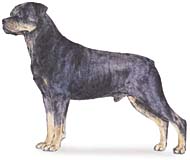 The
ideal Rottweiler is a medium large, robust and powerful dog, black with clearly
defined rust markings. His compact and substantial build denotes great
strength, agility and endurance. Dogs are characteristically more massive throughout
with larger frame and heavier bone than bitches. Bitches are distinctly
feminine, but without weakness of substance or structure.
The
ideal Rottweiler is a medium large, robust and powerful dog, black with clearly
defined rust markings. His compact and substantial build denotes great
strength, agility and endurance. Dogs are characteristically more massive throughout
with larger frame and heavier bone than bitches. Bitches are distinctly
feminine, but without weakness of substance or structure.
Size, Proportion, Substance
Dogs--24 inches to 27 inches. Bitches--22 inches to 25 inches, with preferred
size being mid-range of each sex. Correct proportion is of primary importance,
as long as size is within the standard's range.
The length of body, from prosternum to the rearmost projection of the rump, is
slightly longer than the height of the dog at the withers, the most desirable
proportion of the height to length being 9 to 10. The Rottweiler is neither
coarse nor shelly. Depth of chest is approximately fifty percent (50%) of the
height of the dog. His bone and muscle mass must be sufficient to balance his frame,
giving a compact and very powerful appearance.
Serious
Faults--Lack of proportion, undersized, oversized, reversal of sex
characteristics (bitchy dogs, doggy bitches).
Head
Of medium length, broad between the ears; forehead line seen in profile is
moderately arched; zygomatic arch and stop well developed with strong broad
upper and lower jaws. The desired ratio of backskull to muzzle is 3 to 2.
Forehead is preferred dry, however some wrinkling may occur when dog is alert. Expression
is noble, alert, and self-assured. Eyes of medium size, almond shaped with well
fitting lids, moderately deep-set, neither protruding nor receding. The desired
color is a uniform dark brown. Serious Faults--Yellow (bird of prey) eyes,
eyes of different color or size, hairless eye rim. Disqualification--Entropion. Ectropion.
Ears
of medium size, pendant, triangular in shape; when carried alertly the ears are
level with the top of the skull and appear to broaden it. Ears are to be set
well apart, hanging forward with the inner edge lying tightly against the head
and terminating at approximately mid-cheek. Serious Faults--Improper carriage
(creased, folded or held away from cheek/head). Muzzle--Bridge is straight, broad at
base with slight tapering towards tip. The end of the muzzle is broad with well
developed chin. Nose is broad rather than round and always black. Lips-Always
black; corners closed; inner mouth pigment is preferred dark. Serious Faults--Total
lack of mouth pigment (pink mouth). Bite and Dentition--Teeth 42 in number (20
upper, 22 lower), strong, correctly placed, meeting in a scissors bite--lower
incisors touching inside of upper incisors. Serious Faults--Level bite; any missing
tooth. Disqualifications--Overshot,
undershot (when incisors do not touch or mesh); wry mouth; two or more missing
teeth.
Neck, Topline, Body
Neck--Powerful,
well muscled, moderately long, slightly arched and without loose skin. Topline--The
back is firm and level, extending in a straight line from behind the withers to
the croup. The back remains horizontal to the ground while the dog is moving or
standing. Body--The
chest is roomy, broad and deep, reaching to elbow, with well pronounced
forechest and well sprung, oval ribs. Back is straight and strong. Loin is
short, deep and well muscled. Croup is broad, of medium length and only
slightly sloping. Underline of a mature Rottweiler has a slight tuck-up. Males
must have two normal testicles properly descended into the scrotum. Disqualification--Unilateral
cryptorchid or cryptorchid males. Tail--Tail docked short, close to body,
leaving one or two tail vertebrae. The set of the tail is more important than
length. Properly set, it gives an impression of elongation of topline; carried
slightly above horizontal when the dog is excited or moving.
Forequarters
Shoulder blade is long and well laid back. Upper arm equal in length to
shoulder blade, set so elbows are well under body. Distance from withers to
elbow and elbow to ground is equal. Legs are strongly developed with straight,
heavy bone, not set close together. Pasterns are strong, springy and almost
perpendicular to the ground. Feet are round, compact with well arched toes,
turning neither in nor out. Pads are thick and hard. Nails short, strong and
black. Dewclaws may be removed.
Hindquarters
Angulation of hindquarters balances that of forequarters. Upper thigh is fairly
long, very broad and well muscled. Stifle joint is well turned. Lower thigh is
long, broad and powerful, with extensive muscling leading into a strong hock joint.
Rear pasterns are nearly perpendicular to the ground. Viewed from the rear,
hind legs are straight, strong and wide enough apart to fit with a properly
built body. Feet are somewhat longer than the front feet, turning neither in
nor out, equally compact with well arched toes. Pads are thick and hard. Nails
short, strong, and black. Dewclaws must be removed.
Coat
Outer coat is straight, coarse, dense, of medium length and lying flat.
Undercoat should be present on neck and thighs, but the amount is influenced by
climatic conditions. Undercoat should not show through outer coat. The coat is
shortest on head, ears and legs, longest on breeching. The Rottweiler is to be
exhibited in the natural condition with no trimming. Fault--Wavy coat. Serious Faults--Open,
excessively short, or curly coat; total lack of undercoat; any trimming that
alters the length of the natural coat. Disqualification--Long coat.
Color
Always black with rust to mahogany markings. The demarcation between black and
rust is to be clearly defined. The markings should be located as follows: a
spot over each eye; on cheeks; as a strip around each side of muzzle, but not
on the bridge of the nose; on throat; triangular mark on both sides of
prosternum;on forelegs from carpus downward to the toes; on inside of rear legs
showing down the front of the stifle and broadening out to front of rear legs
from hock to toes, but not completely eliminating black from rear of pasterns;
un-der tail; black penciling on toes. The undercoat is gray, tan, or black.
Quantity and location of rust markings is important and should not exceed ten
percent of body color. Serious Faults--Straw-colored, excessive, insufficient or sooty
markings; rust marking other than described above; white marking any place on
dog (a few rust or white hairs do not constitute a marking). Disqualifications--Any
base color other than black; absence of all markings.
Gait
The Rottweiler is a trotter. His movement should be balanced, harmonious, sure,
powerful and unhindered, with strong forereach and a powerful rear drive. The
motion is effortless, efficient, and ground-covering. Front and rear legs are
thrown neither in nor out, as the imprint of hind feet should touch that of
forefeet. In a trot the forequarters and hindquarters are mutually coordinated
while the back remains level, firm and relatively motionless. As speed
increases the legs will converge under body towards a center line.
Temperament
The Rottweiler is basically a calm, confident and courageous dog with a self-assured
aloofness that does not lend itself to immediate and indiscriminate
friendships. A Rottweiler is self-confident and responds quietly and with a
wait-and-see attitude to influences in his environment. He has an inherent
desire to protect home and family, and is an intelligent dog of extreme
hardness and adaptability with a strong willingness to work, making him
especially suited as a companion, guardian and general all-purpose dog.
The behavior of the Rottweiler in the show ring should be controlled, willing
and adaptable, trained to submit to examination of mouth, testicles, etc. An
aloof or reserved dog should not be penalized, as this reflects the accepted
character of the breed. An aggressive or belligerent attitude towards other
dogs should not be faulted.
A judge shall excuse from the ring any shy Rottweiler. A dog shall be judged
fundamentally shy if, refusing to stand for examination, it shrinks away from
the judge. A dog that in the opinion of the judge menaces or threatens him/her,
or exhibits any sign that it may not be safely approached or examined by the
judge in the normal manner, shall be excused from the ring. A dog that in the
opinion of the judge attacks any person in the ring shall be disqualified.
Summary
Faults
The foregoing is a description of the ideal Rottweiler. Any structural fault
that detracts from the above described working dog must be penalized to the
extent of the deviation.
DISQUALIFICATIONS
Entropion, ectropion. Overshot,
undershot (when incisors do not touch or mesh); wry mouth; two or more missing
teeth. Unilateral cryptorchid or cryptorchid males. Long coat. Any base color
other than black; absence of all markings. A dog that in the opinion of the
judge attacks any person in the ring.
Approved May 8, 1990
Effective June 28, 1990
Newfoundland
Working Group
Breed Standard
General Appearance
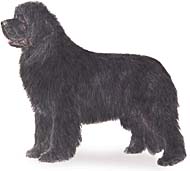 The
Newfoundland is a sweet-dispositioned dog that acts neither dull nor
ill-tempered. He is a devoted companion. A multipurpose dog, at home on land
and in water, the Newfoundland is capable of draft work and possesses natural
lifesaving abilities.
The
Newfoundland is a sweet-dispositioned dog that acts neither dull nor
ill-tempered. He is a devoted companion. A multipurpose dog, at home on land
and in water, the Newfoundland is capable of draft work and possesses natural
lifesaving abilities.
The Newfoundland is a large, heavily coated, well balanced dog that is
deep-bodied, heavily boned, muscular, and strong. A good specimen of the breed
has dignity and proud head carriage.
The following description is that of the ideal Newfoundland. Any deviation from
this ideal is to be penalized to the extent of the deviation. Structural and
movement faults common to all working dogs are as undesirable in the Newfoundland
as in any other breed, even though they are not specifically mentioned herein.
Size, Proportion, Substance
Average height for adult dogs is 28 inches, for adult bitches, 26 inches.
Approximate weight of adult dogs ranges from 130 to 150 pounds, adult bitches
from 100 to 120 pounds. The dog's appearance is more massive throughout than
the bitch's. Large size is desirable, but never at the expense of balance,
structure, and correct gait. The Newfoundland is slightly longer than tall when
measured from the point of shoulder to point of buttocks and from withers to
ground. He is a dog of considerable substance which is determined by spring of
rib, strong muscle, and heavy bone.
Head
The head is massive, with a broad skull, slightly arched crown, and strongly
developed occipital bone. Cheeks are well developed. Eyes are dark brown. (Browns and Grays
may have lighter eyes and should be penalized only to the extent that color
affects expression.) They are relatively small, deep-set, and spaced wide apart.
Eyelids fit closely with no inversion. Ears are relatively small and triangular
with rounded tips. They are set on the skull level with, or slightly above, the
brow and lie close to the head. When the ear is brought forward, it reaches to
the inner corner of the eye on the same side. Expression is soft and reflects the
characteristics of the breed: benevolence, intelligence, and dignity.
Forehead and face are smooth and free of wrinkles. Slope of the stop is
moderate but, because of the well developed brow, it may appear abrupt in
profile. The muzzle
is clean-cut, broad throughout its length, and deep. Depth and length are
approximately equal, the length from tip of nose to stop being less than that
from stop to occiput. The top of the muzzle is rounded, and the bridge, in
profile, is straight or only slightly arched. Teeth meet in a scissors or level
bite.
Dropped lower incisors, in an otherwise normal bite, are not indicative of a
skeletal malocclusion and should be considered only a minor deviation.
Neck, Topline, Body
The neck
is strong and well set on the shoulders and is long enough for proud head
carriage. The back
is strong, broad, and muscular and is level from just behind the withers to the
croup. The chest is full and deep with the brisket reaching at least down to
the elbows. Ribs are well sprung, with the anterior third of the rib cage
tapered to allow elbow clearance. The flank is deep. The croup is broad and
slopes slightly. Tail--Tail set follows the natural line of the croup. The tail
is broad at the base and strong. It has no kinks, and the distal bone reaches
to the hock. When the dog is standing relaxed, its tail hangs straight or with
a slight curve at the end. When the dog is in motion or excited, the tail is
carried out, but it does not curl over the back.
Forequarters
Shoulders are muscular and well laid back. Elbows lie directly below the
highest point of the withers. Forelegs are muscular, heavily boned, straight,
and parallel to each other, and the elbows point directly to the rear. The
distance from elbow to ground equals about half the dog's height. Pasterns are
strong and slightly sloping. Feet are proportionate to the body in size,
webbed, and cat foot in type. Dewclaws may be removed.
Hindquarters
The rear assembly is powerful, muscular, and heavily boned. Viewed from the
rear, the legs are straight and parallel. Viewed from the side, the thighs are
broad and fairly long. Stifles and hocks are well bent and the line from hock
to ground is perpendicular. Hocks are well let down. Hind feet are similar to
the front feet. Dewclaws should be removed.
Coat
The adult Newfoundland has a flat, water-resistant, double coat that tends to
fall back into place when rubbed against the nap. The outer coat is coarse,
moderately long, and full, either straight or with a wave. The undercoat is
soft and dense, although it is often less dense during the summer months or in
warmer climates. Hair on the face and muzzle is short and fine. The backs of
the legs are feathered all the way down. The tail is covered with long dense
hair. Excess hair may be trimmed for neatness. Whiskers need not be trimmed.
Color
Color is secondary to type, structure, and soundness.
Recognized Newfoundland colors are black, brown, gray, and white and black.
Solid Colors--Blacks,
Browns, and Grays may appear as solid colors or solid colors with white at any,
some, or all, of the following locations: chin, chest, toes, and tip of tail.
Any amount of white found at these locations is typical and is not penalized.
Also typical are a tinge of bronze on a black or gray coat and lighter
furnishings on a brown or gray coat.
Landseer--White
base coat with black markings. Typically, the head is solid black, or black
with white on the muzzle, with or without a blaze. There is a separate black
saddle and black on the rump extending onto a white tail.
Markings, on either Solid Colors or Landseers, might deviate considerably from
those described and should be penalized only to the extent of the deviation.
Clear white or white with minimal ticking is preferred.
Beauty of markings should be considered only when comparing dogs of otherwise
comparable quality and never at the expense of type, structure and soundness.
Disqualifications--
Any colors or combinations of colors not specifically described are
disqualified.
Gait
The Newfoundland in motion has good reach, strong drive, and gives the
impression of effortless power. His gait is smooth and rhythmic, covering the
maximum amount of ground with the minimum number of steps. Forelegs and hind
legs travel straight forward. As the dog's speed increases, the legs tend
toward single tracking. When moving, a slight roll of the skin is
characteristic of the breed. Essential to good movement is the balance of
correct front and rear assemblies.
Temperament
Sweetness of temperament is the hallmark of the Newfoundland; this is the most
important single characteristic of the breed.
DISQUALIFICATIONS
Any colors or combinations of colors
not specifically described are disqualified.
Approved May 8, 1990
Effective June 28, 1990
Irish Setter
Sporting Group
Breed Standard
General Appearance
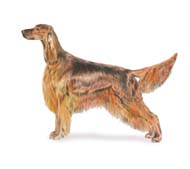 The
Irish Setter is an active, aristocratic bird dog, rich red in color,
substantial yet elegant in build. Standing over two feet tall at the shoulder,
the dog has a straight, fine, glossy coat, longer on ears, chest, tail and back
of legs. Afield, the Irish Setter is a swift-moving hunter; at home, a sweet
natured, trainable companion.
The
Irish Setter is an active, aristocratic bird dog, rich red in color,
substantial yet elegant in build. Standing over two feet tall at the shoulder,
the dog has a straight, fine, glossy coat, longer on ears, chest, tail and back
of legs. Afield, the Irish Setter is a swift-moving hunter; at home, a sweet
natured, trainable companion.
At their best, the lines of the Irish Setter so satisfy in overall balance that
artists have termed it the most beautiful of all dogs. The correct specimen
always exhibits balance, whether standing or in motion. Each part of the dog
flows and fits smoothly into its neighboring parts without calling attention to
itself.
Size, Proportion, Substance
There is no disqualification as to size. The make and fit of all parts and
their overall balance in the animal are rated more important. 27 inches at the
withers and a show weight of about 70 pounds is considered ideal for the dog;
the bitch 25 inches, 60 pounds. Variance beyond an inch up or down is to be
discouraged. Proportion
--Measuring from the breastbone to reaar of thigh and from the top of the
withers to the ground, the Irish Setter is slightly longer than it is tall. Substance--All
legs sturdy with plenty of bone. Structure in the male reflects masculinity
without coarseness. Bitches appear feminine without being slight of bone.
Head
Long and lean, its length at least double the width between the ears. Beauty of
head is emphasized by delicate chiseling along the muzzle, around and below the
eyes, and along the cheeks. Expression soft, yet alert. Eyes
somewhat almond shaped, of medium size, placed rather well apart, neither deep
set nor bulging. Color, dark to medium brown. Ears set well back and low, not above
level of eye. Leather thin, hanging in a neat fold close to the head, and
nearly long enough to reach the nose. The skull is oval when viewed from above or
front; very slightly domed when viewed in profile. The brow is raised, showing
a distinct stop midway between the tip of the nose and the well-defined occiput
(rear point of skull). Thus the nearly level line from occiput to brow is set a
little above, and parallel to, the straight and equal line from eye to nose. Muzzle
moderately deep, jaws of nearly equal length, the underline of the jaws being
almost parallel with the top line of the muzzle. Nose black or chocolate; nostrils wide.
Upper lips fairly square but not pendulous. The teeth meet in a scissors bite in which
the upper incisors fit closely over the lower, or they may meet evenly.
Neck, Topline, Body
Neck
moderately long, strong but not thick, and slightly arched; free from
throatiness and fitting smoothly into the shoulders. Topline of body
from withers to tail should be firm and incline slightly downward without sharp
drop at the croup. The tail is set on
nearly level with the croup as a natural extension of the topline, strong at
root, tapering to a fine point, nearly long enough to reach the hock. Carriage
straight or curving slightly upward, nearly level with the back. Body
sufficiently long to permit a straight and free stride. Chest deep, reaching approximately to
the elbows with moderate forechest, extending beyond the point where the
shoulder joins the upper arm. Chest is of moderate width so that it does not
interfere with forward motion and extends rearwards to well sprung ribs. Loins firm,
muscular and of moderate length.
Forequarters
Shoulder blades long, wide, sloping well back, fairly close together at the
withers. Upper arm and shoulder blades are approximately the same length, and
are joined at sufficient angle to bring the elbows rearward along the brisket
in line with the top of the withers. The elbows moving freely, incline neither
in nor out. Forelegs
straight and sinewy. Strong, nearly straight pastern. Feet rather small, very firm, toes
arched and close.
Hindquarters
Hindquarters should be wide and powerful with broad, well developed thighs.
Hind legs long and muscular from hip to hock; short and perpendicular from hock
to ground; well angulated at stifle and hock joints, which, like the elbows,
incline neither in nor out. Feet as in front. Angulation of the forequarters
and hindquarters should be balanced.
Coat
Short and fine on head and forelegs. On all other parts of moderate length and
flat. Feathering long and silky on ears; on back of forelegs and thighs long
and fine, with a pleasing fringe of hair on belly and brisket extending onto
the chest. Fringe on tail moderately long and tapering. All coat and feathering
as straight and free as possible from curl or wave. The Irish Setter is trimmed
for the show ring to emphasize the lean head and clean neck. The top third of
the ears and the throat nearly to the breastbone are trimmed. Excess feathering
is removed to show the natural outline of the foot. All trimming is done to
preserve the natural appearance of the dog.
Color
Mahogany or rich chestnut red with no black. A small amount of white on chest,
throat or toes, or a narrow centered streak on skull is not to be penalized.
Gait
At the trot the gait is big, very lively, graceful and efficient. At an
extended trot the head reaches slightly forward, keeping the dog in balance.
The forelegs reach well ahead as if to pull in the ground without giving the
appearance of a hackney gait. The hindquarters drive smoothly and with great
power. Seen from front or rear, the forelegs, as well as the hind legs below
the hock joint, move perpendicularly to the ground, with some tendency towards
a single track as speed increases. Structural characteristics which interfere
with a straight, true stride are to be penalized.
Temperament
The Irish Setter has a rollicking personality. Shyness, hostility or timidity
are uncharacteristic of the breed. An outgoing, stable temperament is the
essence of the Irish Setter.
Approved August 14, 1990
Effective September 30, 1990
Chihuahua
Toy Group
Breed Standard
General Appearance
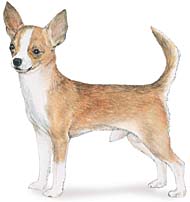 A
graceful, alert, swift-moving little dog with saucy expression, compact, and
with terrier-like qualities of temperament.
A
graceful, alert, swift-moving little dog with saucy expression, compact, and
with terrier-like qualities of temperament.
Size, Proportion, Substance
Weight A well balanced little
dog not to exceed 6 pounds. Proportion
The body is off-square; hence, slightly longer when measured from point of
shoulder to point of buttocks, than height at the withers. Somewhat shorter
bodies are preferred in males. Disqualification
Any dog over 6 pounds in weight.
Head
A well rounded "apple dome" skull, with or without molera. Expression Saucy. Eyes Full, but not protruding,
balanced, set well apart-luminous dark or luminous ruby. (Light eyes in blond
or white-colored dogs permissible.) Ears
Large, erect type ears, held more upright when alert, but flaring to the sides
at a 45 degree angle when in repose, giving breadth between the ears. Muzzle Moderately short, slightly
pointed. Cheeks and jaws lean. Nose
Self-colored in blond types, or black. In moles, blues, and chocolates, they
are self-colored. In blond types, pink nose permissible. Bite Level or scissors. Overshot or
undershot bite, or any distortion of the bite or jaw, should be penalized as a
serious fault. Disqualifications
Broken down or cropped ears.
Neck, Topline, Body
Neck Slightly arched, gracefully
sloping into lean shoulders. Topline
Level. Body Ribs rounded and
well sprung (but not too much "barrel-shaped"). Tail Moderately long, carried sickle
either up or out, or in a loop over the back, with tip just touching the back.
(Never tucked between legs.) Disqualifications
Cropped tail, bobtail.
Forequarters
Shoulders Lean, sloping into a
slightly broadening support above straight forelegs that set well under, giving
a free play at the elbows. Shoulders should be well up, giving balance and
soundness, sloping into a level back. (Never down or low.) This gives a
chestiness, and strength of forequarters, yet not of the "Bulldog"
chest. Feet A small, dainty foot
with toes well split up but not spread, pads cushioned. (Neither the hare nor
the cat foot.) Pasterns Fine.
Hindquarters
Muscular, with hocks well apart, neither out nor in, well let down, firm and
sturdy. The feet are as in front.
Coat
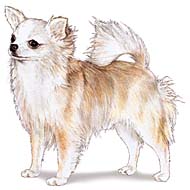 In
the Smooth Coats, the coat
should be of soft texture, close and glossy. (Heavier coats with undercoats
permissible.) Coat placed well over body with ruff on neck preferred, and more
scanty on head and ears. Hair on tail preferred furry. In Long Coats, the coat should be of a
soft texture, either flat or slightly curly, with undercoat preferred. Ears-Fringed. (Heavily fringed ears
may be tipped slightly if due to the fringes and not to weak ear leather, never
down.) Tail-Full and long (as a
plume). Feathering on feet and legs, pants on hind legs and large ruff on the
neck desired and preferred. Disqualification-In
Long Coats, too thin coat that resembles bareness.
In
the Smooth Coats, the coat
should be of soft texture, close and glossy. (Heavier coats with undercoats
permissible.) Coat placed well over body with ruff on neck preferred, and more
scanty on head and ears. Hair on tail preferred furry. In Long Coats, the coat should be of a
soft texture, either flat or slightly curly, with undercoat preferred. Ears-Fringed. (Heavily fringed ears
may be tipped slightly if due to the fringes and not to weak ear leather, never
down.) Tail-Full and long (as a
plume). Feathering on feet and legs, pants on hind legs and large ruff on the
neck desired and preferred. Disqualification-In
Long Coats, too thin coat that resembles bareness.
Color
Any color-Solid, marked or splashed.
Gait
The Chihuahua should move swiftly with a firm, sturdy action, with good reach
in front equal to the drive from the rear. From the rear, the hocks remain
parallel to each other, and the foot fall of the rear legs follows directly
behind that of the forelegs. The legs, both front and rear, will tend to
converge slightly toward a central line of gravity as speed increases. The side
view shows good, strong drive in the rear and plenty of reach in the front,
with head carried high. The topline should remain firm and the backline level
as the dog moves.
Temperament
Alert, with terrier-like qualities.
DISQUALIFICATIONS
Any dog over 6 pounds in weight.
Broken down or cropped ears.
Cropped tail, bobtail.
In Long Coats, too thin coat that resembles bareness.
Approved September 11, 1990
Effective October 30, 1990
Cocker Spaniel
Sporting Group
Breed Standard
General Appearance
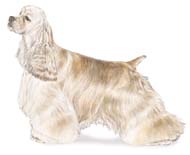 The
Cocker Spaniel is the smallest member of the Sporting Group. He has a sturdy,
compact body and a cleanly chiseled and refined head, with the overall dog in
complete balance and of ideal size. He stands well up at the shoulder on
straight forelegs with a topline sloping slightly toward strong, moderately
bent, muscular quarters. He is a dog capable of considerable speed, combined
with great endurance. Above all, he must be free and merry, sound, well
balanced throughout and in action show a keen inclination to work. A dog well
balanced in all parts is more desirable than a dog with strongly contrasting
good points and faults.
The
Cocker Spaniel is the smallest member of the Sporting Group. He has a sturdy,
compact body and a cleanly chiseled and refined head, with the overall dog in
complete balance and of ideal size. He stands well up at the shoulder on
straight forelegs with a topline sloping slightly toward strong, moderately
bent, muscular quarters. He is a dog capable of considerable speed, combined
with great endurance. Above all, he must be free and merry, sound, well
balanced throughout and in action show a keen inclination to work. A dog well
balanced in all parts is more desirable than a dog with strongly contrasting
good points and faults.
Size, Proportion, Substance
Size-- The ideal height at the
withers for an adult dog is 15 inches and for an adult bitch, 14 inches. Height
may vary one-half inch above or below this ideal. A dog whose height exceeds 15½
inches or a bitch whose height exceeds 14½ inches shall be disqualified. An
adult dog whose height is less than 14½ inches and an adult bitch whose height
is less than 13½ inches shall be penalized. Height is determined by a line
perpendicular to the ground from the top of the shoulder blades, the dog
standing naturally with its forelegs and lower hind legs parallel to the line
of measurement. Proportion--The
measurement from the breast bone to back of thigh is slightly longer than the
measurement from the highest point of withers to the ground. The body must be
of sufficient length to permit a straight and free stride; the dog never
appears long and low.
Head
To attain a well proportioned head, which must be in balance with the rest of
the dog, it embodies the following: Expression--The
expression is intelligent, alert, soft and appealing. Eyes--Eyeballs are round and full and look directly forward. The
shape of the eye rims gives a slightly almond shaped appearance; the eye is not
weak or goggled. The color of the iris is dark brown and in general the darker
the better. Ears--Lobular,
long, of fine leather, well feathered, and placed no higher than a line to the
lower part of the eye. Skull--Rounded
but not exaggerated with no tendency toward flatness; the eyebrows are clearly
defined with a pronounced stop. The bony structure beneath the eyes is well
chiseled with no prominence in the cheeks. The muzzle is broad and deep, with
square even jaws. To be in correct balance, the distance from the stop to the
tip of the nose is one half the distance from the stop up over the crown to the
base of the skull. Nose--of
sufficient size to balance the muzzle and foreface, with well developed
nostrils typical of a sporting dog. It is black in color in the blacks, black
and tans, and black and whites; in other colors it may be brown, liver or
black, the darker the better. The color of nose harmonizes with the color of
the eye rim. Lips--The upper
lip is full and of sufficient depth to cover the lower jaw. Teeth--Teeth strong and sound, not
too small and meet in a scissors bite.
Neck, Topline, Body
Neck--The neck is sufficiently
long to allow the nose to reach the ground easily, muscular and free from
pendulous "throatiness." It rises strongly from the shoulders and
arches slightly as it tapers to join the head. Topline--sloping slightly toward muscular quarters. Body--The chest is deep, its lowest
point no higher than the elbows, its front sufficiently wide for adequate heart
and lung space, yet not so wide as to interfere with the straightforward
movement of the forelegs. Ribs are deep and well sprung. Back is strong and
sloping evenly and slightly downward from the shoulders to the set-on of the
docked tail. The docked tail is set on and carried on a line with the topline
of the back, or slightly higher; never straight up like a Terrier and never so
low as to indicate timidity. When the dog is in motion the tail action is
merry.
Forequarters
The shoulders are well laid back forming an angle with the upper arm of
approximately 90 degrees which permits the dog to move his forelegs in an easy
manner with forward reach. Shoulders are clean-cut and sloping without
protrusion and so set that the upper points of the withers are at an angle which
permits a wide spring of rib. When viewed from the side with the forelegs
vertical, the elbow is directly below the highest point of the shoulder blade.
Forelegs are parallel, straight, strongly boned and muscular and set close to
the body well under the scapulae. The pasterns are short and strong. Dewclaws
on forelegs may be removed. Feet compact, large, round and firm with horny
pads; they turn neither in nor out.
Hindquarters
Hips are wide and quarters well rounded and muscular. When viewed from behind,
the hind legs are parallel when in motion and at rest. The hind legs are
strongly boned, and muscled with moderate angulation at the stifle and
powerful, clearly defined thighs. The stifle is strong and there is no slippage
of it in motion or when standing. The hocks are strong and well let down.
Dewclaws on hind legs may be removed.
Coat
On the head, short and fine; on the body, medium length, with enough
undercoating to give protection. The ears, chest, abdomen and legs are well
feathered, but not so excessively as to hide the Cocker Spaniel's true lines
and movement or affect his appearance and function as a moderately coated
sporting dog. The texture is most important. The coat is silky, flat or
slightly wavy and of a texture which permits easy care. Excessive coat or curly
or cottony textured coat shall be severely penalized. Use of electric clippers
on the back coat is not desirable. Trimming to enhance the dog's true lines
should be done to appear as natural as possible.
Color and Markings
Black Variety--Solid color
black to include black with tan points. The black should be jet; shadings of
brown or liver in the coat are not desirable. A small amount of white on the
chest and/or throat is allowed; white in any other location shall disqualify.
Any Solid Color Other than Black
(ASCOB)--Any solid color other than black, ranging from lightest cream
to darkest red, including brown and brown with tan points. The color shall be
of a uniform shade, but lighter color of the feathering is permissible. A small
amount of white on the chest and/or throat is allowed; white in any other
location shall disqualify.
Parti-Color Variety--Two or
more solid, well broken colors, one of which must be white; black and white,
red and white (the red may range from lightest cream to darkest red), brown and
white, and roans, to include any such color combination with tan points. It is
preferable that the tan markings be located in the same pattern as for the tan
points in the Black and ASCOB varieties. Roans are classified as parti-colors
and may be of any of the usual roaning patterns. Primary color which is ninety
percent (90%) or more shall disqualify.
Tan Points--The color of the
tan may be from the lightest cream to the darkest red and is restricted to ten
percent (10%) or less of the color of the specimen; tan markings in excess of
that amount shall disqualify. In the case of tan points in the Black or ASCOB
variety, the markings shall be located as follows:
1) A clear tan spot over each eye;
2) On the sides of the muzzle and on the cheeks;
3) On the underside of the ears;
4) On all feet and/or legs;
5) Under the tail;
6) On the chest, optional; presence or absence shall not be penalized.
Tan markings which are not readily visible or which amount only to traces, shall
be penalized. Tan on the muzzle which extends upward, over and joins shall also
be penalized. The absence of tan markings in the Black or ASCOB variety in any
of the specified locations in any otherwise tan-pointed dog shall disqualify.
Gait
The Cocker Spaniel, though the smallest of the sporting dogs, possesses a
typical sporting dog gait. Prerequisite to good movement is balance between the
front and rear assemblies. He drives with strong, powerful rear quarters and is
properly constructed in the shoulders and forelegs so that he can reach forward
without constriction in a full stride to counterbalance the driving force from
the rear. Above all, his gait is coordinated, smooth and effortless. The dog
must cover ground with his action; excessive animation should not be mistaken
for proper gait.
Temperament
Equable in temperament with no suggestion of timidity.
DISQUALIFICATIONS
Height--Males over 15½ inches; females
over 14½ inches.
Color and Markings--The aforementioned colors are the only acceptable colors or
combination of colors.
Any other colors or combination of colors to disqualify.
Black Variety--White markings except on chest and throat.
Any Solid Color Other Than Black Variety--White markings except on chest and
throat.
Parti-color Variety--Primary color ninety percent (90%) or more.
Tan Points--(1) Tan markings in excess of ten percent (10%); (2) Absence of tan
markings in Black or ASCOB Variety in any of the specified locations in an
otherwise tan pointed dog.
Approved May 12, 1992
Effective June 30, 1992
Boxer
Working Group
Breed Standard
General Appearance
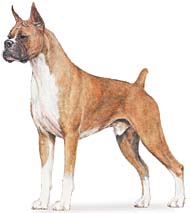 The
ideal Boxer is a medium-sized,
square built dog of good substance with short back, strong limbs, and short,
tight-fitting coat. His well developed muscles are clean, hard and appear
smooth under taut skin. His movements denote energy. The gait is firm, yet
elastic, the stride free and ground-covering, the carriage proud. Developed to
serve as guard, working and companion dog, he combines strength and agility with
elegance and style. His expression is alert and temperament steadfast and
tractable.
The
ideal Boxer is a medium-sized,
square built dog of good substance with short back, strong limbs, and short,
tight-fitting coat. His well developed muscles are clean, hard and appear
smooth under taut skin. His movements denote energy. The gait is firm, yet
elastic, the stride free and ground-covering, the carriage proud. Developed to
serve as guard, working and companion dog, he combines strength and agility with
elegance and style. His expression is alert and temperament steadfast and
tractable.
The chiseled head imparts to the Boxer a unique individual stamp. It must be in
correct proportion to the body. The broad, blunt muzzle is the distinctive
feature, and great value is placed upon its being of proper form and balance
with the skull.
In judging the Boxer, first consideration is given to general appearance to
which attractive color and arresting style contribute. Next is overall balance
with special attention devoted to the head, after which the individual body
components are examined for their correct construction, and efficiency of gait
is evaluated.
Size, Proportion, Substance
Height--Adult males 22½ to 25
inches; females 21 to 23½ inches at the withers, preferably, males should not
be under the minimum nor females over the maximum: however, proper balance and
quality in the individual should be of primary importance since there is no
size disqualification. Proportion--The
body in profile is of square proportion in that a horizontal line from the
front of the forechest to the rear projection of the upper thigh should equal
the length of a vertical line dropped from the top of the withers to the
ground. Substance--Sturdy with
balanced musculature. Males larger boned than their female counterparts.
Head
The beauty of the head depends upon harmonious proportion of muzzle to skull.
The blunt muzzle is 1/3 the length of the head from the occiput to the tip of
the nose, and 2/3 the width of the skull. The head should be clean, not showing
deep wrinkles (wet). Wrinkles typically appear upon the forehead when ears are
erect, and folds are always present from the lower edge of the stop running
downward on both sides of the muzzle. Expression--Intelligent
and alert. Eyes--Dark brown in
color, not too small, too protruding or too deep-set. Their mood-mirroring
character combined with the wrinkling of the forehead, gives the Boxer head its
unique quality of expressiveness. Ears--Set
at the highest points of the sides of the skull are cropped, cut rather long
and tapering, raised when alert. Skull
The top of the skull is slightly arched, not rounded, flat nor noticeably
broad, with the occiput not overly pronounced. The forehead shows a slight
indentation between the eyes and forms a distinct stop with the topline of the
muzzle. The cheeks should be relatively flat and not bulge (cheekiness),
maintaining the clean lines of the skull and should taper into the muzzle in a
slight, graceful curve. Muzzle--The
muzzle, proportionately developed in length, width and depth, has a shape
influenced first through the formation of both jawbones, second through the
placement of the teeth, and third through the texture of the lips. The top of
the muzzle should not slant down (downfaced), nor should it be concave
(dishfaced); however, the tip of the nose should lie slightly higher than the
root of the muzzle.
The nose should be broad and black.
The upper jaw is broad where attached to the skull and maintains this breadth
except for a very slight tapering to the front. The lips, which complete the
formation of the muzzle, should meet evenly in front. The upper lip is thick
and padded, filling out the frontal space created by the projection of the
lower jaw, and laterally is supported by the canines of the lower jaw.
Therefore, these canines must stand far apart and be of good length so that the
front surface of the muzzle is broad and squarish and, when viewed from the
side, shows moderate layback. The chin should be perceptible from the side as
well as from the front. Bite--The
Boxer bite is undershot; the lower jaw protrudes beyond the upper and curves
slightly upward. The incisor teeth of the lower jaw are in a straight line,
with the canines preferably up front in the same line to give the jaw the
greatest possible width. The upper line of incisors is slightly convex with the
corner upper incisors fitting snugly back of the lower canine teeth on each
side. Faults-- Skull too broad.
Cheekiness. Wrinkling too deep (wet) or lacking (dry). Excessive flews. Muzzle
too light for skull. Too pointed a bite (snipy), too undershot, teeth or tongue
showing when mouth closed. Eyes noticeably lighter than ground color of coat.
Neck, Topline, Body
Neck--Round, of ample length,
muscular and clean without excessive hanging skin (dewlap). The neck has a
distinctly marked nape with an elegant arch blending smoothly into the withers.
Topline--Smooth, firm and
slightly sloping. Body--The
chest is of fair width, and the forechest well defined and visible from the
side. The brisket is deep, reaching down to the elbows; the depth of the body
at the lowest point of the brisket equals half the height of the dog at the
withers. The ribs, extending far to the rear, are well arched but not barrel
shaped.
The back is short, straight and muscular and firmly connects the withers to the
hindquarters.
The loins are short and muscular. The lower stomach line is slightly tucked up,
blending into a graceful curve to the rear. The croup is slightly sloped, flat
and broad. Tail is set high, docked and carried upward. Pelvis long and in
females especially broad. Faults--Short
heavy neck. Chest too broad, too narrow or hanging between shoulders. Lack of
forechest. Hanging stomach. Slab-sided rib cage. Long or narrow loin, weak union
with croup. Falling off of croup. Higher in rear than in front.
Forequarters
The shoulders are long and sloping, close-lying, and not excessively covered
with muscle (loaded). The upper arm is long, approaching a right angle to the
shoulder blade. The elbows should not press too closely to the chest wall nor
stand off visibly from it.
The forelegs are long, straight and firmly muscled and when viewed from the
front, stand parallel to each other. The pastern is strong and distinct,
slightly slanting, but standing almost perpendicular to the ground. The
dewclaws may be removed. Feet should be compact, turning neither in nor out,
with well arched toes. Faults--Loose
or loaded shoulders. Tied in or bowed out elbows.
Hindquarters
The hindquarters are strongly muscled with angulation in balance with that of
the forequarters.
The thighs are broad and curved, the breech musculature hard and strongly
developed. Upper and lower thigh long. Leg well angulated at the stifle with a
clearly defined, well "let down" hock joint. Viewed from behind, the
hind legs should be straight with hock joints leaning neither in nor out. From
the side, the leg below the hock (metatarsus) should be almost perpendicular to
the ground, with a slight slope to the rear permissible. The metatarsus should
be short, clean and strong. The Boxer has no rear dewclaws. Faults--Steep or over-angulated
hindquarters. Light thighs or overdeveloped hams. Over-angulated (sickle)
hocks. Hindquarters too far under or too far behind.
Coat
Short, shiny, lying smooth and tight to the body.
Color
The colors are fawn and brindle. Fawn shades vary from light tan to mahogany.
The brindle ranges from sparse, but clearly defined black stripes on a fawn
background, to such a heavy concentration of black striping that the essential
fawn background color barely, although clearly, shows through (which may create
the appearance of "reverse brindling").
White markings should be of such distribution as to enhance the dog's
appearance, but may not exceed one-third of the entire coat. They are not
desirable on the flanks or on the back of the torso proper. On the face, white
may replace part of the otherwise essential black mask and may extend in an
upward path between the eyes, but it must not be excessive, so as to detract
from true Boxer expression. Faults--Unattractive
or misplaced white markings. Disqualifications--Boxers
that are any color other than fawn or brindle. Boxers with a total of white
markings exceeding one-third of the entire coat.
Gait
Viewed from the side, proper front and rear angulation is manifested in a
smoothly efficient, level-backed, ground covering stride with powerful drive
emanating from a freely operating rear. Although the front legs do not
contribute impelling power, adequate "reach" should be evident to
prevent interference, overlap or "sidewinding" (crabbing). Viewed
from the front, the shoulders should remain trim and the elbows not flare out.
The legs are parallel until gaiting narrows the track in proportion to
increasing speed, then the legs come in under the body but should never cross.
The line from the shoulder down through the leg should remain straight although
not necessarily perpendicular to the ground. Viewed from the rear, a Boxer's
rump should not roll. The hind feet should "dig in" and track
relatively true with the front. Again, as speed increases, the normally broad
rear track will become narrower. Faults--Stilted
or inefficient gait. Lack of smoothness.
Character and Temperament
These are of paramount importance in the Boxer. Instinctively a
"hearing" guard dog, his bearing is alert, dignified and
self-assured. In the show ring, his behavior should exhibit constrained
animation. With family and friends, his temperament is fundamentally playful,
yet patient and stoical with children. Deliberate and wary with strangers, he
will exhibit curiosity but, most importantly, fearless courage if threatened.
However, he responds promptly to friendly overtures honestly rendered. His
intelligence, loyal affection and tractability to discipline make him a highly
desirable companion. Faults--Lack
of dignity and alertness. Shyness.
The foregoing description is that of
the ideal Boxer. Any deviations from the above described dog must be penalized
to the extent of the deviation.
Disqualifications
Boxers that are any color other than
fawn or brindle. Boxers with a total of white markings exceeding one-third of
the entire coat.
Approved February 5, 1999
Effective March 31, 1999