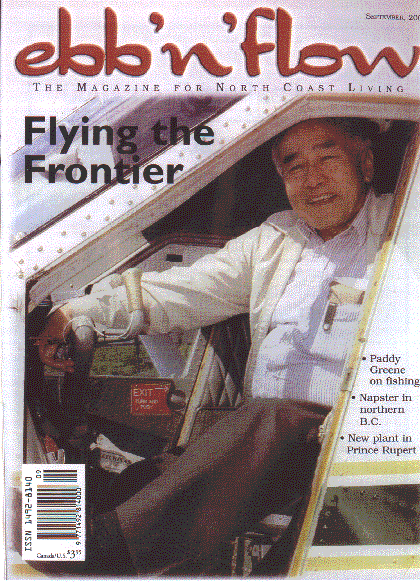
LAST ISSUE: After his return from Hong Kong in 1949, Captain Al Mah continued commercial flying in Canada for over 30 years. In 1995 he was finally recognized by the United States Atr Force, and decorated for his role in the Assam-China airlifts. As a boy in Prince Rupert, Ced Mah would gaze up Tuck Inlet, thinking that the Arctic lay somewhere just beyond those hills. He was infatuated by the stories that he read of Arctic exploration, stories of Back and Franklin. If the Second World War had not erupted, if he had not clung to China to help his family, it is likely that he would have spent his whole career as a bush pilot in northern Canada. As it was, shortly after Mao’s victory in China, Mah devoted the rest of his career to the North.
In 1950 Ced arrived in Vancouver. his days of flying in China now behind him. In fact, it seemed as if any sort of flying was now in his past: he had returned briefly to Vancouver for a gallbladder operation in 1948. and upon his return in 1950 a doctor had prnnounced him unfit to fly. Not to be held down, he founded Playdium Recreation at 1268 Hastings Street in Vancouver with his brother Alex as partner. Playdium was an eight-lane bowling alley, equipped with three pool tables, a 40-seat coffee bar, a barber shop and a magazine stand. Mah applied pressure to regain his licence, which was finally returned in 1951. He immediately joined a friend at Charter Flight, working around the country with small machines.
In 1951, as a pilot of Central BC Airways (later Pacific Western Airlines), Ced Mab was involved in the Kemano project from the time “we first started dropping people on the beach.” The largest civilian project in the world at that time, the Kemano project occupied Ced until 1954. In 1953, a mountain in the Coast Range was named Mount Ced Mah, recognizing the pilot “for outstanding service transporting and supplying a government survey party under difficult flying conditions.” In 1954, Ced Mah was profiled by The Star Weekly as Canada’s only Chinese-Canadian bush pilot.
The book Wings Over The West: Russ Baker & the Rise of Pactftc Western Airlines, by John Condit, provided a Kemano-era example of Mah’s typical sense of humour. Percy Radley. Alcan’s project manager, recalled a visit upcoast with his wife, flying with Ced Mah. Upon landing Mrs. Radley said to
Mah: Thank you very much. That was a very nice flight. It is the first time I have ever flown in a seaplane.” Ced’s response was:“My first time, too.”
Still operating the bowling alley in Vancouver with his brother Alex, Ced Mah continued to fly part-time. He was, in his own words, “all over the place.” Flying on the DEW Line began in 1955. In 1960 he was flying for the Geological Survey of Canada in ‘what Is now Kluane Natonal Park, and ended up spending the summer fighting foresr fires throughout the Smithers district.
In 1964. at a time when 100- and 200-lane bowling alleys were beginning to spring up, Ced Mah sold Playdium Recreation and moved to Edmonton, where he launched full-time into his career as a bush pilot, and finally realized his childhood dream of exploring the Arctic. He joined Gateway Aviation, where he made headlines in 1967 for a remarkable survival story. Carrying geologist Pat Parker Mah encountered a severe Arctic storm with snow squalls, icing conditions, and 40-50 m.p.h. winds which forced him down some 80 miles east of Coppermine. The Cessna aircraft, though safely landed, flooded the battery as the tail sank into the water. Mah used mukiuks bought for a girl in Yellowknife and four sleeping bags to save himself and his passenger. One sleeping bag was used to create a shelter, and another formed part of an echo chamber to enable him to listen for nearby aircraft (a trick from his CNAC days). The Cessna floatplane was also equipped with SARAH, which Mah turned on whenever he heard aircraft. A massive search was launched for the missing airman and his passenger, and one of those who dashed north to help was Albert Mah. Ten days after the accident and twenty pounds lighter, Ced Mab, with Parker, was picked up by Bill Lazeruch in a Beechcraft 18 (the Cessna was salvaged the following day). At Yellowknife Ced and Al were reunited for the first time in 11 years.
Mah’s adventures continued. He flew C 46s out of Yellowknife and Hay River for Pacific Western Airlines, working on the DEW Line. He flew for the Polar Gas project, and for the Polar Continental Shelf Expedition. He worked for a series. of companies. making his way through northern Canada. At the end of the 1970s, however, thoughts of retirement beginning to enter his head, he began, salmon-like, to make his way home to the Northwest Coast. After a brief stint as chief pilot with Smithers Air where a lack of maintenance on the company’s aircraft caused accidents — Ced Mah joined North Coast Air in Prince Rupert in 1980. He was there to do more than just fly. however. He had begun to wonder about his past, and upon arrival launched a 20-year quest into the family of Mah Bon Quen.
A few final farewell trips followed his departure from Prince Rupert in 1984. In the summer of 1985 Ced flew for a tourist lodge at Great Bear Lake. and then in 1986 flew for Rae-Corn Air out of Yellowknife. Then, at the age of 65 in 1987, he let his medical lapse. He had become consumed by history. ‘I said, well, you’d better sit down and do it,~ he recalls. ‘or just be talking about it the rest of your.life,” Today, whenever he is not before his word processor, Ced Mah spends his time at the Alberta Aviation Museum, where he has become something of a living history exhibit — a veteran who recalls the days of the Wop May’s WorldWar II training school in Edmonton, and a half-century of aviation in the bush. He has begun to record his memories, and the results of his research. He has written of the development of aviation on the northern coast — the passion of his youth, in the days when Prince Rupert lay on the Great Circle~Route, and young Ced haunted the docks to glimpse such heroes as Jimmy Mattern as they passed through on their around-the-world flights. But he has written mostly about his own family, and today is preparing to publish the book Clan Horse: One Hundred Generations of the Mah Family.
In 1997, Cedric Mah was also belatedly recognized by the United States government for his service in China during the Second World War. As he jokingly told author Shirlee Smith Matheson in Flying The Frontiers, VoL III, When Albert reached 75 years of age, they finally decided to fire him. Then, when I got to be 75 a couple of years later, they fired me, too.” Upon his discharge from the U.S.A.F. as a member of the CNAC. Mah was entitled to wear the Asiatic-Pacific Campaign Medal. American Campaign Medal, and World War II Victory Medal. Both brothers were also awarded the Hump Victory Medal by the Government of China.
Cedric and Albert Mah are among a small, and dwindling, group of aviation pioneers who are in great demand among authors and documentary filmmakers. Their stories are sought by those who study the Chinese experience in Canada. They are sought by historians who study aviation in China, the CNAC, the CATC. the Burma Hump operation, and the old Flying.Tigers. Historians who study the development of airlines and bush flying in Canada, who study the British Commonwealth Air Training Plan, or the exploration of the Arctic, seek Albert and Cedric M~h. Their stories are related in detail in books such as The Dragon and the Maple Leaf Chinese Canadians in World War II. by Marjorie Wang. Their expertise is sought in books such as the University of Georgia’s The Dragon’s Wing: The China National Aviation Corporation and the Development of Commercial Aviation in China, by William Leary. Al and Ced Mah are featured in hundreds of books, magazines, newspapers and films. The two boys who played on the wooden sidewalks around Sunrise Grocery in the 1920s and 30s have created an almost-incredible legacy, weaving through much of the history of commercial aviation in Canada and the world.
NEXT ISSUE: Check Yee and his wife Phyllis, the daughter of Mali Bon Quen, began their gospel work in Prince Rupert in the 1950s, before moving to San Francisco in 1957. Today they are internationally respected stalwarts of the Salvation Army.
BACK TO CEDMAH HOME PAGE