Highroad to China
Jim Farrell -
Journal Staff Writer EDMONTON
High in the Hlmalayas near thc Burma-chinese border, up in the head waters of the Irrawaddy where the bleached bones of nameless men litter the slopes, four ronnes of cash slowly rot beneath the Asian sun. The bones are the remains of Second World War pilots who died while trying to fly munitions, fuel and money over the mountains to a beleaguered Chinese army. The cash is the jettisoned cargo of one pilot who made it over tlhe mountains and survived.
Cedric Mah, now 77 lives in Edmonton. The son of a Chinese-Canadian storekeeper spins tales of war, Iost fortunes and vanished empires like a latter day buccaneer. But Mah can backup those stories with gover-nment documents, military decorationsand personal photos.
Fifty four years ago, as an employee of the China National Aviation Corporation (CNAC), Mah was part of the biggest airlift operation of the Second World War. The Japanese Army had captured every major port on the Chinese coast and swept west into Burma, cutting off the Nationalist Chinese Army of Chiang Kai-shek from western suppliers. With the fall of Burma, Chiang’s western allies had to supply his troops with fuel, ammunition and money by air.
To flyfrom their base in northeasrt India to Chiang’sheadquarrers in Chungking CNAC transport planes would first have to cross “the Hump,” a towering, barrier of Himalayan peaks. The hump’s tallest mountain was Gongga Shan, a 24,900-foot monster pilots could see out of their stairboard window as they crossed the Burma-Chinese border. But they could see it only if the skies were clear. In the. summer of 1945, monsoon clouds towered 30,ooo feet as U.S. Treasury workers loaded 54 paper wrapped bundles into the yawning belly of Mah’s plane at an airstrip in the Burmese jungle.
A US Army sergeant armed with a pistol and M-1rifle would guard the cargo until it was offloaded in Chungking.
No sooner did we lift the landing gear than we wer In the clouds,’’ Mah recalls. As his plane gained altitude, a film of ice spread over its aluminum skin. As we neared 20,000 feet and the superchargers of his twin engines forced the thin mountain air into the planes starving carburetors Mah strapped on an oxygen mask.
‘About then, the right engine cut out,’ Mah said. ‘We started going down.”The only way to ease the load on the one remaining engine was to lose some weight and lose it fast. I went back into the cargohold, opened the door
and when my co-pilot gestured, I began slashing the cargo ropes wlth my big kukri knife the kind
of knile Gurkhas use for lopping off heads.”
Mah and the sergeant began pitching out bundles ofcash. Fortyeight bundles went out the door. When there were only four left, Mah returned to his pilot’s seat. He wanted to save some money in case he landed at a strange airfield and had to bribe his way out.
‘At about that point, we’d broken through the clouds and could see the peaks around us,”he says. Mah’s plane kept losing altitude. When it reached 10.000 feet, he spotted a large lake — not the best place to crash land but better than a mountainside or the dense jungle. Outside his cockpit warmer air peeled the rime of ice off the wings. Perhaps that same ice had plugged a carburetor and killed his engine. Mah figured it was time to find out. I decided to turn the fuel back on and see if l could backfire the engine and get it started. By golly, she popped, we shook some ice off and started to roar.”
Instead of continuing on to Chungking, Mah turned southeast and headed for Kunming, shortening his flight When he landed, he reported to the airfield’s American and Chinese officers. “They didn’t believe us at first. There were all kinds of coi~ectures about what we might have done with the money~But that was all theycould do.”
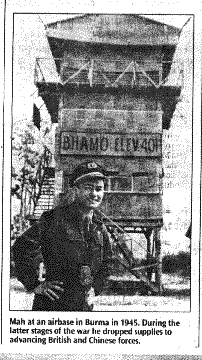
Mah had come a long way from Prince Rupert, the rough-hewn British Columbia fishing part where he was born and raised. In 192O's, when he was only three, Cedric’s horizons suddenly expanded. He heard a buzzing sound overhead. It was one of the early bush planes which serviced Canada’s west coast . Mah was hooked like a Pacific salmon. “I became an air nut.”
In 1940, Mah enrolled in an aviation school in Los Angeles. His older brother Albert—another “air nut” — had already completed the two-year course. On Dec. 7,1941, the Japanese bombed Pearl Harbor andthe aviation worid turned upside down. Mah’s flying school was moved to Arizona. He eventually wound up in Winnipeg where he was a civilian instructor with the British Commonwealth Air Training Program.
Like most young Canadians, Mah wanted to get into the war. Unlike most, his military options were limited.
“No Chinese were accepted as air crew,” he says. So at the controls of Avro Ansons, the twin-engine workhorse of the BCATP, Mah taught student pilots in Winnipeg and later in Edmonton. In April 1944, he got into a discussion with legendary bush pilot Wop May, one of the program’s organizers. ‘
Wop pulled me aside one day and said ‘come on over and have a drink when you’re finished work.”’ May was a notorious partier. It didn’t matter to him that Mah had to be airborne at 7 the next morning. In the ensuing late-night discussion, May pointed out the war would soon end. The 13 CATP had trained enough lots, and it was time Mah consldered working for someone else.
He told me that we’ll be invading Europe very shortly and the next year it could be China, the Far East. Have you ever thought about flying over there?’” Mah’s brother Albert was already flying for the China National Aviation Corp. The company had signed a contract with the U.S. Army in 1942 to carry war supplies over the Hump to China. The Americans provided badly-needed airplanes; Pan American Airlines supplied the pilots. By 1944, the company was looking for more pilots. Mah applied, was accepted and May interceded to get him out of his job, which the Canadian government had deemed “essential.”
After signing on in New York, he was flown to Calcutta, via Casablanca, Cairo and Karachi. From Calcutta, he flew into the northeast corner of India where the Allies had built an asphalt airstrip at Dinjan, a tea plantation nestled between the Himalayas and the Naga Hills.
Under constant harassment by enemy fighters and flying over uncharted territory, CNAC pilots worked 16 to 20 hours a day. In 1944, they carried 38 percent of the world’s strategic air cargo. By war’s end, they’d flown almost 600,000 tonnes of cargo into China. Many pilots logged 500 trips owr the Himalayas.
Mah flew the length and breadth of southeast Asia. In March of 1945, he flew to northwest China on a shopping trip for army horses. The flight began at night in a pasture, illuminated by the headlights of a jeep, and followed the Wolong River past the towering white face of Gongga Shan. Mah recorded his memories, hoping someday to pen an autobiography.
“In the pink of dawn a sidehill monastery hove into sight and lower still the guttering butter lamps,” he wrote of his destination near the borders of Tibet.
‘We banked beneath the snow and overhanging glaciers and set down on a dry creek bed 12,000 feet above sea level. A golden-robed abbot welcomed our veterinary officers as monks and lamas accepted the money payload.”
Walldng about in the crisp cool air was like bathing in champagne/’What a delight to get away from the Assam jungle!” Mah wrote.
By June, the road to China had been recaptured from the Japanese. One day, Mah and some friends joined a convoy and drove through the mountains, 600 km to Kunming. On the way, they met some of the thousands of workers Chiang Kai-shek’s army had forcibly recruited to work on the road. “The peasants’ rib cages showed,” Mah wrote. All lacked iodine and were afflicted with goiters. The children were listless with worms, malaria and dysentery”
By this time, the rollicking lifestyle of CNAC pilots was familiar to readers in Canada and the U.S., thanks to a friendship formed years before at the University of Ohio between aspiring pilot Frank Higgs and aspiring artist Milton Caniff. Higgs later went to work for CNAC. The stories he related to his buddy in letters from the front inspired Caniff to create Terry and the Pirates, a cartoon stip depicting the adventures of a blond American pilot in China
.
Mah continued flying for CNAC after 1945. The end of the war against Japan brought a renewal of the civil war between Chiang Kai-sheks natlonalist army and the Communists. Financially. Mah was doing well. He’d bought a house and several cars in Shanghai and be had a cultured and beautiful Chinese girlfriend. But the world of CNACs prosperous foreign pllots was about to be tossed Into the trash can of history. Chiangs forces were losing the civil war. Nationalist officers were selling U.S.-supplied weapons to the enemy and siphoning off much of America’s $2 billion In aid and depositing it in foreign bank accounts. In a last-ditch effort to bolster his forces, in early Januaryof 1949 Chiang ordered CNAC to air-drop more supplies to prepare the army for a climactic battle.
‘We had 400 transports overhead on the morning of Jan. 10,” Mah recalls. ‘We got there before dawn and were ready to drop everything an army needed but we got no answer on the radio. Then we heard a voice come on the air saying. ‘return 19, return 19’ It was the signal to return to base. “Then all of a sudden we saw a circle of fire about 10 miles across.”
After losing 500.000 soldiers, Chiang’s army had given up. Mah and his feliow CNAC pilots flew their planes to Hong Kong and wondered what to do next. Chiang had fled to Taiwan, supposedly the new home of CNAC, but the Communists were offering $30,000 to any foreigner who turned over CNAC transports to them.
Mah asked the Canadian ambassador what his government’s position would be if he cut a deal with the Communists.
“He said, ‘well, when was the last time you had a holiday?’ I said ‘three years ago.’ He said ‘don’t you think it’s time you took a holiday and looked at the situation from farther away?’
“That’s when I returned to Canada.”
Mah settled in Vancouver, bought property and built a bowling alley. During the winters, he ran the alley. For the next 15 summers, be was a bush flyer. Many of his CNAC colleagues had gone to work for airlines but he’d decided to “go fishing. You can’t fish off the floats of an airliner,” he explains. Mah always loved the bush. In 1957, he married the Chinese girlfriend he’d met in Calcutta 13 years earlier. ‘That lasted about five years. After my marriage broke up. I decided to come back to Edmonton to fly out of here.”
In 1995. the U,S. Department of Defence honoured Mah and others who’d flown for CNAC. Because he’d been one of CNAC’s first pilots. Mah’s older brother Albert received the Distinguished Flying Cross, the U.S. Air Force’s highest decoration. These days, Albert is retired in Montreal. And Mah is a fixture at the Alberta Aviation Museum on Kingsway Avenue. ‘Iwo days a week, he joins other old flyers in refurbishing the planes that wrote Canada’s aviation history.
When these planes thundered overhead, our fathers and grandfathers looked up and wondered what far-distant sIdes they might visit if their hand controlled the throttles of those piston-engine beasts. There was adventure in the air back then. “What can you say? Life will evolve and you’ve got to accept it,” Mah says. “But the nostalgia is still in those old radial engines. The jet engine? It’s nothing but a blowtorch.”
BACK TO HOME PAGE.