|
|
|
|
|
|
|
|
|
|
|
|
|
|
|
|
|
|
|
|
|
|
|
|
|
|
|
|
|
 |
|
|
 |
|
|
|
|
|
|
 |
|
|
|
|
|
|
|
|
|
|
|
|
|
| Day 2 (Sunday 7/25/99) |
| Paddle to Squaw Island and around Garden Island then back to Indian Harbor. |
|
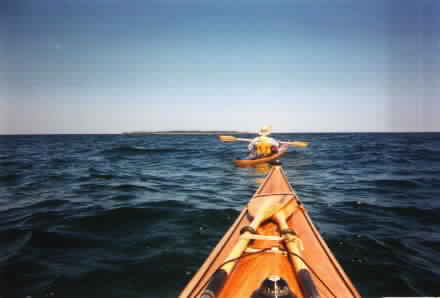
| We packed up camp and launched our kayaks about 9:00 on Sunday morning. We had planned to set up camp on the north end of Garden island. From there, when weather permitted, we would paddle to Squaw island. When we paddled out of Indian Harbor, we could see that Lake Michigan was calm. A quick check of the weather radio revealed a window of opportunity to make the crossing to Squaw Island. After prayerful consideration, rather than paddling to the north end of Garden I., we set out directly for Squaw Island. It was a calm, easy crossing. |
|
|
|
|
|
|
|
|
|
|
|
|
|
|
|
|
 |
|
|
|
|
|
|
|
|
|
|
|
|
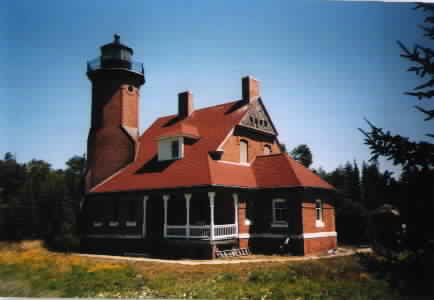
| As the crossing progressed, our excitement grew as we could faintly see the tower of the lighthouse visible on the north end of Squaw island. We had seen pictures of the Victorian style lighthouse on the internet. The lighthouse was constructed of dark red brick with white wood trim. The roof was steeply peaked. Although beautiful on the outside, the bats and carpenter ants had taken their toll on the inside of the lighthouse. A caretaker was employed by the lighthouse`s owner. The caretaker and his son were feverishly working to save the lighthouse, but we wondered if they would win the war with the elements. They showed us the path that a water-spout had followed only a few years earlier. Missing the lighthouse by only 15 feet, the water-spout picked up a small wood water pump shed and carried it 100 feet. The shed landed right side up with little damage. Later the caretaker carried the shed back to its spot over the water pump. The hand operated water pump yielded water from a well. After spending days drinking warm water purified from Lake Michigan, this fresh, cool well water tasted better than the finest wine. |
|
|
|
|
|
|
|
|
|
|
|
|
|
 |
|
|
|
|
|
|
|
|
|
|
|
|
| The thick poison ivy and black flies made Squaw Island seem inhospitable for camping. We again asked the Lord for safety, and launched our kayaks. The paddle back to the north end of Garden island greeted us with light winds and smooth seas. We then set out for a fascinating paddle around the east side of Garden Island. The only sign of man was a lone Ojibway woman hiking the shoreline. We also saw an unoccupied Ojibway sweat lodge. Paul and I practiced our Ojibway chanting as we paddled. Our wives would later become tired of this chanting when we returned home. |
|
| Paddling around the North end of the island required caution because the shoreline was lined with rocky shoals. Since the boats were fully loaded, we feared that they would be split if the trough of a breaking wave dropped us onto a shoal. It was shallow a long way from shore. This created a scenic view as the white breakers struggled across the shoals before falling exhausted on the rocky beach. |
|
| Our paddling destination was Northcutt bay. On the south end of Garden island, the bay sports the only sandy beach to be found. We reached the bay exhausted at the end of a long paddle. We were shocked to find perhaps a dozen powerboats anchored in the bay. To our chagrin, some of the powerboats had transported personal water craft to the island. As other non-native species that had been introduced to the great lakes (like zebra mussels or roughy) the PWCs destroyed the natural balance of the island. Their buzzing and bouncing was more offensive than the black flies or mosquitoes to which we had become accustomed. In our exhausted state, we had no choice but to paddle on. |
|
| We eventually paddled back to Indian Harbor, setting up camp in the same spot where we had been the night before. After a brief rest, we lazily prepared dinner. After dinner we toasted the day with a round of Motrin IB. We slid into our sleeping bags and drifted off into the most peaceful night`s sleep I had experienced in months. We again heard the Indian drums and chanting. The chants sounded forlorn as the group mourned the passing of their dear friend. This time the chants blended with our dreams as we were too tired to lay awake and listen. |
|
| Day 3 (Monday 7/26/99) |
| With our tents facing east, we awoke to a beautiful sunrise. This would be a day of hiking and rest. Most of the Ojibway were leaving the island. They were returning to the modern world. We thought of the sadness they would feel when returning to regular jobs after spending a weekend on the island. Fortunately, it was not yet time for us to return. |
|
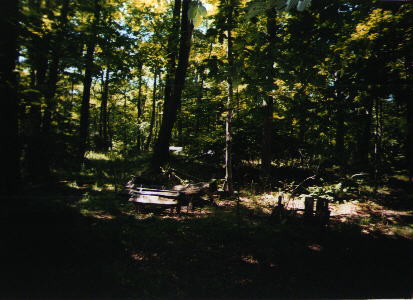
| We hiked back to the Native American Cemetery. This time we were alone to experience the sunlight shinning through the trees, the gentle breeze, and the bird songs that echoed. It was a peaceful place. |
|
|
|
|
|
|
|
|
|
|
|
|
|
|
 |
|
|
|
|
|
|
|
|
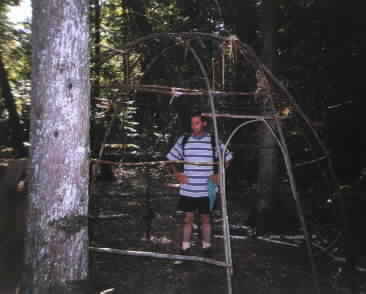
| We hiked north to Kee`s cabin. The cabin was still in use by other Ojibway who planned to continue Kee`s work. Near Kee`s cabin, we noticed that two broken birch logs seemed to mark a faint path into the woods. We followed the path and came across the frame of an Indian teepee. It was constructed of bent tree limbs. We found other such teepees with plastic coverings on them. When we realized that they had recently been in use, we respected the privacy of other such trails we came across. |
|
|
|
|
|
|
|
|
|
|
|
|
|
|
|
 |
|
|
|
|
|
|
|
|
|
|
|
| Hiking further to the west, we came across the remains of a small cabin. The scant walls were still standing, but the roof joists had long since collapsed. We were later to learn that the cabin had been inhabited by an Ojibway fishing net mender. Although blind, the net mender was an expert at repairing nets for the Native American fishermen. |
|
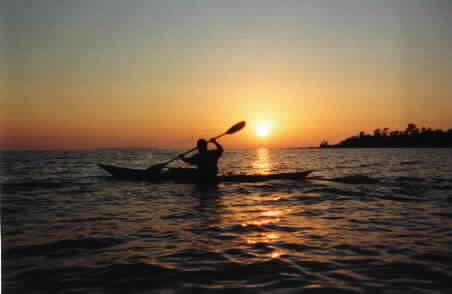
| After dinner that night, Lake Michigan became smooth as glass. Wearing our head lights, we paddled out of the harbor to watch a brilliant sunset across lake Michigan. We used up great amounts of film as we watched yellow blend into orange, then purple. The lake was tranquil. I watched each drop of water that fell from the tip of my paddle create ripples in the smooth lake surface. While hiking the beach earlier that day, we found the tattered bow section of a destroyed fiberglass canoe. Later we found the stern of a demolished wood boat. These findings were an ominous reminder of the lake`s potential fury. The lake was in a good mood. We hoped it would be slow to anger. |
|
|
|
|
|
|
|
|
|
|
|
|
|
 |
|
|
|
|
|
|
|
|
|
| As the last point of sunlight disappeared below the horizon, we turned to paddle back to camp. We didn`t need our head lamps. As the sun had been setting in the west, the full moon had been rising in the east. Looking toward the moon, the lake glistened as thousands of white lights danced on the ripples. There was no boat traffic to worry about. |
|
| That night as we lay in our sleeping bags, the serenity of the evening was harshly derailed. Thinking that there were no bear on the island, we had left our food in our kayaks with the hatches covered. We had also left unburned food wrappers in the fire ring. With years of backpacking experience, how could we have been so careless. Our hearts were pounding as the beast prowled back and forth across our camp. We could hear each deliberate pound of his footsteps as he circled the tent. We could hear the thrashing as he devoured the wrappers from the fire ring. We knew that such a monster could easily destroy our cedar strip kayaks in an effort to get to our food. As the creature retreated into the woods with a food wrapper, we knew we had to act quickly before he returned. Our only hope was to desperately save ourselves by dragging the boats into the water and waiting offshore until the intruder was gone. Before we could act, the beast was back. Maybe we could shine the flashlight on him to assess his size. Much to our embarrassment, the light revealed our foe to be a jackrabbit. Upon seeing the light, the rabbit scampered into the woods in fear. We relaxed. The reign of terror had ended. Paul and I agreed never to speak of this event. |
|
|
|
|
|
|
|
|
|
|
|
|
|
|
|
|
 |
|
|
|
|
|
|
|
|
|
|
|
|
|
|
|
|
|
|
|
|
|
|
|
|
|
|
|
|
|
|
|
 |
|
|
|
|
|
|
|
|
|
|
|
|
|


