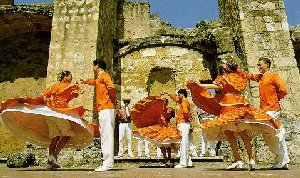
One story alleges the dance originated with slaves who were chained together and, of necessity, were forced to drag one leg as they cut sugar to the beat of drums. The second story alleges that a great hero was wounded in the leg during one of the many revolutions in the Dominican Republic. A party of villagers welcomed him home with a victory celebration and, out of sympathy, everyone dancing felt obliged to limp and drag one foot. Merengue has existed since the early years of the Dominican Republic (in Haiti, a similar dance is called the Meringue). It is possible the dance took its name from the confection made of sugar and egg whites because of the light and frothy character of the dance or because of its short, precise rhythms.
By the middle of the nineteenth century, the Merengue was very popular in the Dominican Republic. Not only is it used on every dancing occasion in the Republic, but it is very popular throughout the Caribbean and South American, and is one of the standard Latin American dances. There is a lot of variety in Merengue music. Tempos vary a great deal and the Dominicans enjoy a sharp quickening in pace towards the latter part of the dance. The most favored routine at the clubs and restaurants that run a dance floor is a slow Bolero, breaking into a Merengue, which becomes akin to a bright, fast Jive in its closing stages.
The ballroom Merengue is slower and has a modified hip action. The Merengue was introduced in the United States in the New York area. However, it did not become well known until several years later. Ideally suited to the small, crowded dance floors, it is a dance that is easy to learn and essentially a "fun" dance.
The origin of this dance, according to the Dominicans themselves, from a program shown on TV "SANTO DOMINGO INVITA". Merengue is a combination of two dances, the African and the French Minuet, from the late 1700's - early 1800's. The black slaves saw the ballroom dances in the Big Houses and when they had their own festivities started mimicking the "masters' dances". But the Europeans dances were not fun, they were very boring and staid, so over time, the slaves added a special upbeat (provided by the drums), this was a slight skip or a hop.
The original Merengue was not danced by individual couples, but was a circle dance, each man and woman faced each other and holding hands - at arm's length. They did not hold each other closely and the original movements of this dance were only the shaking of the shoulders and swift movement of the feet.
There was no blatant movement of the hips like there is today, as native African dances do not move the hips. In fact, African dances, as well as other Indigenous dances throughout the world, consist of complicated steps and arm movements. Tribal dancing does not have "primitive" sexual shaking of the hips, this is only done in Hollywood movies. So, the origin of the Merengue is very similar to that of the "Cake Walk" dance of the American South
Since the 1930s Merengue is readily recognized as the national dance of the Dominican Republic. However, there is some controversy regarding it's origins. To get an unbiased opinion we really do need to differentiate between the music's historical roots and the nostalgia of the dance itself.
Musically, it has links with Cuba but the dance belongs to the island of Hispaniola - one third of which is now called Haiti and the other two thirds make up the Dominican Republic. A quick look at the island's history might assist in providing some understanding to the debate about Merengue's origins. In 1697 Spain ceded one third of the island of Hispaniola to France, who created the colony of Saint-Dominique.
The French colony became the most productive agricultural colony in the Western Hemisphere. By contrast the Spanish colony of Santo Domingo was small and it's economy mainly depended on subsistence agriculture. Prosperous French plantation owners sought to maximize production by importing great numbers of slaves. By 1790 Saint-Dominique was a powder keg waiting to explode! About 500,000 black slaves were being managed by only 57,000 whites and freedmen (in Santo Domingo there were about 60,000 black slaves to 65,000 whites and freedmen). The inevitable happened and in 1791 the slaves revolted.
The initial reaction of Freedmen, French colonists and Spanish colonists to news of the slaughter of Frenchmen to armies of rebellious slaves was to flee to Cuba taking some of their slaves with them. It took 20 years before the first of these emigrates returned to the island. Hence the Cuban connection. It is regularly discussed whether the Merengue music was taken to Cuba (influencing the music there) or whether on return to Santo Domingo the emigrates brought back Cuban music which in turn influenced the development of Merengue. The independent nation of Haiti was established in 1804 and ruled the entire island to 1844.
Hence, the Haitian connection. Of the dance; one story alleges it originated with slaves who were chained together and, of necessity, were forced to drag one leg as they cut sugar to the beat of the drums. This being true the dance probably originated with the slaves of the French Colony.
However, the most popular story relates that a great hero of the revolution, who had been crippled in one leg was welcomed home with a victory celebration. It was known that he loved to dance but all he could do now, was step with one leg and drag the other to close. Out of respect, everyone dancing copied him and the Merengue was born. The trouble with this story is that "which revolution" is not mentioned. If it is the slave revolt then the dance originated in Haiti. If it was the revolt of Spanish emigrates against the Haitians then the dance could be either Dominican or Haitian depending on which side tells the story. Who invented the dance and how it came to exist really doesn't matter to anyone but the Dominicans and maybe the Haitians! The important thing is the imagery of the above stories, both describe stepping side and dragging the other leg to close both are worth remembering as you learn the basic dance steps. From the middle of the 18th century the Merengue developed as rural music in both the Dominican Republic and Haiti. However, the Haitian m鲩ngue is sung in Creole and tends to have a slower, more nostalgic sound, based on guitar.
These days, Merengue is done with the man holding the woman in a vals-like position, they step to the side (paso de la empalizada - stick fence step). Turn clockwise or counter clockwise while maintaining closed dance position (merengue de salor individually perform turns while holding onto at least one hand of their partner (merengue de figura). Strangers and older couples tend to keep a respectable distance from each other, while more intimate couples break the barriers of personal space and entwine their bodies. Whatever age the contagious beat causes the adrenaline to rise and you can imagine yourself dancing bare foot to the pulse of a Caribbean sunset
Back to Merengue
[
Sign my Guestbook] - [Read my Guestbook
]
[Guestbook by TheGuestBook.com]