The Earth's crust is broken into many pieces. These pieces are called
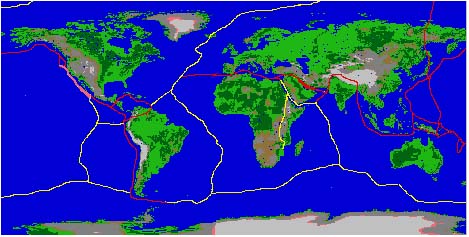
plates . There are twelve main plates on the Earth's surface. The
red lines on this map of the world represent the largest plate boundaries. A
plate boundary occurs where two plates come together. There are three kinds
of plate boundaries:
- Convergent boundary -where two plates collide to form
mountains or a subduction zone.
- Divergent boundary -where two plates are moving in
opposite directions as in a mid-ocean ridge.
- Transform boundary -where two plates are sliding past
each other as in the San Andreas fault of California.
The Earth's plates are in constant, but very, very slow motion. They
move at only 1/2 to 4 inches (1.3 to 10 centimeters) per year!! This does
not seem like much, but over millions of years it adds up to great distances
of movement.
The Continental Drift Theory states that the continents
have moved and are still moving today. In 1912 Alfred Wegener
introduced this theory, but he did not fully understand what caused the
plates to move. A theory is an explanation of a scientific
process that has been successfully tested by many different methods.
The motion of the Earth's plates help scientists to understand why
earthquakes, volcanoes, and mountain building occur.
You will learn more about why the plates are moving in the next lesson,
"How Plates Move".
Scientists believe these plates have been moving for millions of years.
In fact, 250 millions years ago the Earth's seven continents were all
grouped together into a super continent called Pangea.
Introduction |
Task | Process |
Evaluation | Conclusion |
Credits |
Teacher Page
Click on the "Next" button, and be transported back 250 million years!!
|
 Back
Back
 Beginning
 Questions
 Next
Next
 To Volcano World