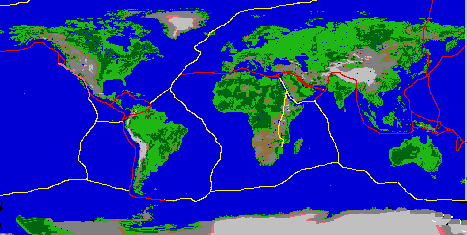
- Convergent boundaries - two plates collide to form mountains or
a subduction zone.
- Divergent boundary - two plates are moving in opposite
directions as in a mid-ocean ridge.
- Transform boundary - two plates are sliding past each other as in the San Andreas fault of California. A transform boundary is like a tear in the Earth's crust. These plates move very slowly across the surface of the Earth as though they were on a conveyor belt. The convection currents in the much hotter mantle continually move the plates about 1/2 to 4 inches per year.
Click on the "Next" button to learn more!!
 Back
Back
 Beginning
 Questions
 Next
Next
 To VolcanoWorld