Dave Arthurs' Opel-GT Hybrid
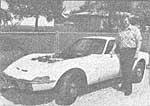
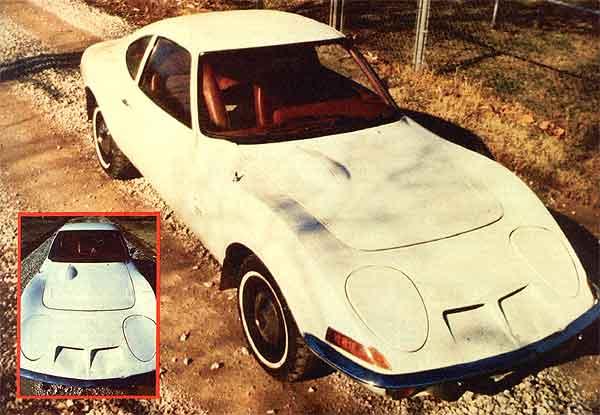
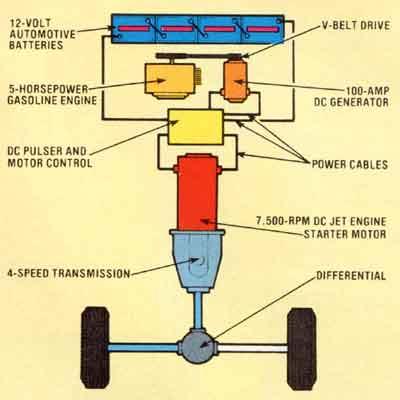
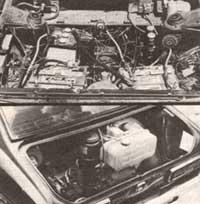
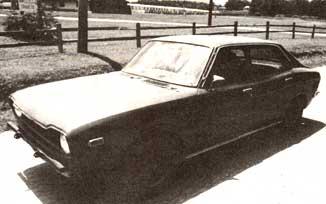
Issue # 58 - July/August 1979 Electric engineer David Arthurs spent 40 hours of his time and $1,500 to come up with.... ROBERT W. MARSHALL LEFT: The lawnmower engine-together with all the electrical components necessary for the conversion-fit comfortably in what was the Opel's engine compartment. ABOVE: The layout of the new drive system. BELOW: Dave's hybrid electric automobile "drives" like a normal vehicle . . . but squeezes 75 miles from each gallon of fuel! BELOW, INSET: The sports car's outside appearance as well as its curb weight-remains virtually unchanged. STAFF PHOTOS With the price of gasoline already out of sight, just about everyone is scrambling for a way to squeeze the last possible drop of energy from each precious gallon. However, David Arthurs-of Springdale, Arkan sas-probably couldn't care less ... because he has designed and built a car that can travel 75 miles or more on just four quarts of the expensive liquid! What's his secret? Well, Dave's Opel CT is a hybrid electric vehicle. That is, the car is driven by an electric motor . . . but that powerplant's "juice" is generated with the help of an ordinary, fuel-stingy lawn-mower engine! Now the fact that the system works isn't really surprising. What's amazing is that the crossbreed hookup performs so well ! According to David, the Opel has not only a virtually unlimited range (when driven prudently), but also a top speed of 90 miles per hour . . . and emits a minimum of pollutants as it tools along the highway. Better yet, the car can-if need be-run on its batteries alone for short in-town hops . . . and will never be "stranded" as long as there's fuel in the "on board" generator! WORLD WAR II TECHNOLOGY Mr. Arthurs is the first to admit that there's nothing "new" to the system he's developed . . . in fact, all the technology incorporated into his design has been available for about 35 years, just waiting for someone to put two and two together and make the whole thing work. "I began researching the idea for a hybrid electric auto about a year ago. There wasn't much information to be found on the subject, so I designed a system from scratch. In about a month's evening-and-weekend time, I had the car finished and running." Surprisingly enough, the project didn't cost a fortune, either. Because the vehicle's components are either standard "off the shelf" hardware or available as reasonably priced military surplus, the conversion to "hybrid drive" only set Dave back about $1,500. By the same token, any necessary replacement parts are easily obtainable . . . and a good deal of the equipment can be "scrounged" rather than purchased new. HOW IT WORKS In essence, David has utilized a small gas lawn-mower engine to drive a generator, which-in turn-supplies the vehicle's drive motor with electricity. To do so, he first removed the Opel's original power-plant and installed a 400-amp DC motor/ generator (actually a jet engine's starting motor) in its place. (Since there's no need for a clutch in Dave's setup, the stock unit was pulled out and the main shaft of the drive motor was fastened directly to the input shaft of the car's transmission.) Then, to provide a consistent source of power for this motor (and to supply an energy storage bank), the engineer installed four 12-volt, heavy-duty automobile batteries-in series-which are "fed" by a 100-amp generator that's run off a 5-horsepower lawn-mower engine. Of course, other components (such as relays, charging diodes, rectifiers, and an additional motor speed regulation circuit) are necessary to keep input and output power within optimum limits-and to allow full control of the vehicle at all speeds-but these are standard electrical parts which have been available for years. The engine-driven generator can handle the demand from the main motor up to speeds of about 50 miles per hour. The "stored" energy in the batteries comes into play at higher velocities, giving extra kick for passing and climbing hills. To guarantee that the charging system isn't overworked . . . Dave has rigged up a regenerative braking circuit which- in effect-turns the drive motor into a generator, to feed the batteries when the vehicle is decelerating. (This not only takes advantage of normally wasted energy, but also saves wear and tear on the car's conventional braking system.) Since the Opel's "stock" cooling apparatus has been removed, two small thermostatically controlled electric fans provide ventilation to the motor and generator as required ... while the gasoline engine is, of course, air-cooled by design. GROWING PAINS Any project fresh off the drawing board has its share of problems, and the Opel hybrid was no exception. When David pressed the accelerator for the first time, he got a 300-amp surge which melted his relays. So he searched his graduate texts for the answer ... and finally found it in-of all places-an old high school physics book: A pulser was necessary to "chop" the current flow and prevent a heavy initial draw to the drive motor. As Dave explains it, "The motor will always have full voltage and full current, but the pulser makes it 'think' the voltage and amperage are cut down to about 1/4 of what's actually available. With this gadget-which is simply a combination of a reworked car generator and an old fan motor-I can keep the draw within limits and effectively control the car's acceleration . . . without sacrificing the maximum current or voltage that's necessary for high-speed driving. I could have achieved the same results with a commercially available FCR control ... but one of those units would have cut my power slightly, and cost in the neighborhood of $800! I can build my own device for about $25, and I can fix it myself if it breaks!" AND IT'S REALLY PRACTICAL! Actually "piloting" the hybrid electric isn't much different from motoring in any conventional automobile. There's a slight hum from the electric motor, but the sound is certainly no more obvious than that of an internal combustion engine at speed. And-unlike many electric vehicles-the little Opel' really has some get-up-and-go . . . due to the fact that the converted car is only about 50 pounds heavier than its original 2,100-pound weight. Of course, some folks will question the idea of shifting without a clutch . . . but with the fully synchronized gearbox-this doesn't prove to be a problem at all (and the motor could be run through a conventional clutch with few complications). As far as the driving range is concerned, Dave points out that-if driven carefully the car can travel unlimited distances (as long as the generator engine continues to function) . . . because of the fact that the motor has a low draw at cruising speeds: only .23 amps at 1,800 RPM. Since the Briggs & Stratton engine turns at a fixed rate and can generate 100 amps at about 28-1/2 volts, normal driving presents no problem. Hot or traveling in a very mountainous area-could, however, tax the car's charging system . . . but even these demands don't pose much of a problem, because the batteries can be brought from a 1/4 charge (the effective "dead" state, with a built-in safety factor) to a full charge in only 15 minutes. David Arthurs' electric Opel sounds almost too good to believe . . . and best of all, its circuitry can probably be adapted to just about any vehicle on the road today! It is true that small, lightweight cars are more easily "hybridized", but this same system will also work in a heavier auto . . . it could even be upscaled to suit one of the large American models. In short, Dave has succeeded in doing-for a lot less money-what countless government-funded researchers have failed to accomplish: building a passenger car that uses a minimum of energy. Now all he has to do is burn "homegrown" alcohol fuel in his generator engine . . . and Mr. Arthurs will have the most economical set of wheels in town! EDITOR'S NOTE: If you're discovering that you can't keep up with the high price of gasoline-and are willing to do something about it-you'll be pleased to know that MOTHER has made some special arrangements with David Arthurs. A set of detailed, easily understood plans will soon be available that will allow the average "backyard mechanic" to convert a conventionally powered automobile to hybrid electric drive. MOTHER's plans package includes schematic drawings, a components list-complete with manufacturers' names and part numbers-and a materials list . . . all put together in a fully explained, easy-to-follow packet. just send your name and address-along with $15.00-to Mother's., Plans, Hybrid Electric Car, P.O. Box A, East, Flat Rock, North Carolina 28726. ************************************************************************** Issue # 65 - September/October 1980 Mother's Own Hybrid Car! In response to the many requests we've received for additional experimental auto information, here's... A little over a year ago we published an article (written by contributor Robert Marshall) that described an experimental hybrid electric automobile designed and built by an Arkansas electrical engineer named David Arthurs (see MOTHER NO. 58, page 160). In that piece, it was reported that Arthurs' vehicle (which used an on-board internal-combustion generator engine to provide "juice" to a battery bank, which�in turn�fed the car's electric drive motor) could not only travel 75 miles on a gallon of fuel, but had been converted to hybrid electric mode using just $1,500 worth of (mostly) government surplus parts! We also, at that time, made arrangements with Mr. Arthurs to produce under his careful eye�and to offer through the magazine�a set of plans detailing the procedures and parts used by the engineer in his automotive conversion. As a result of David's continued testing, suggestions from readers, and our own research . . . we soon discovered that the original magazine article was general enough to allow for some misconception. Furthermore, David pointed out�before we began work on the plans�that there were several technical errors in the original interviews. Considering these facts (and always bearing in mind that Dave's car was truly experimental, and that it was constantly undergoing design changes aimed at making it better), we all went out of our way to detail the jointly prepared plans that followed the original article . . . so that anyone attempting to build a hybrid vehicle could follow those instructions to determine�right from the start�exactly what components would be necessary for the car's successful operation, and could then "custom fit" the design (according to the plans) to suit his or her particular vehicle, terrain, and range requirements. However, a few folks (some of whom hadn't purchased plans and others who had and were seeking extra assistance) were still hungry for more hybrid data . . . and continued to call MOTHER and David, looking for tips. Now Mr. Arthurs has a full-time electronics business to tend to, and he simply wasn't able to conduct his regular research program, keep his business going, and answer the technical questions that came in. So we here at MOTHER decided to build our own version of the Arkansan's prototype�using the plans we had prepared with David's help to do so�in order to be able to answer, from the authority of firsthand experience, the many hybrid-related queries that came up. MOTHER BUILDS HER OWN For a good many months now, MOM's researchers have been conducting exhaustive tests�and compiling valuable data�on several different hybrid car versions . . . finally settling on a vehicle based upon a 1973 Subaru sedan for our "test unit". And despite the extremely mountainous terrain typical of our western North Carolina home (hills and hotrodding, as was explained in the original article and in the plans, can drastically reduce the effectiveness of a hybrid's charging and propulsion system), the vehicle performs well. In fact, we're so pleased with the car that we decided to report exactly what our hybrid has accomplished so far, and how we were able to make it achieve such results! As you read the following figures, keep in mind that our economy and performance tests were all done under actual road conditions . . . unfavorable though those conditions often were. At no time did we estimate or extrapolate range or mileage, or otherwise simulate any kind of driving condition. In short, we stuck to a straightforward, in-use analysis that was even more realistic than that used in the government's EPA mileage tests! Probably the first two questions anyone would want to ask about the experimental hybrid's performance relate to its fuel economy and range. Such considerations are, of course, directly influenced by [1] the choice of engine used to turn the charging generator, [2] the total weight of the car, and [3] the terrain and driving conditions the auto encounters. As explained in the plans package, the lighter the original vehicle, the more effective the hybrid electric (a term which, of course, refers to the fact that the batteries and the liquid-fueled engine work in combination) will be. Because of that fact, the plans suggest that anyone intending to build a hybrid first select the lightest chassis available . . . then go ahead and set it up as a strictly electric vehicle, and make test runs to determine current draws for that car. Armed with such relevant information, a builder would then be equipped to make the best possible choice of engines ... based upon horsepower, torque, and fuel consumption at a given RPM. In our case, the Subaru had a total weight�with batteries and 200 amp generating system on board�of approximately 3,000 pounds. Because of our area's terrain (which, as noted above, increases amperage draws considerably over what they might be during operation in a more level area), we found it necessary to add, as per the plans, six extra six-volt batteries . . . to provide additional storage capability. Our prescribed "electric only" testing then determined that we needed�again because of the steep up-and-down grades of most of our roads�an engine with a continuous rating (DIN) horsepower of about 9. For insurance, we finally settled on a plans�recommended 12.5 (DIN) horsepower Lombardini 720 diesel . . . and then set the impressive little powerplant to run at midrange, at which point it produced approximately the 9 horsepower our auto required. (Although David Arthurs' original 5-horsepower gasoline engine certainly did add to the range of his battery pack�and thus effectively "hybridize" his vehicle�over the comparatively flat Arkansas roads . . . such an engine would not have extended our hybrid's range enough beyond that of the batteries alone to justify its use.) Further testing enabled us to decide upon another "best choice" . . . this in the area of motor controls. Our experience with the "chopper" used by Dave on his prototype Opel hybrid indicated that the system might have a limited lifetime as a result of the sometimes extreme currents that passed through its brushes while in operation. So we read through the alternatives presented in the plans and�rather than fall back on a cost-prohibitive Silicon Controlled Rectifier (SCR) control�chose to utilize a voltage tap system to the field, rather than to the armature, to regulate the main motor's starting torque while still keeping the current passing through the control down to a comfortable 10 amps or so. By doing this, not only have we in stalled an inexpensive, so-far-effective regulating device (our system provides a progressive "stepping down" of field voltage from 30 to 18 to 6, governed by microswitches and operated by depressing the accelerator pedal), but we've also eliminated the need for all the car's high-amperage, high-cost relays . . . except the 400-amp main motor relay! (Our research now indicates that a two-step setup�30/24-volt�may be more practical and would provide more economy.) As another point of interest�especially for the convenience-minded�we found that, although it's quite possible to operate the hybrid without a clutch (as we did over the course of many hours of testing), the car's drivability is increased by installing one of the mechanical uncoupling devices. A clutch probably extends the life of the transmission gears and synchronizers, and also allows the removal of a reactor from the wiring circuit . . . a component which is nothing more than an electrical "shock absorber" used to control high voltage surges when no clutch is employed. Here's an unexpected bonus that resulted from our hybrid car research! Mother's 129-MPG Car! Between testing and improving the various hybrid electric car models, MOTHER's researchers have�as you can imagine�had plenty to keep them occupied over the past months. But they weren't too busy to devote time to another project that's something of a "horse of a different color": the design and construction�from the ground up�of a two-passenger, ultra-high-mileage diesel automobile. If there's one thing we've learned from working with the hybrid car, it's that reduced weight is a key factor in achieving increased fuel economy. Our goal, then, was to build a machine which weighed no more than 900 pounds ... and we ended up doing even better than we'd hoped! Motive power for our lightweight creation comes from a one-cyciinder, 6.4 (DIN continuous rating) horsepower Lombardini diesel engine, driven through a set of Salisbury clutches that allow for an infinitely variable gear ratio, governed by load. Final drive is at a fuel-saving 2.82-to-1 ratio, using a chain and sprocket system connected to the axle of the right rear wheel. MOTHER's roadster, in its present configuration, weighs in at just about 675 pounds . . . a figure we never imagined�several months ago�we'd be able to achieve. However, surprised as we were at the lightness of the machine, the real shock was the car's mileage: At this point, with the engine still as yet not broken in, we're getting as high as 129 miles per gallon in actual suburban driving . . . and we hope to improve that figure�and the vehicle's approximately 45-MPH top speed�as time goes on. Right now, though, we're working on body design, and�although the increased weight of a "shell" will add a few unwanted pounds�its wind-cutting configuration (not to mention the convenience and comfort it will provide to the driver and passenger) should completely offset any such disadvantages. We'll keep you posted on the developments of this project as they occur . . . in'the meantime, maybe we'll do some economy testing using vegetable oil as fuel! THE PROOF IS IN THE TESTING Once our Subaru was set up as described . . . and we had installed our final engine choice, which was still "tight" with only three hours on it ( the break-in time is from 30 to 50 hours), we achieved more than satisfying "mountain driving" results. With a fully charged battery pack and carrying 300 pounds of driver and passenger (anal running with open windows, stock tires, and various other "handicaps" not usually associated with high-mileage tests), the fuel economy over the course of our 78-mile test run (with help from the battery pack) worked out to 83.6 miles per gallon. of diesel fuel. The car's top cruising speed on level ground�in its 30-volt configuration�proved to be about 45 MPH . . . although we did hit 55 MPH on a slight downhill stretch. With the driver controlling the speed of the diesel generator engine, and trying to keep current draws below 200 amps whenever possible by shifting gears (and using the accelerator to vary field voltage) when necessary, the diesel engine�doing its "hybrid job"�more than doubled the range that would have been possible with the batteries alone! (And, of course, when the two separate "fuel systems" worked together, we achieved our best economy figures.) Furthermore, even with the battery pack fully drained and disconnected, we found it possible to motor along at a speed of 45 miles per hour on the generator engine alone. Under engine-only operation, we were still able to achieve 60.5 MPG . . . a figure which could increase by as much as 20% after the Lombardini breaks in. What all these numbers boil down to is this: When the car is operated in the hybrid mode (using both batteries and engine as it was designed to do), it's possible to achieve astounding fuel economy over a more than reasonable commuting distance. Any driving done beyond the 78-mile hybrid range would�in our vehicle under our test conditions�be at the expense of such excellent MPG figures . . . though the numbers wouldn't ever drop to quite as "low" as the 60 (plus) MPG possible using the generator engine alone. And, of course, as long as there's fuel in the on-board diesel, the car's total range is unlimited. BUT THERE ARE SOME LIMITATIONS The figures achieved during our testing vary from those that Robert Marshall reported were "racked up" by David Arthurs' original hybrid some months ago. Several of the discrepancies can likely be attributed to the differences in vehicles and propulsion system configurations, and others to the inequality of terrain involved. But there were several points made in that article that were inaccurate (as folks who ordered the plans, in which the errors were corrected, already know), owing to the fact that David's vehicle was then experimental and still under initial�and at times necessarily somewhat crude�testing. For one thing, it was reported in the original piece that Mr. Arthurs' drive motor had current draws of 23 amps at 1,800 RPM. In reality, the motors that we bench-tested at 30 volts had free-running draws of about 40 amps at 4,800 RPM . . . which�under load on the highway at 30 volts�increased to 100-150 amps on level ground at 30 miles per hour, with the car in third gear. Another point that needs some clarification is the statement, made in the article, that Arthurs' engine-driven generator could handle the demand from the main motor at speeds of up to 50 MPH, after which the energy in the batteries came into play. Our testing so far indicates that the generator, without the "hybrid" boost provided by the storage pack, is capable of propelling the car at around only 45 MPH and�at that velocity�doesn't produce enough surplus to significantly charge the battery bank. Which brings us to another point concerning performance of the vehicle: Dave's original car was set up to use a 24/48-volt system (an option emphasized in the plans) . . . in other words, the auto could be switched to the higher voltage to achieve greater speeds for passing and such. Making a switch to "48", however, increases amperage draws drastically (causing a corresponding reduction in the vehicle's range), and�since the batteries can't be charged at 48 volts�continuous travel at such speeds would be impossible. (Furthermore, though it was reported that Dave's speedometer registered 90 MPH on a gradual downhill grade, we feel that the drive motor would have had to be fed yet more voltage�at least on level ground�to achieve such an admittedly excessive speed.) The capability�mentioned in the original article�of using the on-board generator to charge the stationary vehicle in a short time, is another matter that deserves attention. According to Dave's gauges, his original hybrid Opel's batteries could be brought from 1/4 strength to a full charge in 15 minutes. This has proven to be a misleading reading, however. The meters were, we have found, actually indicating only a full surface charge (which wouldn't be able to power the car for long). In reality, the best way to renew the battery pack is by "trickle charging" . . . feeding the current at a rate of about 25 amps over a period of approximately 10 hours. DOLLARS AND CENTS The cost figures for the project, as David Arthurs itemized them, were absolutely accurate. However, the prices reflect costs as they stood more than two years ago, and inflation has since then taken its toll. What's more, the law of supply and demand�especially in the case of some of the limited-availability government surplus parts�has driven the cost of certain components (such as the 400-amp starter generator) up to triple what it was back then! Fortunately, with a straight "one-voltage" system�as used by MOTHER's car�some of the high-amperage relays can be eliminated and much money saved. However, anyone starting to build a hybrid today should know that the possible need for more batteries and/or a larger engine (such as our fuel-economical diesel), coupled with future changes in price and availability of government surplus components, could add a good bit to the cost of the total project. (It would probably now be a good idea to check with surplus suppliers to determine the size of their parts inventories before embarking on the project.) MOTHER's researchers intend to finish testing our hybrid car�and to monitor the continuing research conducted by David Arthurs�and we'll report any breakthroughs as they occur. We're also interested in a related project: By replacing the generating assembly with batteries, we hope to achieve an "electric" range of 60 miles, without the noise and pollution that are unavoidable when using any internal combustion engine! Considering that the cost of "plug-in" energy for the hybrid car is under 2.5� per mile (based upon our area's rate of approximately 4� per kilowatt-hour), such a vehicle should prove very attractive . . . especially in light of the fact that the average American car consumes fuel at a rate of more than 6� per mile! And more news for our fellow experimental car enthusiasts: The DOE recently awarded General Electric an $8 million contract to develop two hybrid prototypes that�it's hoped�will use a "whopping" 5% less total energy than today's Detroit products. With that kind of money, it shouldn't be long before Big Industry reaches the point where Dave Arthurs was two years ago! EDITOR'S NOTE: Those who'd like to use their already purchased plans to build MOTHER's experimental version of the hybrid car can get free update information by sending a stamped, self-addressed envelope to Mother's Plans, Hybrid Car Update, P.O. Box A, East Flat Rock, North Carolina 28726. And if you haven't yet bought the plans, you can order a set-containing information on all the hybrid options mentioned in this article�for $15, from, Mother's Plans, Hybrid Car, P.O. Box A, East Flat Rock, North Carolina 28786. ********************************************************************** 1980 Issue # 61 - January/February 1980 Six months ago, in our July/August 1979 issue, we published an article about a 75-mile-per-gallon hybrid electric automobile that a fellow out in Springdale, Arkansas built-in just a month's worth of spare time-for a scant $1,500 (see MOTHER NO. 58, page 160). The car's designer, Dave Arthurs, not only developed the vehicle using standard off-the-shelf parts and reasonably priced military surplus, but also fabricated a motor controller (which, up to this point, had been the "joker in the deck" for many electric vehicle enthusiasts . . . because of the typically high cost and low efficiency of such units). Furthermore, Mr. Arthurs' controller was made from $25 worth of junkyard parts, was a cinch to build, and-better still-consumed a minimum of precious energy while in operation. What's more, Dave was willing to share his automotive "discovery" . . . by first permitting MOTHER to report on what he'd done, then by working with this magazine to develop a set of plans to, help other folks build their own hybrid electric cars! NOTHING SUCCEEDS LIKE SUCCESS And build they did. To date, thousands of folks have ordered plans so that they, too, could take advantage of the econ omy that David Arthurs enjoys. (His hybrid electric auto uses a fuel-sipping 5horsepower generator drive engine, and can attain speeds of up to 90 MPH!) But Dave certainly didn't stop with his first prototype. Even before roughing out our initial plan schematics, the Arkansas electrical engineer had incorporated a few additional features into his car (including a home charging circuit, a more powerful-but still economical-gasoline engine, and increased generator output) which made the hybrid even more practical . . . especially for extended use. He also figured out a way to utilize the heat given off from the small generator drive engine to supply his car's defroster and wintertime climate control system, and give his engine self-starting capability by temporarily routing current backward through the generator during initial start-up! AND THERE'S MORE WHERE THAT CAME FROM! The ingenious inventor has done a lot of additional research, too. While scouting out an efficient, lightweight battery, for instance, he uncovered several good sources of such power-packs, as well as additional access information for drive motors, generators, and assorted parts and components . . . all of which-along with the design innovations-Dave supplied to MOTHER for her plans package. However, the best news may be yet to come: Mr. Arthurs has informed the editors and research folks here at MOTHER that he's putting together yet another hybrid vehicle . . . this time a VW transporter bus, which he plans to use as a delivery vehicle for his small electronics and stereo shop. Although the mini-van isn't quite finished, David reports that it "works like a charm" so far . . . and-after he completes the final cosmetic touches-he wants to jump right into his next effort: a hybrid electric boat! Needless to say, MOTHER will be right on top of both projects, and as soon as possible (maybe even in the next issue) we'll be showing you the latest in hybrid electric transportation from Springdale, Arkansas! EDITOR'S NOTE: If the increasing price-and decreasing availability-of gasoline has you scratching for a better way to travel, you can still take advantage of the system David Arthurs has developed. For a complete four-page set of plans-which includes a list of materials, detailed drawings, an explanation of the car and its electrical system, and a rundown of parts suppliers-plus an additional two-page sheet listing manufacturers of components, send your name and address with 815.00 to Mother's Plans, Hybrid Electric Car, P.O. Box A, East Flat Rock, North Carolina 28726. ***************************************************************************** May 1980 Introducing David Arthur's latest internal-combustion/electric creation: HYBRID II David's newest hybrid car conversion. Nearly a year ago, in our July/August 1979 issue, we featured an article about a 75-mile-per-gallon hybrid electric car that a gentleman named David Arthurs from Springdale, Arkansas had put together for a total of $1,500 (see MOTHER NO. 58, page 160). Six months after that (in MOTHER NO. 61, page 158) we ran a short update on the success of Dave's design and mentioned that he was working on several other alternative transportation projects that we felt sure MOM's readers would want to know about. Well, Mr. Arthurs recently gave us a call to let us know that one of those vehicles�his hybrid VW transporter bus�is now on the road and in regular use. The Volkswagen bus uses essentially the same circuit as did Dave's original hybrid Opel GT. He has, however, made some improvements and design changes which not only simplify construction of the vehicle, but make it a downright practical form of urban transportation. The new hybrid delivery van still uses a 400-amp starter/generator as its "prime mover", and that motor is coupled to the existing transmission through a clutch and commercially available adapter plate. Four batteries within the vehicle provide "juice" to make the system operate. The big change is the charging setup: Instead of mounting an internal combustion engine within the body of the bus, the inventor chose to mount it�and its generator "mate"�on a separate trailer fabricated from some pieces of tubular steel. Heavy gauge welding cable ties the mobile power-pack to the VW's drive motor, and the trailer itself is clamped tightly onto the rear bumper of the tow vehicle. In addition, Dave has opted, for economy reasons, to go with a 9-HP Lombardini air-cooled diesel engine rather than a more conventional gasoline-powered unit and, with the generator charging at a rate of 200 amps, the soundness of that decision is verified by the 1/2-gallon-per-hour fuel consumption figure that David has calculated. Other changes include a reduction in the number of relays required (he now needs only two . . . the main power and generator switches). With his delivery vehicle as it is now, the engineer has the option of either disconnecting the power trailer completely (and taking short local drives on battery-stored energy) or leaving the trailer connected, and�with help from the diesel engine�providing "juice" to his power packs for an extended driving range at in town speeds. At this point, Mr. Arthurs is�to say the least�sold on hybrid electric vehicles. He is, in fact, so involved in the concept that he's started a newsletter to encourage an exchange of information among HEV enthusiasts. (You can receive copies by writing to Dave at AMP, Inc., 1008 West Sunset Street, Springdale, Arkansas 72764 . . . but please, slip in a dollar to help him cover his printing and handling costs.) So, if you're building a hybrid car and need a little help, drop Dave a line ... and by all means, if you've finished your home�built fuel-sipper, be sure to let MOTHER know about it! **************************************************************************** Issue # 138 - June/July 1993 1993 Update:Dave Arthurs' Amazing Hybrid Electric Car Alternative-energy vehicles have been motoring through the pages of EARTH DIARY by Matt Scanlon MOTHER since 1970. Our response to the energy crisis at that time took the form of a number of investigations into alcohol, ethanol, gasohol, and ultra-efficient diesel engines. But in 1979, Dave Arthurs, then of Springdale, Arkansas, came upon a design combining electric and gas engine formats that made even the billion dollar development efforts in Detroit seem like a waste of time. Above left: The battery bank for the electric drive, composed of three 12-volt, deep-cycle batteries in series. Above: Dave points out some of the components in the 400-amp electric motor. Right The bed of the pickup was an ideal place to put the hybrid-engine array because the original engine remains under the hood. Using parts that he had purchased for under $1,500, Dave designed and built an engine system for his Opel GT that could propel the car 75 miles or more on a single gallon of gas! Dave's Opel was a hybrid electric vehicle. That is, the car was driven by both an electric motor and a conventional internal combustion engine. An array of six-volt batteries provided the direct power for the electric drive, while an efficient six-horsepower (hp) lawnmower engine ran continuously to generate power for and recharge the batteries. The combination of power plants made the car amazingly versatile. The batteries alone could be used for trips of under 25 miles, but the car had an unlimited range as long as the generator engine was running and the driver didn't have a penchant for drag racing. Additionally, if the electric power plant developed a problem, the Opel could travel on the five-hp engine alone at speeds of 30 miles per hour. Dave reported that the crossbreed hookup performed so well that, initially, MOTHER'S editors were more than a bit skeptical. It was decided that the only way to effectively test the design was to build our own. A few weeks later, we had a hybrid engine comfortably placed in a 1973 Subaru chassis. We had decided to install a slightly bigger generator engine, but our car still averaged 83.6 miles to the gallon, ran flawlessly, and emitted a minimum of pollutants as it tooled along the highway. The idea caught on like wildfire among MOTHER readers and over the course of the next year, 60,000 people asked for plans to convert their cars. As might be imagined, technology has marched along at a pretty brisk pace since 1979, and recently we were gratified to hear that Dave has been to the drawing board again, converting the engine of a 1980 Toyota pickup into an even more efficient hybrid of electric and gas formats. The results are simply better than ever. MOTHER spoke to Dave at his Fayatteville, Arkansas, home about his designs. Some Electricity Basics If it has been more than a few years since physics class, and Dave's talk of amps and volts leaves you in the dark, here's a short refresher. Dynamic electricity is simply electricity�a number of freed electrons, or negatively charged atomic particles�set in motion. An amp, or ampere, is a measure of the number of electrons flowing through a conductor (in most cases, a copper wire). In other words, an amp is a measurement of the volume of electricity. When the electrons travel through the wire, they encounter resistance from other atoms and particles. An ohm is a measure of this resistance. A volt is a measure of the force of the electrical flow which causes one ampere of electricity to travel through one ohm of resistance. A nine-volt battery, for instance, is capable of generating a flow of nine amperes of electricity through a one-ohm conducting wire. MOTHER: How has the format of the hybrid vehicle changed since 1979? Dave Arthurs: Although there have been quite a few developments in combustion engine design over the last decade, battery technology has taken the real leap. That's fortunate for the hybrid car since the electric engine provides the lion's share of the motivation. Basically, batteries are getting lighter and more powerful. Six-volt batteries were the only types suitable for my purposes back in the '70s. Have you ever seen one of those old six-volt batteries? They're monsters. I had to use six to generate the appropriate current, and at 75 pounds apiece, a very significant amount of the batteries' energy was spent hauling itself around. The new models weigh precisely the same but produce twice as much power. As a result, cruising range has now been extended, as has as average cruising speed. The batteries I use are deep-cycle with a cold-cranking power of 1,314 amps. I highly recommend a 36-volt circuit, so you'll need at least three of these 12-volt batteries. Most cars will draw 150-200 amps at 45 mph. When looking for a battery, compare the reserve capacity and the number of plates per battery. A high number indicates deep-cycle capability and high-current output. One battery I've found has 186 plates and a 75-amp, 12-volt output for 100 minutes. MOTHER: But does a conventional engine still supply the batteries with power? DA: Absolutely. That's a must if you want to travel distances of over 25 miles. The small combustion engine must operate at a constant speed if a long-range drive is in the works, supplying the batteries with power. I installed three 12-volt, heavy-duty automobile batteries�in series�"fed" by a 10-amp generator to do that job. The small engine then powers the generator. But I decided I wanted a bit more power in the new pickup, so I decided to forgo another five-hp gasoline engine in favor of a nine-hp diesel. That's equivalent to about a 20-hp gasoline engine. It turned out to be a perfect arrangement. It has tremendous torque, will bear very heavy loads without stalling, and is incredibly reliable. MOTHER: Can the batteries be charged at home if you want to just use them for a short trip? DA: Sure. Either a 36-volt charger can be used to charge all three batteries at once or a 12-volt model (which is much less expensive) can be used to charge each battery individually. Either one can be plugged into a standard home outlet. The electric rate here in Arkansas is 74 per kilowatt-hour. At that rate the cost is less than a penny per mile to operate the hybrid in the electric mode. But the range is limited by the number and type of batteries that you use. If you want to be able to drive for longer distances on the electric drive alone, the battery pack must be enlarged accordingly. MOTHER: How would I arrive at the right battery pack for my own car? DA: A typical 2,500 pound hybrid electric car will require approximately 200 amps at 36 volts to run 45 mph. Using that kind of information you can arrive at the best kind of battery pack for your particular use. For instance, two banks of the 186-plate, 12-volt batteries (six batteries) has nine kwh available. It takes 7.2 kwh to go 45 miles on the open road. With this battery system you should have a good hour of drive time on the batteries alone. MOTHER: How does the conversion process happen? DA: It can happen in many different ways. The simplest modification that you can make will give you a parallel hybrid. Add an electric motor to the existing engine of a car through drive belts, install an electric clutch (much like an air compressor), and that's basically it. The original engine and electric motor run in tandem and offer considerably improved fuel economy. The disadvantage to this method is that the large gas engine has to run all the time. It would be better if you could run on either gas or electric independently of each other. The series hybrid accomplishes that. In that design (used in the truck), the small diesel engine indirectly provides the motive force of the car. In other words it drives a generator to provide electricity to the electric motor. This method has several advantages. The diesel engine can be run at a constant number of revolutions per minute matching its peak fuel economy, and the electricity the generator produces can be shunted directly to the drive motor or into a battery bank. One of the greatest things about a series hybrid is its efficiency. Very little power is wasted. Every time you are going downhill and every time you stop, you have the opportunity to turn that inertia into electricity. You see, the electric motor which drives the vehicle is also a generator. A motor and a generator are virtually the same animal as long as we are speaking about direct current electricity. And when you are slowing down, you are actually "gearing down" : This over-revs the motor, turning it into a generator that produces electricity for the batteries. If you glance at the amp meter, you actually can see electricity returning to the batteries when this happens. This is not only energy efficient, but also saves a great deal of wear on the brakes because it slows the truck down. MOTHER: Why did you choose a pickup for your new design? DA: I just happened to have a older truck to modify. Any car can be used (although the lighter the better) for a hybrid. I needed a test vehicle capable of demonstrating different versions, both series and parallel, so I settled on a four-wheel drive pickup because there is enough room in the rear for the engine/generator package while the original engine remains up front. The rear wheels are powered by the electric motor; the front by the original gas engine. Vehicles modified at home will probably have the original engine removed, but I needed both to demonstrate efficiency, performance, etc. The truck is modified by removing the rear drive shaft altogether and mounting a short drive shaft and an electric clutch to the motor. The short drive shaft is the same as the front drive shaft in length. MOTHER: What kind of performance are you getting? DA: The electric motor performs and accelerates best at low speeds, as opposed to a gasoline engine which has most of its torque at the high end. So depending upon maintenance, charging, etc., you accelerate from zero to 40 mph in six to eight seconds. The engine-driven generator can handle the demand from the main motor up to speeds of about 50 mph. The "stored" energy in the batteries comes into play at higher velocities, giving extra kick for passing and climbing hills. Gearing can be changed if higher performance is desired but the truck was never really intended to be a scorcher. I was gunning for reliability and efficiency. Let the speed enthusiasts think up a supercharger if they want one! MOTHER: But isn't driving the truck dramatically different from driving a conventional car? DA: It's exactly the same. There is a slight hum from the electric motor and a bit of noise from the diesel engine, but actually, noise levels in the cab are lower than those in a conventional car. MOTHER: What kind of mileage do you get when the diesel engine is running? DA: A 25-mile test run using the nine-hp diesel engine showed that a gallon of fuel could produce sufficient amperage at 36 volts to drive the car two hours at 45 mph. That's 90 miles to the gallon. If the terrain had been a bit less hilly, the average speed would have been closer to 55 mph. It's important to realize, however that stop-and-go traffic shortens the range and reduces efficiency because of the heavy current draws (600 amps) in taking off. That's where the surge current (cranking power) of the battery comes in. A great deal of city driving will certainly affect overall fuel economy. MOTHER: Lead and acid batteries are still not exactly nature's best friend though. They're going to stick around those landfills long after we're gone, leaking lead and acid the whole time. How big an issue has that been in your design? DA: If you're careful, you need never throw away the batteries in the truck. When exhausted, they can be cheaply rebuilt by the manufacturer. The problem is getting consumers to want to recycle them. Here in Arkansas, in order to make sure that as few batteries and their contaminating agents as possible end up in the landfills, a $10 fine has been imposed on any buyer of a battery who doesn't bring the old one with them. All those old batteries go back and get remanufactured. MOTHER: The Opel conversion cost you $1,500. What has happened to the prices of equipment since 1979? DA: The main expense was, and still is, the electric motor, which is actually the starter motor for some commercial jet engines. Often they can be obtained surplus for as little as $300�$400. A new one will run you about $800. Wiring, batteries, and relays generally cost about $400, a generator about $200. The last�and most variable big cost�is the combustion engine. A lightweight vehicle may run just fine on the 5-hp engine used in my first car. You'll be writing a check for about only $200-$300 for that one, but if additional power and bigger engine are needed, the costs will go up. My diesel engine ran me about $1,200. It's important to remember that all of these expenses will go down considerably, though, if you are willing to do some scrounging and dealing. A careful buyer can spend as little as $2,000 for the whole thing, though I've known folks who forked out twice that much for all-new equipment and custom installation. MOTHER: Do you consider this process very practical if the conversion's going to cost $2,000 from the start? DA: It's actually very practical if you happen to have an old car or truck with serious engine problems that you still want to keep around. I'm not suggesting that you tear the engine out of your new '93, but an older car that still has a good chassis will run reliably for years on the hybrid drive, getting two to three times the mileage and producing a fraction of the pollutants in the process. MOTHER: How many years will the drive run before problems begin? DA: You might not believe this, but I'm still using the same electric motor that I installed in the Opel in 1979, and that motor was built in 1952! It has over 100,000 miles on it and the only maintenance it has ever required is $8 for parts. The only possible problem with an electric motor is overheating, so I've made a point of using a cooling fan and running it continuously. The weakest link in the chain is obviously the combustion engine. The 5-hp lawn mower engine I used in the Opel lasted only a few years, but it was so cheap that replacing it was really no big deal. Eventually I decided that the new design merited an investment in the diesel, which I purchased new in 1980. It's still running perfectly. I think the chassis will fall apart before the engine does. MOTHER: What's on the horizon for hybrid design? DA: I'm in the process of experimenting with a rotary engine currently. One of its great advantages is that it can be modified to run on virtually any kind of fuel-alcohol, peanut oil, anything. I've also developed some plans for people who want maximum battery range. My newest banks can sustain the car for well over 100 miles. That's more than enough for most commuter trips. NASA has already designed powerful batteries which can take a full charge in minutes. That technology will just get cheaper and more accessible, and in the not too distant future I expect that fuel stations will offer quick chargers for similar battery packs in addition to conventional fuel. The best experiments have really just started.
1979 Mother Earth News Article
1980 (Jan) Mother Earth News Article
1980 (May) Mother Earth News Article
1993 Mother Earth News Update