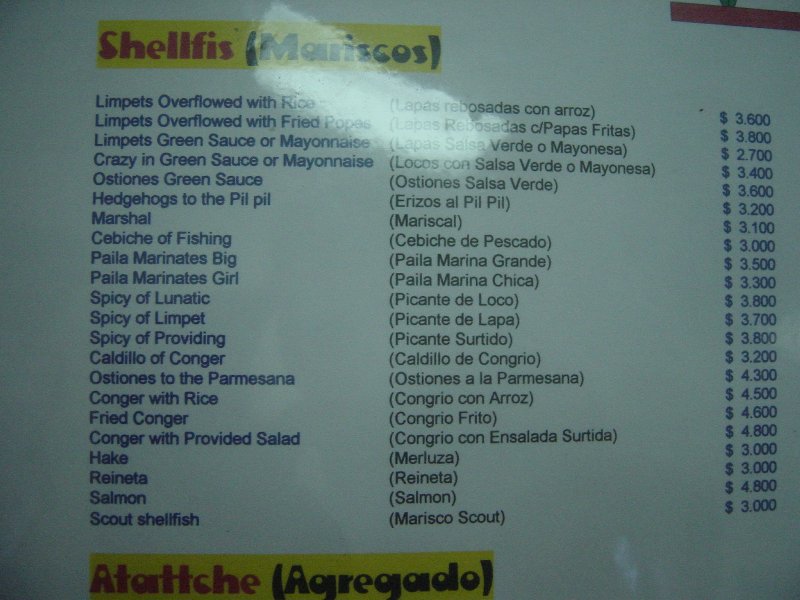
[Mmmmm, 'spiced lunatic' anyone?]
Chile is quite surprisingly different to Bolivia. One gets the sense on crossing the border that one is travelling forwards back to the modern world after the Bolivian experience. The buses, for a start are excellent: they don't stop in the middle of nowhere to pick up extra fares; they don't travel with people, chickens, leaf springs etc. in the aisles; and, most importantly, they do travel on wonderfully smooth tarmac roads.
However, their English skills are actually slightly worse than elsewhere. Never was this better illustrated than in the first restaurant we dined in, where they proudly produced their 'English version' menu. This was a piece of comedy quite comfortable being placed alongside anything from Blackadder or Monty Python. A certain amount of subtlety with respect to the waiter had to be employed, but I have the photo:
[Mmmmm, 'spiced lunatic' anyone?]
The Iquique bus turned out to be bearable and arrived ahead of time in the place. We immediately checked into a place 100m from the beach. This beach was an excellent specimen with particularly fine Pacific surf crashing in all day, fine white sand and a 2,000m mountain range immediately behind it. We caught up on sleep in the morning and then decided that we had earned the right to sunbathe on the beach. Here I made the first of two terrible mistakes, one rather less forgiveable than the other. Mistake number one was to assume that I could reach all points on my back when applying the sun-cream. After an afternoon spent body-surfing and reading in the sun we returned to our guesthouse where a burning feeling began on my back. Inspection in the mirror revealed, to Jon's amusement, that I had a lovely crimson strip right through the centre of my back. To make matters worse, one particularly evil wave had dispatched me onto the seabed at considerable velocity straining some internal muscles.
However, one of the most undiscovered remedies for sunburn (or any other injury) is a pitcher of beer on a beachside cafe watching the sunset. When this can be obtained for about 3 pounds the pain gets even less so things weren't that bad.
After a poor night's sleep I resolved to be more careful and the next day we sought out and hired a sun-umbrella from the touts on the beach. Mistake number two was to assume that this provided any sort of protection from the sun whatsoever. Despite spending much of the day wearing a T-shirt and nearly all of it under this umbrella I still managed to burn pretty much everywhere that had survived day 1's roasting. I was now the true specimen of an Englishman abroad, more commonly referred to as "The Lobster". More beers were clearly required.
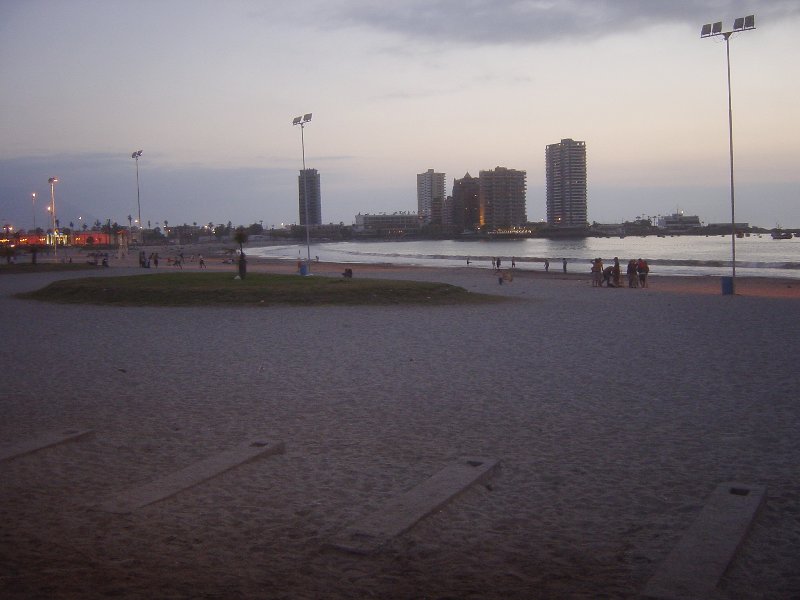
[An unfortunately rather poor photo of Iquique beach taken from the cafe at sunset]
This experience clearly proved that I am incapable of the arduous task of lounging around on the beach and so speed-sightseeing was clearly required again. Our final noteworthy experience of Iquique was getting a taxi to the airport. As ever, I had cut things pretty fine and so we were getting a little marginal as we got into Pedro's car and we informed him that our plane departed fairly soon. Now, the continent of South America has produced Juan Fangio, Nelson Piquet, Ayrton Senna and Rubens Barrichello to name but four of a glorious history of great drivers. The balance, however, has been redressed with Pedro. Buses and lorries were overtaking with ease and if there had been any cyclists we'd have been watching their backsides as well. I had not ever expected to be longing for our La Paz chap again. Disaster was averted when we reached the airport, for Heathrow it was not, and it was even dwarfed by the small military base with which it interestingly shared a runway.
The excellent LanChile got us safely to Santiago where a university friend of my father had very kindly arranged for us to be booked into a nice hotel and even to be transported there. The place was a little above our budget but was definitely worth it and excellent (ab)use of the free breakfast was made.
Santiago is a massive but very pleasant city surrounded by some truly enormous mountains that rise more than 5,000m higher than the city itself and provide ample skiing opportunities in winter. Alas, even our weather curse couldn't bring snow to the slopes in summer.
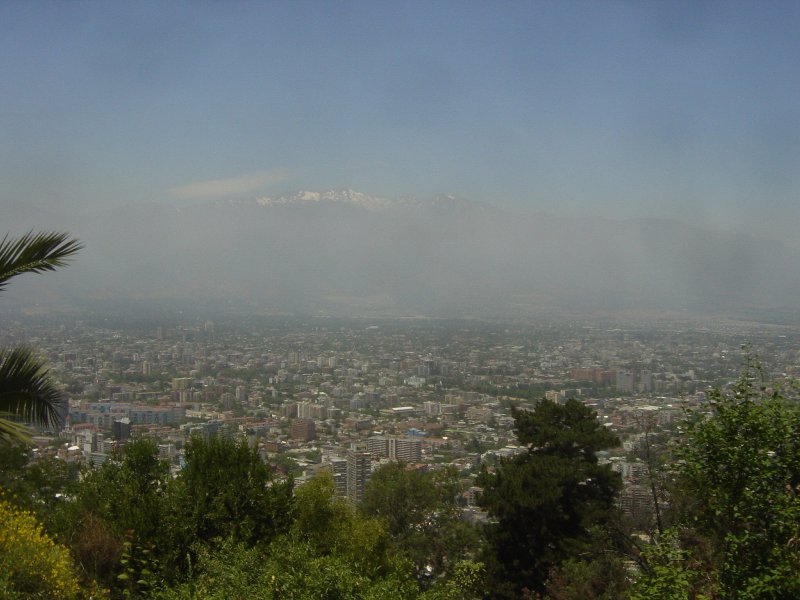
[Santiago viewed from Cerro San Cristobal]
We stayed in Santiago for several days visiting the main sites in town including a very well stocked zoo, where sympathy must be extended towards a particularly unfortunate [and probably very sweaty] polar bear. We also got close to the ultimate South-American-capital-city-challenge - mastering the bus system. This, being unregulated and not municipal, has a lot in common with La Paz, except that there were so many of them here that they outnumbered cars!
A few day trips were also in order, with the main highlight being a trip to the coastal port of Valparaiso where we had a splendid seafood lunch in a cafe placed at the top of a decidedly dodgy-looking funicular that proudly(!) boasted about being unchanged since the 19th century.
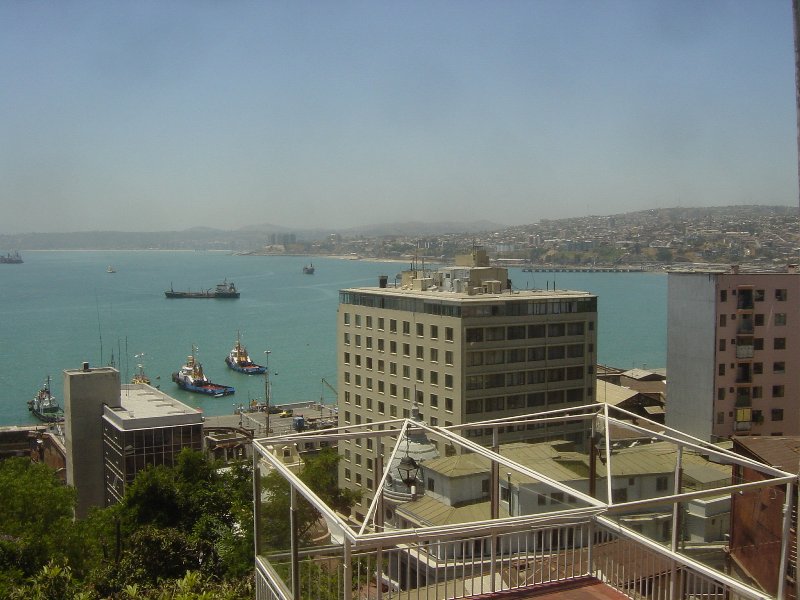
[View from Cafe Turri, Valparaiso. Note how sun, yes sun, is out again]
In fact, the food in Chile (and Peru and Bolivia to be fair) is superb, especially if one is a proper carnivore and willing to pay for it (by pay for it I mean about 2-3 pounds per meal rather than 50p). In one place our dish was brought out to us on it's own bed of hot coals. It was advertised as enough for two but I reckon even an Olympic rowing IV would have had enough for it appeared to contain practically the whole cow and a pig too. We easily had enough of the steaks and chops to avoid having to go too far into offal territory but some of the unidentifiable (to me, at least) bits were surprisingly nice. Others were definitely not.
Other highlights were an excellent tour of a massive vineyard and Jon managing to blag his way into getting a flight with the local gliding club. Alas, conditions on that day were unseasonably poor and so he was not able to soar up to Aconcagua (tallest mountain outside Himalayas) as can normally be done.
We were now due to cross the Pacific but travelling on a round the world ticket allows one a lot of stops so it would have been rude not to take advantage of this and off we went to Easter Island for a day and a half.
The combination of travelling with 6' 7" Jon and on the splendid LanChile airline ensured that were immediately allocated the exit rows and ensured an enjoyable journey to Easter Island, apparently the most remote inhabited spot on the Earth, population 2,000, and governed by Chile.
Easter Island is most famous for its Heads (more on that later) but it is quite a cool island having been formed by three volcanoes that now form the corners of the triangular landmass (if a 15 mile island can properly be called a landmass).
Coming into land is quite amusing for the runway takes up an entire width of the island. This airport is even more modest than Iquique and the plane comically had to go all the way to the end of the runway to go round a slightly wider bit representing the only bit wide enough for a turn, before heading back to the arrivals terminal, sorry, hut.
On day 1/2 we walked up to one of the volcanoes and went round an old village of the original people. This was entertaining but the vegetation on the island is pretty uninspiring (very few trees), and the weather is humid with frequent showers.
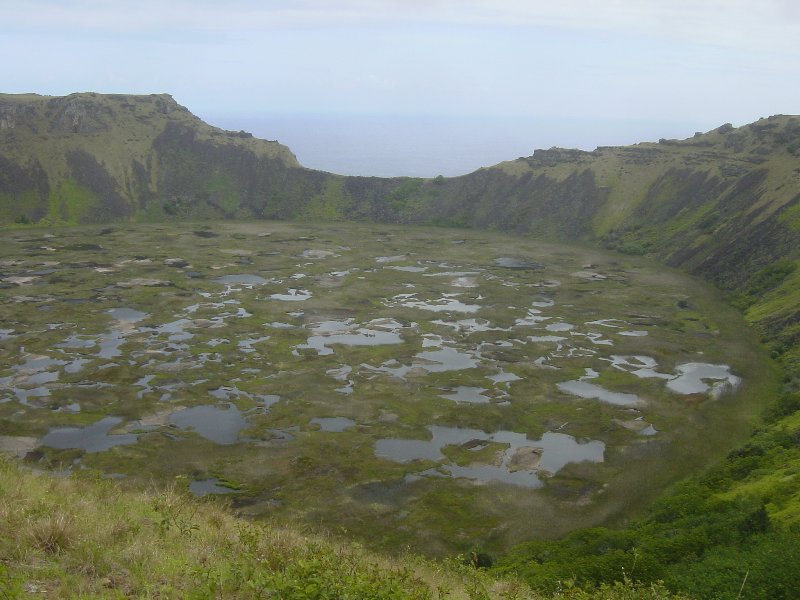
[Is this not a damn cool crater? Pacific Ocean in background]
As a result, on day 2 we hired some mountain bikes to go and explore the main part of the island and check out the maoui (Heads).
Now, as a rower I have met plenty of fairly obsessional people (including myself, some might say) but the Easter Islanders bring a new dimension to this. The amount of effort that must have gone into these statues may well be an explanation for why the native population was already in decline before we Europeans came to mess everything up. One can imagine the scene in the ancient Easter Island tavern:
However, the end product is undeniable impressive. Some of the maoui are over 10m tall and they all originally had topknots (sort of hats) made from a curious red stone. Most of the maoui were knocked over or destroyed by inter-tribe wars and tidal waves but many have now been restored. The stones are believed to represent a tribute to ancestors but are also a boast to the other tribe, which led to the later ones getting bigger and bigger. They all also boast a strange pensive expression.
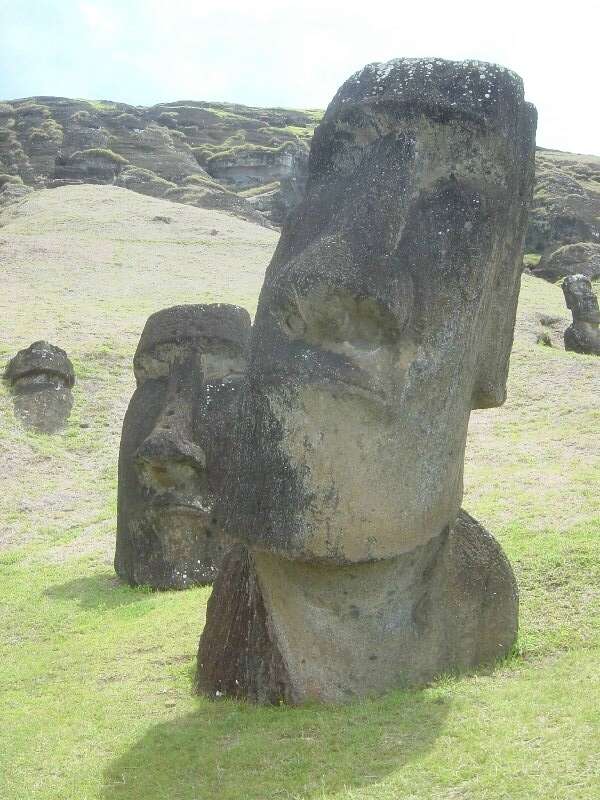
[Close up of an (unrestored) head]
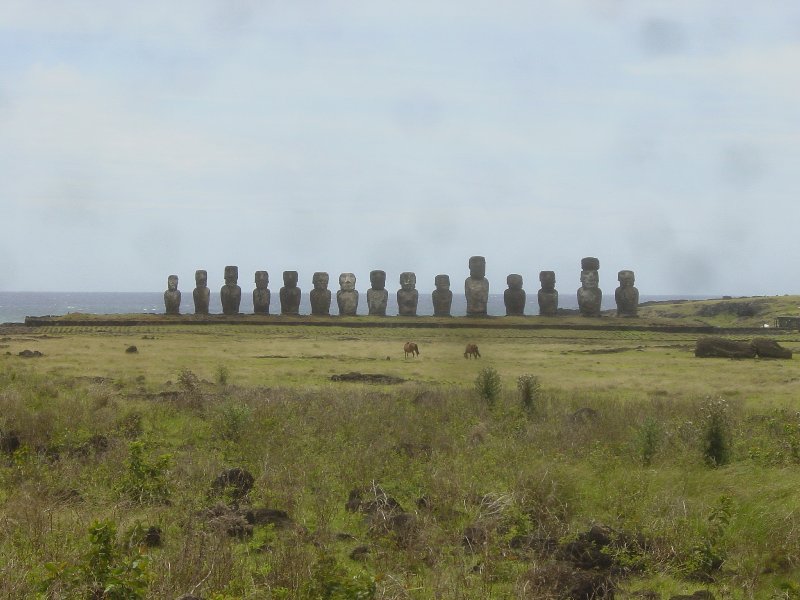
[Massive restored heads silhouetted. Note size compared to horses in foreground]
We also saw the quarry where they were hacked out of the stone. When the wars broke out between the tribes on the island, the work suddenly stopped so some of them are still half-complete in the quarry.
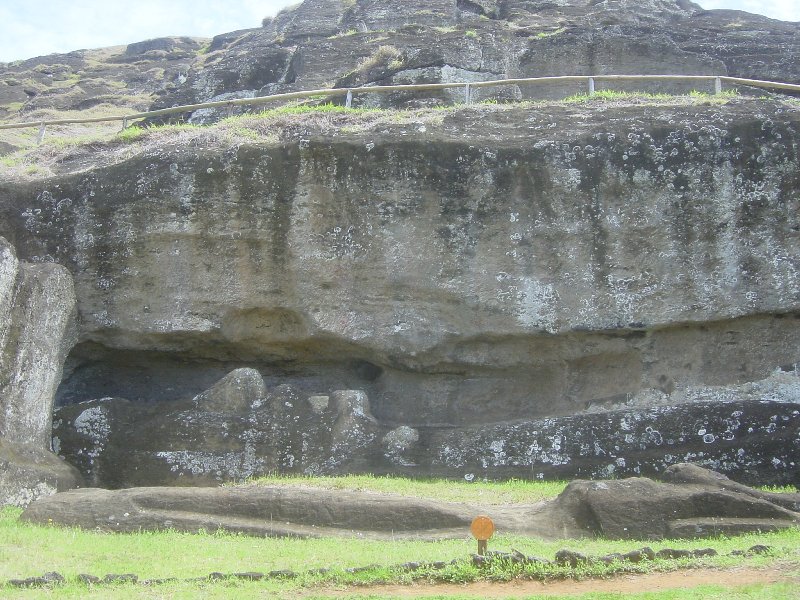
[Rather ambitious incomplete maoui. He is still part of rockface]
The cycling was getting quite tiring as the roads are unpaved and very bumpy and we had been heading into a 25mph headwind all the way up the island. Luckily at this end of the island is Anakena beach, where most people head each day. This beach is in a stunning setting with palm trees backing it and the white sand bringing out that wonderful aquamarine colour only seen on warm beaches.
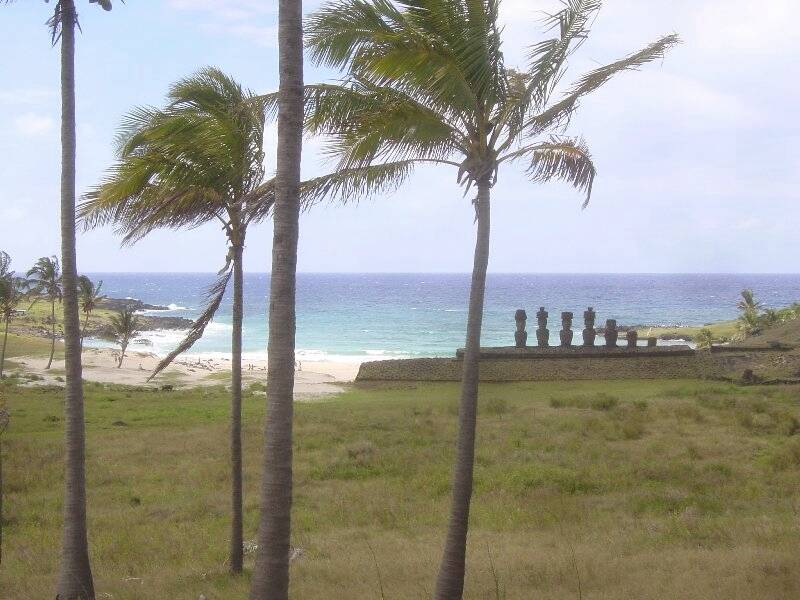
[Anakena beach with restored maoui, complete with red (trust me!) topknots]
The run back from the beach necessitated a nasty 300m hill climb, which left us briefly worrying about getting back in time (a common theme when I'm involved) but was followed by a long gentle (tarmac, hurrah) slope with the 25mph tailwind ensuring no disasters. A day and a half is easily enough to see Easter Island so we were not sad to leave that night especially as the irregularity of the flights means that one has the option of a day and half or a week.
Easter Island is only reached from two destinations in the world, Santiago and Papeete in Tahiti with the flight arriving from one to then leave 90 min later for the other. We thus had no choice but to head to Tahiti (oh no!) and so arrived at the left hand side of the hut, which dealt with departures. Here, I discovered my dream job: The Easter Island air traffic controller. His hours are approximately 20:00 - 22:00 (plenty of time for a lie-in) on a mere three days a week :-). As far as I can tell, the only decisions lie with the weighty problem of telling the plane whether to go east (Santiago) or west (Tahiti) and switching on the ILS system if it is raining. The nearest other airport is about 2,500 miles away, there are no aircraft based on the island, never more than one departure in a 48 hour period, and there is only one place for the plane to go once on the ground. Perfect.
Our lateness checking in meant all the emergency exit row seats were taken but LanChile earned (yet) more of my respect by unbelievably persuading some unlucky punters to give up their seats for us.
Back to main page.