Dear
all,
Hopefully,
this new format is working as well as the prior ones but the new improved
version shouldn’t clog up your Inboxes.
Anyway,
off we went, out of the (over-) developed world of LA and into the continent of
South America. This, pleasingly, gave
me the full set of (inhabited) continents.
Antarctica I will definitely get to some day, but for now I have neither
the time, resources or cash required.
In addition, by travelling to the area between the Tropic of Capricorn
and the Equator in the austral early summer we would finally escape the snow
that had doggedly pursued us. Indeed,
some simple experiments involving dropping stones onto their shadows suggested
that the midday sun was within a couple of degrees of vertical ascension!
Lima,
we had heard, was a bit of a dump and so to save time we flew straight from
Lima to Cusco. This necessitated 6
hours overnight in Lima airport. I
think I managed about 45 minutes success in my sleeping bag on the floor, but
overall it was not an experience I would recommend. My only memories of Lima are that it was cloudy and achieving the
not insubstantial task of managing to be quite cold despite being at sea level
near the Equator. [Geographers, please
explain this.]
The
flight to Cuzco was fairly spectacular with lots of snow-capped peaks poking
through the clouds. The landing is also
fairly exciting as one flies along the valley below the hills either side prior
to touchdown, which itself is noticeably more lively on account of the
altitude. The town is at 3,650m (12,000
feet) which was a new record (short-lived) for me. The lack of air is very noticeable. Just walking through the airport becomes quite tiring.
The
town itself is a bizarre duality of Spanish colonial architecture on top of
(often literally) Inca ruins. Much of
the Inca stonework is highly impressive with stones as heavy as 128 tons
perfectly stacked together without any use of mortar.
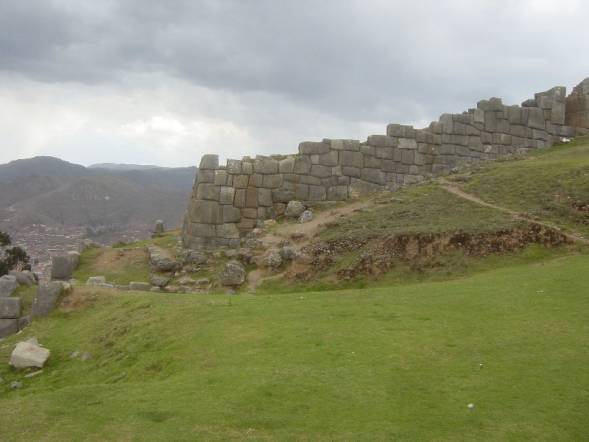
[Sacsayhuaman, amusingly pronounced ‘sexy
woman’ with Cusco in background]
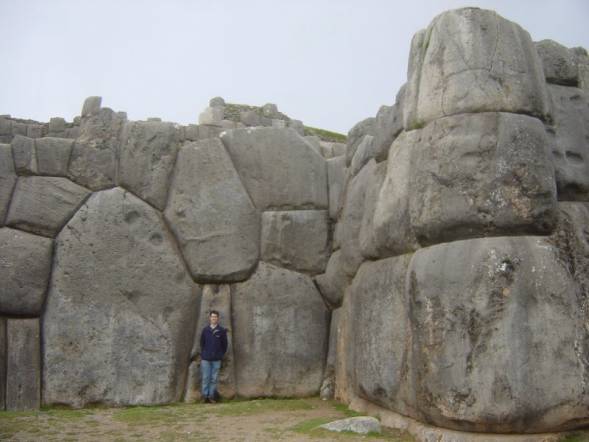
[Sacsayhuaman up close.
Some of these stones weigh over 100 tonnes!]
It
is also clear to see the Spanish attempts to impress upon the natives the
superiority of their religion. The
inside of the cathedral is the most over-the-top decoration I have seen. The main altar is solid silver (guess where
all that silver came from) and numerous other mini-altars are highly ornate and
covered with gold leaf and jewels.
There is also much intricate woodwork.
The
central plaza of the town has a very European feel to it although outside the
main square it becomes fairly run down.
Qusco (I saw at least 5 different spellings of the place) is allegedly
expensive for Peru but one can find a nice hotel twin room for six pounds a
night and eat well for half that. The
downside is that as an obvious gringo (foreigner) you are besieged by vendors
wherever you go, and one must be generally careful with security.
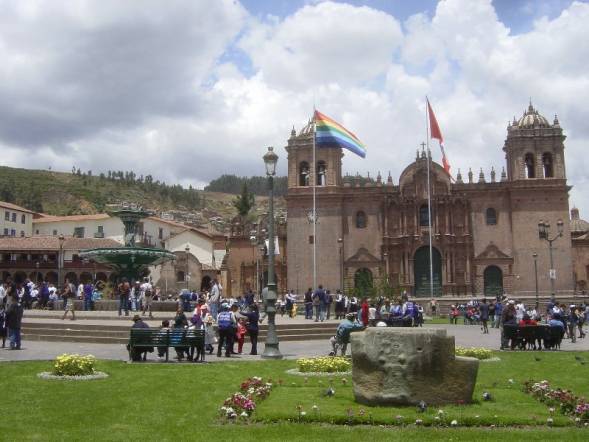
[Cusco plaza – rainbow flag is the Inca flag, not the
‘other’ flag]
Around
Cusco are many Inca remains of their temples etc. which we did a day tour
around. Here you can see quite how
awesome their masonry skills were. It
beggars belief to then be told that many of these structures would have been
gilded with solid gold and silver before the Spanish came and nicked it all back
on their galleons (though thanks to Drake and co. we got our fair share as
well!).
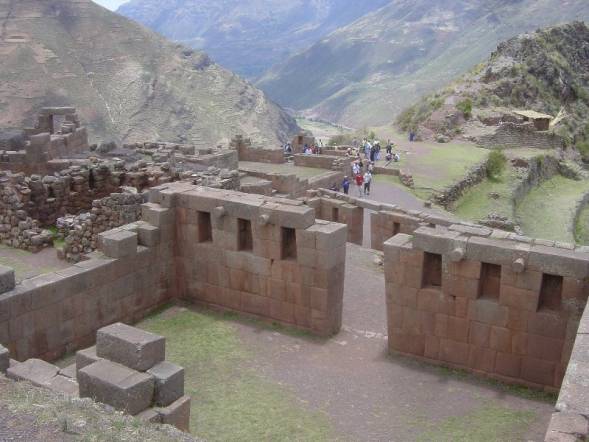
[Impressive Inca stonework at Pisac]
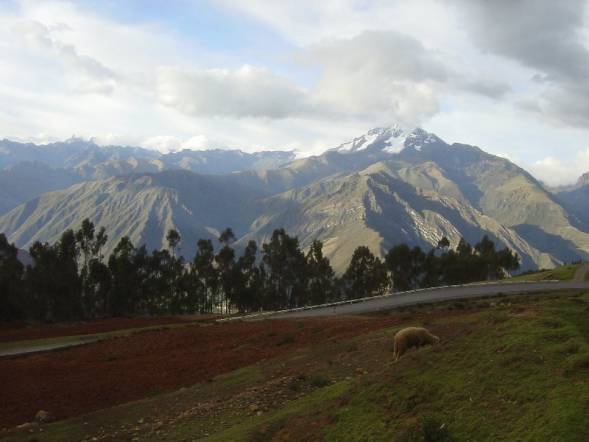
[Some of the mountains around the ruins are
breathtaking]
One
cannot come to cusco without doing the Inca trail so we made some enquiries and
booked ourselves in with an agency called SAS who were relatively expensive but
allegedly the best. The tour didn't
start for a few days so sense was actually forced upon us and we had time to
acclimatize to the altitude for another couple of days chilling over the
delicious local beer, Cusquena, and a few pisco sours. This was a very nice drink although we
discovered later that the magic ingredient is raw egg white. Hmmm.
The
Inca trail is sold as a 4 day, 3 night trek.
Our fantastic SAS service meant that we carried our own backpacks but
they were responsible for tents and food.
This becomes seriously worthwhile when you arrive at the campsite in
pouring rain to find your tent pitched and lunch laid out! Our group was an excellent bunch of 16
people, mainly in their twenties and, pleasingly, all English-speaking.
Day
one is seriously simple. You have a
pointlessly early 5am start where a bus takes you to the start and you walk in
a group (and therefore mind-numbingly slowly) along a river at 2,500m for a
couple of hours and then slightly uphill to day one camp (3,000m). This is basically a couple of fields on the
edge of a farm but some entrepreneurial farmer has pleasingly set up a beer
shop thereby providing something to do in the evening. One sees a few Inca ruins but the general
might of the mountains is most impressive, many snow capped peaks are 5,000 or
6,000m tall. Weather conditions are
typically mountain-like with cloud, rain, sun cycling round quickly and with no
warning. In fact, some of the best
sights are watching a bank of cloud come up the valley from below you and then
melt away for no apparent reason.
Day
two is billed as the seriously strenuous day and you are encouraged to hire a
porter for your backpack. Having
already wimped out of tent and food carriage, we weren't going to be completely
wussy so reckoned we'd be fine. The
path heads steadily uphill from the camp above the treeline at 3,700m to the
unpleasant sounding Dead Woman's pass at a breathless 4,200m. It turns out that this name comes from the
profile of the pass allegedly resembling a woman, albeit an impressively
endowed one. Jon and I, being our keen
selves, quickly found ourselves at the head of our group with a Canadian chap
who had experience of the Himalayas and even Everest base camp so clearly knew
what he was doing. The allegedly
strenous climb turned out to be hard work but perfectly doable and we reached
the top in 2hr 15min. Here, the
Glass-Ingram curse struck again. We may
have been 13 degrees off the equator, we may have been as close to the equator
as madras or bangkok and we may have had sun directly overhead but where we go,
it snows and so it did. The worst type
too, wet and heavy. This meant that the
prospect of waiting for the rest of the group seemed miserable and the views
weren't up to much either so we headed down the other side. As we approached camp 2 (3,600m) the sun
managed to re-appear, which did at least mean that we could put all our stuff
out to dry, although it meant that everyone going at a normal pace got the nice
views at the top.
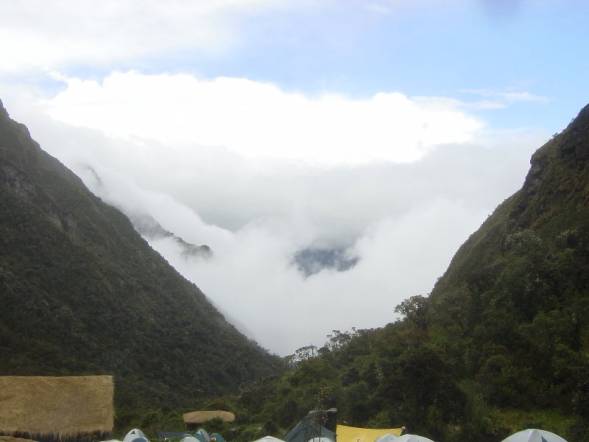
[Camping above the cloudline!]
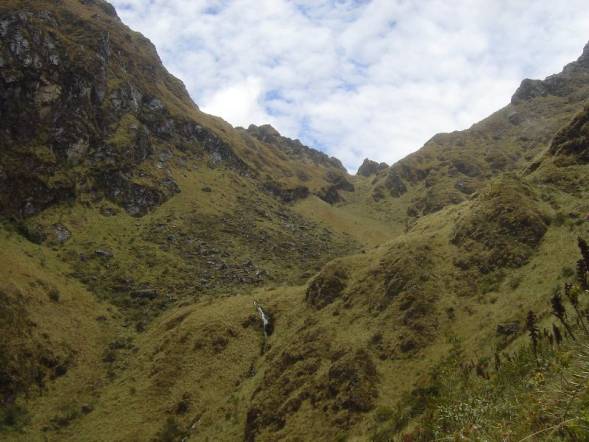
[Dead woman’s pass – use your imagination and you can
just make out the ‘breast’!]
We
had made it to our camp by 11:30 in the morning so there was little to do for
the rest of the day. Feeling a bit
sticky I decided that I would brave the unheated mountain shower. This was a bad idea. Never in my life have I experienced such
intense pain inflicted by mere cold water.
As far as I could tell, not a single one of the blokes foolhardy enough
to go in managed to get through without a constant stream of gasps and
expletives. Anyway, character-building
stuff and all that and at least I was no longer sticky. After lunch in the afternoon a most tremendous
rainstorm appeared which left everyone stuck in the main dining tent (SAS
justifying every penny) twiddling their thumbs. However, the guides are clearly used to such situations and a
bottle of rum appeared just when spirits were beginning to flag. And another one after that.
The
night that night was rather cold and the downward slope meant that I was on
good terms with the door of the tent by daybreak but one's mood is always
improved by being woken up with a fresh mug of tea or coffee! Day 3 was the most spectacular. It is longer along the ground and involves
another ascent to 4,000m before a trek along a ridge and then down into the
valley next to Machu Picchu. During
this day you pass through cloud forest (basically rainforest) that teems with bromeliads
(spiky plants that grow symbiotically on others), orchids and lots of
moss. There are also many spectacular
views of the mountains and valleys.
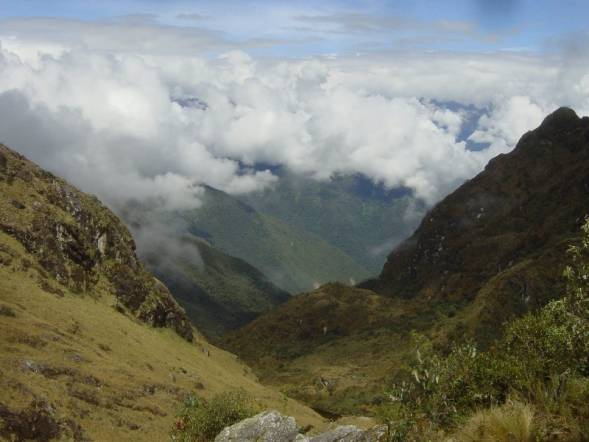
[Above the cloud (and trees) again!]
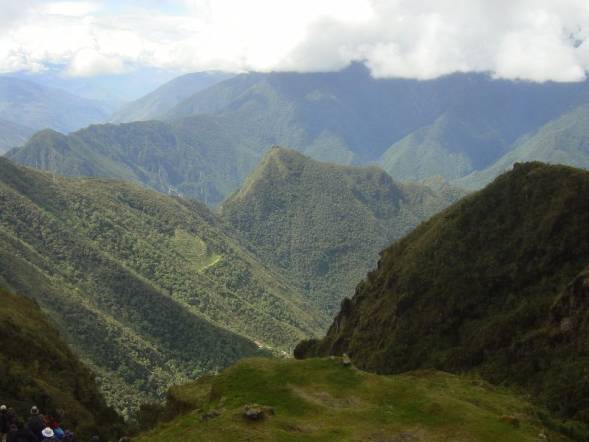
[Final descent to camp 3 is through rainforest – note
ruins in background]
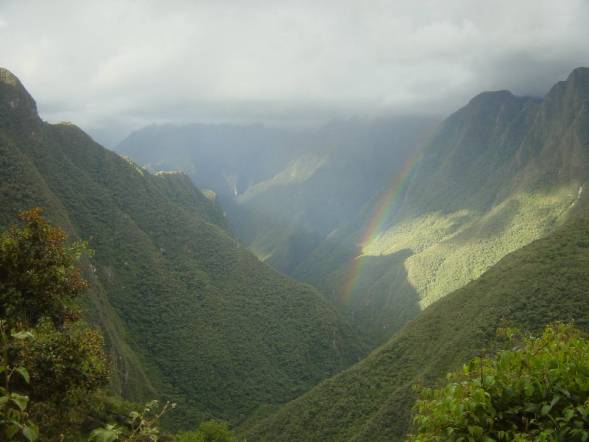
[Camp 3 during the end of a great storm – Machu Picchu is over the ridge on the left]
The
final campite is based spectacularly on the hillside overlooking a steep
forested valley. The river at the
bottom is, remarkably, a tributary of the Amazon. There is also a bar and it is traditional that a mini-party
occurs there on the final evening, which made for a not exactly optimal feeling
when we were woken at 4am to set off for the final 2 hours into Machu Picchu.
The
theory is to see the supposedly spectacular sunrise over the place, but the
reality is that the place is almost always in thick cloud as we
discovered. This did however mean that
instead of a sunrise, we got the magical sudden appearance of the place as the
cloud lifted. Machu Picchu has been
impressively restored, rather like Pompeii but smaller, and is a complete Inca
village complete with temples, terraces and water channels. Many of the stones and creations are
allegedly perfectly aligned north-south or to cast various shadows on the
equinoxes, but it is my cynical opinion that if you look hard enough then there
will always be such things through statistical variations. Anyway, it is impressive enough without the
astro-mumble-jumble.
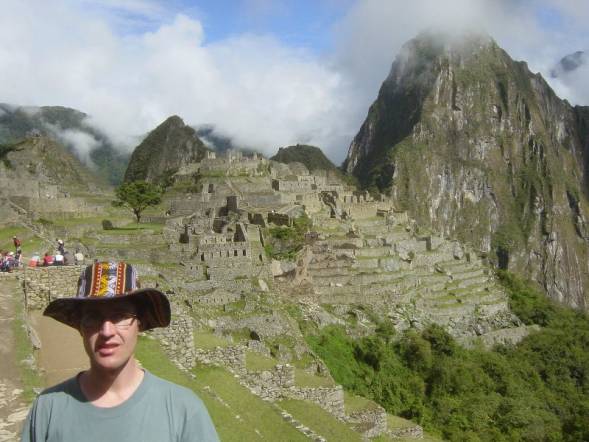
[Machu Picchu with Hyaunu Picchu in background. Note authentic Peruvian headwear!]
In
the afternoon we had the option of climbing up Hyaunu Picchu whish is a large
pointy rock overlooking the place. Our
tour guide made a big thing of stressing how dangerous this was, which put
almost all of the group off but I went up and, though narrow and with some
interesting drops in places, it was perfectly do-able and there wasn't even any
sheet ice! (a la Mt. washington.) The
360 degree view from the top is pretty cool and worth the climb.
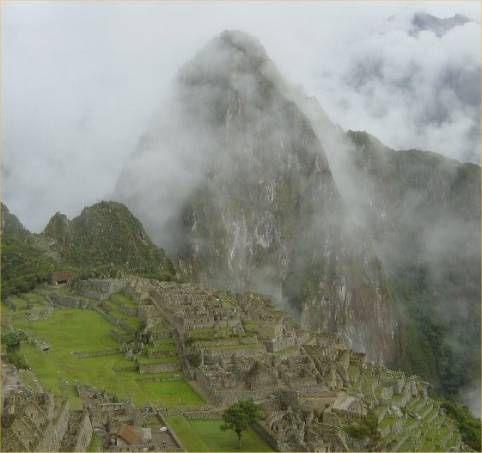
[Hyaunu Picchu in the cloud. An interesting climb!]
So
that was the Inca trail over and done.
A fantastic hike through great scenery and not nearly as difficult as
made out. However, rather sadly, it is
becoming over-commercialised, and despite the limit on numbers now imposed, the
sight of a line of brightly coloured backpacks stretching into the distance
detracted a little from the experience for me.
One
returns from Machu Picchu to Cusco by train, which was a unique
experience. The last bit into Cusco is
made down a steep hill where the train zig-zags forwards and backwards in a
switchback, thus effectively achieving sideways movement. Alas, this occurs at an average of perhaps 5
kph so that the final couple of kilometres as the crow flies takes about an
hour! Back in Cusco we arrived to find
a political rally occurring in the main square, for it was local elections
time. Being South America there was not
a great deal of difference to a pop concert.
Expansive rhetoric it was not!
Having
overstayed our plans in Cusco, we unfortunately didn't have any days to spend
alongside the beautiful and massive Lake Titicaca but at least saw the place on
our excellent bus to La Paz. Here, we
experienced South America at its best as on arriving at the border on time, we
found that Manuel the border guard had had a few too many Piscos the night
before and had not made it into work on time.
Two hours later after numerous other inefficiencies, including a 20
minute search of the coach that consisted of opening the hold and staring in
over the course of a few fags and a coffee, we reached Bolivia and went on to
La Paz.