Most of you are already familiar with the name of Nicolas Copernicus. We have all heard about how Copernicus proposed a new astronomical theory in 1543, that the earth was a planet that revolved around the sun and that it rotated on its axis daily. This wasn't the first time this theory had been proposed; an ancient Greek astronomer had argued this almost two thousand years before Copernicus. But the sixteenth century was different.
You have already seen how religious authority was being challenged during the Reformation. With Copernicus and other early scientists, or "natural philosophers" as they were called then, scientific authority was also being challenged.
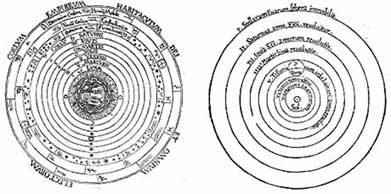
Below are diagrams that represent the two most interesting theories about the basic structure of the universe. On the left is the theory of Claudius Ptolemy, a second-century C.E. Hellenistic astronomer. In the center is the earth, and it is in turn surrounded by the orbits of the moon (luna), Mercury (Mercurii), Venus (Veneris), the Sun (Solis), Mars (Martes), Jupiter (Jovis), Saturn (Saturni), the "fixed" stars, and the "Empyreum" realm. The earth is, in this model, stationary and in the center of the universe.
On the right is Copernicus's diagram for his theory. Here, the Sun (Sol) is at the center, and it is surrounded by the various planetary orbits. [Note that the farthest planetary orbit then know was that of Saturn. Why was this the case?]
Source: Image - Lilly Library, Indiana
University, Bloomington, Indiana