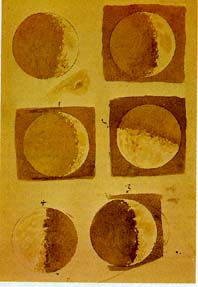
Galileo's Phases of the Moon
Galileo Galilei (1564-1642) did something revolutionary in 1610. He heard about a new instrument that was useful for seeing things that were very far away. Apparently this instrument had been invented in Holland and was used to look for incoming ships so that the acquisitive Dutch could set prices to make a killing in the markets. Well, Galileo was a mathematician and astronomer, and it was his job to investigate things in the heavens. He heard about this new gadget, he replicated one, and (here's the revolutionary part) he pointed it up to the sky. What he saw changed the world forever.
Among other things, Galileo made a careful
investigation of the moon. He reported these findings in a small
book that would instantly become a best-seller, Siderius Nuncius
(or The Starry Messenger). Concerning the moon, Galileo argued
that it was covered by mountains and valleys, a claim that disputed
the dominant Ptolemaic astronomy that claimed that they moon and
all other heavenly objects were perfectly smooth. Below, you can
see Galileo's own sketches of the moon as he saw it through his
telescope.
Points to Ponder:
-- Why would the claim that the moon was not
perfectly smooth be so revolutionary?
--. What other things do you suppose Galileo saw through his telescope?
(What would you look at?)
-- Why would the simple act of
looking through a telescope have the effect of changing the world?