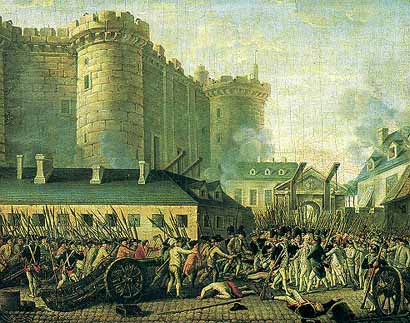
The Storming of the Bastille
King Louis XVI had decided to use the military to force the Estates-General to dissolve. He was thwarted in his plans by a number of rural and urban uprisings. The most noted of these uprisings was the taking of the Bastille on 14 July, 1789. The fall of the royal armory and sometime prison (that held five forgers and two insane people at the time) became a symbol of the victory over autocratic monarchical rule.
The storming of the Bastille by groups of (mostly) lower-class urban artisans served to support the struggle of the Third Estate (the commoner class in the Estates-General) in their fight against autocratic rule and against the privileges of the nobility.
--. How important do you think public violence
was in pre-modern Europe? And what roles did it play in society?
-- Would you think that the relatively uneducated artisans at
the Bastille would have been influenced by Enlightenment philosophy?
-- Does the storming of the Bastille
make you wonder just how much the ideals of the Enlightenment
influenced the French Revolution?