Palermo
The city was founded in 734 BC by the Phoenicians as Ziz. The present name is derived from the Greek Panoremus meaning 'always fit for landing in'. Palermo became part of the Roman Republic, the Roman Empire and eventually part of theByzantine Empire, for over a thousand years. From 827 to 1071 it was under Arab rule during the Emirate of Sicily when it first became a capital. Following theNorman reconquest, Palermo became capital of a new kingdom (from 1130 to 1816), the Kingdom of Sicily. Eventually it would be united with the Kingdom of Naples to form the Two Sicilies until the Italian unification of 1860.
The population of Palermo urban area is estimated by Eurostat to be 855,285, while its metropolitan area is the fifth most populated in Italy with around 1.2 million people. In the central area, the city has a population of around 650,000 people. The inhabitants are known as Palermitans or, poetically, panormiti. The languages spoken by its inhabitants are the Italian language and the Sicilian language, in its Palermitan variation.
Known Places
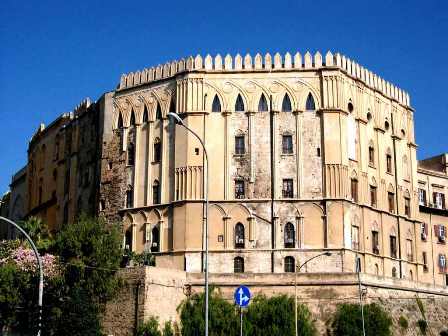
Palazzo dei Normanni
The Palazzo dei Normanni (in English, Palace of the Normans) or Royal Palace of Palermo is a palace in Palermo, Italy. It was the seat of the Kings of Sicily during the Norman domination and served afterwards as the main seat of power for the subsequent rulers of Sicily. Today it is the seat of the regional parliament of Sicily.
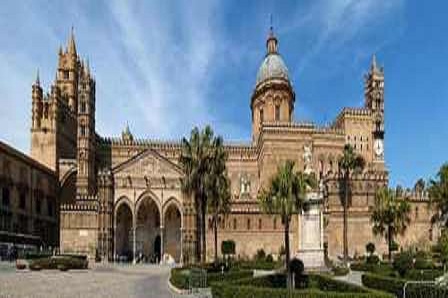
Palermo Cathedral
Palermo Cathedral is the cathedral church of the Roman Catholic Archdiocese of Palermo, located in Palermo, Sicily, southern Italy. As an architectural complex, it is characterized by the presence of different styles, due to a long history of additions, alterations and restorations, the last of which occurred in the 18th century.
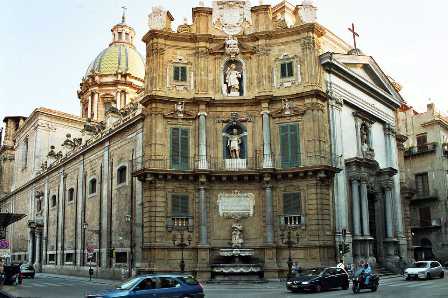
Quattro Canti
Quattro Canti, officially known as Piazza Vigliena, is a Baroque square in Palermo, Sicily, southern Italy.It was laid out on the orders of the Viceroys between 1608-1620 by Giulio Lasso at the crossing of the two principal streets in Palermo, the Via Maqueda and the Corso Vittorio Emanuele.
The piazza is octagonal, four sides being the streets; the remaining four sides are Baroque buildings, the near-identical facades of which contain fountains with statues of the four seasons, the four Spanish kings of Sicily, and of the patronesses of Palermo, (Cristina, Ninfa, Olivia, and Agata). The facades onto the interchange are curved, and rise to four floors; the fountains rise to the height of the second floor, the third and fourth floors contain the statues in niches. At the time the piazza was built, it was one of the first major examples of town planning in Europe.
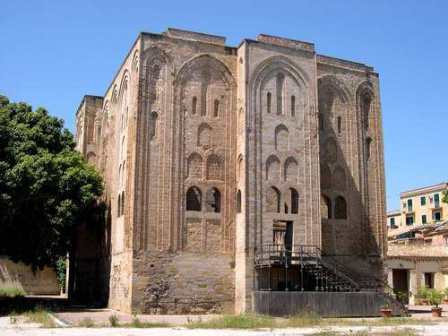
Cuba
The Cuba is a palace in the Sicilian city of Palermo. It was built in 1180 by William II of Sicily in his great Royal Park, as his personal recreation pavilion, together with an artificial lake: it shows strong Fatimid art influences, as it was (at least partially) designed and decorated by Arab artists still living in Palermo after the Norman conquest in 1072. During the rule of Bourbon kings of Naples it was annexed to a barracks. In the 16th century it was turned into a lepers' colony.
The edifice has a rectangular plan, with massive forms. The four fa�ades are marked by blind arcades, small windows, and niches. The nameCuba derives in fact from its approximately cubical form. The famous Italian Middle Ages authorBoccaccio was impressed by the Cuba and set here one of the novellas included in the Decameron. The Cubola or Little Cuba is another edifice built by William II for his park, in smaller dimensions. The most striking feature of the Cubola is the little hemi-spherical cupola.