Milan
Italy's climate is predominantly Mediterranean: Alpine in the far north; hot and dry in the south. Winter in Milan is relatively mild but foggy, with temperatures ranging from zero to 8 degrees Celsius. Summer can be very humid with brief thunderstorms; temperatures range from 14 to 29 degrees. From March through April temperatures range from 6 to 18 degrees. From October through November they range from 6 to 17 degrees.
Milan�s origin goes back to 400 B.C., when Gauls settled and defeated the Etruscans. In 222 B.C. the city was conquered by Romans and was annexed to the Roman Empire. After 313 A.D., the year of the Edict of Tolerance towards Christianity, many churches were built and the first bishop was appointed: Ambrogio was such an influential person that the church became the Ambrosian Church (7 December is a holiday to honour Sant�Ambrogio). In 1300 the Visconti family which are noblemen from Bergamo, Cremona, Piacenza, Brescia and Parma ruled and brought a period of glory and wealth to the city. The Duomo was built in 1386 and became the symbol of Milan. The Sforza family assumed the Castle and the power of the Visconti family and finally Milan achieved peace after many years of war against Venice and Florence. Under the Sforza duchy the city began the development of sciences, art and literature. Ludovico il Moro (Ludovico Sforza) called Leonardo da Vinci and �il Bramante� to his court
Known Places
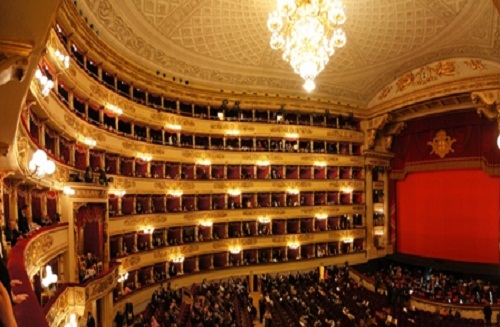
Teatro alla Scala
La Scala, as the Teatro alla Scala is locally known, was built at the end of the 18th century. The opera house soon became one of the world's most revered venues and numerous famous works by composers such as Verdi and Bellini premiered here.
The exterior of the Scala is rather sober such an important building, probably because it was originally located at a rather narrow street; the Piazza della Scala was only created in 1858. The fa�ade shows a three-bay carriage entrance topped by a neoclassical front with pilasters and a central pediment. In contrast with the exterior, the building's interior is sumptuous. Its foyer is decorated with fluted columns and large mirrors line the walls. The auditorium, known for its exceptional acoustics, has a seating capacity of just over 2,000. It is lavishly decorated with red velvet, silk and gilded stucco. The chandelier is made of bohemian cristal and contains 365 lamps. The podium is one of the world's largest with to total surface of 1200 sq meter.
The theater Museum was founded in 1913 with the purchase of a collection of Jules Sambon, a Parisian antique dealer who had a unique collection of theatrical attributes. The museum depicts the history of the Theatro alla Scala and the history of the opera in general with a display of objects such as posters, paintings, statues, set designs, instruments, original musical scores and other theatrical memorabilia. A large section of the museum is dedicated to Giuseppe Verdi, one of Italy's most famous composers.

Santa Maria delle Grazie
The Santa Maria delle Grazie is one of Milan's most famous churches thanks in part to its architectural history, which resulted in an intriguing combination of Gothic and Renaissance design. But the church's fame is mostly a result of Leonardo da Vinci's 'Last Supper', which can be admired in the adjoining refectory.
Both the interior and exterior show an interesting combination of Gothic and Renaissance styles. The sober brick facade was designed by Solari while the Renaissance-style entrance is attributed to Bramante. The lunette in the portico was painted by Leonardo da Vinci and shows Maria accompanied by Ludovico and his wife. The exterior is dominated by Bramante's masterfully designed dome, decorated with medallions of Saints and coat-of-arms. The central nave and aisles are magnificent examples of late Gothic architecture with elegant pointed arches embellished with delicate frescoes. The Renaissance style chancel is less decorated and seems almost sparse in contrast. Along the aisles are a number of chapels, many of which are beautifully decorated with frescoes. Also of note are the wooden choir stalls in the apse. To the left is the entrance to the Chiostrino delle Rane, a small cloister named after the bronze frogs at the fountain. From here you have a nice view of the church's dome.
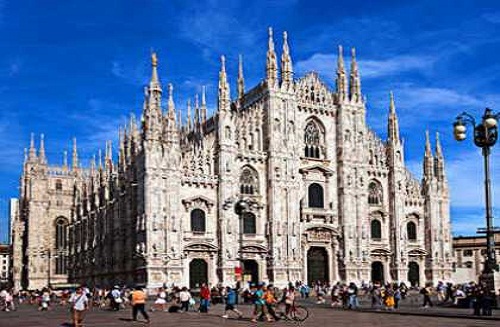
Milan Cathedral
The Duomo di Milano, Milan's magnificent Gothic cathedral, is one of the world's largest churches. Its dazzling white front facade, arguably the world's most beautiful, dominates the cathedral square.The Duomo is literally at the center of Milan. Streets radiate from the cathedral or circle it and it occupies what has always been the most central location in the city.
The construction of the cathedral was commissioned by bishop Antonio da Saluzzo in 1385. He was supported by the first duke of Milan, Gian Galeazzo Visconti, who envisioned the creation of the world's largest church. He gave access to his marble quarries, granted tax exemptions and invited architects from across Europe. Construction commenced in 1386, but it would drag on for centuries. When the cathedral was consecrated in 1418, construction of the nave had only just started. Construction would continue until 1813, and final finishes were applied as late as in 1965. Over the years numerous master builders were involved and the initial design was continuously altered to become even more spectacular. The long construction period also led to a mash-up of a variety of styles but the final result is surprisingly homogenous, with a decidedly flamboyant Gothic design.
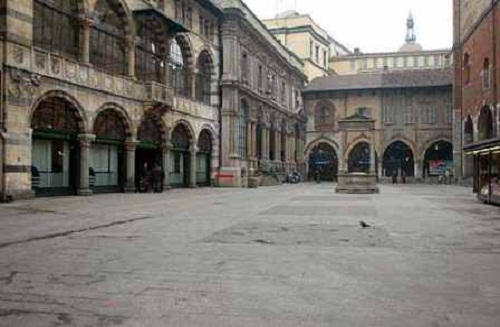
Piazza Mercanti
Piazza Mercanti is a picturesque square just a stone's thrown away from the Duomo. During the Middle Ages, this was the commercial and governmental center of Milan.During medieval times the city hall, lawcourt and even a prison were located at this square. Weddings were announced here as well. Due to its importance and central location the square was always buzzing with activity. And a market made the square even more crowded.
The large building at the center of Piazza Mercanti is the Palazzo della Ragione, which was built between 1228 and 1233. It was constructed on order of Milan's magistrate, Oldrado da Tresseno, who is depicted on a horse in a relief at the exterior of the Palazzo. The relief was possibly created by Benedetto Antelami, one of the era's most renowned sculptors. The first floor of the Palazzo della Ragione was home to the city's law courts until the 18th century and the open arcade below was the site of a daily market. The top floor was added in 1773 as a storage archive.
Arguably the most intriguing building at the Piazza Mercanti is the Loggia degli Osii, commissioned in 1316 by Matteo Visconti, who at the time ruled over Milan. The building was constructed as a loggia, with large open arcades and housed offices of notaries and judges. The building's fa�ade is embellished with statues of saints and coat of arms. From its balcony officials announced weddings, edicts and sentences.
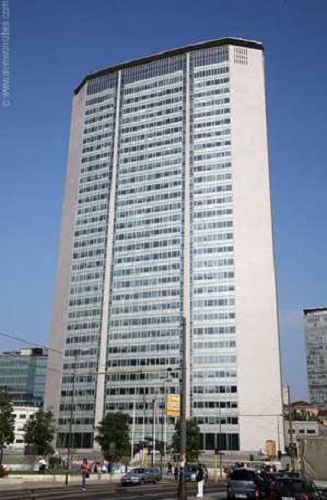
Pirelli Tower
The slender Pirelli Tower was the first building in Milan to surpass the height of the cathedral. The innovative skyscraper, nicknamed Pirellone (Big Pirelli), was instantly recognized as an international landmark when it was completed in 1959 as the headquarters of Pirelli. Construction of the tower started in 1955 at the site where the company's first factory stood since 1872. It was designed by a collective of architects, spearheaded by Gio Ponti and Pier Luigi Nervi. Ponti was both a designer and architect who created items ranging from coffee machines and chairs to houses and even churches. Nervi was one of the greatest engineers of his time, specialized in concrete structures. The combined knowledge and creative thinking of these two led to a truly innovative skyscraper.
The most striking aspect of the Pirelli Tower's design is its slender shape. Thanks to Nervi's technical knowledge it was possible for Ponti to design a tower with a very narrow base, supported by concrete piers that decrease in size as it approaches the top of the building. The building's slender appearance is reinforced by the receding concrete walls that hold the service areas at either side of the building. Here the front and back facade almost touch each other, except for a narrow gap that runs all the way from the bottom to the top, reinforcing the image of a tall and narrow tower. A similar gap between the roof and top floor result in a roof that seems to float above the building.
The Pirelli Tower rises from a small base straight up to a height of 127 meter (417ft). It was the first building that rose above the top of the Madonnina on the Duomo, which for centuries marked the highest point in the city. For a short time after its completion in 1959 the tower also held the title of the world's tallest reinforced concrete building. Today it isn't even the tallest tower in the city, but the iconic building is still the most elegant and architecturally successful skyscraper in Milan. Soon after its completion the building became an inspiration for other architects, and its form can be found in other skyscrapers, most notably the PanAm Building (now Metlife Building) in New York.