Florence
Florence is famous for its history. A centre of medieval European trade and finance and one of the wealthiest cities of the time, Florence is considered the birthplace of the Renaissance, and has been called the Athens of the Middle Ages. A turbulent political history includes periods of rule by the powerful Medici family, and numerous religious and republican revolutions. From 1865 to 1871 the city was also the capital of the recently established Kingdom of Italy.
The historic centre of Florence attracts millions of tourists each year, and Euro monitor International ranked the city as the world's 72nd most visited in 2009, with 1,685,000 visitors. It was declared a World Heritage Site by UNESCO in 1982. Due to Florence's artistic and architectural heritage, it has been ranked by Forbes as one of the most beautiful cities in the world, and the city is noted for its history, culture, Renaissance art and architecture and monuments. The city also contains numerous museums and art galleries, such as the Uffizi Gallery and the Pitti Palace, amongst others, and still exerts an influence in the fields of art, culture and politics.
Florence is also an important city in Italian fashion, being ranked within the top fifty fashion capitals of the world; furthermore, it is also a major national economic centre, being a tourist and industrial hub. In 2008, the city had the 17th highest average income in Italy.
Known Places
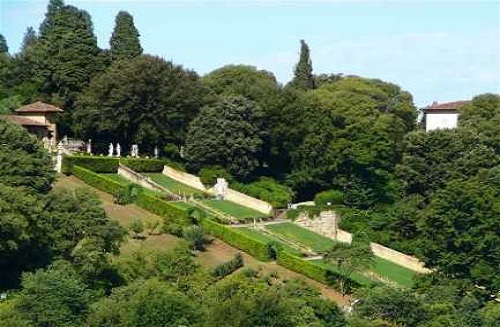
Bardini Garden
The Giardino Bardini is a 4 hectare large garden situated between the Piazzale Michelangelo and the Giardino di Boboli in Oltrarno, across the river from the historic center of Florence.The Bardini Garden is not as famous as the nearby Boboli Garden, but it is more quiet, has a romantic feel and a varied layout.
After entering the garden via Via dei Bardi one passes a small rose garden. A wooded area ahead is the original English garden, once part of the Manadora estate. A winding path leads through the gardens uphill and brings you to the Villa Bardini, now home to a restaurant, cafeteria and bookshop. The path continues west to the top of the slope where you can take a break at the Kaffeehaus.From here you have a magnificent view over the city of Florence.
On its way to the top the path passes along the central Baroque staircase, the centerpiece of the garden. On either side of the long staircase are terraced lawns and its top is decorated with elegant statues. There are many other picturesque areas in the Bardini garden which can be discovered by aimlessly wandering around the garden; you'll come across a grotto, several fountains, a small canal, a tempietto and an agricultural park with orchards. Depending on the time of the year the garden can be very colorful thanks to the many flowering plants, including roses, irises, hydrangeas and a beautiful wisteria pergola.
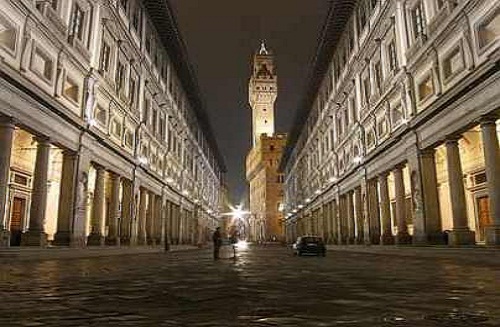
Galleria dell'Accademia
The Galleria dell'Accademia is one of the most popular museums in Florence, mostly thanks to Michelangelo's David statue. The museum also houses other artwork, including statues, religious paintings and musical instruments.
Cosimo I de' Medici, grand duke of Tuscany, founded Europe's first art academy in 1563. Michelangelo Buonarroti was one of the first teachers in the academy, which was called Accademia delle Arti del Disegno. In 1784 it became part of a new institution, the Accademia di Belle Arti (Academy of Fine Arts), founded by the then grand duke of Tuscany, Peter Leopold. Leopold also founded the Galleria dell'Accademia, a museum located adjacent to the academy. The purpose of the museum was to provide the students with examples of historic artwork as study material.
The most important masterpiece in the Galleria dell'Accademia is Michelangelo's statue of David, possibly the world's most famous statue. The statue, 5m 17cm tall (17ft), was commissioned by the Florentine republic, who saw the biblical hero slaying the giant Goliath as a symbol for the creation of the nascent republic. The statue was installed in front of the Palazzo Vecchio but in 1873 it was replaced by a replica and moved to the Galleria dell'Accademia to protect it from the elements. Another replica can be found at the center of the Piazzale Michelangelo. The statue, which was created by Michelangelo in 1501-1504 from a single block of marble, was instantly admired for its proportions and attention to detail. Michelangelo chose to depict David as an adolescent instead of a young boy, as was customary. The statue brought instant fame to the 29 year-old Michelangelo.
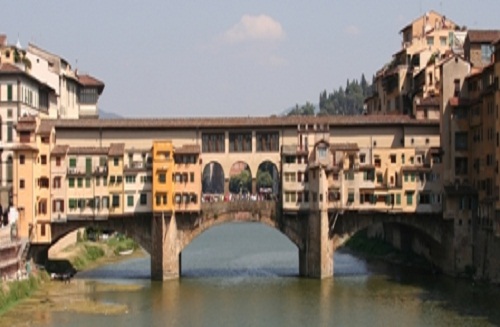
Ponte Vecchio
The Ponte Vecchio (Old Bridge) is a medieval bridge spanning the river Arno in Florence. It is one of the few remaining bridges with houses built upon. The Vasari corridor that runs over the houses connects the Uffizi with the Pitti Palace on the other side of the river.The pedestrian bridge is often teeming with tourists and the many musicians, portraitists and other entertainers create a constantly vibrant atmosphere. The bridge is at its most beautiful at dusk, especially when seen from the Ponte Santa Trinità.
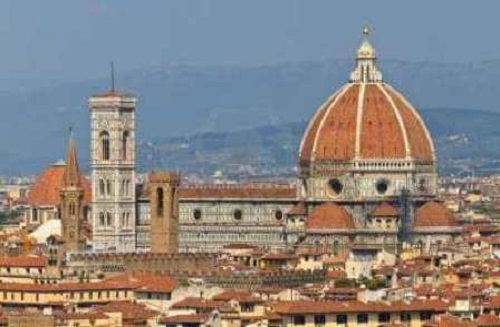
Duomo di Firenze
The Duomo di Firenze, the Florence Cathedral, was built between 1296 and 1436. The cathedral is one of the largest in the world. Its imposing dome, attributed to the Florentine architect Filippo Brunelleschi, still dominates the city.
The Cathedral of Florence, officially known as Cattedrale Santa Maria del Fiore but better known as the Duomo, was originally planned in 1296 as a Gothic cathedral by Arnolfo di Cambio. It replaced the church of Santa Reparata, a cathedral church with a history going back to the early Middle Ages. The new cathedral symbolized Florence's growing importance and was to be significantly larger than its predecessor. Francesco Talenti, who lead the construction of the cathedral from 1351 on increased its size even more by expanding the apses and extending the nave. Filippo Brunelleschi - the most important architect of the early Renaissance - designed the Duomo's most striking feature, the enormous dome.
Construction of the church would last until 1436 when it was consecrated by pope Eugene IV. The originally planned Gothic front façade however was unrealized. The magnificent marble cladding that we see today was only added much later, between 1871 and 1887, in a neo-Gothic style with colorful patterns. As a result the façade nicely complements the design of the cathedral's 14th century bell tower. Some statues that were created for the originally planned façade are now on display at the Museo dell'Opera dell Duomo, a nearby museum dedicated to works of art from the cathedral.