Bologna
An important cultural and artistic centre, its importance in terms of landmarks can be attributed to homogenous mixture of monuments and architectural examples (medieval towers, antique buildings, churches, the layout of its historical centre) as well as works of art which are the result of a first class architectural and artistic history. Bologna is also an important transportation crossroad for the roads and trains of Northern Italy, where many important mechanical, electronic and nutritional industries have their headquarters. According to the most recent data gathered by the European Regional Economic Growth Index (E-REGI) of 2009, Bologna is the first Italian city and the 47th European city in terms of its economic growth rate.
Bologna is home to prestigious cultural, economic and political institutions as well as one of the most impressive trade fair districts in Europe. In 2000 it was declared European and in 2006, a UNESCO �city of music�. The city of Bologna was selected to participate in the Universal Exposition of Shanghai 2010 together with 45 other cities from around the world. Bologna is also one of the wealthiest cities in Italy, often ranking as one of the top cities in terms of quality of life in the country: in 2011 it ranked 1st out of 107 Italian cities.
Known Places
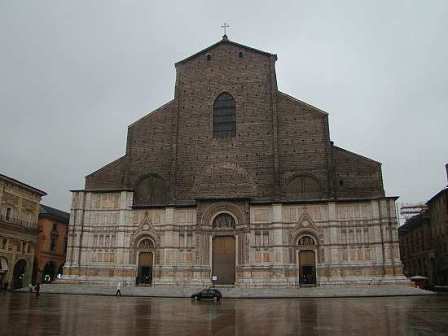
Petronio Basilica
The Basilica of San Petronio is the main church of Bologna, Emilia Romagna, northern Italy. It dominates the Piazza Maggiore. It is the fifteenth largest church in the world, stretching for 132 meters in length and 66 meters in width, while the vault reaches 45 meters inside and 51 meters in the facade.
The basilica is dedicated to the patron saint of the city, Saint Petronius, who was the bishop of Bologna in the fifth century. The construction was a communal project of Bologna, not of the bishops: The property was a symbol of communal power that was not transferred from the city to the diocese until 1929; the basilica was finally consecrated in 1954. It has been the seat of the relics of Bologna's patron saint only since 2000; until then they were preserved in the Santo Stefano church of Bologna.
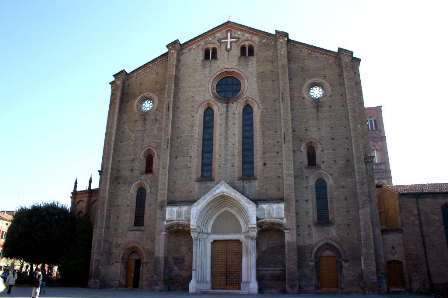
San Francesco
San Francesco is a church in Bologna, northern Italy.It was begun in 1236 by Marco da Brescia and his brother Giovanni, a Franciscan monk.
Despite its Romanesque fa�ade, it is one of the best example of French Gothic architecture in Italy. This is manifest in the interior, which has a nave and two aisles, in the apse with corridor, in the high vaults divided into six sections (like in Notre-Dame de Paris) with ogival arches, and in the use of buttresses.The church is home to the monuments of the jurist Accursius and his son Francesco, Odofredus and Rolandino dei Romanzi.
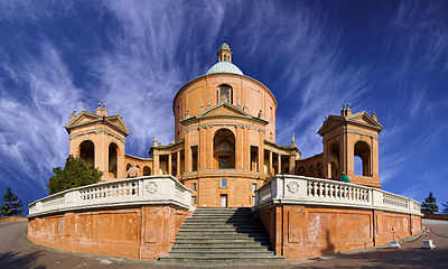
Sanctuary of the Madonna of San Luca
The Sanctuary of the Madonna of San Luca is a basilica church in Bologna, northern Italy, sited atop Colle or Monte della Guardia, in a forested hill some 300 metres above the plain, just south-west of the historical centre of the city.
The Sanctuary was meant to house a miraculous icon of the virgin. A church or chapel existed on the hill for about a thousand years. The present church was constructed in 1723 using the designs of Carlo Francesco Dotti. The lateral external tribunes were built by Carlo Francesco's son,Giovanni Giacomo, using his father's plans. The centrally planned sanctuary has painted artworks by Domenico Pestrini, Donato Creti (second chapel on right); Guido Reni(Assumption in the third altar on the right), Giuseppe Mazzain chapel of St. Anthony of Padua, Vittorio Bigari (frescoes) and Guercino (sacristy). Stucco works are by A. Borelli and G. Calegari and statues by A. Pi�.
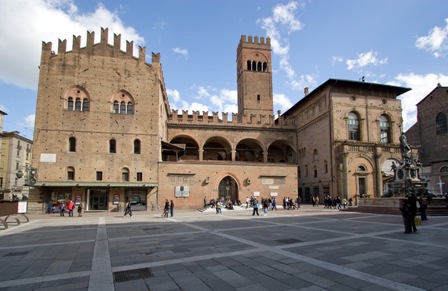
Palazzo Re Enzo
Palazzo Re Enzo is a palace in Bologna, northern Italy. It takes its name from Enzio of Sardinia, Frederick II's son, who was prisoner here from 1249 until his death in 1272. The palace was built in 1245 as an extension of the nearby Palazzo del Podest�, which had proven insufficient for the exigences of the Commune of Bologna.
Three years after the palace completion, Enzio was captured by theGuelphs at the Battle of Fossalta, and after a short stay in Anzola he was moved here, where he remained until his death. In 1386 Antonio di Vincenzo finished the Sala dei Trecento ("Hall of the Three-Hundred"), which was to become the city's archive. The last floor was largely renovated in 1771 by Giovanni Giacomo Dotti. The current Gothic appearance dates from the restoration of 1905 due to Alfonso Rubbiani. On the right of the palace is the access to the chapel of Santa Maria dei Carcerati, where the condemned to death went to. In the first floor was held the Carroccio and the war machines, while in the middle floor were the offices of the praetor and the chapel.
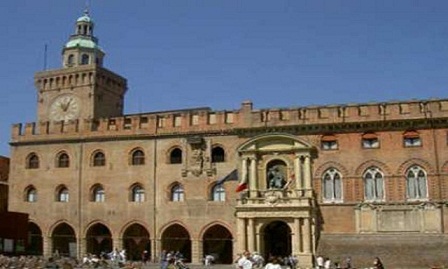
Palazzo d'Accursio
Palazzo d'Accursio (or Palazzo Comunale) is a palace in Bologna, Italy. It is located on the Piazza Maggiore and had been the city's Town Hall until 11 November 2008.
Palazzo d'Accursio is home to the Civic Art Collection, with paintings from the Middle Ages to the 19th century. It also houses the Museo Morandi, with the works by Giorgio Morandi donated to the comune by his family.