I
f you stare at it long enough,it'll start to move.
O
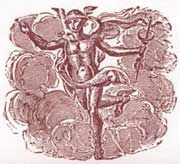
r;-How to interpret the myths and accoutrements of Hermes?
-H
ow indeed!For without the searing search beam and firm and winkless gaze of sober modern scholarship the morsel of art and the crumb of history must remain "a site of intersection for a complex tangle of signifying practices rather than a self-sufficient, independent "thing".1
B
esides which…"Practical experience shows us again and again that any prolonged preoccupation with an unknown object acts as an almost irresistible bait for the unconscious to project itself into the unknown nature of the object and to accept the resultant perception, and the interpretation deduced from it, as objective."
-C.G. Jung, The Spirit Mercurius.2S
o suitably advised, let us proceed anyway.
*****
"By all the Greeks
the honors due the gods
were paid to unwrought stones."
{Pausanias, 7.22}
Hermes was a god of crossroads on a vertical as well as a horizontal axis, for he served both as a herald to the gods on high and as an usher of souls to the world below (Hades). His charge it was to "[maintain the] free rights of way for all travelers on any road in the world"
{Graves, pp.65}3The word 'herma' in greek means 'stone pile'. Thus through phonetic similarity Hermes became "he-of-the-stone-pile" (or even "old heapy"4). Hermes was first worshiped as a spirit residing in the stone cairns (known as 'herms') found in the remote Arcadian countryside. Such cairns might mark a crossroads; a diverging path, or perhaps a burial place. Or the cairn might be erected to honor some local spirit or god. Gifts left as a tribute to a god by one traveler might be regarded as a gift from the god by the next.
"At the base of the pillars, hungry travelers would sometimes chance upon offerings to the god - offerings they would duly steal, not to thwart Hermes but to honor the lucky finds he bestows."
{Erik Davis, pp. 15f}5
T
he Hermaion - gift.Donald Kunze* wonderfully refers to the chimney as a vent, a vertical axis, a santa-claus-herm, around which milk and cookies could be placed as an offering to the god.
"The vent, in contrast, is a contradictory connection, usually made between low spaces and high spaces, each to the other of which is conceived as a void…
In architecture the vent is most often a concealed connection. In myth and poetry, it often takes the guise of a wind, a word, a spell, a charm, or a curse…
Or, it can be a cellar window."
{Kunze, 1998}6
Donald Kunze also discusses a phenomenon known as silent trade (known also as "dumb barter") and theorizes that this type of free exchange of surplus goods might evolve from this kind of give-and-take around the stone pile.
A description of silent trade is given in Herodotus;
"The Carthaginians also tell us that they trade with a race of men who live in a part of Libya beyond the Pillars of Heracles (i.e. the straits of Gibraltar--mine). On reaching this country, they unload their goods, arrange them tidily along the beach, and then, returning to their boats, raise a smoke. Seeing the smoke, the natives come down to the beach, place on the ground a certain quantity of gold in exchange for the goods, and go off again to a distance. The Carthaginians then come ashore and take a look at the gold; and if they think it represents a fair price for their wares, they collect it and go away; if, on the other hand, it seems too little, they go back aboard and wait, and the natives come and add to the gold until they are satisfied. There is perfect honesty on both sides; the Carthaginians never touch the gold until it equals in value what they have offered for sale, and the natives never touch the goods until the gold has been taken away."7
*****
And, though Hermes does not figure in Chinese custom, I love free association, and in the following there is something reminiscent of the hermaion, the gift of Hermes left at the stone pile;
"The Chinese burial section embraces about an acre and was conferred without deed, by word of mouth alone. Some three hundred are interred, though no more Chinese funerals are permitted. Curious customs surrounded these Chinese burials. According to report each dead was given a coin to hold in the mouth, with which to pay admission to heaven - or perhaps it was to pay the ferryman, Charon, to cross the Styx. All the deceased's papers were burnt in the brick oven which still stands at the corner of the cemetery acre.
Food was provided and set out on the newly made grave so that the departed might not go hungry....Vagrants and other perennially hungry and impecunious were not above visiting
Chinese graves right after a funeral to feast on the roast pig or duck, chicken, noodles and whatnot of tasteful viands set out for the benefit of those underground."
(from Lone Fir - Silent City of the Dead, by D.A. Lund; pen-name of Charles O. Olsen.)
*****
"That a monument of this kind could be transformed into an Olympian god is astounding."
{Burkert,1985, pp.156}8
In the time of Socrates the herm had become a common feature in Athens, in the public places and at the gates of private homes. The form that the hermetic rubble had evolved into was that of a simple quadratic column with a head of Hermes atop and, bizarrely from my vantage point, a (usually erect) phallus in front.
Why a phallus? I don't know. The meaning of the hermetic phallus is variously interpreted depending on who you talk to, though it is generally agreed that the phallus in this instance is not a fertility symbol. Hermes was not a fertility god, and the hermetic phallus was commonly found in places where fertility is not the first concern (graveyards, for instance.)
"The head Sublime, the heart Pathos,
the genitals Beauty, the hands & feet Proportion."
{William Blake, The Marriage of Heaven and Hell}
Goethe describes phallic monuments(in a temple? a museum?) that apparently impressed him;
"'They are Gods! Wondersome odd, who ever again re-create themselves and never know what they are.'
This "never knowing" would be the blind phallus, the pure impulse, in contrast to the Hermetic phallus which, in its own special way, is conscious of being so."
{Goethe, in Kerenyi, pp.74}
9Perhaps images of the genitals were regarded as representations of the soul, and/or the genitals themselves considered the locus of the soul. Thus the image of an ithyphallic Hermes as guide of souls becomes more apt.
Perhaps that charm commonly found around the Mediterranean, the tiny winged phallus, is a wandering, disembodied soul. Or a guardian angel?
*****
BIB.
& NOTES.
1
- The source of this quote is, regrettably, misplaced at the moment of writing.2
- Jung, Spirit Mercurious, quoted from a page created by Wendell Piez; http://www.rci.rutgers.edu/~piez/mercbibl.htm3
- Robert Graves, Greek Myths, 1992, Penguin Books, England. Graves in his forward to this book advances the idea that hallucinogenic mushrooms were perhaps part of the secret Orphic and Eleusinian mysteries.4 -
Charles Seltman, The Twelve Olympians, New York,Thomas Y. Crowell Company, 1962.- A very enthusiastic and congenial writer who begins his book with the dedication, "To Pan and the Nymphs", and, following a plea for a recommitment to civil courtesies,"...good manners are a trouble to acquire and, like toleration, difficult to keep", he closes with the motto; "Manners Maketh Man."
5
- Erik Davis, Techgnosis: Myth, Magic & Mysticism in the age of information, 1998, Harmony Books, New York.6 -
See Donald Kunze;http://wgn111.ce.psu.edu/polythetics/workshops/silent_trade.html
7 -
Herodotus, Histories, 4.196. Translation by Aubrey de Sélincourt. My source for this quote was found on-line; Gabriel Adeleye, Portraiture of the Black African by Caucasians in both Antiquity and Modern Times; http://department.monm.edu/history/faculty_forum/AFRICAN.htm8 -
Walter Burkert, Greek Religion, 1985, Harvard University Press, Cambridge, MA, pp. 156.9 -
Karl Kerenyi, Hermes, Guide of Souls, 1996, Spring Publications, Woodstock, CT.I also enjoyed and do recommend Murray Stein's on-line article, Hermes and the Creation of Space, at:
http://www.jungatlanta.com/hermes.htmlTo find original texts of ancient writers on-line, try searching this site:
www.perseus.tufts.edu