COMMERCE AND INDUSTRY
ECONOMY
COMMERCE AND INDUSTRY
Agriculture is the main industry and major crops are rice, corn, coconut, and sugarcane. There are sugar centrals in Pilar in the east and Dumalag in the south.
The rich offshore fishing grounds are supplemented by many fishfonds where bangus and prawns are raised. The six coastal municiaplities supply different kinds of fish, crustaceans, and shellfish to neighboring provinces and Manila.
Cottage industries include weaving of pi�a and jusi cloth, abaca mats and slipper-making, and bamboo and shell-based handicrafts.
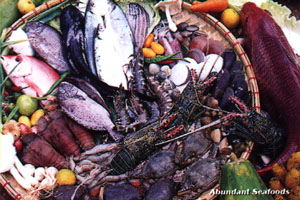
The battle cry of Capiz' claim to fame is being the "Seafood Capital of the Philippines". The markets are always bursting with almost every kind of seafood imaginable. From blue marlin, tuna, prawns and shrimps, crabs, eel, shellfish and other marine species. Capiz offers only the best. And if you have had a taste of its exquisitely delicious seafood delicacies, surely you would agree...
Gifted with people blessed with ingenuity and mind for progress, Capiznon's turned wide expanse of swampy lands, interwined with networks of brackish water, into fishponds. Prawns and milkfish are among those cultured in fishponds. Having one of hte riches fishing grounds in the country and because of the large demand for marine products, several sophisticated food processing plants, particularly in Roxas city, export their products to Japan, the United States and several countries. Recently, Capiz was chosen as the site for two of the biggest crab meat processing plant in the country like Whanam Phils, and Phillips Seafood, Inc.
With its 90 kilometer shoreline, Capiz makes use of the abundance of "Kapiz" shells which are used in manufacturing handicrafts and several novelty items for export.
ECONOMY
The even distribution of rainfall throughout the year makes the province highly suitable for agriculture and aquaculture industries. Capiz is also the biggest rice and corn producer in the region.
Its waters teem with the best gifts of the sea -- blue marlin, tuna, prawns and shrimps, crabs, eel, shellfish and other marine species. Prawn and milkfish are also cultured in fishponds.
Agriculture and fishing dominate the economy of Capiz. Palay, corn sugar cane and coconut are the main crops of the province. The coastal waters of Capiz constitute one of the richest fishing grounds in the Western Visayas. Fishponds abound with a total area of 20,000 hectares. The combined catch of aquamarine products make Capiz one of the major producers and suppliers of milkfish, crabs, shrimps and prawns. The industry sector includes manufacturing of garments, furniture-making, bakery and processed foods, handicrafts and shellcrafts, and processing activities such as food, oysters, mussels, fish and prawn processing.
As the Garden Capital of Northern Panay, Capiz farms grow orchids, various ornamental plants and flowers that supply a thriving cut-flower business. Its fertile land is a good grazing ground for cattle and for raising swine, goats and poultry. Its long coastal areas abound with "kapis" shells for export, which are used in the manufacture of novelty items.
The province has total exports of 1,671,637. There are mostly frozen prawns, crab meat and clams canned oysters and mussels, gifts and housewares, horticultural products and electronics. Export markets of these products are Europe, USA, Japan, Singapore, Canada and South Africa.