INTRODUCTION
The history and philosophy of the Coffee House was studied and considered in respect to its viability in today's marketplace. Coffee is the second largest commodity traded in the world (second only to oil) and has proven to be immune to recessions. Consumption declined in the 1800s with the introduction of tea, but today coffee-houses also sell tea and other beverages.
Regardless of competition, a properly organized casual meeting place where quality, specialty coffees are offered will always be viable, especially where it contributes some uniqueness to the local scene.
Today, coffee drinking and the café experience are more popular than ever. The average Canadian is said to drink on average three cups of coffee per day. Coffee-houses have become once again the place to meet with friends or to simply enjoy a few moments of solitude in a comfortable atmosphere. The target consumer is not limited by race, creed, age or occupation.
PROFITABILITY
The essentials for a profitable operation are:
- Location: highly visible and easily accessible by a large number of prospective customers, by foot or by vehicle, with parking facilities. The overall key to success.
- Once a prospective customer notices your existence, there must be a marketing strategy to entice him in
- Interior (workstation) designed for speed and efficiency of service, as well as good looks
- Once in, a customer must be enticed to order an espresso based drink, not regular coffee (which they can get anywhere) - an espresso-focused operation is essential
- Capable and well-trained staff, with a willingness to learn and a professional attitude
- Quality, freshly-roasted coffee beans selected on customer tastes (they must like what you offer) backed up by proper preparation techniques
- Unique atmosphere with ambience, and a unique product line: stand out from the crowd
- An emphasis on customer service: customers must be served promptly or they won't return
- Competitive pricing: what is offered must be worth the price
- Comfortable seating in a relaxed atmosphere, and in a scrupulously clean environment
- Creative cost savings: every dollar should be used to produce maximum results
- Knowing how many sales are necessary to (a) break even, and (b) maintain a desired standard of living
- Aiming for a minimum of 70% of gross sales through espresso based drinks
- Adequate financing
To summarize: once one has found the right location, design, promote and operate it so as to maximize its potential.
Cost-savings over traditional operations can be achieved by:
- the use of flavored coffee syrup on a per cup basis rather than buying flavoured coffee beans, which normally requires a complete brew to be set aside for this purpose, reduces waste. Same policy with flavoured drinks.
- keeping equipment installation to a minimum without reducing efficiency
- emphasizing espresso-based drinks: A regular coffee may bring in a profit of $0.75 per cup, whereas an espresso-based drink would bring in on average at least $2.35 per cup. Most coffee bars reach only 15-30 % in espresso sales.
IDENTIFYING THE RISKS
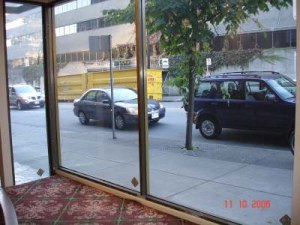
The risks are minimal. Even at an extremely low volume, as indicated here, the captive hotel audience should allow the operation to profit from the very beginning. There should also be substantial and continuous foot-traffic from Cambie Street.
Hotel staff indicated that guests often asked where they could find coffee and expressed satisfaction that a coffee shop would now take the place of the previous gift-shop.
COMPETITIVE ANALYSIS
There are numerous coffee shops and chains in the city. Independent coffee-shops have the reputation of being the preferred location, as they are more customer-oriented than the chains or franchised operations. It should be noted however that, despite the abundance of such establishments downtown, all seem to be very profitable operations, even in the highest cost rental areas. None have ever closed down except for relocation. The proprietors, as long-term drinkers of espresso-based coffees, agree with the opinion, shared by many, that a well-run, independently owned coffee house can be more profitable and popular than one franchised on account of the flexibility of local control, and personal attention to customers and the local population. This was demonstrated in Vancouver, where even a Starbucks had to close down (Denman Street) and move to a different location.
FINANCE
Coffee businesses are not complicated, but require an organized approach, like any other business, in order to be successful.
The capital cost needed to open a coffee-shop is reported as being between $50,000 and $300,000, $75,000 being the average. Franchise fees vary from $200,000 to $350,000. In a good location the initial investment could be recouped in the very first year. A Second Cup quotation was in excess of a quarter million dollars. Royalties vary from about 6% to 11% of gross sales. A franchise is not apparently the most advantageous way to go, and also reduces creativity. If one does not go with a franchise, it is recommended that the services of an experienced, independent consultant be used. Starting from scratch is generally preferable to taking over an existing business, but allowance should then be made for slow initial growth.
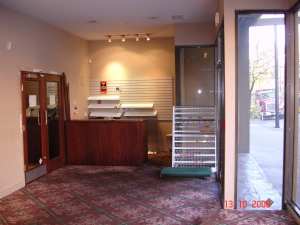
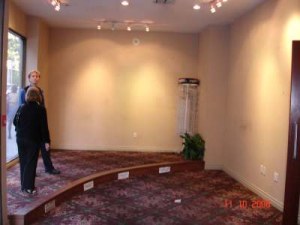
Capital cost of the project in downtown Vancouver is estimated at under $50,000 as the area is very small - under 400 square feet plus extensive available patio area, plus storage provided by the hotel. This does not include renovations and improvements undertaken by the hotel, who remain owners of the property, so outlay is limited to equipment and initial supplies. The premises are currently vacant.
The net profit is projected very conservatively at $30,390 in the first year, increasing thereafter. This does not reflect the full capability of such an operation - sales could well be three to four times as much once well established.
Only 55% of North American consumption is roasted or ground coffee, indicating a huge potential for gourmet coffee growth.
MENU
One must offer a better tasting product, with faster service at a competitive price, in comparison to competitors - i.e. better value. A wide range of beverages should be available - only 50% of Americans are said to drink 'coffee'. High quality teas (not tea-bags, which contain tea-dust, lower grade tea and the undesirable taste of paper) should therefore also be offered, as well as the currently popular 'flavoured' beverages. Attention should also be paid to providing natural 'milk substitutes' such as soy or rice milk to counter lactose-intolerance in customers.
The menu will be limited, emphasizing espresso-based drinks. Apart from coffee and other refreshments there will be baked goods and other items associated with coffee-drinking.
"The Drink (coffee) Comforteth the Brain, and the Heart, and Helpeth Digestion" (St Hildegard of Bingen)
MARKETING
Marketing will be directed by the hotel to their customers and added to their own advertising. Additional advertising may be considered in due course. Promotional costs should not exceed 5% of the operational budget for the year.
Equally effective, although strictly localized, is the distinctive aroma of freshly brewed coffee. One should always ensure that the smell of coffee escapes from the premises - perhaps helped strategically by a fan and vent over the entrance. Coffee is addictive.
OPENING HOURS
An early start is necessary to catch those requiring a snack or breakfast before starting work. 59% of all coffee is consumed during breakfast hours. Most decaffeinated coffee however tends to be drunk in the evenings, so opening hours should cover both busy parts of the day. Iced beverages are a must in summer. In this particular location, hotel guests may be offered an alternative to a full breakfast - coffee and muffin, or similar. The requirements will shift throughout the day, so specials should change as the day progresses.
COFFEE EDUCATION
There is no formal education for becoming a professional in the coffee industry. Other than taking a Ph.D. in coffee chemistry in Bologna, which would surely be disregarded by everyone else in the industry, there are only courses offered by the Specialty Coffee Association of America (SCAA) on an ongoing basis. The science and art of coffee tasting, blending, roasting and processing is normally learned by the hands-on process, but most suppliers provide comprehensive staff training both on- and off-site. Franchises have their own "coffee schools."
Apart from the use of consultants there is one particular magazine which should be subscribed to - "Fresh Cup Magazine" - which would help to keep participants educated and up-to-date with the world of coffee.
Control will be local. The proprietors are European linguists, resident in downtown Vancouver, who have systematically read and digested everything about coffee for some years, and have obtained as much information as possible not just from suppliers to the industry and several local operators but from specialists who provide impartial consultant services. [The consultant used to ensure maximum profitability is Alex Fisenko of Portland, Oregon, who introduced espresso-based drinks to America in the 1960s]. This has resulted in the compilation of a comprehensive coffeehouse administrative manual.
SHORT & LONG-TERM GOALS
The initial purpose of the management team was to start a small business within an industry where failure is the exception to the rule and in a field which they understood and could love and enjoy (which coincides with Donald Trump's maxims for success), limiting it to family management if possible, then expand at a later date to other locations.
The coffee-shop fulfils that, especially as they had thoroughly researched the industry in 2001 and are still coffee afficionados.
The aim is to open by 1st January 2006, but preferably before the Christmas season.
Other Principles:
- For renovations and planning permissions, allow two-three months lead time for grand opening.
- Grand Opening should take place at least three weeks after opening the doors for business - giving time to iron out kinks
- Develop strategic alliances with specific local businesses
- Develop as a meeting place - where people can meet others, exchange information, read international periodicals and coffeehouse newsletters.

BIBLIOGRAPHY
- How to Make Real Money with Espresso (Alex Fisenko)
- Espresso Coffee: Professional Techniques (David C. Schomer)
- Start and Run a Profitable Coffee Bar (Self Counsel Press)
- Coffee House Manual, June 2000 - Fresh Cup Magazine
- "Java Jive" - 1999 CBC Newsworld documentary on Coffee
- "Opening Soon" - Food Channel TV show
- Custom Gourmet Coffee
- Fresh Cup Magazine
- Tea and Coffee Trade Journal
- Castle Communications
- Start Up (William J Stolze)
- St Hildegard of Bingen
- Sandman Hotels
COFFEE BUSINESS CONSULTANTS
Alex Fisenko, 6107-SW Murray Blvd. PMB 297, BEAVERTON Oregon 97008. - and others, including suppliers of equipment and beverages.
N.B.- It was Alex Fisenko who introduced espresso to Americans in the 1960s.
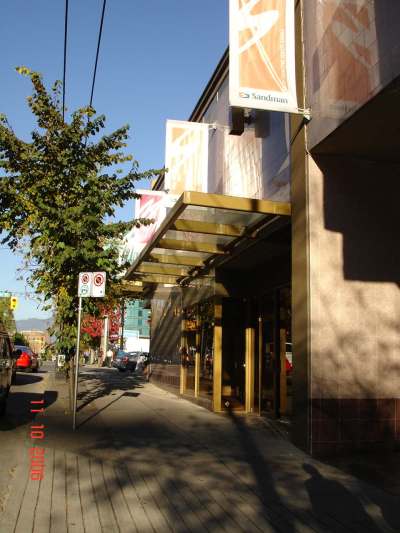
Covered Entrance from Cambie Street
Photo Copyright: Milson Macleod 2006