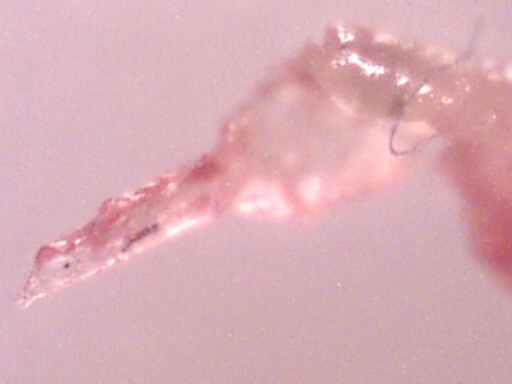
Pulled this one out of the back of my skull
Your mother told you not to pick at it or it'll get infected and your arm will fall off. Well, I'm here to tell you your mom wasn't all that far off...
Pulled this one out of the back of my skull
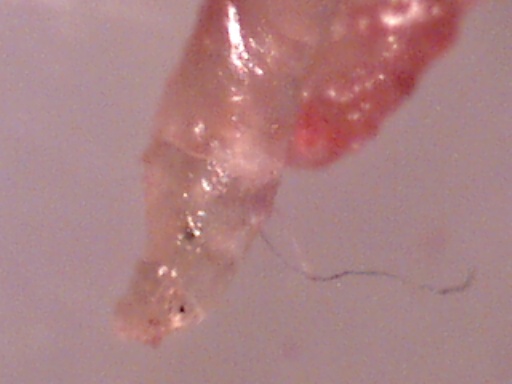
This one, also. Note the difference at the end.
My theory is that the these things are more-or-less baseball bat shaped and after they grow or dig themselves into place they send out a cone-shaped probe to find a feeding spot, most likely a blood or lymphatic vessel. When they are growing and reproducing they are pliable and usually reddish in color. Once they have reproduced they die off and become hard and clear. It is at this point when they can become quite painful; having a hard, sharp point sticking into the second or third dermal layer. If they remain undisturbed they eventually start to breakup and working out of the skin. The "threads" commonly seen are the collagen remains of the dead invaders. If one of the softer specimens is allowed to dry-out, separated from the host, the partially-hardened specimen can be crushed to produce "threads" similar to those seen by victims of the disease. The color often seen in the threads can be explained by the presence of various bodily fluids during the desiccation process.
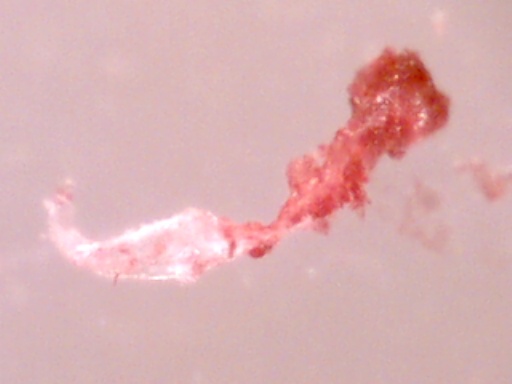
Here's one yanked from my skull; the red part was on the outside and the clear part was sticking in.
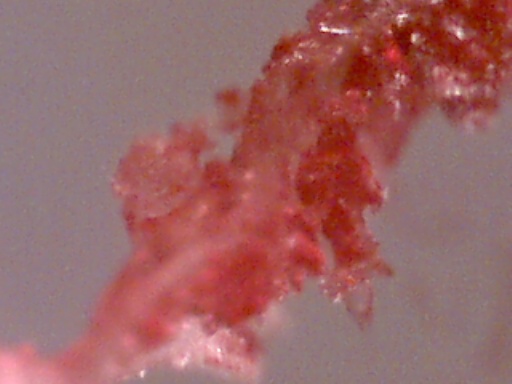
Here's a closeup of the shaft. Note the multiple smaller specimens hanging on.
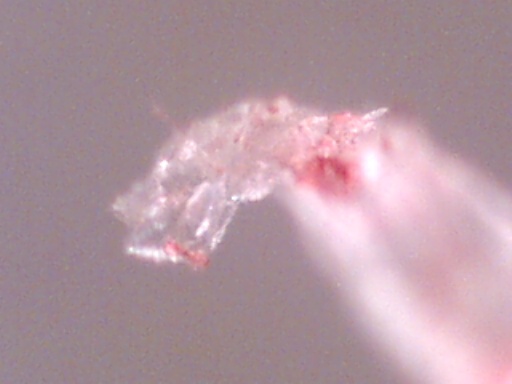
Here's a closeup of the end. Note that it is really a collection of much smaller specimens, which are extruding out of the end. This is the really puzzling part of these things - any one of them usually seems to be made up of many smaller specimens. Very fractal-ish. I think that what is happening is that generally these things are not found and removed until they become irritating to the host. As they probably secrete some sort of sensation-dulling enzyme while they are active [a normal and well-documented strategy used by many parasites] they are not discovered until they are well-dead. Given the fact that the dead specimen is surrounded by newly-hatched specimens they are most-likely used by the newest members of the family as breakfast, being recycled from the inside-out, eventually leaving only the collagen strings behind. This is all conjecture on my part, but the theory meets the observations. Of note is the fact that the few "new" and unattached specimens I have found are not found to have loads of the smaller things hanging on or within. In these cases the smaller specimens are a different stage in the lifeccyle of the pest. It is well documented that these type of vermin has multiple stages of life - caterpillar/butterfly, maggot/fly, etc.
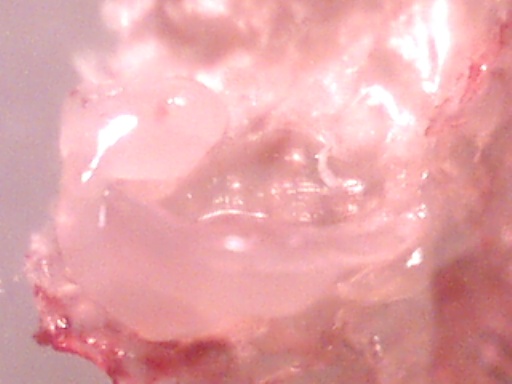
Here's a couple of brand-new guys taken from my head just to prove my point. Note the smooth, undefiled surfaces.