Synthesis of C2-Symmetric,
Non-Racemic Ketones
as Catalysts for Asymmetric Epoxidations
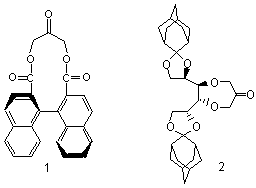
- It could be proved that ketone 1,
which is derived from binaphthalene really is a good catalyst for epoxidation
and that it gives a high enantiomeric excess.
- The mannitol-derivative 2
was supposed to be a good catalyst also. The large adamantyl-groups should
have enhanced the effect of the chiral centers and thereby rise the enantiomeric
excess. Yet, this synthesis failed.

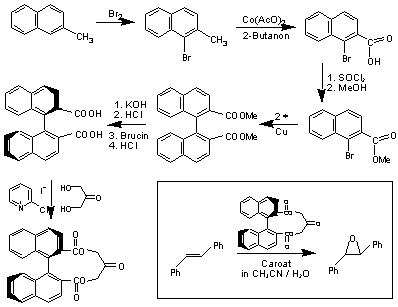
Synthesis of the catalyst 1:
- Bromine-Addition to 2-methylnaphthalene in postion 1.
- Oxidation of the methyl-group to the carbon acid.
- Synthesis of the methylester via thes acid chlorid.
- Ullmann-coupling to the binaphthyl-derivative.
- Acetic working-up gives the free acid.
- Separation of the enantiomers with Brucin
- Formation of the ester with 1,3-dihydroxyacetone
Þ
in situ epoxidation of trans-stilbene: Yield 70 %, ee
= 44 %.
Ketone 1
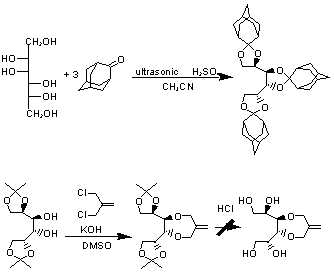
The second aim of this project was
the synthesis of the C2-symmetric,
chiral catalyst 2
on a D-mannitol basis. I did not succeed in acetalizing in the 1,2-
and 5,6-position, but I could obtain the triacetalised product. Even the
other pathway (forming the ether first) did not lead to the desired product.
Last modified at April the 3rd 1998.
Back to the main page.
Publish your own homepage at geocities.