Costel Rizescu

RADIATION DETECTORS

HOME


RADIATION DETECTOR: What it is, what it does?

SCINTILLATORS

Bismuth Germanate - Bi4Ge3O12
  • Bismuth Germanate, also called BGO, is a high density scintillation material. Due to the high atomic number of bismuth (83) and its high density, BGO is a very efficient -ray absorber. Because of its high effective Z value, the photofraction for -ray absorption is high, which results in a very good photo-peak to Compton ratio.
  • The scintillation emission maximum of BGO is centered at 480nm. The scintillation light can be detected with standard photomultiplier tubes. The light yield (photons/MeV- ) is about 20-25% of NaI(Tl), but, since the emission is partly in the region above 500 nm where PM tubes are less sensitive, the relative photocathode yield compared to NaI(Tl) is only ~10-15%.
  • It also is possible to read out Bismuth Germanate crystals with silicon photo-diodes, but due to the relatively modest light output and less-than optimum spectral characteristic, this is generally only useful in current mode, or for the detection of high energy particles or photons of more than a few MeV in pulse mode.
  • The scintillation intensity of Bismuth Germanate is a strong function of the temperature. At room temperature, the light output increases approximately 1% for each 1 deg. C drop in temperature. The decay time of BGO is about 300 ns at room temperature, which is comparable to that of NaI(Tl). However, the afterglow is much lower, typically about 0.005% after 3 ms.
  • BGO scintillation crystals are susceptible to radiation damage starting at radiation doses between 1 and 10 Gray (102 - 103 rad). Since the radiation damage to BGO crystals depends on the presence of sub ppm impurities, large differences between individual crystals can occur.
  • BGO is relatively hard, rugged, non-hygroscopic crystal which does not cleave. The material does not show any significant self absorption of the scintillation light. The crystal housing can be kept simple since no hermetic air-tight sealing is required. BGO can be machined to various shapes and geometries. BGO scintillation crystals are used in applications where a high photofraction is required (as in PET scanners) or because of its high density (as in Compton suppression spectrometers).

    Summary of Properties
    Density; 7.13 g/cm3
    Cleavage plane -- none
    Hardness; 5 Mho
    Hygroscopic; no
    Wavelength of emission maximum; 480 nm
    Lower wavelength cutoff; 320 nm
    Refractive index at emission maximum; 2.15
    Primary decay time; 300 ns
    Afterglow (after 3ms); 0.005 %
    Light yield; 8 - 10 x 103 photons/MeV
    Photoelectron yield; 15 - 20 % of NaI(Tl) for rays.

    Cadmium Tungstate - CdWO4
  • Cadmium tungstate is a high density (7.9 g/cm3), high Z scintillator with a relatively large light yield. The emission maximum is in the region of 500 nm and the total light yield is about 35-40% of NaI(Tl). However, since the emission of CdWO4 is at a much longer wavelength than that of NaI(Tl), the relative photocathode yield is only 25-30% relative to NaI(Tl).
  • CdWO4 has two emission maxima, one at 470 nm and one at 540 nm. For -ray irradiation, both components are excited. The intensity of the scintillation emission of CdWO4 varies only slightly near room temperature (300 K), which can be important for some applications.
  • The decay time of the 470 nm component is 20 µs, the 540 nm component has a 5 µs decay time. The afterglow of CdWO4 upon x-ray irradiation is very low, typically less than 0.1% after 3 ms. The material shows a very good radiation resistance: for doses of 104 Gray (106 rad) -rays, the optical transmission of the crystal decreases less than 15%. For -particles, this effect is even smaller: less than 6% for 105 Gray (107 rad).
  • CdWO4 is a crystal that cleaves very easily and is therefore very susceptible to mechanical and thermal shock. Since some self-absorption of the scintillation light occurs, CdWO4 is usually not fabricated in large dimensions.
  • Due to the high density of CdWO4, the crystal thickness to stop 150 keV photons is only 3 mm. The high stopping power and the low afterglow of CdWO4, together with the possibility to detect the scintillation light efficiently with photodiodes, make it an attractive scintillator for x-ray detection (e.g. in CT scanners).

    Summary of Properties
    Cleavage Planes (010)
    Decay Constant 20.0 µs, 5 µs
    Density 7.90 g - cm-3
    Emission Spectral Range 330 to 540 nm
    Peak Scintillation Wavelength 520 nm
    Photons / MeV 13,000
    Radiation Length 1.00 cm
    Refractive Index at peak emission 2.25
    Stability -- Stable (non hygroscopic)
    Structure Monoclinic
    Cesium Iodide
  • Cesium iodide has a reasonably high -ray stopping power due to its relatively high density and high effective "Z" (atomic number). For scintillation counting with Si diodes, CsI doped with a thallium "activator" is generally used. This material is designated CsI(Tl).
  • Cesium iodide has high resistance to thermal and mechanical shock due to the absence of a cleavage plane. Most physical characteristics of CsI are independent of the activator used. Compared to NaI(Tl), CsI is relatively soft and plastic. It is easily fabricated into a variety of detector geometries. Because of its rugged character, Cesium iodide has been extensively used for well logging, space research or other applications where severe shock conditions are encountered.
  • Cesium iodide itself is soluble in water but is not hygroscopic in the real sense. However, when in contact with materials to which water vapor can adhere, or when used in atmospheres with a high relative humidity, surface degradation can occur. For undoped CsI and CsI(Tl), resurfacing the crystal will generally restore the original performance. CsI(Na) is hygroscopic and must be hermetically sealed at all times just as NaI(Tl).
  • CsI(Tl) has the highest light output of all presently known scintillators. The maximum of the broad emission is situated at 550 nm and the emission is, therefore, not well matched to a bialkali photocathode photomultiplier tube. This results in a photo-cathode yield for -rays which is only 45% of the value for NaI(Tl). However, the emission spectrum is very well-matched to the sensitivity characteristic of Si PIN diodes, and is often, therefore, the scintillator of choice in such applications.

    Summary of Properties
    Scintillator (Activator) CsI(Tl) CsI(Na) CsI(undoped)
    Density [g/cm3 4.51 4.51 4.51
    Hygroscopic slightly yes slightly
    Emission wavelength max [nm] 550 420 315
    Lower Cut-off [nm] 320 300 260
    Refractive index @ emission max 1.79 1.84 1.95
    Primary decay time [µsec] 1.0 0.63 0.016
    Light yield [photons/MeV ] 52- 56 x103 38-44x103 2x10³
    PMT Photocathode yield [% of NaI(Tl)] 45% 85% 4% - 6%

    Converting gamma -ray energy to electronic charge
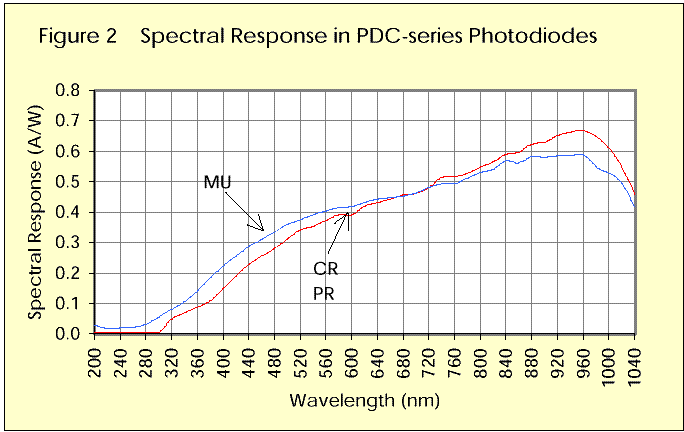


    Quantum Efficiency for a photo-diode is the number of electron - hole pairs that can be detected as a photo-current divided by the number of incident photons. This is usually expressed as a "percent" (at a particular wavelength) and is given by the following relationship:
    QE(lambda) = S(lambda) ÷ (lambda) x 1240 x 100%
    Where S is the photo sensitivity in A/W at a particular wavelength, and (lambda) is the wavelength expressed in nm (nanometers).
    Example 1: In the figure above, the quantum efficiency of a PDC-series diode with a resin window coupled to a CsI(Tl) scintillation crystal whose spectral peak is centered at 550 nanometers is the spectral sensitivity at 550 nm (~0.37 A/W) ÷ 550 x 1240 or ~83%.


    Pulse Mode readout using CsI(Tl)

    Choice of Diode: In general, pulse-mode read-out requires the use of a back-biased PIN type of photodiode (PDC series) which has a much lower junction capacitance for a given active area, and consequently a much faster signal response, compared with that of a planar photo-diode (PDA series) of the same active area.

    Optical Coupling: Since the index of refraction of most scintillation crystals is substantially higher than 1.0 (1.0 is the index for air and is close to the value for the resin window on a Si diode), getting the scintillation light out of the crystal and into the diode almost always requires the use of an optical coupling medium - a gel or silicone grease for temporary construction, or an epoxy-based compound or other resin-type adhesive for permanent construction.

    For optimum light-transmission, the coupling medium should have an index of refraction which is the geometric mean (i.e., the square root of the product) of the indices for the crystal and the entrance window of the diode.

    Determining the efficiency of optical coupling in a scintillation detector: One can estimate the optical coupling efficiency between crystal and photodiode using a small (~1 uCi) low-energy gamma-emitting check-source, such as 241Am (59.5 KeV principal gamma emission). This is about the maximum useful energy for this technique, since detection efficiency in a Si photodiode drops very quickly at higher photon energies, and detection in the scintillator crystal begins to swamp the the overall system count-rate.

    Assuming the detector assembly is not completely opaque to the 59.5 KeV gamma rays, one can position the source on the rear (diode side) of the detector so that some of the incident radiation is detected directly in the PIN photodiode, rather than in the crystal. The results of one such experiment are shown below. The detection efficiency for 59.5 KeV gamma rays in Si is rather low (~1%), and the attenuation of 59.5 KeV gamma rays by the detector assembly itself is rather high, so these measurements took a few hours to acquire.
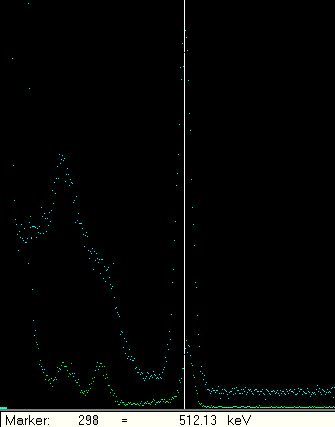
    In the figure above, the top-most spectrum is from a 22Na source detected in a 1 cm3 CsI(Tl) scintillating crystal coupled to a 1 cm2 Si PIN diode. The prominent peak is at 511 KeV. The lower spectrum shows a partial gamma ray spectrum from 241 Am detected directly in the Si photodiode, where all of the system parameters, gains, etc., are unchanged from one measurement to the next.

    The 511 KeV peak in CsI(Tl) corresponds to channel 297; the 59.5 KeV peak in Si corresponds to channel 302. We know from our data on CsI(Tl) that the conversion from gamma ray energy to optical photons is ~55,000 photons per (absorbed) MeV, or 28,105 photons at 511 KeV. We also know that it requires 3.6 eV to produce one charge-pair (electron-hole pair) for direct detection in Si. Based on the latter measurement we have an absolute measure of electronic charge versus channel number: 59.5 KeV corresponds to 59,500 ÷3.6 = 16,528 electron-hole pairs, or 2.644 x 10⁻¹⁵ coulombs which, in turn, corresponds to channel 302.

    The peak at channel 297 from 511 KeV in CsI(Tl) corresponds to a slightly lower value -- 2.6 x 10⁻¹⁵ coulombs. We started with 28,105 optical photons, and the quantum efficiency of our photodiode is ~83%, so if the optical coupling efficiency were perfect we would expect an electronic pulse of 0.83 x 28,105 = 23,327 charge-pairs, or 3.73 x 10⁻¹⁵ coulombs.

    However, our 511 KeV scintillation peak turns out to be only ~70% of this value, so we must conclude that the overall optical coupling efficiency for this detector is only ~70%, leaving some room for improvement.


  • CdZnTe Detectors

    CdZnTe radiation detectors were first developed around the beginning of the 1990s. The compound is based on the well known material CdTe, but a fraction of the Cd (Z=48) content is replaced with Zn (Z=30). This yields an increase in the resistivity of the material, reducing leakage current in the detectors and allowing the use of simple planar devices with non-blocking contacts. It also removes the requirement for compensation mechanisms (e.g. Cl doping) often employed in CdTe.

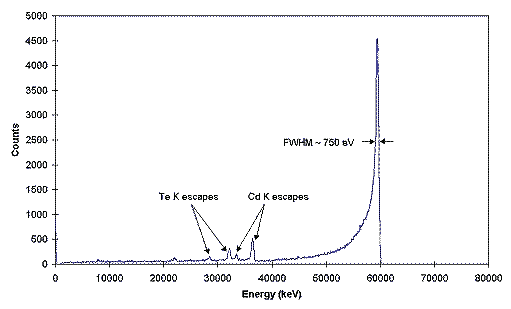
    Like many other compound semiconductor materials, hole transport is a major limitation on device operation. The room temperature CdZnTe spectrum below illustrates the effect of hole trapping on photopeak shape. Also visible are the escape peaks of the Cd and Te.

    Cooled Detector Results

    Cooling to -40 degrees C has lowered the electronic noise to less than 200eV, allowing X-rays to be detected down to 1740 eV (silicon K). Most measurements have been acquired using radioactice sources. A typical Fe-55 spectrum is shown in the figure below. Photopeak resolution is about 238 eV FWHM. The best resolution achieved at this energy is 220 eV. Noise is presently limited by acoustic pick-up. Present packaging limitations prevent complete removal of these effects. Noise analysis shows that 1/f is a dominant noise component, probably contributing > 100 eV to the peak width.
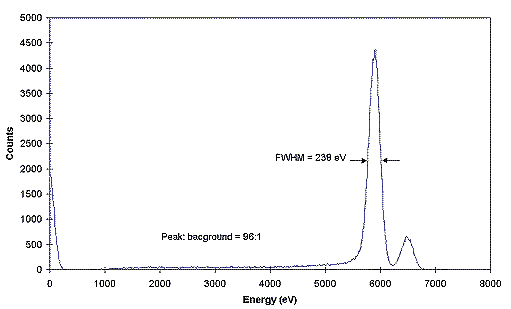
    The shelf of counts is due to low field effects in the region of the cathode. Shelf levels vary between detectors and with energy. The best peak to background ratio obtained was about 200:1. This is a high background figure, but is comparable to Peltier cooled Si PIN diodes. The presence of a large shelf, and of multiple escapes makes quantative analysis of multi-energetic sources difficult. This is demonstrated in the plot below where several fluorescence spectra are summed to simulate a complicated mixture of materials. Peak intensities appear quite different at lower energies where shelf counts become a problem.

    Cooled spectra have also been acquired with Americium gamma irradiation, an example of which is shown below. Higher bias voltages are possible under cooling and spectra show some improvement in charge collection. Energy resolution is vastly improved when compared to room temperature results.

    Escape peaks add additional complication to the spectrum. Some data resolve the Te Ka1 and Ka2 escape lines. Data acquired over very long timescales also exhibit Cd, Te and Zn characteristic X-ray peaks. The mechanism for the production of these features is uncertain. It is possible that primary interactions occurring in 'dead' regions of the detector may emit secondary X-rays that are detected within the sensitive volume.


       CURRICULUM VITAE     PUBLICATIONS    R & D / Paper ABSTRACTS    Manufacturing & Technology     HOME


    Copyright 2004, All rights reserved
    Hosted by www.Geocities.ws

    1
