
|
| Costel Rizescu |
|
Lithotripsy |

|
How does Lithotripsy Work? Lithotripsy uses shock waves to
pulverize urinary calculi (kidney stones) non-invasively. In contrast,
other methods of stone removal require open surgery (surgical nephrotomy);
extraction of the stone through a puncture in the side of the patient
(percutaneous extraction); or the insertion of a ureteroscope via the
urethra with subsequent stone fragmentation and removal by mechanical
means. All invasive procedures carry a higher risk of infection
complications than non-invasive procedures such as
lithotripsy. Occasionally, if the stone blocks the flow of urine (an obstructive calculus) the patient experiences severe pain (renal colic). This pain can be controlled by introducing a stent into the ureter. The stent is basically a tube which is placed in the ureter and allows the urine to drain past the obstruction. The stent may be left in after lithotripsy in case of obstruction due to fragments becoming lodged in the ureter. A shock wave is characterized by a very
rapid pressure increase in the transmission medium and is quite different
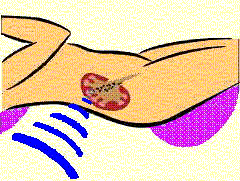
from Ultrasound. The shock waves are transmitted through the patient's
skin and pass harmlessly through the patient's soft tissue. The shock wave
passes through the kidney and strikes the stone. At the stone boundary,
energy is lost, and this causes small cracks to form on the edge of the
stone. The same effect occurs when the shock wave exits the stone. With
successive The process generally takes about 1 hour during which up to 8,000 shocks are administered. The patient will experience some discomfort during the treatment depending on the patient's pain tolerance. Analgesics may be administered to make the patient more comfortable. |
|
CURRICULUM VITAE PUBLICATIONS R & D / Paper ABSTRACTS Manufacturing & Technology HOME |
| Copyright 2004, All rights reserved |
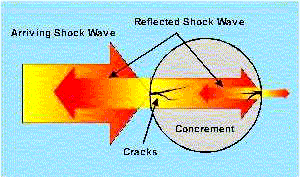
 shocks, the cracks open up, and in turn, smaller
cracks form within the large cracks. Eventually, the stone is reduced to
small particles, which are then flushed out of the kidneys or ureter
naturally during urination.
shocks, the cracks open up, and in turn, smaller
cracks form within the large cracks. Eventually, the stone is reduced to
small particles, which are then flushed out of the kidneys or ureter
naturally during urination.