Technical Analysis
The main framework of this service is based on the combination of technology. There are plenty of ways to achieve an excellent and efficient service, however factors like compatibility and cost limit them.
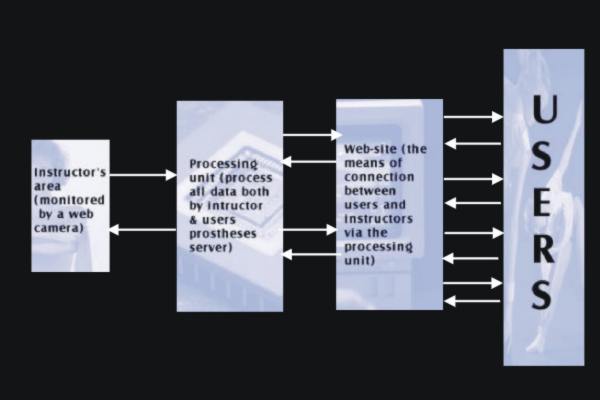
Four individual sections compose this service: an instructor, the users, a processing unit and a web-site. The instructor will act and behave like being in a normal aerobics class. He is going to be monitored by a high-resolution digital camera. With the use of appropriate software (based in the processing unit), his image will be isolated but still, maintaining all his movements. Because this is an Internet application, the software package, which will be implemented, is suggested to be created by Java.
This image will be automatically sent to the web-site. Users, connected to the web-site will be able to view and listen to him on a real-time basis. In fact the use of virtual helmets is strongly recommended; because aerobics is a "viewing and hearing" activity, virtual helmets offer an excellent three-dimensional virtual reality view (identical to reality) and an excellent quality audio surround.
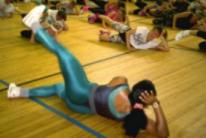
"Additionally, the processing unit can transfer these images in numerous "virtual environments". for example create a tropical beach, or an alpic mountain view."
|
A standard web-camera can monitor users and the same software package will discriminate their image. These images will then be transferred to the web-site and then to the processing unit. During the process both users and instructor will be added virtually and compose an aerobic class. The instructor will also wear a virtual helmet so as to be able to view all his class; he is going to be able to assist, instruct and view his class. Users will also be able to view themselves and thus feel and perform better.
Additionally, the processing unit can transfer these images in numerous "virtual environments". For example, being able create a tropical beach, or an alpic mountain view. The users will be able to view, hear and sense the virtual environment, with the use of virtual helmets through the web-site. The magic difference between a virtual helmet and a standard screen is the real world illusion; virtual helmets provide a three dimensional virtual vision, space sensation, unique audio surround and above everything else, mobility.
Thus, they provide, to the user a general feeling of isolation against all external audio and visual disturbances from the surrounding environment. The suggested virtual helmet is the Sony Glasstron, well known for its lightweight design, style and excellent technical specifications.
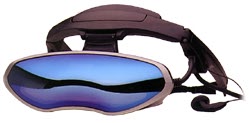
"The suggested virtual helmet, the Sony Glasstron, which is well known for it's lightweight design, style and excellent technical specifications."
|
Regarding the type of connection, it is highly recommended that a reasonable requirement is that of an ISDN data line; it is an efficient type of connection for transferring data related to graphics and images and thus provides a reliable real-time video transfer. A standard phone line could transfer a maximum of 8-10 pictures per second, while an ISDN line could transfer approximately 16-20 pictures per second, which is not far from absolute reality. Alternative methods, like the use of fibre-optic cables, super phone lines or terrestrial transmission would probably increase the quality, but currently the use of such means is quite expensive to be solely implemented by a single company. However, such methods of links are within the prospects of this project and they are expected to be widely used during the next two years within the U.K. and Europe (already in use within the U.S.A.).
Schematic 1
Final comments regarding the actual processing unit; it is essential to use a server dedicated to this service, since it could equate the ratio of data transfer to the users and a achieve a single speed simultaneously and thus obtain a higher, sole and reliable speed and service.