 |
| Renaissance History |
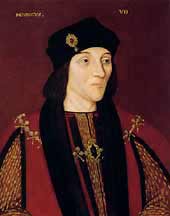
| I. The Birth of the Reniassance A. Started in Italy, this "rebirth" of learning of the Greek and Roman classics led to a renewed interest in human nature and beauty. 1. The Pre-Christian works were reinterpreted so as to give the new Renaissance people a better feeling of accomplishment and to justify their great feats. B. Medieval thinking of focussing on the afterlife and your religion was replaced by the more materialistic view of enjoying the present world. C. All areas of learning grew tremendously. 1. The goal of someone was to become a "Renaissance man," or to develop all natural talents to their fullest potential. 2. Old ways of thinking were challenged, and people began to think more about personal development and the importance of the individual. II. England Before the Renaissance A. Internal strife prevented England from participating earlier in the revival of learning. 1. 1485 AD marked the end of the bloody War of the Roses between the houses of York and Lancastor over the right to the throne. 2. Henry of Tudor became Henry VII, the new King of England. B. Henry VII, while not a very lively fellow, was a very able ruler. 1. Was a strong ruler at home. 2. Built up a stronger merchant fleet so as to keep up with the new outstanding commerce treaties he was setting up. 3. Encouraged and funded expeditions to the New World so as to gain colonies for England. 4. Set up the marriage of his son, Arthur, to Catharine of Aragon, daughter of King Ferdinand and Queen Isabella of Spain. He hoped to try and create an alliance between these two revivals instead of fighting over the New World. a. Arthur died unexpectedly, however, before the marriage could be carried out. b. The Pope granted a special dispensation to give the marriage contract to Henry, Arthur's younger brother, and new heir to the throne. |
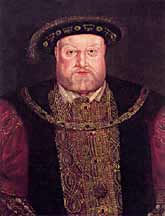
| III. Henry VIII's Reign A. Came to the throne in 1509 AD after his father's death. B. A true man of the Renaissance, had perfected his skills as an athlete, poet, musician, and speaking Latin, French, and Italien. C. At first fought against the Protestant Reformation when it swept northward. 1. Yet Catharine had only given him one heir, a daughter named Mary, during their whole 18 years of marriage. 2. Henry VIII declared that the papal dispensation had been a mistake, and called for the Pope to announce the marriage void. 3. Pope refused and in 1534 AD, the Church of England was established with King Henry VIII as its head. D. Married Anne Boleyn, a hand maiden in Catharine's court. 1. Only a daughter was born of the union, Elizabeth. 2. Anne executed on the charge of adultry and her head hung from London Bridge. E. Henry VIII then married Jane Seymour. 1. Edward VI, the only male heir, was born a sickly child to this couple. IV. The Heirs A. Edward VI took the throne in 1547 AD when he was only 9 years old. 1. The Church of England grew farther from the ways of the Catholic Church. a. The Church published all of its rituals and beliefs in the Book of Common Prayer. B. Mary then took the throne at the death of Edward VI. 1. Tried to bring out Catholicism again. 2. Married her cousin, Philip II of Spain. 3. Persecuted Protestants so much to earn her the name"Bloody Mary." C. Elizabeth followed her half-sister to the throne upon Mary's death in 1558 AD. |
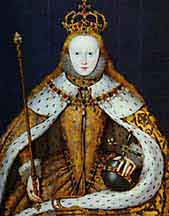
| V. The Reign of Elizabeth I A. Her reign was marked by its pomp and circumstance that was balanced by its spendthift attitude toward keeping a low national budget. B. Kept complete control over her empire, but still was respectful to Parliament and the commoners. C. Reestablished Church of England so as to provide a neutral territroy between the Catholics and the Puritans, a new sect of Protestants who wished to purify the Church of England of all Catholic influences. D. Used her possibility of marriage as a trump card to manipulate many European princes and to keep to her policy of remaining out of costly wars. E. Encouraged the expansion in the New World, especially at the cost of the other nations of Europe. 1. Knighted Francis Drake for his many pirating expeditions upon the rich Spanish galleons returning from the mines of Mexico and Peru, and for cicumnavigating the world. 2. Sir Walter Raleigh was also rewarded for his attempt at colonizing the Virginia colony. F. She was forced to kill her cousin, Mary Stuart the Catholic Queen of Scots. 1. Catholics had always disputed Elizabeth's right to the throne because of the way in which her mother married her father. 2. They claimed Mary Stuart was the rightful heir to throne, and had tried to carry out many conspiracy's to gain her the throne. G. One of the most noteworthy events of Elizabeth's reign was the Spanish Armada, a series of ships sent by Philip II to try and invade England and challenge its new navy. 1. A harsh storm shifted the battle in favor of the smaller British navy warships. H. She died in 1603 AD VI. The House of Stuart A. James VI, son of Mary Stuart, succeded Elizabeth I to be renamed as James I. 1. James I thought to support the Church of England. a. The Catholics thought he would support them because he was the son of Mary. b. The Protestants thought he would support them because he was the king of Scotland, which was Presybyterian. c. Neither were pleased with James I's choice, but the Protestants were to cause James I the most trouble. B. Charles I, James I's son, took the throne in 1625 and continued the policy of the supreme power of the monarch. 1. Both of them believed strongly in the idea of God appointing the royal families as his keepers on the earth. 2. There was no one who could overrule their decisons, making for a very difficult relationship with Parliament, which wasn't helped by the expernsive lifestyle that they both led. a. By this time the Puritans had gained control in Parliament's House of Commons. 3. Charles I didn't gain any other popularity points by attending "High Church" ceremonies of the Church of England which was pratically a Catholic ceremony. 4. Finally fed up, Charles I dismissed Parliament, not calling them until 11 years later when he was in desparate need of money. a. Used the Court of the Star Chamber to get rid of any political and religious opposition with the non-trial by jury court. b. His need of money was brought about when he tried to order the Scots to accept Anglican prayers and practices and the Scots went to war. c. The Long Parliament was then called, and Charles I was forced to give up many of the monarchy's powers. 5. To escape the injustice and civil war of England, many English traveled to America to start again. |
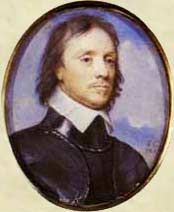
| VII. The Rise of the Commoners A. The civil war was brought about because of King Charles I military attack on Parliament after the end of the Long Parliament. 1. The sides of the civil war are: a. The Royalists are mostly Roman Catholics, Anglicans, and the nobility. b. The Parliament supporters were mostly Puritans, small landowners, and middle-class townspeople. 2. Oliver Cromwell's disciplined Puritan army smashed the Royalist's army in 1645 AD, with the king surrendering the next year. B. At the end of the war, and after King Charles I had been beheaded, Parliament began to look for a new system of government. 1. A Commonwealth under Cromwell's leadership was the first system. 2. Then Cromwell was appointed as "Lord Protector" for life. C. The new Puritan government changed English life dramatically from Elizabethan time. 1. Theatres and other recreation were closed or forbidden. 2. Sunday became only a day for prayer, not even walks for pleasure were allowed. D. At Cromwell's death in 1658 AD, his son Richard gained the title of Lord Protector but it soon became apparent that he was not the same able politican as his father. E. The Protestant governemnt soon became the very tyrants they had overthrown, and Charles II was invited back to become king of England again. 1. Charles II's reign was to bring in the Restoration. VIII. The Great Vowel Shift A. During the 1400's the English language changed in the way vowels were pronounced. 1. The e at the end of words was also not pronounced. 2. Eve though some vowels were not pronounced they still stayed when the word was spelled. Like the k and e in knave. B. The printing press helped devlop a standard system of spelling, so that by the time of the Reniassance, the words would stay the same as they are spelled today. C. While spelling was the same there were some differences in language. 1. Thee, thou,thy, and thine were considered common addresss while you, your, and yours were formal adress. 2. This tree (near), that tree (farther), and yon tree (even farther) were also used. 3. -est and -st were added to the second-person sigular subject. Like thou leadest or thou canst. 4. -eth and -th were added to third-perso singular subject. Like she looketh and he doth. D. Because of the increase in contact with other languages because of trade, it became fashionable to incorporate new words into literature. IX. Development of Literature A. Early writers of England were Sir Thomas Wyatt and Henry Howard, the earl of Surrey, who were the first to introduce the sonnet of Italy to England. |
| King Henry VII |
| King Henry VIII |
| Queen Elizabeth I |
| Oliver Cromwell, Protectorate of England |
|
 |
 |
 |