 |
| Medieval History |
| I. William the Conqueror's Reign A. The Normans had settled in France before traveling to England, and brought with them the new French ways of society. 1. Feudalism, a heirarchy of lord and vassal based upon the idea that the king owns all of the land in the kingdom. a. One fourth went to William, a fourth to the Church, and the remainder to anyone who had gained William's favor, mostly Norman nobles. In return, the nobles would either pay the king or agree to send him knights. b. Barons swore allegiance to the king, the knights to the barons, and so on down the line. The Anglo-Saxons became serfs since they had been conquered. c. Barons built castles to protect themselves from neighbors' raids, while churchmen filled their lands with great cathedrals and abbeys. II. The Struggles for Power A. Matilda vs. Stephen 1. After William's son Henry died, barons struggled between supporting the daughter Matilda or the nephew Stephen. Only when Matildia's son Henry Plantagenet finally came to power in 1154 AD did the chaos cease. 2. Henry II, the new name of Henry Plantagenet, remade the judicial system, started new royal courts, and the beginnings of British common law. 3. Eleanor of Aquitaine, wife of Henry II, was a French queen who gave to England large French holdings as part of her dowry. She also brought the code of chivarly to the knights. |
|
|
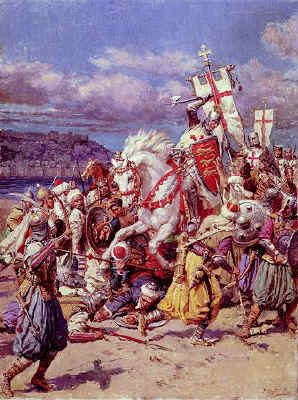
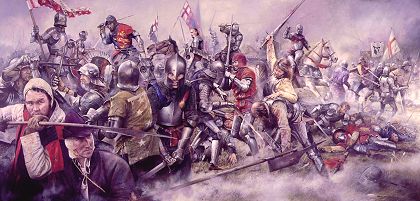
| B. The Lionheart 4. Richard the Lionheart, Henry II's son, spent most of his reign on Crusades and fighting to keep his French possessions. His brother, John, plotted against him at home until he was able to become king at Richard's death. By that time, the treasury was bankrupted, and John was forced to sign the Magna Carta. 5. Parliament began to come to term regualry under the reign of Henry III. In 1295 AD, the modern Parliament consisting of two houses, Lords and Commons, began to meet. III. Feudalism's Decline A. The Crusades and commoners' increase in power led to raises in trade, formation of guilds, and growth of towns. 1. Decline of feudalism because land ownership no longer determines wealth. 2. Crowded towns grew sickness and plagues 3. Towns began to also become learning centers. a. Oxford University housed Francis Bacon, who advanced the study of science and mathematics. b. John Wyclif and his followers, the Lollards, tried to end chruch corruption and influenced Martin Luther later on. IV. The Hundred Years' War A. Began during the reign of Edward III, over his right to the throne of France and England. 1. England suffers Black Plague, Peasants' Revolt in 1381, and Richard II's abdication in 1399. 2. In actual war events, Henry V's win at Agincourt and Joan of Arc lifts the seige of Orleans. B. End of the war brought about England losing all its French lands, and the War of the Roses. 1. House of York, white rose, verses the House of Lancaster, red rose, over the throne of England. 2. Ended when Henry Tudor of Lancaster killed Richard III of York at Bosworth Field. Tudor became Henry VII. |
 |
 |
| Richard the Lionheart at the Battle of Acre by Matania |
| Battle of Barnet by Chris Collingwood |