| Anglo-Saxon History |
| I. Before Rome A. The people of the island were divided into separate areas. 1. Britons lived on the southern part of the main island and the Picts on the northern end. 2. The Gaels, a Celtic people, lived on Ireland to the west. B. The cultures were skilled in agriculture and metal working and had a good trading system with the Celtic people on the European mainland. C. The Druids, a class of priests, kept the oral history and literature of the people. |
 |
 |
|
|
|
|
|
|
|
| VII. The Growth of Literacy A. When Christianity came to the Anglo-Saxons it brought with it the Roman alphabet and the new tradition of writing down literature. B. The new era of literature had arrived. 1. Poetry avoided the new way and continued to be performed orally but now the poems were sometimes written down. 2. However, the only way to record a poem was to have scribes write it out by hand, and so not many manuscripts have survived the test of time. a. One of the most famous poems to survive this period is a piece titled Beowulf by an unknown author. b. The Exeter Book containing many Anglo-Saxon lyrics like "The Seafarer" and "The Wife's Lament" also survived. c. Until the time of Alfred the Great most books were written in Latin. Afterwards, the common language (english) began to be used for publications. 3. One of the few known authors is a monk named Caedmon who is mentioned by the Venerable Bede, a eighth century scholar. |
 |
|
|
|
|
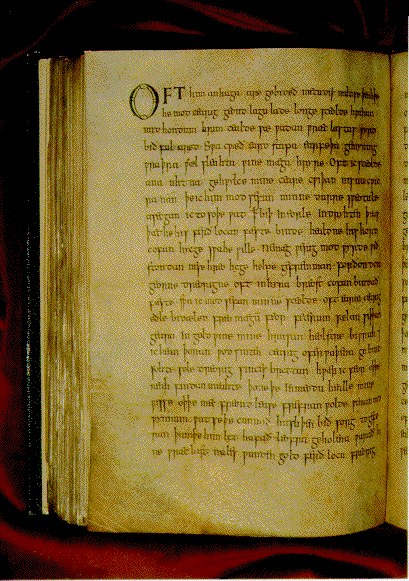
| The Exeter Book |
 |
| II. The Roman Invasion A. In 55 BC Julius Caesar came to the isles to claim them as part of the Roman Empire. B. A century later, Roman armies returned to back up the claim. 1. Quickly they defeated the Britons and then pushed the Picts into Scotland. 2. The Romans Introduced cities, written scholarship, a system of causeways, and Christianity. C. Eventually the Britons became dependent upon the Roman armies to protect them. 1. So when the armies had to return to Rome to settle problems in the heart of the empire, the Britons were left open for another invasion. |
| III. The Anglo-Saxon Invasion A. Around 449 AD Angles, Saxons, Jutes, Friesians, and other Germanic tribes began settling on Britain. 1. A Christian king named Arthur might have led defenses against the invaders. 2. Britons lost though and were driven into Cornwell and Wales, as well as across to nowadays France into an area called Brittany. B. The conquerors divided the land into seven kingdoms that formed an alliance, the Heptarchy. 1. The kingdom of Kent in the southeast went to the Jutes. 2. The kingdoms of Sussex, Essex, and Wessex in the west went to the Saxons. 3. The kingdoms of East Anglia, Mercia, and Northumbria in the north went to the Angles. a. The Angles were dominant in the early history, and so the island was called Angle-land or England and the people became known as the English. C. The Anglo-Saxons brought with them a new belief in wyrd, or fate, and a great admiration for heroes whose wyrd is to be victorious in battle. |
| IV. Christianity Comes to the Isles A. In the 5th Century, a Romanized Briton, Patrick, converted the Gaels of Ireland to the new faith. B. When the Gaels began settling on the northern shores of Scotland, they brought their faith with them. 1. Monasteries on the isle of Mona and others spread the faith to the Picts and Angles. C. In 597 AD Augustine, a Roman missionary, built a monastery in Canterbury, Kent. D. By 690 AD all of England was converted to the new faith. V. The Norsemen Arrive A. Around 790 AD, the Vikings began looting the monasteries of the British isles and conquering the northern lands. B. They were stopped from advancing further south by the efforts of Alfred the Great, a Wessex king. 1. After winning stunning battles in 878 AD and 886 AD, Alfred forced the Vikings to sign a truce and to accept Christianity. C. The Danes (the Vikings) still had some control over the land. 1. In 1016 AD Canute, a Dane, became king of all England. He had the support of many of the Anglo-Saxon nobility. |
 |
| D. In 1042 AD Edward the Confessor came to the throne with no heirs. 1. William, duke of Normandy, claimed that Edward had once sworn that William would be his heir. 2. Harold, earl of Wessex, claimed that Edward had sworn an oath making Harold his heir. 3. Upon Edward's death, the witan, the nobility's official, supported Harold's claim. 4. Angered William led his Normans to seize control of the throne. a. Harold was killed at the Battle of Hastings. E. William the Conqueror was crowned King of England on Christmas Day 1066 AD. VI. Ancient English A. When the Germanic invaders crossed over into England, their language gradually shifted until it had created a new language that would be called Old English. 1. Old English differed from modern day English in a few ways. a. There were no silent letters. b. When speaking the language it is harsher sounding than today's. c. Writing the language was difficult in that it was written phonetically and that the grammar allowed for words to be spelled differently depending upon their function. The order of the words in sentences could also be changed. 2. The best part of the language was the fact that it could incorporate any word that it needed into the growing language. |
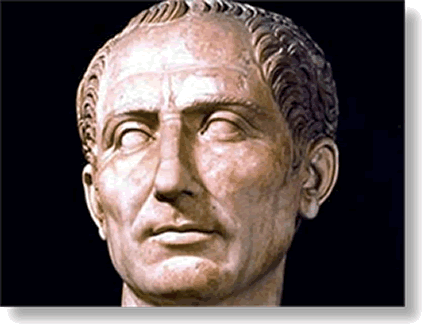
| Julius Caesar |
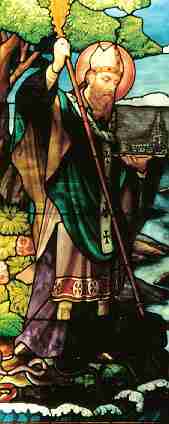
| St. Patrick |
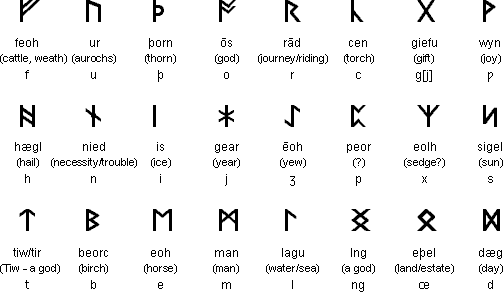
| VI. Anglo-Saxon Literature A. The Anglo-Saxon alphabet was called the runic alphabet, but it was mostly used only to mark coins, monuments, and other such public uses. B. Literature was composed and performed orally by scops, or oral poets, in the mead halls of noblemen. 1. Some of the styles the scops performed were epic poems, which told of the great deeds of legendary warriors. |
 |
| 2. Another was the shorter lyric poem. In these the subject was sometimes death or great losses that were dealt with the traditional Anglo-Saxon bleak fatalistic view. a. After the Anglo-Saxons were converted to Christianity their new faith and its morals became a source of inspiration for the scops. 3. A last type of literature that was popular with the Anglo-Saxons were riddles, which described ordinary objects and left it up to the audience to discover what the riddle was talking about. |
| The Runic Alphabet |
|
|