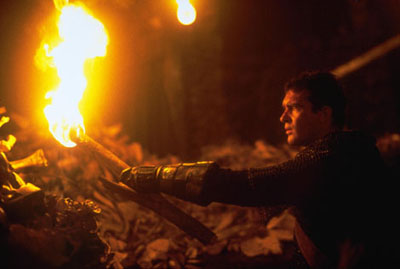
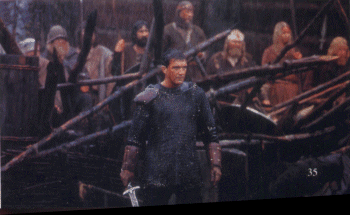
| The Anglo-Saxons are widely known for their savage warfare and history for conquering lands. Perhaps not so widely known are the beliefs and culture of these people. Yes, they were savage and loved war, but they also held a deep respect for their religion and the strength of their fellow man. The movie, The 13th Warrior, does a respectable job of portraying the lives of the Norsemen in all parts of their culture. The core to all cultures is their religion, and the Anglo-Saxons were no different. In the opening part of the movie, Arab is allowed to witness an old-style burial of a king. He is told that the riches, goods, and even the young woman will be set ablaze with the king so that he might enjoy them in Valhalla. How strong must a person's faith be to willing agree to be burned alive so that your lord can enjoy your company in the after-life? Keeping to this show of faith, later on in the movie as the warriors prepare for the final battle against the Venn, each man repeats a chant: "Lo, I see my father before me Lo I see my mother before me Lo I see my brothers, sisters, n' all the way to the beginning of my line Welcoming me to join them in the halls of Valhalla Where the brave shall live forever!" All of them relish the chance of dying an honorable death so that they might enjoy the rewards of Valhalla in the next life. This is why the Anglo-Saxons were so vicious in battles, so savage. To die in combat was their sole goal in life! Their religion was an intricate part of what the Anglo-Saxons were. The Anglo-Saxons respected strength and power in their people. Squabbles between heirs were expected and usually ended with bloodshed, as was shown in the movie by Bulvine and the other claimant of the throne. Though animal-like on the outside, they possessed the ability to walk the lines of politics as skillfully as any courtesan. During the movie, the Prince plots behind Bulvine's back in an attempt to gain power for himself. Instead of challenging the Prince outright, Bulvine sends one of his trusted warriors, Sven, to pick a fight with a hireling of the Prince. Through a series of insults, a duel is begun in which Sven deceives the other combatant into thinking that Sven is a tired, old man. Once Sven and Bulvine see the Prince signal his henchman to finish the duel in death, the tables are quickly turned. The Prince is left grasping at straws, his man beheaded and lying at his feet, and wondering what else Bulvine has up his sleeves. A masterful example of the amount of effort the Anglo-Saxons went to, to secure power and fame for themselves. Their culture obeyed the code of "only the strong survive," and so they prized strength-physically and mentally- in their people. The last aspect of their culture was their belief in oracles and prophecies. Before a quest was to begin, an oracle would be brought to cast the bones and read the signs. Only if the omens were favorable would they quest begin. To do otherwise was to ask for failure and misery. In the movie, the warriors send for an oracle twice. The first is after a messenger arrives seeking Bulvine's aid. The "bones woman" is called in, and after throwing the bones, exclaims that thirteen warriors are to go on the quest. She shouts a name, and each warrior proudly takes his place until only the thirteenth is missing. "The thirteenth warrior can be no Norseman," she says and so Arab is chosen to go. The second time, the band of warriors visit the oracle in her cave to help find the lair of the Venn. After divining what she could from an Venn artifact left behind at a battle, she tells them where to go so that they might stomp out th evil in the land. She also tells them that the Venn will not stop their attacks until the Mother of the Venn and the chief war leader are killed. The Anglo-Saxons believed strongly in this system of omens and signs, and based their way of life according to how much favor they could gain from the gods. Although the film does take some literary license, the overall portrayal of the Anglo-Saxons is true to their culture and nature. Mysticism, strength, and a deep respect for their religion were all shown through out the movie. This gave the audience insight into their characters so that the audience could fully realize what they were watching, and to get a chance to become a part of that world. |
| This is a timed writing from October 4, 2001. The topic was to discuss three aspects of the Anglo-Saxon culture represented in the movie, The Thirteenth Warrior. Some of the names I could not remember, so here is the following break-up of the characters of how I have named them. "Arab" is the man played by Antonio Banderas, the Arabic ambassador. "Bulvine" is the Norseman who is crowned king in the beginning of the movie. He is also the one killed by the Mother of the Venn by the snake venom. "Sven" is the Norseman who speaks to Arab in Greek until Arab learns the Norse tongue. He is Arab's close friend in the movie. The prince and king whom the Thirteen warriors set out to help, I have no idea what their names are and have so called them simply "Prince" and "King." To learn more about The Thirteenth Warrior, go to the Acknowledgements page and click on the movie site. |
 |
 |
 |
|
|
 |
 |