Tradition of human-sacrifice still alive at Baro Devi puja
COOCH BEHAR, Sept. 18: Human sacrifice is not possible these days but the tradition of human sacrifice (Nara-Boli) is still on at the puja of Baro Devi of Cooch Behar. That tradition is maintained symbolically by sacrificing a human image made of rice-powder on the Maha-Astami night during Gupta-puja (secret worship). Human blood is needed to perform the Gupta-puja.
Like previous years a man from Kaljani village is to supply the blood by piercing his fingers as a hereditary act. The Cooch Behar Debottar Trust Board (running under the state tourism department) is to pay him a nominal sum for the act.
It is said that human sacrifice was a reality at the regime of Maharaja Nara Narayan. Once he reportedly sacrificed 150 persons to Baro Devi and for that act he earned fame in those days. Later, the system became discontinued, but the tradition of human sacrifice is still followed by symbolic sacrifice.
Sacrifice is a major part of the Baro Devi puja. Goats, buffaloes, hogs and numerous pigeons are sacrificed here. Sacrifice of hog is a speciality of Baro Devi puja, which is done during Chaliya-Bariya puja ritual.
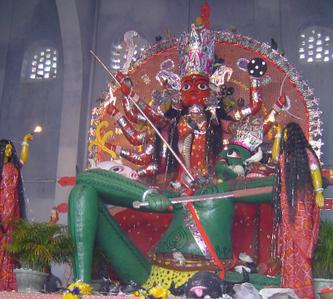
Baro Devi is a special form of Goddess Durga worshiped by the Cooch Behar royal family. Maharaja Nara Narayan initiated the puja in 1533, as the saying goes. The image of Baro Devi is totally different from the familiar Durga idols. Devi Durga's four sons and daughters are absent here. Jaya and Bijaya are here to replace them. The cult-animals are jointly a tiger and a lion, instead of a lone lion.
According to sayings, Mararaja Nara Narayan saw the Goddess (Baro Devi) in this form in his dream when he was on fasting for days to get blessings from Her. Later he introduced the puja of Baro Devi and the clay-image was made following his description. Till now the image is identical to the previous ones to keep the tradition alive. As a hereditary act, the Chitrakar family of Dodeyarhat was entrusted to make the idol this year too, on the age-old and permanent platform, following traditional sacred rules. The Chitrakars are now busy in the idol making with other helpers at the Baro Devi temple situated at Devibari in Cooch Behar town.
Though the days of the Maharajas were gone, the rituals and systems for performance of the Baro Devi puja and the construction of the clay-image are almost similar to the earlier days. The Debottar Trust Board, running under state government patronage, is very much cautious in keeping all the old-day rituals on as-is-where-is basis.
The puja of Baro Devi ends on Maha-Navami. The large image is sliced into pieces and immersed into Jamuna (Lamba) Dighi. In those Raj-days the Maharaja sitting on the royal elephant set a Khanjan (wagtail) bird free on Bijoya Dashami during Yatra-puja ritual. According to the sayings, Cooch Behar Maharajas had to start for conquering new regions following the flight-route of the bird. The last time a Khanjan was set free in 1969.
A fair is also organised during the puja days surrounding the age old Baro Devi temple at Debi Bari in Cooch Behar. Numerous devotees and puja viewers from distant places come to witness the puja and offer anjali to the Baro Devi on the Maha-Astami day. []
PHOTO : Baro Devi of Cooch Behar.