By: Katie B. *katb*
ICM-2nd Period
Hyperbolas for dummies
Chapter 10 ~ Conics!
Section 4~THE HYPERBOLA
"I've
not failed 10,000 times, I have found 10,000 ways that wont work. "--Thomas
Edison
This quote is about perseverance
and patience. I know that learning this section is going to be hard for
you to understand. If at first you do not succeed, then try again.
You might be wrong the first couple times around, but that does not mean that
you are a failure, it just means you need to try again. Do not look down
on yourself if you can not get something right in life, instead look up to
yourself for trying until you succeed.
A hyperbola can be defined as a plane curve consisting of all points such that the difference between the distances from any point on the curve to two fixed points (foci) is equal. It is the conic section formed by a plane cutting both nappes of the cone; it thus has two parts, or branches. The center of a hyperbola is the point halfway between its foci. The principal axis is the straight line through the foci. The vertices are the intersection of this axis with the curve. The transverse axis is the line segment joining the two vertices. The latus rectum is the chord through either focus perpendicular to the principal axis. The asymptotes are lines, in the same plane, which the curve approaches as it approaches infinity. An equilateral, or rectangular, hyperbola is one whose asymptotes are perpendicular. A second hyperbola may be drawn whose asymptotes are identical with those of the given hyperbola and whose principal axis is a perpendicular line through the center; the two hyperbolas thus related are called the conjugate.
The standard form equation of a hyperbola with center at (h, k) and transverse axis of 2a units, where b2=c2+a2, is as follows:
| USE: (x-h)2/a2 - (y-k)2/b2 = 1 | USE : (y-k)2/a2 - (x-h)2/b2 = 1 |
|
when the transverse axis is parallel to the x-axis |
when the transverse axis is parallel to the y-axis. |
To find asymptotes, use the following :
|
USE: y-k=+-b/a (x-h) |
USE: y-k=+-a/b (x-h) |
|
for a horizontal transverse axis |
for a vertical transverse axis |
Okay, the boring stuff is over!!!
Here's some helpful hints for graphing:
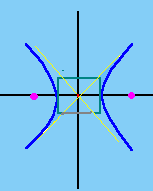
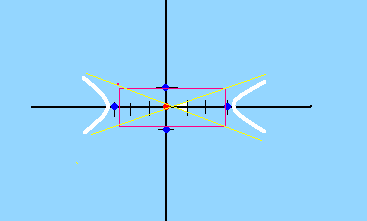
You knew it was coming.....
You're time is running out.....
IT'S TIME TO PRACTICE!!!!
Little Tom is working on his math homework... he's working on hyperbolas too. What a coincidence. Suppose that his equation reads :(y-4)2/25 - (x-2)2/9 = 1. We need to help him find the center, the foci, the vertices, and the equations of the asymptotes. So, "Let's do the dang thing."
The center is located at (2,4) because (x-2=0 comes out to x=2) and (y-4=0 comes out to y=4). We also know that a=3 because the square root of 9=3 and b=5 because the square root of 25=5.
The equations of the asymptotes are (y-4)=+-3/5 (x-2). (Use equations in chart above.)
The vertices are located at (2,9) and (2,-1). Since a=5, you add 5 to the y-coordinate in the center, and subtract 5 from the y-coordinate in the center also, to get the vertices.
Let's find the foci. We know that c2=a2+b2, so c=the square root of 34. By remembering that the center is at (2,3) we know that the foci are at (2,3+**34) and (2, 3-**34).
The graph of all of this looks like this:
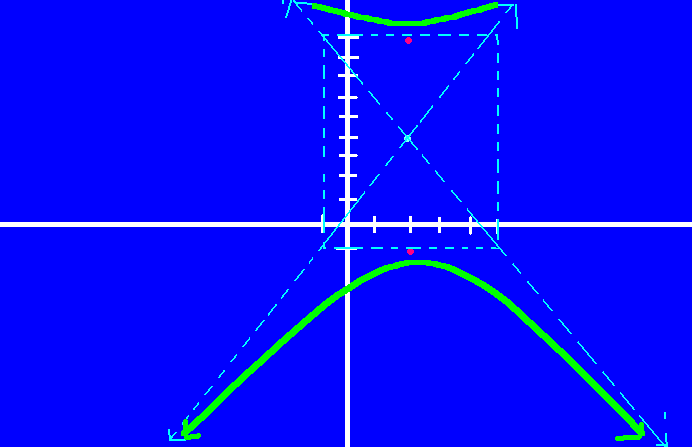
YAY!!!! We did it!!! I mean... Little Tom did it ;)
Still need more help??? I went ahead and found some more sites for ya! (But, I haven't asked permission to use their websites in mine, so just highlight the URL address, right click on your mouse, select copy, click your cursor into the web address box, right click again, select paste, and press enter)
http://www.geocities.com/CapeCanaveral/Launchpad/2426/page63.html
http://www.uaschools.org/high%20school%20web%20site/hpdm/conics/hyp/Index.htm
http://documents.wolfram.com/teachersedition/Teacher/Hyperbolas.html
http://hh4.hollandhall.org/kluitwieler/pages/conic%20sections/hyperbolas.htm
And I also found some neat quote sites for you too!! http://www.annabelle.net/topics/perseverance.html
Bye-Bye!