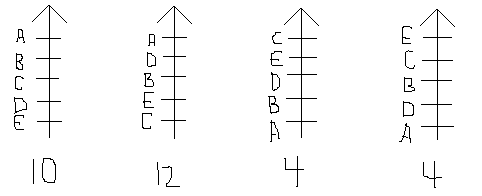
Chapter One-An Election Theory Jennifer W.
Section One - An Election Activity
1) Bill was running for student class council his sophomore year. Along with his nomination, there were three others, Sarah, Jodi, and Ashley. Bill is very popular, so out of the sophomore class of 300 students, he had 175 of the votes. Sarah is outgoing so she is well-known by everyone, therefore she was in second place with 75 votes. Ashley is a really big dork, so she only had 5 votes. Jodi is very rich, so she was able to pay off 45 votes for herself. Arrange the class council candidates according to the popular vote.
Popular Vote = The person with the most votes
Popular Vote = Bill
Sarah has the 2nd most votes.
Jodi has the third most.
Ashley has the least.
Section Two - Group-Ranking Methods and Algorithms
1) A class of thirty students did a survey on which fast food restaurants were their favorites. Out of the fast food restaurants they picked, each student made a choice on which one they liked the most. The restaurants are : Bojangles, McDonalds, Arbys, Burger King, and Taco Bell.
Below are the rankings of the student's favorite restaurants in order from greatest to least.
BOJANGLES = 10 students
McDONALDS = 7 students
TACO BELL = 6
BURGER KING = 4 students
ARBYS = 3 students
The plurality winner is based on first-place rankings only. The winner is the choice that receives the most votes. Which restaurant is the plurality winner?
BOJANGLES is the Plurality Winner.
The Borda Method
*The most common way of applying the Borda method to a ranking of n choices is to assign n points to a first-place ranking, n - 1 to a second-place ranking, n - 2 to a third-place ranking, ..., and 1 point to a last-place ranking. The group ranking is established by totaling each choice's points.*