Chapter 10 Section 4
Hyperbolas
by Allison H.
|
Standard form: (x-h)2 -(y-k)2
=1 or |
(y-k)2-
(x-h)2 =1 |
|
a2
b2 |
a2
b2 |
In the formula the h term is or the x coordinate and the k term
is for the y coordinate.
-
if the x term is first then the hyperbola will be horizontal, if the y term is
first then the hyperbola will be vertical
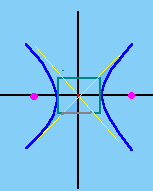 In
the picture to the left is a hyperbola. The red dot in the middle is the center.
The blue lines are the branches or the actual hyperbola,
the fuchsia dots are the foci. The gray box is from the the vertices so you
can se where the hyperbola are supposed to touch. The yellow
lines are the asymptotes. The black lines are the
axis.
In
the picture to the left is a hyperbola. The red dot in the middle is the center.
The blue lines are the branches or the actual hyperbola,
the fuchsia dots are the foci. The gray box is from the the vertices so you
can se where the hyperbola are supposed to touch. The yellow
lines are the asymptotes. The black lines are the
axis.
problem/story:
| Once upon a time in a
tenth grade English class a teacher, Mrs. Holland, was asking the class
about hyperboles. From the back corner of the room little Johnny who never
answered a question correct the whole year, shouted, "I KNOW THE
ANSWER!" Johnny continued to give the definition, not of a hyperbole,
but of the conic shape, the hyperbola. Since he had just come from math
class the topic was still fresh in his mind. Mrs. Holland seeing how
excited Johnny was about understanding hyperbolas, set up a problem for
him to solve. She told Johnny her hyperbola was horizontal. She
then told Johnny the center was going to be the origin. Mrs.
Holland asked Johnny to write the equation in standard from, Johnny
interrupted and argued he sill needed information, so finally Mrs. Holland
told Johnny the asymptotes equation was y=+1/3x Can
you help Johnny by putting the equation in standard form? |
| ANSWER:
ok, first make a list of
what you know - 1) the hyperbola is horizontal 2) the center is the origin
3) the asymptotes equation is y= +1/3x
Now since the hyperbola is
horizontal you know the first term is going to be the x term. then you
know since the center is the origin the h and k are both going to be zero.
The hardest part is going to be getting the a's and b's from the
asymptotes equation. Well first you need to know the asymptotes equation
is (y-k)=+b/a (x-h) Well we can look at the equation from the
problem and the 1 from the 1/3 is the B so b=1 and the 3 from the
1/3 is the A term so a=3.
Now go up to the an plug in
the answers (x-0)2 / (3)2 - (y-0)2 /
(1)2
the final answer you should
get is: x2/9 - y2/1 =1 |
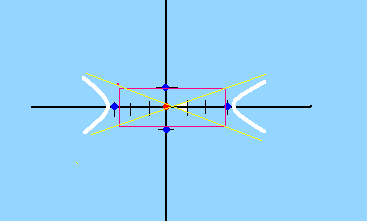
| Now the last part is graphing first step is to
graph the center.
The you move from the vertices
the a distance or the b distance from your term depending on which on
you're using first. Now from the vertices draw a box
connecting the vertices. Now draw the branches
or the actual hyperbola. The branches "kiss" at the x vertices.
The last part is drawing the asymptotes. All you have to do is draw
diagonal lines through |
| QUOTE:
"Go confidently in the direction of you dreams. Live the life
you have imagined." - Thoreau
What it means:
It talks about being courageous and bold and to do what it is you
want to do for the rest of your life. It tells you to persevere and
be responsible enough for your own choices. |
|
For more math help with
hyperbolas go to:
http://occawlonline.pearsoned.com/bookbind/pubbooks/demana_awl/chapter1/medialib/studytips/chapter8.html
For more quotes go to:
www.quotationspage.com
BACK