The Real
Issues: Economics
Tax Breaks or Government Direct Spending - Is There a Right Answer?
By Michael Mohr, Jan. 6th, 2009
Home Economics
page
The Times and the WSJ (as
well as almost everyone else) covered many of the details of Obama's
new tax cut proposal, which is part of his overall economic stimulus
package. Although this is a common tool used by many presidents
during a recession (it was practically George W. Bush's mantra), I
think we are facing very different circumstances in the 2008
recession. The articles (NY
Times, WSJ)
discuss the tax break as a foregone decision, entirely dedicating the
focus to the size of the break. The plan is a $300 billion tax cut
for those who are currently working, no income cap (the $250,000 that
we heard so much about during the debates) has been determined yet. I
will ignore my fear of labeling myself an extreme liberal and explain
why a tax break may not work, but will also briefly look at why it
really doesn't need to work to be effective.
Regardless of actual effectiveness, a tax break
is a common political response to any recession. The hope is to
energize spending with a wealth
effect, which jump starts personal consumption.
But, in contrast to recessions of our recent past, I do not believe
the wealth effect will occur in our current crisis. The difference in
2008/2009 is primarily a change in consumption, stemming from job
market instability. I predict this fundamental shift in consumer
behavior will prevent a tax break mechanism from making
any improvements in the recovery process.
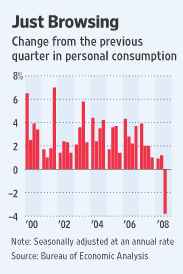
First, examine the graph below from the WSJ
(source: "Hard
Hit Families Finally Start Saving, Aggravating Nation's Economic
Woes"). The take away is that
Americans are not spending... anything. For the first time in a very
long time Americans are actually saving money!
For
a tax cut to be effective in our economy, one simple mechanism
would need to function: citizens would get a check in the mail from the
government and
would then go out and spend it. A stimulus would generated by
the heightened consumer activity, which would raise demand
for
goods. This would stimulate businesses to produce more goods, hire more
people to meet the demand etc. And so the wheels of the economy would
turn again.
This is how the mechanism would function in a perfect world, where
every $1 of tax cut is spent within the U.S. economy. The reality, I
believe, lies in stark contrast to this scenario. I think it will be
more like this: U.S. citizens get a check in the
mail and use it for: (1) credit card bills with
now exorbitant interest rates, (2) towards a mortgage they
can't afford anyway (the real problem here is explained in my article
"Truly Understanding The Credit Crisis...") or (3) Hoard it
for a rainy day. Each of these three uses reflects very rational
behavior for the common citizen in today's world. If nothing else,
the gloom of an impending deepening recession, and the possibility of
massive layoffs would lead someone to hoard their dollars to float
them through possible unemployment. None of these three realistic
outcomes will lead to the kind of economic stimulus the
President-Elect is hoping for, it will just increase the debt burden
of the federal government.
As I discussed in previous articles, the federal government has
extremely advantageous access to low-cost capital. With
historically low rates on
treasuries, the government is in a great position to spend -- but there
should still be some thought to spending wisely. Cutting taxes will not
give the economy the jolt it needs, but I do have two
suggestions for plans that I believe might make a wider impact.
Firstly, direct
government spending, and secondly, support for weak state and
local governments.
Obama is a champion of direct infrastructure improvements, I can
only hope he does not lose his focus on this productive stimulus
option. Direct government spending may remind us of the Great
Depression, but it may not be a bad idea. I realized that the
tenor of financial markets was really dire when the short term
treasury rate dipped below 0% in December at the same time the
Federal Funds Rate was at 0% (see related article Money Does
Grow On Trees...). Investors just do not trust private
investment right now. The solution to restoring confidence is to
stabilize consumption, which can only be done with a stable job
market. When people know their next paycheck will definitely be
there, they will spend today. It is scary to say it, but with private
business contracting, and private cost to capital extremely high, the
logical solution is for government to employ its citizens directly.
It stabilizes the job market and will give a lot of attention to some
much needed infrastructure improvements. Sounds like socialism? Call
it what you want, it will be effective. People will be employed,
consumer confidence will return, Americans will soon start consuming
in massive quantities, the consumption will spur private
activity, the activity will stem the risk of lending to private
companies, and the lending will get the whole economy back on track.
Some attention also needs to be paid to
state/city government budget deficits, which I have not heard
addressed on the national level. Many states are in some serious
trouble, with California and New York at the top of the list. Since
states and local governments are responsible for all the services
that stabilize communities like fire, police, and health, allowing
these governments to become delinquent on their debts would further
destabilize economic recovery. States do not have the same spending
luxury as the Federal Government. With dropping income taxes from
rising unemployment, states are looking at some serious deficits.
Compounding the problem is the municipal bond market which is the way
many state and local governments take on debt (the state version of
treasuries). This market has slowed rapidly in recent months, loosing
a large
number of buyers
because of the wall street fallout.
As fewer and fewer people have confidence in states' abilities to pay,
the cost for states of taking out loans from the public in the form of
bonds goes up. This will begin to stall a state's access to capital.
This should be on
the radar for the federal government. A bailout for some states will
probably be inevitable, and should be funded to keep basic services
running.
Shifting the gears of pessimism, I want to
briefly look at why a tax break does not necessarily need to work1
to be effective2,
maybe there is a much bigger plan. This tax break may be a move
by Obama to start restoring the spirit of Americans.
Consumer confidence is simply all about confidence in one's government
and the stability of their lives. The policy for this administration, at least in the short
term, is to use everything at its disposal.
Money is cheap, treasuries remain low, and moving the Fed Funds rate
hasn't given the effect the Federal
Reserve was hoping for. As a result, Obama is pulling
out all the stops. He is vying for the American spirit, comforting
citizens by having them believe he is doing everything possible and
thereby restoring their confidence in the free market. I personally
think $300 billion is a high price to pay for the spirit of Americans,
but I suppose it may not be the worst idea as long as the government
doesn't run out of money (or have to start paying a significant
interest rate). I have outlined more worthy 3 (from
an investment perspective) uses for the funds, but can accept that
there are less tangible victories than the return on investment. I
just hope Obama is not expecting some traction from this plan,
because it is unlikely to come.
Work meaning actually cause
economic stimulus.
Effective meaning making some kind
of impact or change.
I determine them to be more
worthy because i think they will have a wider impact on the overall
economy.
Comment
View
Comments
Economics
page
Home