THE SO-CALLED ‘SHÔJU’ INITIATIVE AND ITS SPONSORS
continued...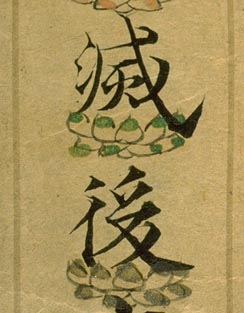
Lotus Pedestal Character Lotus Sutra (Detail)
(Kyoto National Museum)part - 7 of 8
DOES KYÔGYÔSHÔ GOSHO REALLY URGE SHÔJU?
(Before I proceed further, I wish to state that I am discussing this work
because the ‘shôju’ proponents have introduced it as proof of their position; the
work itself, which survives only in later copies, notably that by Gyôgakuin Nitchô
has some dubious passages; it refers to Ryôkan’s appeal to “Hôkôji dono”, His Lordship of Hôkôji, a reference to Hôjô Munetoki (1251-1284) but this title was one applied to Munetoki when he took the tonsure during his last illness in 1284, AFTER Nichiren Shônin’s death; though it is possible he was addressed by such a title before his tonsure, it is noteworthy that the term appears among Nichiren Shônin’s writings only in the notorious forgeries, the autobiographical letters, Hakiri dono gosho (STN, v. 2, 1927) and the Hokke hommon shûyô shû; the Kyôgyôshô gosho thus appears to be a dubious work, at least in its present form).In the Kyôgyôshô gosho which the ‘shôju’ party puts forward as proof of the
abolition of shakubuku it says: “Now in the two thousand years of the True and Counterfeit [Dharmas] when they kept and relied upon the Lesser Vehicle and Provisional Great Vehicle, and practices putting one’s merit [effort] into them, in general there was benefit. Even so, although everyone who practiced those various sutras thought that they obtained the benefit by the various sutras upon which
they relied, when we inquire on the meaning by the Hokekyô, they had not one bit
of benefit. What is the reason why? It being when the Buddha was in the world
they formed a connecting condition with the Hokekyô but it depended upon whether
or not there was maturation or not in their capacities. Those whose capacities of
the Perfect Teaching are pure and matured in the time [when the Buddha] was in
the world attained Buddhahood. Those whose faculties and capacities were faint
and inferior [or not yet mature] backslid to the True Dharma [era] and took their realization from the Jômyô [Vimalakîrti], Shiyaku, Kan[muryôju]kyô, Ninnô hannya
kyô and so on, just as when [the Buddha] was in the world. And so in the True
Dharma [era] was jointly possessed together of the three, teaching, practice and realization.“In the Counterfeit Dharma [era] there was teaching and practice but no realization. Now on entering the Latter Dharma there are the teachings, but there is no practice
or realization. There is not one person of those who formed the connecting condition when the Buddha was in the world. The two capacities of the Provisional and Real [Teachings] are all gone. At this time for the two [types] of people who are of
the rebellious [sins] and blasphemy of the present era for the first time one takes
Namu Myôhô renge kyô of the ‘Chapter of the Measure of Life’, the Essence of
the Hommon as the laying down of the seed (or, as the Buddha Seed). “‘This good, excellent medicine now I leave here. You should take and swallow it. Do not worry
that you will not be cured’” refers to this.“It is as when long ago in the Counterfeit Dharma [era] of the past Buddha Ionnô when there was not one person who knew the Great Vehicle, the Bodhisattva Fukyô came forth and chanted the Twenty-four Characters which the Master of Teachings had preached. Those who heard those Twenty-four Characters not lacking one
person also [later] encountered the Great Being (Mahâsattva) Fukyô and obtained benefit. This then was because they made the previous hearing of the Dharma the laying down of the seed (geshu).Now it is also like this. That was the Counterfeit Dharma; this is the polluted evil Latter Dharma. That was a practicer of the First (Elementary) Following Joy [level]; this is a worldling of the Name {Identity]. That was the laying down of seed of the Twenty-four Characters; this is only the Five Characters [of the Daimoku]. Although the times of obtaining the Way (tokudô: Buddhahood) are different, their ultimate meaning of Attaining Buddhahood would be completely the same” (STN, v. 2, 1479-1480).
Comment: here again there is emphasis on the era of the Latter Dharma,
described as polluted and evil (joku aku), and the point is made that there is some difference between the Counterfeit Dharma and the more evil Latter Dharma era.
In the Latter Dharma the other sutras exist only as teachings having no practical benefits. Likewise the capacities for such teachings have completely disappeared.
As Nichiren Shônin had stated earlier: there are “only evil countries, evil kings,
evil ministers, evil commoners and they turn against the True Dharma and revere perverted dharmas and perverted teachers” (STN, v. 1, 735, cited above). Even conceding that there is a few people who have planted the seed of Buddhahood,
among the great number of blasphemers in the world they are “like a little water
in the midst of a great fire” and “only result in evil karma” (STN, v. 1, 778 ll. 1-4).
So the only thing left is to lay down anew the seeds (geshu) of future Buddhahood
by the Five Characters “Myôhô renge kyô” (Nichiren Shônin ibun kôgi zenshû, v.
12, 356-357), and this applies to both evil people who commit the Five Rebellious
Sins and those who blaspheme; that is all that there is.The Kyôgyôshô gosho then demonstrates the parallelism between Nichiren
Shônin’s own case and that of the Bodhisattva Fukyô of the Counterfeit Dharma
era of an ancient Buddha. Although the Saint’s narration is somewhat abbreviated
but it is clear from the Sutra text itself: the surpassingly arrogant four congregations rejected the Bodhisattva Fukyô’s “Twenty-four Character” salutation. (N.B. Nichiren Shônin describes this as having been preached (tokiokitamaishi) by the Master of Teachings; it is a legacy of a Buddha just as the Daimoku has been left by the Buddha Shakya to the Bodhisattva Jôgyô, who appears as Nichiren Shônin). Subsequently, however, after having fallen to Avici Hell for a thousand kalpas and after their
sin has been completely atoned for they again meet Jôfukyô and the teaching of
Supreme Buddhahood (T.9. 51a26-b1) (Nichiren Shônin zenshû kôgi, v. 24, 213).Now even the ‘shôju’ partisans admit that Jôfukyô is a model for Nichiren
Shônin and that the latter practices shakubuku (which they want to change);
that being the case, we can see that the model for propagation is deliberately approaching the blasphemers (unbelievers) of this age, who are without good
seeds, and planting the seeds of Buddhahood in the form of “Myôhô renge kyô”;
in both cases, that of Nichiren Shônin and that of Jôfukyô, it is a deliberately provocative practice which allows those satisfied with lower spiritual goals to be “seeded” with the goal of Supreme Buddhahood by their very rebellious opposition
to the Truth; the Sutra says that Fukyô “deliberately went to them” (T.9.51c22)
and when Fukyô salutes them with his Twenty-four Character phrase, he is actually
telling them their current self-satisfaction with other Buddhist spiritual goals is
wrong and that is why they are so violently hostile. His obeisance and his words
have nothing to do with conventional politeness. This is clearly a form of shakabuku. If Jôfukyô were practicing gentle, gradual shôju, he would not have provoked them
so but let them go on practicing their current provisional teachings, confident in
their lesser spiritual attainments, for they are described as being of surpassing
arrogance (zôjôman) (T.9.50c15), one of the seven attitudes of arrogance (shichi
man) specifically defined as thinking or claiming to have attained enlightenment
even though one has not (Nakamura Hajime, Bukkyô go daijiten, 588a). In other
words, they are in their spiritual disposition a post-Extinction parallel to the Five Thousand Arhats of the Buddha’s Lifetime in the “Chapter of Expedience” 2,
which we discussed above. They do not accept the teachings of the Hokekyô
with regard to the Shakumon or the Hommon. But the Bodhisattva Messenger of
the Buddha, living in a declining or decadent era, must treat them differently from
the way the Buddha treats such beings; such a Bodhisattva should deliberately
preach the Supreme Truth and thus plant the seeds of Buddhahood (geshu) for
future maturation (juku) and liberation (datsu). Thus his practice is exclusively
of the Real Sutra, the Hokekyô, and so the “Chapter of the Bodhisattva Jôfukyô”
20 concludes with these verses:“For this reason let the practicers
After the Buddha’s Extinction,
Having heard this Sutra,
Not produce doubts and confusion;
They ought single-mindedly
To preach this Sutra widely.
Age after age they shall meet Buddhas
And rapidly achieve the Buddha Way” (T.9.51c5-7).Next....

UDANA NICHIKI - A PROPER ROLE MODEL?
(Compilation and translations by H. Graham Lamont; formatted here by Steven Polito. Copyright ©2000-2001 H.G.Lamont all rights reserved) We would like to give special thanks to the Kyoto Museum for the use of its historical Art work.