Computer History
Computers are simply extension of counting machines. In all probability, it began with the man's use of his fingers and toes for purposes of counting. As man increasingly engaged in trading of items for the purpose of living --Barter System --, his requirement of working with numbers became more and more complicated.
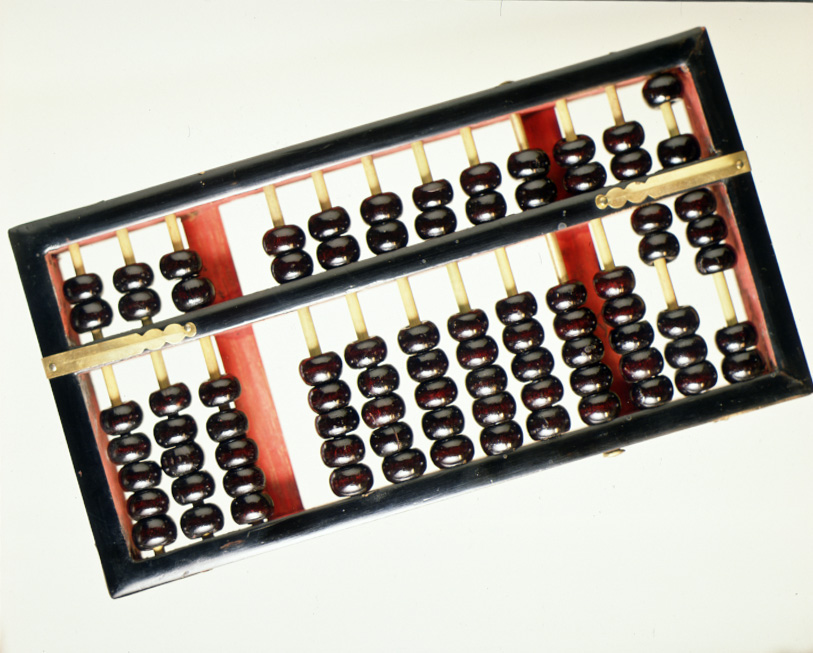
First physical counting machine was known as ABACUS. In Chinese language it is called ZHUSUVAN. The origin of Abacus date back to 500 BC. in Egypt. The ABACUS as is being used today, came into use in China around 200 AD (In China it is called as ZHUSUVAN). Very popular in Japan (known as Soroban) and is being used even today.
A Spaniard named Magnus around 1000 AD devised another counting machine. This was a machine made of brass resembling a human head with figures instead of teeth. There is no record to show this worked.
Leonardo da Vinci (1452-1519),
the Renaissance genius, greatest artist (MONA LISA Painting) dabbled in science but was never known to be interested in calculating machines. Yet in 1967, two volumes of his manuscripts were discovered in Madrid's National library of Spain detailing a digit-counting machine. A model, interpreted from his drawings, is at IBM.John Napier (1550-1617)
in 1614, a Scottish mathematician discovered the Logarithm. This could enable the user to solve complex mathematical formulae with ease. 3 years later he designed a set of rods that were arranged in a manner that made it possible to fit them together into a multiplication table. These rods are called Napier's bones.Blaise Pascal (1623-1662)
was a child prodigy. Before he turned 13, he had proven the 32nd proposition of Euclid and discovered an error in Rene Descartes's geometry. At 16, Pascal began preparation to write a study of the entire field of mathematics, but his father who was a tax collector required his time to hand total long columns of numbers. In order to solve the drudgery of manual calculations, Pascal began designing a calculating machine, which he finally perfected when he was 30. The Pascaline, a beautiful handcrafted brass box about 14 x 5 x 3 inches, the first accurate mechanical calculator, was thus born. This machine used toothed wheel (gear system) to do addition and subtraction.Gottfried Wilhelm von Leibniz (1646-1716),
son of a philosopher and one of the greatest German Renaissance thinkers, perfected the Pascal machine. It was Leibniz who quoted "It is unworthy of excellent men to lose hours like slaves in the labor of calculation which could safely be relegated to anyone else if machines were used."Joseph Jacquard (1752- 1834)
Joseph Jacquard, the son of a silk weaver, was born in Lyon in 1752. He inherited his father's small weaving business but trade was bad and eventually went bankrupt. In 1790 he was given the task of restoring a loom made by Jacques de Vaucasan. Although fifty years old, it was one of the earliest examples of an automatic loom. Working on this loom led to him developing a strong interest in the mechanization of silk manufacture.
The French Revolution brought a temporary halt to Jacquard's experiments. Jacquard fought on the side of the Republicans but as soon as they achieved victory, he returned to work. In 1801 he constructed a loom that used a series of punched cards to control the pattern of longitudinal warp threads depressed before each sideways passage of the shuttle. Jacquard later developed a machine where the punched cards were joined to form an endless loop that represented the program for the repeating pattern used for cloth and carpet designs.
Jacquard's invention allowed patterns to be woven without the intervention of the weaver. At first Jacquard's looms were destroyed by weavers who feared unemployment. The French government took over the invention and Jacquard was given a royalty on every loom sold.
By 1812 there were 11,000 Jacquard looms working in France, and they were also beginning to appear in other countries. The growth of the use of the Jacquard loom in the 1820s gave the textile industry a tremendous boost in Britain. By 1833 there were about 100,000 power-looms being used in this country that had been influenced by Jacquard's invention.
Joseph Jacquard died in 1834. Charles Babbage was later to adapt Jacquard's punch-card system to produce a calculator that was the forerunner of today's methods of computer programming.
Charles Babbage (1792-1871 - F.R.S in 1816 - at the age of 24),
Lady Ada
was his colleague and collaborator - countess of Lovelace and daughter of Lord Byron , helped correct some errors and fallacies in Babbage's work but developed on her own the notion of repeating one set of instructions over and over wheel making a large calculation - what we term today a "LOOP" or a "Sub-routine". She is rightly considered the worlds' first programmer and the programming language "ADA" is named after her.Herman Hollerith
was born in America in 1860. He worked for the US Bureau of Census. He applied the punched card that Joseph Jacquard had used, in early 19th century France, to the census tabulating machine. Hollerith devised his statistical tabulating system between 1884 and 1890, when the census Bureau put it to work for the first time. As a result the counting took only two and a half years - one third the time it had taken in 1880. A head count of 62,622,250 was represented by 2 billion holes. The punched card was named the "HOLLERITH" card. For codification of materials and other items, such codes are named as "Hollerith codes" are in use even today.