BRUCE AND EPIDERMOLYSIS
BULLOSA
Making Goals and Dreams
Come True
As printed in the Summer 2000 issue
of DebRA Currents

|
|
|
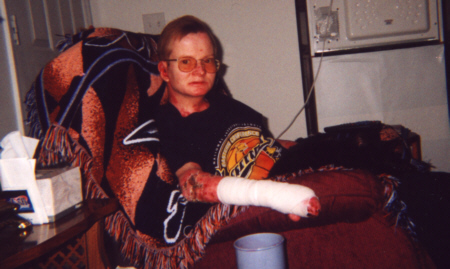
In my House with my cat Digit on my lap.
|
During my teenage years
I knew I was beating the odds given to me at birth. With every birthday
I was achieving the impossible.
In high school I was treated
fairly equal to everyone else, needing few adjustments to make getting
around easier. Getting out of each class five minutes early to be on time
for the next class and drinking soda toward the end of the day, kept me
from being tired for the last class and improved my attention capabilities.
Both were small changes in my schedule that made a big difference in my
school success.
I knew that after graduation I would be able to work, but did not know
what I would do. My special education teacher was a great source of encouragement
for me, telling me I could drive and live independently. It was in her
class that I first used a computer, giving me direction for work.
Graduation was an important milestone in my life. At the time of graduation,
1986, I was 19 years old but still looked like a little boy. I proceeded
into Vocational Rehabilitation to help me find a job. I was placed with
Janus Developmental Services, Inc., a workplace for mentally and physically
handicapped adults. Janus brings in work from area businesses for the
clients to work on for a paycheck. After hand surgery in the fall of 1986,
I was able to begin work at Janus in the spring of 1987. I started at
a workshop in Tipton, Indiana, a small workshop with about 20 clients
working.
I knew I wanted a job with computers and was able to work making computer
labels for Fisher's Guide. The job consisted of receiving orders from
Fisher's Guide on when the labels needed to be run, description and part
number of what they were. These labels consisted of all sorts of part
numbers and descriptions. We had to make sure we had the right label format
and I needed to just learn the ropes of something new, knowing the different
labels and part numbers. We also had to tear the labels and package them.
At first I would tear off one at a time and soon learned how to do more
than one at a time and do quality work at the same time.
|
|
|
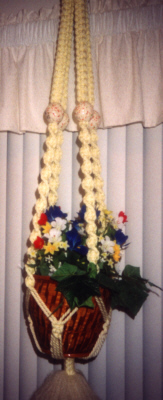
The plant hanger I made my self in 4-H with the way my hands were,
between the hand surgeries I had as a teenager.
|
After working at Janus
for about one year I began thinking of moving on from the workshop to
a community job. This would necessitate learning how to drive. Janus vans
had provided transportation to and from work for those who couldn't drive,
but now I would have to drive myself. I knew that my Dad wouldn't be the
best one to teach me after seeing my two older brothers and sister go
through it. I knew I needed someone more patient for a driving instructor.
Vocational Rehabilitation sent me to Crossroads Rehabilitation Center
in Indianapolis where I first learned to drive. On the first day I went
to to downtown Indianapolis, the Monument Circle. By my second day of
driving I went on Interstate 465 and passed a Semi going 70 mph After
my first driving class, my mom came home and said to my dad: "Put
your thinking cap on and change it, because your son is going to learn
how to drive". My dad wasn't sure my leg reflexes were good enough
to drive a car, but I knew I could do it. My special education teacher
always helped by saying I was capable and I had the confidence in myself.
My driving lessons were three days a week for 21 sessions and would be
like 6-8 weeks of driving education. I only needed 13 driving lessons,
by the end of my 13th session, I got my license and found a car. On July
7, 1989 I got my license and my car, a 1986 Oldsmobile Ciera. I knew this
was important for me to be more independent. Nobody told me I had to get
my driver's license, I just wanted it and went for it. No one stepped
me and it was my next major achievement in life.
After working for 2 years,
I began to get irritated-I wasn't going on job assignments and it was
hard to find a job I could do in the office. I needed a chance to try
and an employer to five me a chance. As work was slowed down, around Christmas,
I took time off from the workshop. In this way I could get their attention
because I wasn't happy still being in the workshop and wanted a community
job. At one of the annual meetings, our workshop director mentioned that
I wasn't getting the credit I deserved, that I had worked long and hard
for three years at the workshop. After all the work I had done for the
organization, I appreciated the director/manager standing up for me.
At the end of May 1990, after being there for 3 years, a position became
available in the Janus front office starting a data information computer
system. This meant putting client's data information in the system and
typing the annual and semi-annual client reports required by state law
as well as learning other skills in the office. I had to drive 30 minutes
to Noblesville and knew the job would mean traveling. The secretary had
known about me in the workshop and wanted me for a position as a receptionist
at one of the other workshops, but I couldn't take it because there was
no central air in the workshop at the time. When this job became available
at the office, she had me in mind. My social coordinator thought about
it thought and I wasn't happy with the social coordinator anyway: three
months later in October of 1990 I wasn hired and began my training.
|
|
|
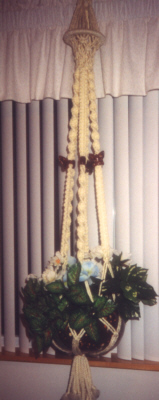
A second plant hanger I made.
|
It is hard to believe
I've been with Janus for 10 years now and have undergone many changes
through it all. When we went without a receptionist and needed someone
dependable, I was the one to fill in. I've worn many hats at Janus, taking
on various responsibilities at the office. I have 5 case coordinators
under me, one handling the adult clients 18 years or older in the workshop
as well as 4 case coordinators for children who are developmentally delayed
in their fine and gross motor skills and speech/language development for
children under 3 years of age. We have about 150 children in the program
and 65 adults. I type letters to Doctors, parents and type case conferences
notices to be sent out, as well as keeping the data information system
updated, typing annual and semi-annual client progress reports throughout
the year in addition to being the backup receptionist when she is sick,
at lunch or on vacation. Whatever needs to be done, I'm the one to do
it for staff support in the office.
I've learned much in my ten years as an administrative aide. Until five
years ago I didn't even need to use my medical insurance, when I needed
to have my first hand surgery. I have been using my insurance since then
and the benefits are great, not to mention the pay is getting better.
If you are EBer you must never lose the dreams or goals you want to achieve
in life. My parents never told me 'no' and I did what I was capable of
doing within reason. I realize parents are protective of EB children,
but you need to let them explore what life has to offer and at least encourage
them to find out for themselves what they are capable of doing. Only your
child knows his or her limits and not every EBer is capable of doing what
they set out to do. I want's always sure of myself, but I knew there wasn't
a cure for EB and sitting around wasn't good for me either. I was on disability
when I first turned 18 and got off when I started working full time. I
wanted more than what disability could give me, but that was my choice.
Having RDEB isn't easy and working full time isn't always easy either.
There are many days I go in whether I am sick or not, when I need to push
myself, but that's me. Co-workers would know if I wasn't feeling well,
or walking really slow because I broke out in blisters on my legs and
knees, but I never complained and moved on. Now and then I will complain,
but there is nothing wrong with that. I have learned to pace myself and
do what I'm capable of doing and not worry about what I can't and move
on.
Focus on what you can do, not what you can't. Parents, don't give up hope
for your child and think positively about your child's future with EB.
One day we will have a cure, so don't stop living life and don't think
there is no hope for your EB child, because there is. I'm just one example
of and EBer who is making it and there are many more out there.
Back
Home