BRUCE AND EPIDERMOLYSIS
BULLOSA

A Battle Every Day
this is the article that appeared on the Front Page
of the Kokomo
Tribune on August 4th, 2001

By AARON KRAUSE
Tribune staff writer
TIPTON -- Blistering comes as naturally as breathing for 34-year-old Tipton
resident Bruce Gunn. However, he has never suffered burns in a fire. Still
the blisters form nearly every day on skin that won't stick to his body.
|
|
|
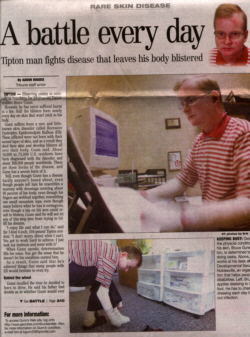
The article how it appeared on the front section of the paper.
|
Gunn suffers from a rare
and little- known skin disorder called Recessive Dystrophic Epidermolysis
Bullosa (EB). Those afflicted were not born with their second layer of
skin, and as a result they shed their skin and develop blisters all over
their body, Gunn said. About 50,000 to 75,000 U.S. residents have been
diagnosed with the disorder, and about 300,000 people worldwide. There
are three forms of the disease, and Gunn has a severe form of it.
Still, even though Gunn
has a disease hardly anyone's heard about, even though people tell him
he resembles a mummy with dressings covering about 90 percent of his body,
even though his fingers are webbed together, resembling two small mountain
tops, even though many believe what he has is contagious, even though
a tap on his arm could result in blisters, Gunn said he will not let any
of this stop him from trying to fulfill his dreams.
"I enjoy life and what I can do," said the 5-foot 4-inch, 104-pound Tipton
resident. "I don't worry about what I can't. You got to work hard to achieve.
I just took my instincts and went with it."
When Gunn speaks, determination fills his voice. You get the sense that
he doesn't let his condition control him.
As a result, Gunn said that he's achieved things that many people with
EB would hesitate to even try.
Behind the wheel
Gunn recalled the time
he decided to learn to drive. He said his father had doubts as to whether
Gunn would ever drive. Gunn, though, sought driving lessons elsewhere.
He took lessons through Crossroad Rehabilitation Center -- and it only
took about a dozen lessons before he was ready to take the test, he said.
He still recalls the date and day: Friday, July 7, 1988.
"That was the biggest day of my life of independence," Gunn wrote on his
Web site. "My dad didn't think I was capable of driving, but I showed
everyone."
Gunn currently makes a half-hour commute to work every day -- with some
modifications -- such as a 5-inch mirror, a steering wheel handle allowing
for a better grip and a key hold. The modifications make it easier for
him to drive without blistering more than he does, Gunn said.
Works at nonprofit
Gunn may resemble a mummy
with dressings covering the blisters all over his body, but he doesn't
sit home thinking about it. Gunn works part-time at Janus Developmental
Services Inc., a nonprofit agency in Noblesville, that helps children
with developmental disabilities. Gunn has worked at the agency for about
11 years, and said he gets along just fine with his colleagues.
"They treat me normal, like everyone else," Gunn said.
Gunn, in fact, stands out at work, but not in a bad way, he said. He sits
at a desk in the middle of a hallway, allowing everybody to get to know
him. He added that he feels it's important for him to have open conversations
with people about his condition.
Julie Emswiller, development director at Janus, has been working at the
organization for only about two months. Still, she said that she's learned
a lot about Gunn just from speaking to him and browsing his Web site.
"I was very taken by his Web site," she said.
|
|
|
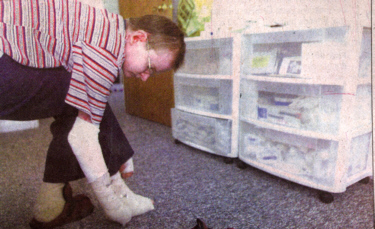
Bruce as he applies dressings to his foot. He has to change the
dressing each day to keep out infection.
|
Emswiller said she had
never heard of EB before meeting Gunn. Meeting him, and talking to him,
made her realize that it can be difficult to get people to donate to a
disease not high profile in nature.
Mostly, Emswiller said she's impressed with Gunn's outlook on life and
his condition.
"Oh, it's incredible," she said. "He's probably the most optimistic person
I've met in a long time. He's quite a treat to work with."
Barb Klopp, who has worked at Janus for 25 years, said that Gunn also
has a positive work ethic.
"He doesn't expect things to just be handed to him," she said, adding
that he comes to work every day. "I'm amazed that he can do as much as
he does."
Gunn is also a joy to talk to, said Klopp, who has known Gunn for about
10 years. "He's just a great guy," Klopp said.
Lives alone
Gunn has lived with his
parents for most of his life, but when he started dating, he said he wanted
to change that, and asked Habitat for Humanity to build him a home, which
is handicapped accessible.
"That was my personal investment, because I wanted to be independent,"
Gunn said. Habitat, he said, requires clients to put in 250 hours of work
on their future home, but Gunn said that organization officials excused
him from physical labor. Instead, he did office work, took part in fund-raising
events and performed general volunteer work for Habitat.
For Gunn, living alone means
applying new dressings to his skin daily, and rinsing off old ones. Routine
events, such as taking a shower, can take several hours for Gunn and others
with EB, he said.
Gunn said that the purposes of the dressings are to heal his wounds, make
sure his clothing doesn't stick to them and to make him comfortable.
"I feel naked without my bandages," he said, adding that's because he's
missing a second layer of skin.
The wounds, he said, can hurt, depending on how big they are, or if he's
leaned on them. He added that although he has a high tolerance of pain,
a few times a year he suffers from pain severe enough that he has to take
painkillers.
But even though Gunn's blisters hurt at times and his fingers are webbed
together, he said he can pick things up, and do just about anything others
without his condition can do. He can still recall the first time he walked,
in fact. It was a Sunday morning, and his father was reading the Sunday
paper. Suddenly,
dad looked up and saw his son walking while holding furniture.
"Dad called mom into the room, but she wanted to run over before I fell
and hurt myself. But dad said to leave him alone, that I was doing fine,"
Gunn wrote on his Web site.
All's not been rosy
Even though Gunn has
managed to find a job, live alone and learn to drive, he has had to endure
severe infections and long hospital stays. From 1997 to 2001, for example,
Gunn noticed a sore on his right ankle that didn't heal, had a stiff neck
and felt run-down. He went to his family doctor, who admitted him to the
hospital. Gunn found out that his hemoglobin, a component of a person's
red blood cells, was 7.5 (a man's normal hemoglobin 13.1-18.0 g/100 ml).
Meanwhile, the sore on his right ankle started getting bigger, and his
infection wasn't improving. With treatment, the infection got better,
but the ulcer did not. As a result, Gunn saw a dermatologist, who performed
a biopsy, which found cancer.
|
|
|
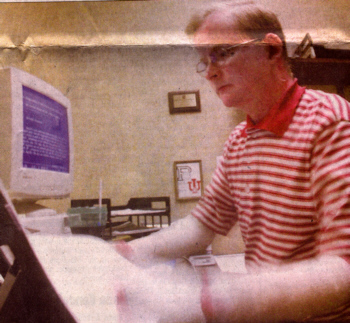
Keeping Busy: Despite the physical condition of his skin, Bruce
Gunn, Tipton, is determined to keep doing tasks. He works at his
desk above at Janus Developmental Services in Noblesville, an organization
that helps people with disabilities.
|
Another doctor told Gunn
that the cancer was serious, and that he could lose his leg.
"From the time I saw the plastic surgeon and my surgery date, was the
longest three weeks of my life," he said. "I had to decide to lose my
leg, because nobody could tell me us EBers could survive radiation and
chemotherapy, because I'm not that big, and don't weigh very much either."
Gunn ended up having surgery, which found that doctors caught the cancer
just in time. In all, he spent five weeks in the hospital, underwent four
days of radiation and three operations. He also had to go from working
full-time to part-time. He estimated that over the last four years, he's
had to pay $6,000 to 8,000 in hospital bills. And that only includes his
end, not his insurance company's, Gunn added.
Involved in support
group
Gunn's cancer is currently
in remission, and in addition to working, he keeps busy through an EB
support group, whose members communicate via the Internet.
"That keeps me going, because I can share my story" with other EBers,
Gunn said. "It's blossomed into one huge family."
He said that he's tried to convince parents of children stricken with
EB to let them live independent lives as much as they can.
"I'm grateful and blessed that I have you all as my 'extended family,'"
Gunn wrote on his Web site.
Dr. Steven Wolverton, one of Gunn's dermatologists, said that he's impressed
with Gunn's outlook.
"His attitude is incredible," Wolverton said. "[Gunn is] one of the most
inspiring people I've met."
Speaking of doctors, Gunn said that one of his doctors told his parents
that he wouldn't live past 4 or 5. Like he's done with other people, though,
Gunn proved him wrong.
"Doctors," he said, "don't know everything."
Back
Home