Britain
Language
Traditions
National Symbols
Flags
Saints
Emblems
Getting to Know...
About
.
.
.
.
Head of State
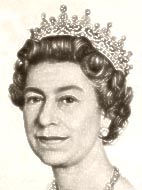 Britain's Head of State is Her Majesty Queen Elizabeth II. The Queen celebrated her 50th year on the throne February 6th, 2002.
Princess Elizabeth never expected to become queen. Her father Albert, the Duke of York, was superceded by elder brother Edward. Prince Edward was the heir to the throne, expected to marry and produce an heir of his own. Any of his children would naturally outrank those of his younger brothers.
However, Edward's support for Hitler and love for divorcee Wallis Simpson made the British government cringe. His desire to marry Wallis was rejected by the Prime Minister, Stanley Baldwin and the Dominion governments. His support for Hitler was met with outrage, and he was urged to abdicate in favor of his younger brother Albert. In 1936 Edward signed the Instrument of Abdication, making Albert King George VI. Elizabeth became the heir to the throne.
When the king died February 6, 1952, Elizabeth became Queen Elizabeth II. She was just 25 years old. Her son Charles became the heir to the throne. She created him Prince of Wales in 1969.
Family
The Queen and her husband, Prince Philip, have 4 grown children: Charles, Anne, Andrew, and Edward. They will celebrate their 60th (Diamond) wedding anniversary in 2007 with their children and 7 grandchildren.
The Queen turns 80 years old in April. Her mother, Queen Elizabeth the Queen Mum, lived to be 101 years old, so it seems that longevity is in the genes! Will the Queen reign longer than Queen Victoria, whose record of 63 years is unsurpassed?
Work
Her Majesty carries out hundreds of official engagements every year - but it's all in a day's work for the Sovereign of the United Kingdom. In 1998, for example, the Queen had a total of 440 engagements on native soil and 55 overseas visits. A lot of visits around the country and overseas give Elizabeth the chance to meet people from various backgrounds.
The Queen also attends many meetings with the government, including government ministers in the Privy Council and the Prime Minister, and gives audiences to foreign and British ambassadors. Elizabeth contends with truckloads of paperwork, consisting of letters from supporters of monarchy, government officials, and the top secret papers in the "red boxes" - Government and Commonwealth policy documents and other State papers - which arrive every day of the year, wherever she is. She even "does the boxes" at her holiday residence of Balmoral.
The Queen cannot just rule arbitrarily. She conducts weekly meetings with the Prime Minister - usually on Tuesdays - to see what is happening in the government and the general political goings on. She, on almost all matters, acts on the advice of the government of the day. Her Majesty is only a constitutional monarch, meaning she does not have absolute rule over her country. She must take Parliament's and other members of government's views into consideration.
The Parliament of the United Kingdom of Great Britain and Northern Ireland is the supreme legislative institution in the United Kingdom, as well as British overseas territories. At its head is the Sovereign; then there's the Upper House (the House of Lords) and the Lower House (the House of Commons).
The House of Lords has two types of members: the Lords Spiritual, who are the senior clergy of the Church of England, and the Lords Temporal, the members of the Peerage. This house is an unelected body. The House of Commons, however, IS an elected chamber.
The House of Lords and the House of Commons meet in the Palace of Westminster, set in the British capital city of London (and the borough of Westminster).
Parliament evolved from the ancient council which advised the Sovereign. In theory, power is vested not in Parliament, but in the "Queen-in-Parliament" (or "King-in-Parliament"). The Queen-in-Parliament is often said to be a completely sovereign authority but in today's modern times, the real power lies in the hands of the democratically elected House of Commons; the Queen today acts only in a ceremonial capacity and the powers of the House of Lords are greatly limited.
NEXT: Saints and Emblems
.
.
.
.
 America
Language
Holidays
National Symbols
Flags
Emblems
Getting to Know...
Resources