Britain
Language
Traditions
National Symbols
Flags
Saints
Emblems
Getting to Know...
About
.
.
.
.
Chrtistmas crackers are very popular in England. Crackers are a novelty used to decorate the table for a Christmas Dinner. You pull the cracker with a friend. Each person grasps one end of the cracker and with a sharp tug pulls the cracker. There is a device inside that makes the cracker pop. Inside are little gifts, a paper hat, and a saying or joke. Everyone must put on their paper hats and read out their saying or 'motto'.
The British lay the table and serve huge plum puddings, turkey, mince pies, and Christmas cake. One tradition is to serve the dish of 'Mugga'. This was a small meal found on the dinner table at Christmas Eve. Mugga is porridge sweetened with honey, which originally was eaten before the main meal and also throughout Advent.
There are many traditions which are carried out by British families, and some of these date back to the time of the Vikings! Whether food or folklore, these are ancient customs...
Santa
In Britain, Santa is referred to as 'Father Christmas'. This figure originated in the time of the Vikings as well. The Vikings brought their god Odin, when they invaded the British Isles. Odin was the 'father' of the gods, and he had twelve characters. The personage for December was known as Jul and his month was known as Jultid. From this, we get Yuletide.
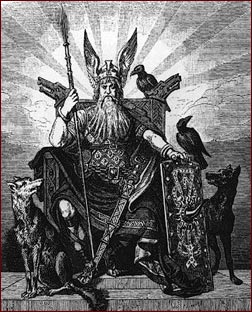 During December - the Jultid - the Vikings believed that Odin would come to earth, disguised in a long hooded cloak carrying a satchel of bread to distribute to poor homes.
The Saxons welcomed 'King Frost' or 'King Winter'. They believed that by welcoming the winter as a sort of elemental deity, that 'he' would be less harsh to them throughout the winter months.
The two beliefs eventually overlapped one another, and this is how we get the customs today associated with Father Christmas/Santa: the hooded figure, the secret visits, the leaving of a gift or the bringing of good fortune.
As with many customs in the tradition of British Christmas, the myth remained while the religious elements were lost. Father Christmas became a benevolent chap, but his saintly attributes were gone.
As British Christmas was influenced more and more by America, he was presented as a fat and jolly character who filled stockings. He would ask children if they had been naughty, and would warn that he would be watching to see who was good or bad.
Thanks to Christmas Archives - The Great British Christmas
Christmas Tree's Origins
The earliest story relates how British monk and missionary St. Boniface (born Winfrid in A.D. 680) was preaching a sermon on the Nativity to a tribe of Germanic Druids outside the town of Geismar. To convince the idolaters that the oak tree was not sacred and inviolable, the "Apostle of Germany" felled one on the spot. Toppling, it crushed every shrub in its path except for a small fir sapling.
A chance event can lend itself to numerous interpretations, and legend has it that Boniface, attempting to win converts, interpreted the fir�s survival as a miracle, concluding, "Let this be called the tree of the Christ Child." Subsequent Christmases in Germany were celebrated by planting fir saplings.
We do know with greater authority that by the sixteenth century, fir trees, indoors and out, were decorated to commemorate Christmas in Germany. A forest ordinance from Ammerschweier, Alsace, dated 1561, states that "no burgher shall have for Christmas more than one bush of more than eight shoes� length." The decorations hung on a tree in that time, the earliest we have evidence of, were "roses cut of many-colored paper, apples, wafers, gilt, sugar."
It is a widely held belief that Martin Luther, the sixteenth-century Protestant reformer, first added lighted candles to a tree. Walking toward his home one winter evening, composing a sermon, he was awed by the brilliance of stars twinkling amidst evergreens. To recapture the scene for his family, he erected a tree in the main room and wired its branches with lighted candles.
By the 1700s, the Christbaum, or "Christ tree," was a firmly established tradition. From Germany the custom spread to other parts of Western Europe. It was popularized in England only in the nineteenth century, by Prince Albert, Queen Victoria�s German consort. Son of the duke of Saxe-Coburg-Gotha (a duchy in central Germany), Albert had grown up decorating Christmas trees, and when he married Victoria, in 1840, he requested that she adopt the German tradition.
Christmas tree origin from the website - http://www.serve.com/shea/germusa/tree.htm
"Here We Come a Wassailing by Sara Doersam
"At Christmas, which was naturally a time of great festivity, the master of the house gathered his family around the bowl of wine, or mead or spiced ale, and passed it around to the words "'Waes haeil!'" -- Beverages Past and Present, 1908
Traditional English yuletide always includes the wassail bowl, a hot spiced ale with roasted apples. It was the custom for every English family to have a steaming bowl of wassail ready to serve throughout the holiday season in old England.
In ancient times, Romans, Greeks and pagans of Northern Europe ushered in the arrival of the winter solstice with celebration. Beginning Dec. 23, the winter solstice marked the end of the dark days and a sense of renewed optimism and brighter days to follow. Sounds to me like a good excuse to party.
Later, the early Roman Catholic Church chose to observe the birth of Christ during the winter solstice, reasoning that it would be best to continue the festivities during the same period but simply change the purpose of the celebration. Thus, a pagan celebration became a sacred Christian holiday.
During the Middle Ages, a high alcohol ale, made specially for the holiday season, was brewed by European monks, English villagers and Scandinavian brewsters (women brewers). The English toast at the time was an Anglo-Saxon term, "waes haeil," meaning "be whole" and was replied with "drink haeil" meaning "to your health." Sir Watkin W. Wynne is credited with preparing what is considered to be the first wassail bowl cocktail in Oxford, England in 1732. In some parts of England roving bands of wassailers strolled up and down village streets spreading good cheer by carolling and carrying their wassail bowl decorated with ribbons and garlands. Upon arriving at each house, they offered their wassail to the householders or asked their wealthier neighbours to fill their bowls.
The wassail bowl was a popular concoction of apples, ale or wine, sugar and spices and was served warm to comfort the bodies and liven spirits of the wassailers. By most accounts, this was more a harmless pagan practice, rather than Christian tradition, which the church did not try to stop. After all, it did promote peace and goodwill unto all.
Although the wassail bowl tradition has not widely survived in the American culture, home brewers as well as pub and microbrewers have led the revival of spiced beers in the United States. Anchor Brewing Co., San Francisco, pioneered the revival of holiday spiced beers in 1974 when it introduced Our Special Ale. Since then, it has continued to brew, in limited quantities, a spiced ale from a different recipe each year for the holiday season. Countless micros have followed suit with winter warmers released each year for the holiday season.
5-12 oz. bottles porter
5-12 oz. bottles English bitter
2 lbs. cooking apples
1 bottle (750 ml) medium dry sherry
3/4 lbs. light brown sugar
2 cinnamon sticks
1 tsp. grated nutmeg
4 whole cloves
2 thinly sliced lemons
12 beaten eggs or equivalent egg substitute
Preheat oven to 375�F. Core the apples and pare 1-inch strip of skin from around the middle of each apple to prevent splitting. Place apples upright in a buttered baking dish. Place 1 tablespoon of brown sugar in centre of each apple. Bake uncovered 30-40 minutes. (Time will vary with size and variety of apples.)
In a kettle, heat, but don't boil, the ale with remaining brown sugar and cinnamon sticks for 10-15 minutes, stirring occasionally. Add sherry, nutmeg, ginger, lemon slices and cloves and heat five more minutes. Remove from heat, add beaten eggs while mixing well. Remove cloves, lemon slices and cinnamon sticks.
Serve the brew from the kettle or pour it into a punch bowl after allowing it to cool slightly. Add the baked apples. Serve in cups. The apples may be eaten.
Many thanks to We Are The English
.
.
.
.
.
.
 America
Language
Holidays
National Symbols
Flags
Emblems
Getting to Know...
Resources