 Do
It Yourself
Do
It Yourself
Instructions
for basic repairs and maintenance for A-types
Replacing CV-joint
boots
It's very important for constant
velocity (CV) joints to have a protection from outer influences. If protecting
rubber boots (position 2 on figure 2) are damaged, grease will run
out and the dirt will run in - and that will be the end for precisely made elements
of joints. Keep in mind to check the condition of protecting boots, and to replace
them immediately if needed! In order to do this, you must remove outer parts of
the driveshafts (position 1 on figure 2; in further text we'll call them
just "driveshafts"). Do the following:
- lift up the front end
of the car. Car must be leaned safely!
- remove front wheels
- remove the split pin
(position 2 on the figure 1) which prevents hub retaining nut (1) from
unscrewing
- unscrew the hub nut
(1) with 32 mm open ended or ring spanner; prevent hub from turning like shown
on figure 1 by using appropriate stick or rod (position A).
If you don't have such tool just shift into 1st and pool the manual brake;
if the hub is still turning when you try to unscrew nut (1), you will need
assistant to push the brake pedal
important: never lean rod (A) under steering connecting rod
since its retaining bolts can be broken!
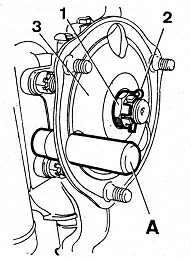
Figure
1: front hub (wheel carrier) (3), hub retaining nut (1) and split pin
(2)
- turn the steering wheel
to the end position, to the same side on which is the driveshaft you want
to remove (for removing left driveshaft, turn the steering wheel to the
full left and vice versa)
- loosen clamp
(position 6 on the figure
2) which retains boot (5) on the inner part of the driveshaft (not shown
here)
- push the driveshaft
inward (toward the diferential housing) to separate its end from the wheel
carrier
- pull out the driveshaft
- remove old rubber boot;
wash the joint with diesel oil if needed; put enough grease into the joint,
as well as into new boot (this is very important!), and attach new boot onto
the joint; tighten clamps (3 and 4, figure 2) tight enough!
- place the driveshaft
back in the same way you took it off; put some grease onto its inner grooved
area, and inside the boot (5) before placing; attach the boot (5) onto the
inner part of the driveshaft and tighten the clamp (6)
- put the end of the driveshaft
into its place in the wheel carrier; screw the nut (1 on figure 1)
tight (35-40 daNm tightening torque is determined by the factory) and put
the split pin back.
- repeat all these steps
for the other side
- have a nice drive! (of
course, with front wheels attached :-) )
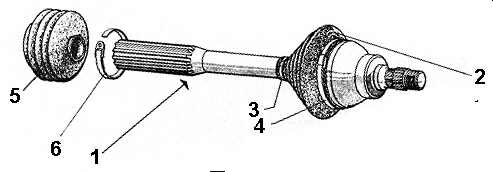
Figure
2: outer part of the driveshaft (1), rubber boots (2 and 5), the clamps
(3, 4 and 6)